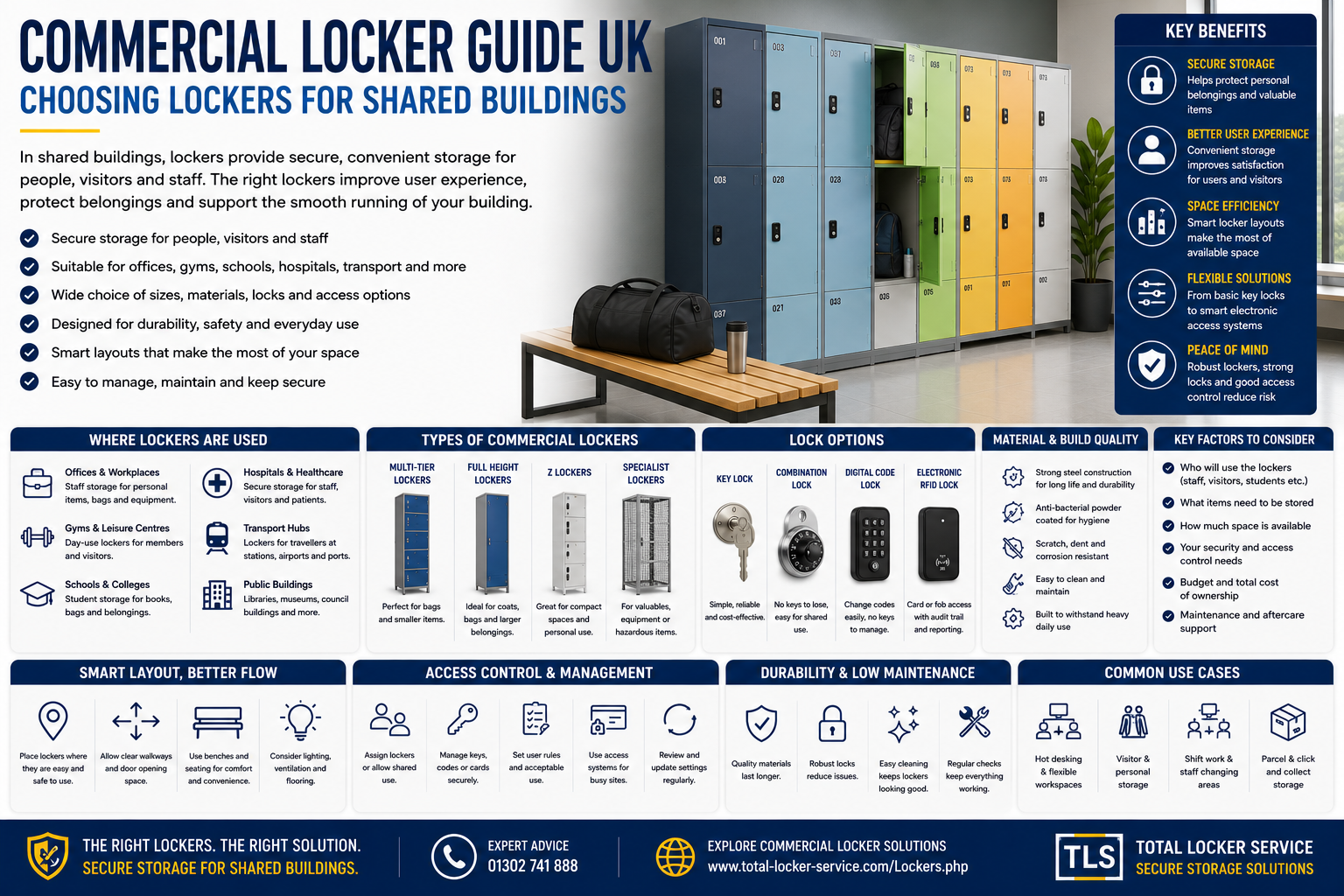
Commercial lockers are used wherever many people need secure, organised storage in a shared building. They appear in offices, schools, leisure centres, gyms, healthcare sites, universities, transport hubs, public buildings, visitor areas, staff welfare spaces and mixed-use facilities. In each setting, lockers help control belongings, reduce clutter and provide a clear place for bags, coats, devices, uniforms, tools or personal items.
The challenge is that shared buildings do not all work in the same way. Lockers are used by named staff every day. A selection are used by visitors for only an hour. Some hold laptops or tablets. Some are in damp changing rooms. There are some need strong key control. Some need keyless access. Some need to match a modern office interior. Others simply need to survive heavy public use.
A good commercial locker system is therefore not just a row of lockable compartments. It is a managed storage system. The right choice depends on the building, user group, stored items, level of supervision, lock method, cleaning requirements, maintenance plan and expected traffic.
This guide explains how to choose commercial lockers for shared buildings in the UK. It covers locker types, materials, layouts, locks, visitor access, staff storage, public use, maintenance and long-term management.
For product options, start with commercial locker systems from Total Locker Service. For wider product and advice routes, visit Total Locker Service locker solutions UK and the locker guides, key management and storage advice hub.
Quick answer: what are commercial lockers?
Commercial lockers are secure storage units used in shared, public, workplace or managed buildings. They are designed to store personal belongings, bags, clothing, uniforms, devices, tools, equipment or visitor items while controlling who can access each compartment.
A good commercial locker system should include:
- A locker type matched to the building and user group
- Enough capacity for peak demand
- Correct size and depth for the items stored
- A durable material suited to the environment
- A lock or access system that the site can manage
- Clear numbering and signage
- A layout that protects movement and accessibility
- A process for lost keys, forgotten codes or abandoned lockers
- Regular cleaning and maintenance access
- A plan for future expansion or replacement
The strongest commercial locker projects start with the user journey. Who enters the building? What do they carry? How long do they need storage? Who manages access? What happens when the locker is not emptied? These answers shape the correct product.
Why shared buildings need planned locker systems
Shared buildings create shared storage problems. People bring belongings into a space where they may not be able to keep them at a desk, workstation, classroom, treatment area, gym floor, meeting room or production space.
Without lockers, bags and personal items often end up in unsafe or inconvenient places. They may be left in corridors, under desks, beside gym equipment, behind reception, in staff rooms, inside cupboards, on benches or near walkways. This can create clutter, trip risks, cleaning problems, theft concerns and user frustration.
Commercial lockers help shared buildings by providing:
- Secure personal storage
- Controlled visitor storage
- Better staff welfare storage
- Reduced corridor and reception clutter
- Cleaner changing areas
- Organised device and equipment storage
- Clearer ownership of each compartment
- Reduced lost property issues
- Better management of shared-use spaces
The locker system should be planned as part of how the building operates. It should not be treated as a late add-on after rooms, routes and access systems have already been fixed.
Common commercial locker settings
Commercial lockers are used across many building types. Each setting has a different storage pattern.
| Building type | Typical users | Common storage need |
|---|---|---|
| Office buildings | Staff, visitors, contractors | Bags, coats, laptops, personal items |
| Leisure centres and gyms | Members, guests, staff | Clothing, bags, valuables, sports kit |
| Schools and colleges | Pupils, students, staff | Books, bags, coats, PE kit, devices |
| Healthcare and care sites | Staff, visitors, contractors | Uniforms, outerwear, bags, personal items |
| Factories and warehouses | Employees, shift teams, contractors | PPE, boots, uniforms, tools, personal belongings |
| Public buildings | Visitors, staff, service users | Bags, coats, temporary personal storage |
| Universities and colleges | Students, staff, visitors | Books, laptops, sports kit, day-use storage |
| Transport and mixed-use buildings | Travellers, staff, visitors | Bags, luggage, temporary storage |
For a wider sector breakdown, use the Total Locker Service guide on where lockers are used in the UK.
Start with assigned use or shared use
The first commercial locker decision is whether lockers are assigned or shared. This affects the number of lockers, lock type, access process and management workload.
Assigned lockers are given to one person or one team for a set period. They are common for staff, students, tenants or regular users. Shared lockers are used temporarily by different people. They are common in gyms, leisure centres, visitor areas, hot-desk offices and public buildings.
| Use type | Best suited to | Good lock options | Main management issue |
|---|---|---|---|
| Assigned use | Staff, pupils, tenants, long-term users | Key locks, padlock hasps, assigned digital locks | Key issue, leavers and reallocation |
| Shared use | Visitors, gym users, hot-desk staff, short-term users | Coin locks, combination locks, digital locks, RFID locks | Forgotten access, abandoned lockers and reset process |
| Managed use | Devices, equipment, staff assets, controlled storage | Digital, RFID or smart systems | Permissions, audit trails and administration |
| Department use | Facilities, IT, operations, cleaning teams | Key locks, master-keyed systems, controlled access | Ownership and accountability |
A shared building may need more than one model. Staff lockers may be assigned. Visitor lockers may be shared. Device lockers may be managed centrally. The best design separates these functions rather than forcing every user into one access method.
Commercial locker types
Commercial lockers come in many formats. The correct type depends on the items stored, the available space and the access model.
Personal storage lockers
Personal storage lockers are used for bags, coats, phones, keys, wallets and small belongings. They are common in offices, public buildings, staff rooms, schools, gyms and visitor areas.
They may be full-height, two-door, three-door, four-door or small-compartment lockers depending on how much storage each user needs.
Staff and workplace lockers
Staff lockers are used for employee storage, workwear, uniforms, PPE and personal belongings. They often need a clearer issue process than visitor lockers because they may be assigned to named people.
For staff-specific guidance, use workplace lockers for staff storage and changing areas.
Visitor lockers
Visitor lockers are used for short-term storage. They appear in museums, leisure centres, offices, event venues, healthcare buildings, schools, universities, public buildings and reception areas.
Visitor lockers should be easy to understand. Users may be unfamiliar with the building and may only use the locker once. Clear instructions, simple locks and a staff override process are important.
Changing room lockers
Changing room lockers are used in gyms, leisure centres, workplaces, healthcare buildings, sports facilities and staff welfare areas. They may need to handle bags, coats, footwear, uniforms, wet clothing and valuables.
These lockers should be planned with benches, aisle width, door clearance, ventilation and cleaning access in mind. In wet areas, material choice becomes more important.
Charging lockers
Charging lockers are used for laptops, tablets, phones, radios, scanners, handheld devices and powered tools. They combine storage with electrical charging and often need a stronger management process.
For powered storage, link to the charging lockers UK guide.
Parcel and collection lockers
Some commercial buildings use lockers for parcel collection, click-and-collect, internal mail, IT equipment issue or staff distribution points. These systems need a different access model from ordinary personal lockers.
They may require smart access, audit trails, notifications, staff administration or integration with wider building processes.
Locker materials for commercial buildings
Material choice should reflect the building environment, expected traffic, cleaning requirements and visual standard.
Steel commercial lockers
Steel lockers are a strong, practical choice for many commercial buildings. They suit offices, schools, staff rooms, warehouses, dry changing rooms, public buildings and general secure storage areas.
Steel is usually the best starting point where durability, value and a wide choice of sizes matter.
Laminate and MFC lockers
Laminate and MFC lockers are often used in offices, universities, commercial interiors, reception-facing areas and premium changing rooms. They give a more furniture-led appearance and can help locker storage blend into the design of the space.
They should still be chosen with cleaning, impact and maintenance in mind. A public or high-use area needs finishes and hinges that can cope with the expected traffic.
Plastic and wet-area lockers
Plastic and corrosion-resistant lockers are useful where moisture, humidity or frequent cleaning are part of the environment. Leisure centres, swimming pools, spas, wet changing rooms and some healthcare or washdown areas may need these materials.
A locker material that works well in a dry commercial office may not survive in a poolside changing area. The building environment should control the specification.
Commercial locker sizes and tiers
Locker size should be based on what users store and how long they store it. Smaller compartments can increase capacity, but they may fail if users carry large bags, coats or equipment.
Common commercial configurations include:
- Single-tier lockers for coats, uniforms and bulky items
- Two-tier lockers for strong general personal storage
- Three-tier lockers for bags and compact storage
- Four-tier lockers for high-capacity staff or visitor areas
- Six-tier lockers for small personal items
- Cube lockers for compact storage zones
- Z-lockers for hanging space in a smaller footprint
- Charging lockers for laptops, tablets and phones
- Specialist lockers for PPE, tools or equipment
The right tier count is a balance. More doors increase capacity, but each compartment becomes smaller. If the compartments are too small, users may not use them properly.
For broader planning guidance, use Locker Planning UK: Layout, Space & Installation Guide.
Planning lockers in shared buildings
Commercial locker layout should be based on peak movement and real user behaviour. A locker bank may fit on a wall, but that does not mean the area will work when users open doors, stand in front of compartments, place bags on the floor or queue for access.
Planning should consider:
- Entrances and exits
- Reception flow
- Queueing space
- Aisle width
- Door opening clearance
- Bench spacing
- Accessible routes
- Cleaning access
- Fire routes and evacuation paths
- Supervision and sight lines
- Location of power for charging lockers
- Future expansion
Shared buildings often have mixed users. Staff may know the site well, but visitors may not. Clear numbering, signage and instructions are important.
For layout detail, use the locker layout planning guide UK and the locker aisle width guide UK.
Commercial locker security
Commercial locker security depends on the lock, the locker body, the building layout and the management process. A strong lock will not solve poor key control. A digital lock will not solve unclear user rules. A public locker area still needs supervision, maintenance and clear procedures.
Security decisions should consider:
- What is being stored
- Whether lockers are assigned or shared
- How users prove access rights
- Whether staff need override access
- How lost keys or forgotten codes are handled
- Whether audit trails are needed
- Whether the area is supervised
- How abandoned lockers are opened
- How damaged locks are replaced
For a deeper security comparison, use the locker security options guide. For theft-prevention context in shared settings, use locker security and theft prevention in shared environments.
Commercial locker lock options
The lock type should match the user model. A site with assigned staff lockers may use key locks. A leisure centre may use coin locks or wrist straps. A shared office may use digital locks. A public building may need simple instructions and a reliable staff override process.
| Lock type | Best for | Main issue to manage |
|---|---|---|
| Key lock | Assigned staff, pupils, long-term users | Lost keys and spare key control |
| Padlock hasp | Simple user-led locking | Abandoned padlocks and unsuitable padlocks |
| Coin lock | Leisure centres, gyms, visitor changing rooms | Lost keys, wrist straps and coin jams |
| Combination lock | Keyless shared or assigned storage | Forgotten and shared codes |
| Digital keypad lock | Flexible shared or managed use | Battery checks and reset process |
| RFID lock | Card or fob-based access systems | Credential control and administration |
| Smart locker system | Managed storage, parcels, devices, audit trails | Software, permissions and integration |
For access control planning, use the locker access control systems UK guide.
Visitor lockers in commercial buildings
Visitor lockers need to be easy for first-time users. Visitors may be unfamiliar with the building, the rules and the lock type. This means instructions should be clear, the locker bank should be easy to find and staff should know how to deal with problems.
Visitor locker planning should cover:
- Where the locker bank is located
- How users choose or are assigned a locker
- Whether storage is free, paid, token-based or staff-issued
- How long lockers can be used
- What happens if a user leaves items behind
- How staff open lockers when access is forgotten
- Whether valuables should be stored
- How the area is supervised
Visitor lockers should not create more work than they solve. A simple, visible and well-signed system is usually better than a complex system that staff must explain repeatedly.
Staff lockers in commercial buildings
Commercial buildings often need staff lockers as well as visitor lockers. Staff lockers may be used by reception teams, cleaners, security staff, facilities teams, retail staff, hospitality teams, maintenance workers, gym staff or office employees.
Staff lockers usually need a different process from visitor lockers. They may be assigned, included in a staff policy and managed through keys, master keys or access cards.
Staff locker planning should consider:
- Staff numbers and shift patterns
- Uniforms and PPE
- Changing areas
- Clean and dirty storage
- Key issue and recovery
- Staff leavers
- Secure storage for personal items
- Maintenance and cleaning
For this branch of the canister, use Workplace Lockers UK: Staff Storage, Security, Compliance and Planning.
Commercial lockers for offices and hybrid workplaces
Office buildings often use lockers to support hybrid working, clean desk policies, visitor storage and secure personal storage. In a shared office, lockers may replace permanent desk storage.
Office locker planning should consider whether lockers are assigned, shared or used for day storage. It should also consider the look of the lockers, where staff arrive, how close lockers are to work areas and whether laptop charging is needed.
Modern offices may prefer laminate, MFC, steel or mixed-material lockers depending on the interior. Access may be via key, code, RFID or digital systems.
Commercial lockers for leisure and changing rooms
Leisure buildings need lockers that can handle high turnover. Gyms, swimming pools, spas and sports facilities have users who often need short-term storage while changing, exercising or swimming.
These environments need strong planning around lock type, moisture, changing room flow, bench spacing, cleaning and lost key handling. Wet areas may need plastic or corrosion-resistant lockers. Shared-use access may need coin locks, digital locks, RFID locks or padlock hasps.
Where lockers are close to showers or pools, the material and lock choice should be selected for the environment, not just price.
Commercial lockers for healthcare and public buildings
Healthcare and public buildings often have mixed storage needs. Staff may need assigned lockers. Visitors may need temporary storage. Contractors may need secure access during site work. Some areas may need cleanable finishes and controlled access.
Planning should consider the relationship between lockers, reception, staff entrances, changing areas, public routes and restricted zones. The locker system should support the building’s operating process rather than interrupting it.
Public buildings also need clear instructions. Users may not be familiar with the site, so locker location, numbering and access method should be easy to understand.
Commercial lockers for schools, colleges and universities
Educational buildings often combine assigned student lockers, staff lockers, sports lockers, visitor storage and device lockers. A commercial locker specification for education should account for age group, traffic, durability, key control and safeguarding-aware access procedures.
Schools need durable student lockers and clear key management. Colleges and universities may also need shared-use lockers, charging lockers and lockers for specialist departments.
For school-specific product options, use school lockers from Total Locker Service.
Accessibility and inclusive locker planning
Commercial buildings should consider a range of users. Some people may need lower lockers, easier reach, wider approach space, clearer signage or simpler lock operation. Accessibility should be considered before installation, not after users report difficulty.
Inclusive locker planning should consider:
- Approach space
- Wheelchair turning and passing routes
- Reach height
- Door opening space
- Lock operation
- Numbering visibility
- Signage
- Lighting
- Staff assistance procedures
Not every locker must be identical. A commercial building may need a mix of standard and accessible options to serve the full user group properly.
Cleaning, inspection and maintenance
Commercial lockers should be easy to clean, inspect and maintain. This is especially important in shared-use areas where users change frequently and staff may not know who used a locker last.
Maintenance should include:
- Lock operation
- Door alignment
- Hinges and fixings
- Number plates
- Key codes and spare keys
- Digital lock batteries
- Coin lock operation
- Signs of forced entry
- Cleanliness inside compartments
- Lost property checks
- Corrosion in wet areas
- Condition of benches and surrounding fittings
A locker system should not be left until it fails. Regular checks reduce lockouts, complaints and damage. They also extend the life of the installation.
Abandoned lockers and lost property
Shared buildings need a process for abandoned lockers. This is especially important in gyms, universities, public buildings, hot-desk offices and visitor areas. If lockers are left locked, the site needs a fair and consistent way to open them, record items and return belongings where possible.
The abandoned locker process should define:
- How long a locker can remain occupied
- When staff can open it
- Who authorises access
- Whether two staff members should attend
- How items are recorded
- Where lost property is stored
- How long items are kept
- How users are informed of the rules
This process should be set before lockers are opened. Staff should not have to decide the rules during a busy day.
Commercial locker procurement checklist
Use this checklist before buying commercial lockers for a shared building.
User and building type
- Who will use the lockers?
- Are users staff, visitors, students, members or contractors?
- Is use assigned, shared or managed?
- How long will users need storage?
- What items will be stored?
- Is the area public, staff-only or restricted?
Size and material
- What is the largest item that must fit?
- How many compartments are needed?
- Is the area dry, damp or wet?
- Does the locker need to match an interior finish?
- Does the site need steel, laminate, MFC, plastic or specialist material?
- Will the lockers be heavily used?
Layout and access
- Is there enough aisle space?
- Can doors open fully?
- Are fire routes kept clear?
- Can users queue without blocking routes?
- Are accessible lockers included?
- Is signage clear?
Locks and management
- Which lock type suits the user group?
- Are keys, codes or credentials needed?
- Is staff override required?
- How are lost keys handled?
- How are forgotten codes handled?
- How are abandoned lockers opened?
- Who maintains records?
Frequently asked questions
What are commercial lockers?
Commercial lockers are secure storage units used in shared, public, workplace or managed buildings. They store belongings, clothing, devices, equipment or visitor items while controlling access to each compartment.
Where are commercial lockers used?
Commercial lockers are used in offices, schools, colleges, universities, gyms, leisure centres, healthcare buildings, public buildings, factories, warehouses, transport sites and mixed-use facilities.
What is the best lock for commercial lockers?
The best lock depends on whether the lockers are assigned or shared. Key locks suit assigned use. Coin, combination, digital, RFID or smart locks may suit shared-use, visitor or managed storage areas.
Are shared-use lockers different from staff lockers?
Yes. Shared-use lockers are used by different people for short periods and need reset or release procedures. Staff lockers are often assigned and need key records, leaver checks and longer-term access control.
What material is best for commercial lockers?
Steel lockers suit many dry commercial settings. Laminate or MFC lockers suit design-led interiors. Plastic or corrosion-resistant lockers are better for wet or humid areas such as swimming pools and some changing rooms.
How many commercial lockers are needed?
The number depends on peak demand, not just total building occupancy. Shared-use sites should consider visitor numbers, staff numbers, shift patterns, dwell time and how often lockers are emptied and reused.
Do commercial lockers need access control?
Most commercial lockers need some form of access control. This may be keys, padlocks, coin locks, PIN locks, RFID access, digital locks or smart locker software depending on the building and user group.
Can commercial lockers charge devices?
Yes. Charging lockers can store and charge laptops, tablets, phones, radios, scanners and other devices. They need planning for power, ventilation, cable management and access control.
What should happen with abandoned lockers?
Shared buildings should have a written abandoned locker process. It should explain how long items can remain, who authorises opening, how items are recorded and how lost property is stored or returned.
Why is locker layout important in shared buildings?
Locker layout affects movement, queueing, door clearance, accessibility, cleaning and user confidence. A locker bank that fits physically may still fail if users cannot open doors or pass safely at busy times.
Conclusion: commercial lockers must match the building, not just the budget
Commercial lockers work best when they are planned as part of the building’s daily operation. The right system gives staff, visitors, students, members or service users a secure place to store belongings without creating clutter, queues or management problems.
The correct locker choice depends on the building type, user group, storage need, lock method, layout, material and maintenance plan. A visitor locker in a leisure centre needs a different approach from a staff locker in an office or a device locker in a managed workplace.
Start by deciding whether lockers are assigned, shared or managed. Then choose the size, material, lock type and layout around the real user journey. Plan access control, abandoned locker procedures and maintenance before installation.
For commercial locker product options, visit commercial locker systems from Total Locker Service. Planning guidance, use Locker Planning UK. For lock selection, use the locker security options guide. For managed access, use the locker access control systems UK guide.