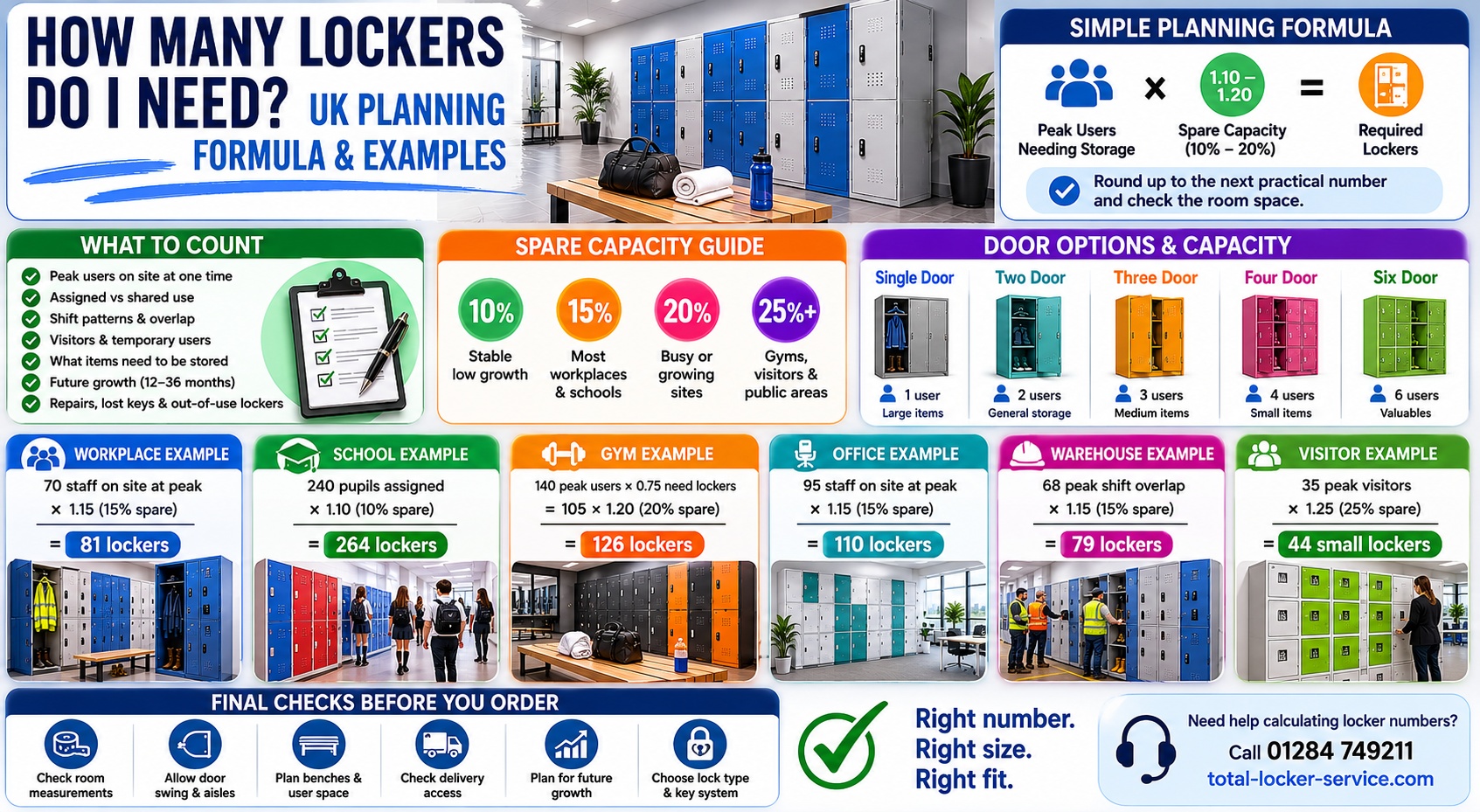
Knowing how many lockers you need is one of the first steps in planning a locker room, staff storage area, school corridor, gym changing room or commercial facility. Too few lockers create pressure, clutter and user complaints. Too many lockers can waste budget, wall space and floor area.
The right number depends on users, shift patterns, shared use, visitor demand, compartment size, spare capacity and the room layout. A workplace with 100 staff may not need 100 lockers if only 60 staff are on site at one time. A school with 500 pupils may need a different calculation depending on year groups, corridor space and allocation rules. A gym may need to plan around peak use rather than total membership.
This UK guide gives simple locker planning formulas and worked examples for workplaces, schools, gyms, offices, leisure centres, warehouses and shared buildings. It also explains when to use single-door lockers, two-door lockers and smaller multi-door lockers as part of the calculation.
Quick answer: how many lockers do you need?
For assigned lockers, start with one locker per regular user, then add 10% to 20% spare capacity for growth, temporary users, repairs and changes. For shared-use lockers, calculate peak users rather than total users, then add spare capacity. For staff sites with shift patterns, use the highest number of people on site at one time, not the total payroll number.
A simple planning formula is:
Required lockers = peak users needing storage + spare capacity allowance
For example, if 80 staff need assigned storage and you want 15% spare capacity, calculate 80 × 1.15 = 92 lockers. If 120 gym members may use the changing rooms at peak time and only 70% are expected to need lockers, calculate 120 × 0.70 = 84 lockers, then add spare capacity.
| Site type | Calculation basis | Typical spare capacity |
|---|---|---|
| Workplace lockers | Staff on site at peak or assigned users | 10% to 20% |
| School lockers | Pupils allocated lockers by year group or area | 5% to 15% |
| Gym lockers | Peak changing room use, not total membership | 10% to 25% |
| Office lockers | Assigned staff, hybrid attendance or hot-desk users | 10% to 20% |
| Visitor lockers | Expected visitor peak plus valuables demand | 10% to 30% |
| Shift worker lockers | Highest shift overlap plus storage policy | 10% to 20% |
This guide should support the lockers UK guide, the locker size guide, the locker installation guide and the locker door options guide.
Basic locker planning formula
The simplest locker calculation starts with the number of users who need storage at the same time. Then add spare capacity. This prevents the system from being full on day one and gives room for growth, damaged compartments, temporary users and future changes.
Step 1: Count peak users who need storage.
Step 2: Multiply by your spare capacity factor.
Step 3: Round up to the next practical locker bank or compartment count.
Use this simple version for most projects:
Required lockers = peak storage users × 1.10 to 1.20
Use 1.10 for a 10% spare allowance. Use 1.15 for a 15% spare allowance. Use 1.20 for a 20% spare allowance. Higher spare capacity may be useful for gyms, visitors, public buildings and fast-growing sites.
| Peak users needing lockers | 10% spare | 15% spare | 20% spare |
|---|---|---|---|
| 25 | 28 lockers | 29 lockers | 30 lockers |
| 50 | 55 lockers | 58 lockers | 60 lockers |
| 75 | 83 lockers | 87 lockers | 90 lockers |
| 100 | 110 lockers | 115 lockers | 120 lockers |
| 150 | 165 lockers | 173 lockers | 180 lockers |
| 200 | 220 lockers | 230 lockers | 240 lockers |
After calculating the number, check the room. A calculation may say that 120 lockers are needed, but the room may only fit 90 practical compartments once aisles, benches, door swing and access routes are included. The number and layout must work together.
What to count before calculating lockers
Do not start with the wall space. Start with the users and stored items. A locker count is only useful if the lockers are the right size for what people need to store.
- Total number of users.
- Highest number of users on site at the same time.
- Number of users who need assigned storage.
- Number of users who only need short-term storage.
- Shift patterns and overlap periods.
- Visitors, contractors or temporary users.
- Stored items such as coats, bags, PPE, uniforms, shoes and devices.
- Whether lockers are for full personal storage or small valuables only.
- Expected growth over the next 12 to 36 months.
- Any compartments likely to be out of use during repairs.
This prevents a common mistake: counting compartments without checking whether those compartments are usable. A site may install 100 small lockers, but if users need space for coats and bags, the real usable capacity is much lower.
Spare capacity allowance
Spare capacity is the extra locker space added above the current need. It allows for staff growth, new pupils, visitors, contractors, repairs, lost keys, broken locks, changing work patterns and future site changes.
For most workplace and school projects, 10% to 20% spare capacity is a practical planning range. For visitor areas, gyms and public-use facilities, a higher allowance may be useful because demand can vary more strongly by time of day or season.
| Spare allowance | Best use | Comment |
|---|---|---|
| 5% | Stable, low-growth sites | Only use where user numbers are predictable |
| 10% | Small workplaces and controlled-use areas | Good minimum planning allowance |
| 15% | Most workplaces, schools and staff areas | Balanced option for growth and repairs |
| 20% | Busy or growing sites | Useful where user numbers may rise |
| 25%+ | Gyms, visitors and variable-use sites | Useful where peak demand changes strongly |
Spare capacity should not be random. It should reflect how much uncertainty the site has. A stable office may not need the same spare allowance as a busy leisure centre or growing school.
Assigned lockers vs shared lockers
The calculation changes depending on whether lockers are assigned or shared. Assigned lockers are used by the same person. Shared lockers are used by different people at different times.
Assigned lockers usually need one compartment per assigned user, plus spare capacity. Shared lockers need a peak-use calculation. For example, a gym may have thousands of members, but only a smaller number need lockers at the same time. An office may have 150 employees, but only 90 are present on a normal peak day because of hybrid working.
| Use model | How to calculate | Best for |
|---|---|---|
| Assigned lockers | One locker per assigned user + spare capacity | Staff, students, PPE, uniforms and regular users |
| Shared lockers | Peak users needing storage + spare capacity | Gyms, visitors, hot desks and short-term use |
| Department lockers | Peak department users + equipment storage allowance | Factories, warehouses, healthcare and teams |
| Valuables lockers | Peak small-item users + visitor allowance | Phones, wallets, keys and small belongings |
Lock type also changes with use model. Assigned lockers often suit key locks or managed digital locks. Shared lockers often suit hasp, coin, combination or digital locks. For lock selection, use the locker lock options guide.
How door options affect locker numbers
The number of locker doors affects capacity. A single-door locker provides one large compartment. A two-door locker provides two medium compartments in the same column. Four-door and six-door lockers increase the number of users per column but reduce the size of each compartment.
This means you cannot choose the number of lockers without choosing the compartment size. A six-door locker may give six compartments, but it cannot replace six full-height staff lockers if users need coats, uniforms, PPE and large bags.
| Door format | Users per column | Best use | Planning warning |
|---|---|---|---|
| Single-door locker | 1 | Coats, bags, PPE, uniforms and large items | More columns needed for the same user count |
| Two-door locker | 2 | General staff, school and gym storage | No full-height hanging space |
| Three-door locker | 3 | Medium-small personal storage | May be too small for larger bags |
| Four-door locker | 4 | Small bags, shoes and valuables | Not ideal for full changing-room use |
| Six-door locker | 6 | Phones, wallets, keys and small items | Very limited compartment size |
For the door configuration decision, link this page to the locker door options guide. For height, width and depth, link to the locker size guide.
Workplace locker example
A workplace has 86 staff. On the busiest shift, 70 staff are on site at the same time. All staff on site need storage for coats, bags and work items. The site wants 15% spare capacity.
Calculation: 70 peak users × 1.15 = 80.5
Rounded answer: 81 lockers or compartments
If staff need coats, PPE and larger bags, single-door lockers may be best. If storage is lighter, two-door lockers may be suitable. The site should not choose six-door lockers simply because the compartment count looks efficient.
Recommended product route: workplace lockers.
School locker example
A school wants lockers for Year 7 and Year 8 pupils. There are 240 pupils across both year groups. The school wants one assigned locker per pupil and 10% spare capacity for new pupils, repairs and allocation changes.
Calculation: 240 pupils × 1.10 = 264
Rounded answer: 264 locker compartments
If the lockers are for bags and books, two-door or three-door lockers may be practical depending on corridor space and compartment size. If pupils need larger storage for sports kit or coats, the school may need larger compartments in selected areas.
Recommended product route: school lockers.
Gym locker example
A gym has 1,200 members, but total membership is not the correct calculation. The gym estimates 140 people may use the site during peak evening periods. Around 75% of peak users are expected to need changing room lockers. The gym wants 20% spare capacity because demand varies strongly.
Step 1: 140 peak users × 0.75 = 105 locker users
Step 2: 105 × 1.20 = 126
Rounded answer: 126 locker compartments
If members need bags, shoes, towels and clothing storage, two-door or single-door lockers may be suitable. Smaller four-door or six-door lockers can be added separately for phones and valuables.
Recommended product route: leisure lockers.
Office and hybrid workplace example
An office has 160 employees, but only 95 are usually on site at peak because of hybrid working. The business wants shared lockers for hot-desk users and a 15% spare allowance.
Calculation: 95 peak users × 1.15 = 109.25
Rounded answer: 110 shared locker compartments
If staff store laptops, bags and personal items, the office should check compartment size carefully. If devices need to charge during the day, charging lockers may be a better solution than standard lockers.
Recommended product route: charging lockers where powered storage is required.
Warehouse and shift worker example
A warehouse has three shifts. The largest shift has 54 staff. During handover, up to 68 staff may be on site at one time. Staff need storage for coats, bags, PPE and safety footwear. The site wants 15% spare capacity.
Calculation: 68 peak overlap users × 1.15 = 78.2
Rounded answer: 79 lockers or compartments
Because PPE and footwear are involved, the site should avoid small compartments. Single-door lockers or larger two-door lockers may be more practical than high-density multi-door lockers.
Recommended product route: workplace lockers.
Visitor and valuables locker example
A visitor area expects up to 35 visitors during peak periods. Most visitors only need storage for phones, wallets, keys and small bags. The site wants 25% spare capacity because visitor demand can change.
Calculation: 35 peak visitors × 1.25 = 43.75
Rounded answer: 44 small locker compartments
Four-door or six-door lockers may work well here because the stored items are small. The site should choose a lock type that visitors can use without heavy staff support, such as combination, coin, digital or a managed key system.
Checking the number against room space
After calculating the number of lockers, check whether the room can support the layout. Locker count should never be separated from physical space. A room may fit many lockers along the walls but still fail if users cannot open doors, sit on benches, move past each other or reach exits easily.
Check wall length, locker depth, door swing, aisle width, benches, radiators, columns, sockets, fire exits and cleaning access. If the required number does not fit safely, consider a different compartment format, another room, staggered allocation or a shared-use model.
- Check the delivery route before finalising the locker order.
- Measure the room, not just the wall.
- Allow for open locker doors.
- Allow for users standing in front of lockers.
- Plan benches with locker access.
- Keep fire exits and main routes clear.
- Leave cleaning and maintenance access.
For delivery and positioning checks, use the locker installation guide. For full room layout planning, use the locker planning guide.
Common locker quantity mistakes
Most locker quantity mistakes come from counting the wrong thing. Total staff, total pupils or total members may not be the right number. The correct number is usually the peak number of people who need storage at the same time, adjusted for spare capacity and use model.
- Using total membership for gyms instead of peak changing room demand.
- Using total payroll for shift sites instead of peak shift overlap.
- Forgetting spare capacity for growth and repairs.
- Counting compartments without checking if they are large enough.
- Choosing six-door lockers for users who need bags and coats stored.
- Forgetting visitors, contractors or temporary users.
- Not allowing for damaged or out-of-service lockers.
- Ignoring room space, door swing and aisle clearance.
- Using assigned-locker calculations for shared-use storage.
- Ordering lockers before checking delivery and installation access.
The strongest calculation starts with real use, then checks the room. User count, compartment size and layout must all agree.
Locker quantity planning checklist
Use this checklist before deciding how many lockers to order.
| Question | Answer |
|---|---|
| How many total users are there? | Insert number |
| How many users are on site at peak time? | Insert number |
| How many peak users need locker storage? | Insert number |
| Are lockers assigned or shared? | Assigned / Shared / Mixed |
| What spare capacity is needed? | 10% / 15% / 20% / Other |
| What do users need to store? | Bags / coats / PPE / devices / valuables |
| What compartment size is needed? | Large / medium / small |
| Which door option is suitable? | Single / two / three / four / six door |
| What lock type is needed? | Key / hasp / coin / combination / digital |
| Does the room fit the calculated number? | Yes / No / Needs layout check |
| Has delivery access been checked? | Yes / No |
| Has future growth been considered? | Yes / No |
Internal links for this locker quantity guide
This page should act as the calculation layer between the main lockers guide, locker planning guide, locker size guide and product pages. It should link upwards to the main lockers route and sideways to the relevant planning and sector articles.
| Reader need | Recommended link | Anchor text |
|---|---|---|
| Browse all lockers | Lockers.php | commercial lockers |
| Choose workplace storage | worklockers.php | workplace lockers |
| Choose school storage | schoollockers.php | school lockers |
| Choose gym and leisure storage | Leisurelockers.php | leisure lockers |
| Choose charging storage | Charging.php | charging lockers |
| Choose lock types | LockerLockbytype.php | locker locks by type |
| Order replacement keys | Locker-keys.php | replacement locker keys |
Use varied hub-facing anchors across the wider canister. Suitable examples include lockers UK guide, complete lockers guide, choosing lockers for UK sites and main locker buying guide.
Final recommendation
To calculate how many lockers you need, start with peak users who need storage, not just total users. Then add a spare capacity allowance. For assigned lockers, use one locker per assigned user plus spare capacity. For shared lockers, use peak demand plus spare capacity. For shift sites, use the highest overlap period.
After calculating the number, check that the room can support the layout. Locker count, compartment size, door option, lock type and installation space must all work together. A smaller number of correctly sized lockers is usually better than a larger number of compartments that users cannot use properly.
Total Locker Service supplies workplace lockers, school lockers, gym lockers, leisure lockers, charging lockers, locker locks, replacement keys and accessories for UK workplaces, schools, gyms, leisure centres and commercial buildings. Browse commercial lockers, view workplace lockers, or call 01284 749211 for help calculating how many lockers your site needs.
How many lockers do I need? FAQs
How do I calculate how many lockers I need?
Start with the number of peak users who need storage at the same time, then add spare capacity. A simple formula is peak storage users × 1.10 to 1.20, depending on how much spare capacity is needed.
Should I count total staff or peak staff?
For shared or shift-based lockers, count peak staff on site at the same time. For assigned lockers, count every person who needs their own locker, then add spare capacity.
How many spare lockers should I allow?
Most sites should allow 10% to 20% spare capacity. Gyms, visitor areas and fast-growing sites may need a higher allowance because demand changes more strongly.
Do gyms need lockers for every member?
No. Gyms should calculate lockers from peak changing room demand, not total membership. Use the number of members likely to need lockers at the busiest time, then add spare capacity.
Do schools need one locker per pupil?
Some schools choose one assigned locker per pupil, while others allocate lockers by year group, area or need. The calculation should follow the school’s allocation policy, corridor space and storage requirement.
How many lockers are needed for shift workers?
For shift workers, calculate the highest number of staff on site during shift overlap. Then add spare capacity. If lockers are assigned to individuals across all shifts, the calculation may need one locker per assigned user.
Should I choose more small lockers or fewer large lockers?
Choose locker size based on what users need to store. More small lockers are useful for valuables, phones and keys. Fewer larger lockers are better for coats, bags, PPE, uniforms and changing room storage.
What locker type gives the most users per space?
Six-door lockers provide high user capacity in a small footprint, but each compartment is small. They are best for valuables and small items, not full personal storage.
Can locker numbers be reduced by using shared lockers?
Yes. Shared lockers can reduce the total number needed where users are not present at the same time. This works well for gyms, visitors and some hybrid offices, but it needs clear rules and the right lock type.
Who can help calculate locker numbers for a UK site?
Total Locker Service can help UK workplaces, schools, gyms, leisure centres and commercial sites calculate locker numbers, choose compartment sizes and plan locker layouts.
“`