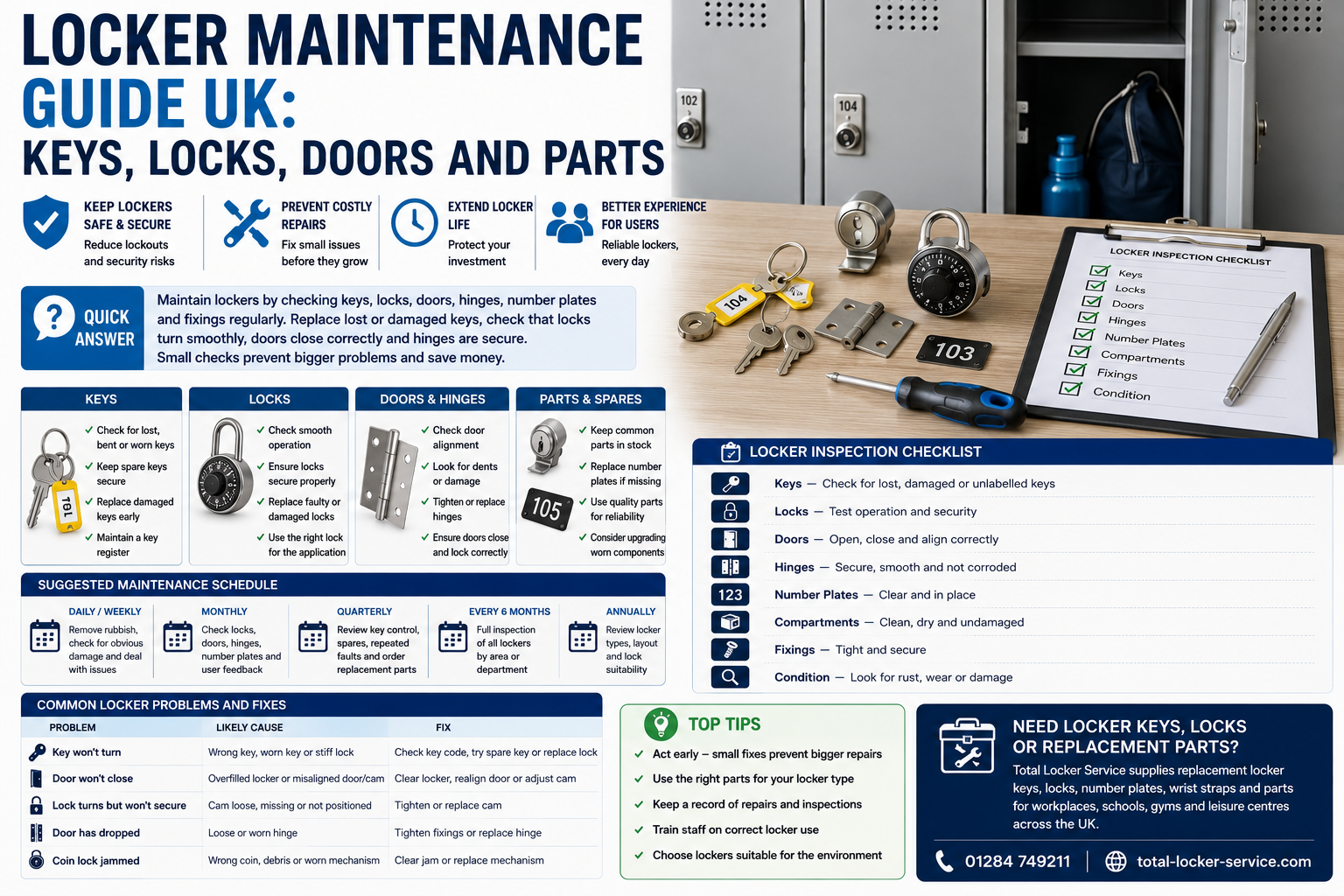
Locker maintenance keeps lockers safe, usable and cost-effective. A good maintenance routine helps prevent stuck locks, lost keys, damaged doors, loose hinges, missing number plates and avoidable replacements. It also improves user experience because staff, students, members and visitors can access their lockers without delays.
This UK locker maintenance guide explains how to look after locker keys, locks, doors, hinges, number plates, compartments and replacement parts. It is designed for workplaces, schools, gyms, leisure centres, factories, offices, healthcare sites and commercial buildings that need reliable locker storage every day.
The aim is simple. Repair small locker problems before they become larger ones. A missing key, loose cam, bent door or broken hasp can often be fixed quickly if it is found early. Left too long, the same issue can lead to lockouts, user complaints, damaged lockers and unnecessary replacement costs.
Quick answer: how do you maintain lockers?
Maintain lockers by checking keys, locks, doors, hinges, number plates and fixings regularly. Replace lost or damaged keys quickly. Check that locks turn smoothly, doors close correctly and hinges are secure. Tighten loose parts, replace damaged locks and keep a record of repairs. In wet areas, also check for corrosion, swelling, trapped moisture and damaged fittings.
Most locker faults start small. A stiff lock, loose key, misaligned door or missing number plate may seem minor, but it can quickly create user problems. Regular checks help facilities teams fix issues before lockers become unusable.
| Maintenance area | What to check | Recommended action |
|---|---|---|
| Keys | Lost, bent, worn or unlabelled keys | Order replacement keys and keep a controlled spare set |
| Locks | Stiff movement, loose barrels, failed cams or damaged hasps | Adjust, lubricate if suitable, or replace the lock |
| Doors | Bent doors, poor alignment, dents or doors not closing | Realign, repair or replace affected components |
| Hinges | Loose, stiff, broken or corroded hinges | Tighten, replace or repair before the door fails |
| Number plates | Missing, damaged or unclear locker numbers | Replace with clear numbering for easier management |
| Compartments | Rubbish, damp items, damage or misuse | Clean, inspect and remind users of locker rules |
Why locker maintenance matters
Lockers are used repeatedly. In a school, a student may open the same locker several times per day. Within a workplace, staff may use lockers at the start and end of every shift. In a gym or leisure centre, hundreds of users may use shared lockers each week. This regular use creates wear on keys, locks, doors, hinges and fittings.
Without maintenance, small problems build up. A few missing keys become a key control problem. A stiff lock becomes a lockout. A bent door becomes a failed door. A missing number plate makes support slower. Poor maintenance also affects how users treat the lockers. If lockers look neglected, users are more likely to misuse them.
Good maintenance protects the value of the locker installation. It also reduces downtime and helps avoid replacing complete locker units when only a key, lock, hinge, cam or number plate is needed.
Locker key maintenance
Locker keys are one of the most common maintenance issues. Keys get lost, bent, snapped, mixed up, taken home or left inside lockers. In schools, gyms and workplaces, lost keys can quickly become a daily admin problem unless there is a clear process.
The best approach is to treat locker keys as part of the locker system, not as loose accessories. Each key should match a clear locker number or lock code. Spare keys should be controlled. Replacement keys should be ordered before the site runs out of working access options.
How to manage locker keys
- Keep a record of locker numbers and key codes.
- Store spare keys in a secure key cabinet or controlled office.
- Do not leave master keys unsecured.
- Replace bent or worn keys before they snap in the lock.
- Order replacement keys using the correct lock or key code.
- Use clear locker numbers so keys can be matched quickly.
- Review missing keys during routine inspections.
Where keyed lockers are used at scale, key control matters as much as the locks themselves. A site with hundreds of lockers should not rely on memory or informal notes. A simple spreadsheet, key register or labelled key system can save time and prevent confusion.
For replacement keys, see locker keys cut to code. For locker number plates and identification, see locker number plates.
When to replace a locker key
A locker key should be replaced when it is bent, cracked, badly worn, difficult to turn or no longer clearly identifiable. Do not wait until the key snaps inside the lock. A snapped key can damage the lock barrel and create a more expensive repair.
Replacement keys are usually much cheaper than replacing a full lock. However, the correct key code is important. Check the number stamped on the key, the lock face or the site’s key register before ordering.
Locker lock maintenance
Locker locks need to open, close and secure the door reliably. A lock problem affects the whole user experience. A locker with a broken lock is either unusable or insecure. Routine lock checks should be part of every maintenance plan.
Different lock types need different checks. Cam locks, hasp locks, coin locks, combination locks and electronic locks all fail in different ways. The maintenance process should match the lock type installed on the lockers.
| Lock type | Common issue | Maintenance action |
|---|---|---|
| Cam lock with key | Lost keys, stiff barrel, loose cam or worn key | Replace keys, tighten cam or replace the lock |
| Hasp lock | Bent hasp, worn staple or poor padlock fit | Replace damaged hasp parts and check padlock compatibility |
| Coin return lock | Coin jam, lost key or failed return mechanism | Clear jam, check operation or replace lock mechanism |
| Mechanical combination lock | Forgotten code, stiff dial or failed reset | Reset where possible or replace if unreliable |
| Electronic lock | Battery failure, keypad issue or access fault | Replace batteries, check settings or service the lock |
For lock options and replacements, see locker locks by type. If the site has many faulty locks, it may be worth reviewing whether the current lock type still suits the way the lockers are used.
Signs a locker lock needs attention
- The key is difficult to insert or remove.
- The key turns but the door does not open.
- The lock barrel feels loose.
- The cam does not engage properly behind the frame.
- The hasp is bent or no longer aligns.
- A combination lock does not reset correctly.
- A coin lock jams or keeps coins.
- An electronic lock gives intermittent access faults.
Do not force a faulty lock. Forcing keys, dials or handles can damage the door and turn a simple lock replacement into a larger repair.
Locker door and hinge maintenance
Locker doors take a lot of daily impact. Users may slam doors, lean on them, overfill compartments or force them shut against bags and clothing. In high-use areas, doors and hinges should be checked regularly.
A door that does not close properly can damage the lock. A hinge that is loose can make the door drop. A bent door can stop the locker from securing correctly. These problems are usually easier to fix early.
Door checks
- Check that each door opens and closes smoothly.
- Look for dents, bending, twisting or sharp edges.
- Check that the door aligns with the frame.
- Make sure the lock engages correctly when the door closes.
- Check for damage caused by overfilled compartments.
- Replace badly damaged doors where repair is not practical.
Hinge checks
- Check for loose hinge fixings.
- Look for corrosion, especially in wet or humid areas.
- Check that doors do not drop or scrape.
- Listen for grinding, sticking or excessive movement.
- Replace damaged hinges before the door fails.
Door and hinge problems are common in schools, gyms, factories and busy changing rooms. These areas have high user turnover and repeated opening cycles. A maintenance check every few months can prevent a large number of user complaints.
Locker parts and spares
Many locker faults can be fixed with replacement parts rather than complete locker replacement. Common locker spares include keys, locks, lock cams, hinges, number plates, wrist straps, key fobs, coin lock parts and door components.
Keeping a small stock of common parts can reduce downtime. This is useful for schools, gyms, leisure centres, factories and large workplaces where lockers are used every day. The right stock depends on the lock type, locker range and number of lockers on site.
| Part | Used for | When to replace |
|---|---|---|
| Replacement keys | Restoring access to keyed lockers | When keys are lost, bent, worn or missing |
| Locker locks | Replacing failed or outdated locking systems | When locks are broken, unreliable or no longer suitable |
| Lock cams | Securing the door behind the frame | When cams are loose, bent or not engaging |
| Number plates | Identifying locker doors clearly | When numbers are missing, damaged or unclear |
| Wrist straps | Holding locker keys in leisure and pool environments | When straps split, stretch or become unhygienic |
| Key fobs | Labelling and managing keys | When fobs are damaged or numbers are unclear |
| Hinges | Supporting locker doors | When hinges are loose, stiff, broken or corroded |
For locker accessories and identification products, see engraved key fobs and locker accessories. For wrist straps, see locker key wrist straps.
Locker inspection checklist
A simple inspection checklist helps keep locker maintenance consistent. It also gives facilities teams a record of faults and repairs. Use the checklist below as a practical starting point.
- Check that every locker number is clear and present.
- Check that every door opens and closes correctly.
- Check that every lock secures the door properly.
- Test a sample of keys against the correct lockers.
- Check for lost, bent, worn or unlabelled keys.
- Check for loose lock barrels, cams and fixings.
- Check hinges for looseness, stiffness or corrosion.
- Check doors for dents, sharp edges or misalignment.
- Check compartments for rubbish, damp items or misuse.
- Check locker tops, bases and surrounding floors.
- Check for rust, swelling, cracks or damaged finishes.
- Check that master keys and spare keys are secure.
- Record faults and repair dates.
- Order replacement keys, locks and parts before stock runs out.
For large sites, divide inspections by area. For example, inspect school corridor lockers by block, gym lockers by changing room, or workplace lockers by department. This makes the task easier and gives better fault tracking.
Locker maintenance by site type
Different sites need different maintenance priorities. A school corridor is not the same as a swimming pool changing room. A factory locker room is not the same as an office hot-desk area. The maintenance plan should match the environment and user behaviour.
Workplace locker maintenance
Workplace lockers are often used by assigned staff. Maintenance should focus on key control, lock condition, door alignment and PPE or workwear storage. In factories and warehouses, check for overfilled lockers, damaged doors and dirty or damp compartments.
For staff storage options, see workplace lockers.
School locker maintenance
School lockers need regular checks because student lockers are used heavily and can suffer from door damage, lost keys, missing number plates and lock misuse. Schools should keep a clear key register and deal with faulty doors quickly to prevent repeated damage.
For education storage, see school lockers.
Gym and leisure locker maintenance
Gym and leisure lockers often use shared locks, coin locks, wrist straps and public-use compartments. Maintenance should focus on lock reliability, key return, wrist strap condition, cleaning, user instructions and abandoned items.
In wet changing rooms, also check for moisture damage, corrosion, blocked ventilation and poor cleaning access. For leisure settings, see leisure lockers.
Charging locker maintenance
Charging lockers need normal locker checks plus cable and power checks. Inspect doors, locks, hinges, sockets, USB points, cables, ventilation and user behaviour. Damaged chargers or trapped cables should be removed from use quickly.
For powered device storage, see charging lockers.
Should you repair or replace a locker?
Many locker problems can be repaired. Lost keys, faulty locks, damaged cams, missing number plates and loose hinges are often simple part replacements. However, replacement may be better when the locker body is badly damaged, heavily corroded, structurally weak or no longer suitable for the environment.
The decision should be based on safety, reliability, cost and long-term use. Replacing a lock on a good locker makes sense. Replacing locks repeatedly on old, corroded wet-area lockers may not. In that case, new wet-area lockers may offer better value.
| Problem | Repair likely? | Replacement may be better when |
|---|---|---|
| Lost key | Yes | The lock has no usable code or is already failing |
| Faulty lock | Yes | Many locks are failing and the lock type no longer suits the site |
| Loose hinge | Yes | The door or frame is badly damaged |
| Bent door | Sometimes | The door cannot secure properly or has sharp edges |
| Missing number plate | Yes | Only rarely; number plates are simple to replace |
| Corrosion | Sometimes | The locker is in a wet area and corrosion is widespread |
| Swollen material | Sometimes | The locker is no longer suitable for the environment |
Common locker problems and fixes
Most locker maintenance issues fall into a few common categories. The table below gives a quick diagnosis route.
| Problem | Likely cause | Fix |
|---|---|---|
| Key will not turn | Wrong key, worn key, stiff lock or damaged barrel | Check key code, try spare key, replace key or lock |
| Door will not close | Overfilled compartment, bent door or misaligned lock cam | Clear compartment, realign door or adjust lock cam |
| Lock turns but does not secure | Cam loose, missing or incorrectly positioned | Tighten or replace cam |
| Door has dropped | Loose or worn hinge | Tighten hinge fixings or replace hinge |
| Locker number missing | Number plate lost or damaged | Fit replacement number plate |
| Coin lock jammed | Wrong coin, debris or worn mechanism | Clear jam or replace lock mechanism |
| Combination forgotten | User error or no reset process | Use management override or reset process |
| Rust appearing | Damp environment, damaged coating or poor ventilation | Review location, material and maintenance routine |
Suggested locker maintenance schedule
The right maintenance frequency depends on user numbers and environment. A quiet office may need fewer checks than a school, gym or swimming pool. Use the schedule below as a practical guide and adjust it to suit the site.
| Frequency | Maintenance task |
|---|---|
| Daily or weekly | Remove rubbish, check for obvious damage and deal with abandoned items |
| Monthly | Check locks, doors, hinges, number plates and user complaints |
| Quarterly | Test key control, inspect spare keys, review repeated faults and order parts |
| Every 6 months | Complete a full locker condition audit by area or department |
| Annually | Review whether the locker type, lock type and layout still suit the site |
Busy schools, leisure centres and industrial sites may need more frequent checks. Wet areas should also be checked for moisture-related issues, corrosion, odours and cleaning access.
Final recommendation
Locker maintenance does not need to be complicated. The most important step is consistency. Check keys, locks, doors, hinges, number plates and compartments regularly. Replace small parts quickly. Keep a clear record of key codes and repairs. Review repeated faults before they become a larger site-wide problem.
For many sites, the best maintenance saving comes from replacing keys, locks and parts instead of replacing complete lockers. However, if lockers are badly damaged, heavily corroded or unsuitable for the environment, replacement may offer better long-term value.
Total Locker Service supplies replacement locker keys, locks, wrist straps, number plates, accessories and locker systems for workplaces, schools, gyms, leisure centres and commercial buildings across the UK. Browse replacement locker keys, view locker locks, or call 01284 749211 for help maintaining your locker system.
Locker maintenance FAQs
How often should lockers be maintained?
Busy lockers should be checked monthly, with a fuller inspection every 6 to 12 months. Schools, gyms, leisure centres and wet areas may need more frequent checks because the lockers are used heavily or exposed to moisture.
Can lost locker keys be replaced?
Yes. Many locker keys can be cut to code if the correct key or lock number is available. This is usually cheaper than replacing the complete lock.
What should I do if a locker key snaps in the lock?
Do not force the lock. Remove the broken key only if it can be done without damaging the barrel. If the lock is damaged or unreliable, replace the lock and order new keys.
When should a locker lock be replaced?
A locker lock should be replaced when it is stiff, loose, damaged, unreliable or no longer secures the door properly. It may also be worth replacing locks when the current lock type no longer suits how the lockers are used.
Why do locker doors stop closing properly?
Locker doors may stop closing because the compartment is overfilled, the door is bent, the hinge is loose or the lock cam is misaligned. Check the door, hinge, frame and lock before replacing the whole locker.
Can locker hinges be replaced?
In many cases, damaged locker hinges can be tightened, repaired or replaced. If the door or frame is badly damaged, replacing the door or locker may be more practical.
How do I stop locker key problems?
Keep a key register, label spare keys clearly, replace worn keys early and store master keys securely. Sites with many lockers should order replacement keys before key shortages become a daily problem.
What parts commonly need replacing on lockers?
Common replacement parts include keys, locks, lock cams, number plates, wrist straps, key fobs, hinges and some door components. These parts can often restore a locker without replacing the full unit.
Should rusty lockers be repaired or replaced?
Light surface issues may be manageable, but widespread rust suggests the locker may be unsuitable for the environment. In wet or humid areas, plastic or wet-area lockers may provide better long-term value.
Who supplies replacement locker keys, locks and parts in the UK?
Total Locker Service supplies replacement locker keys, locker locks, wrist straps, number plates, engraved key fobs and locker systems for UK workplaces, schools, gyms, leisure centres and commercial sites.