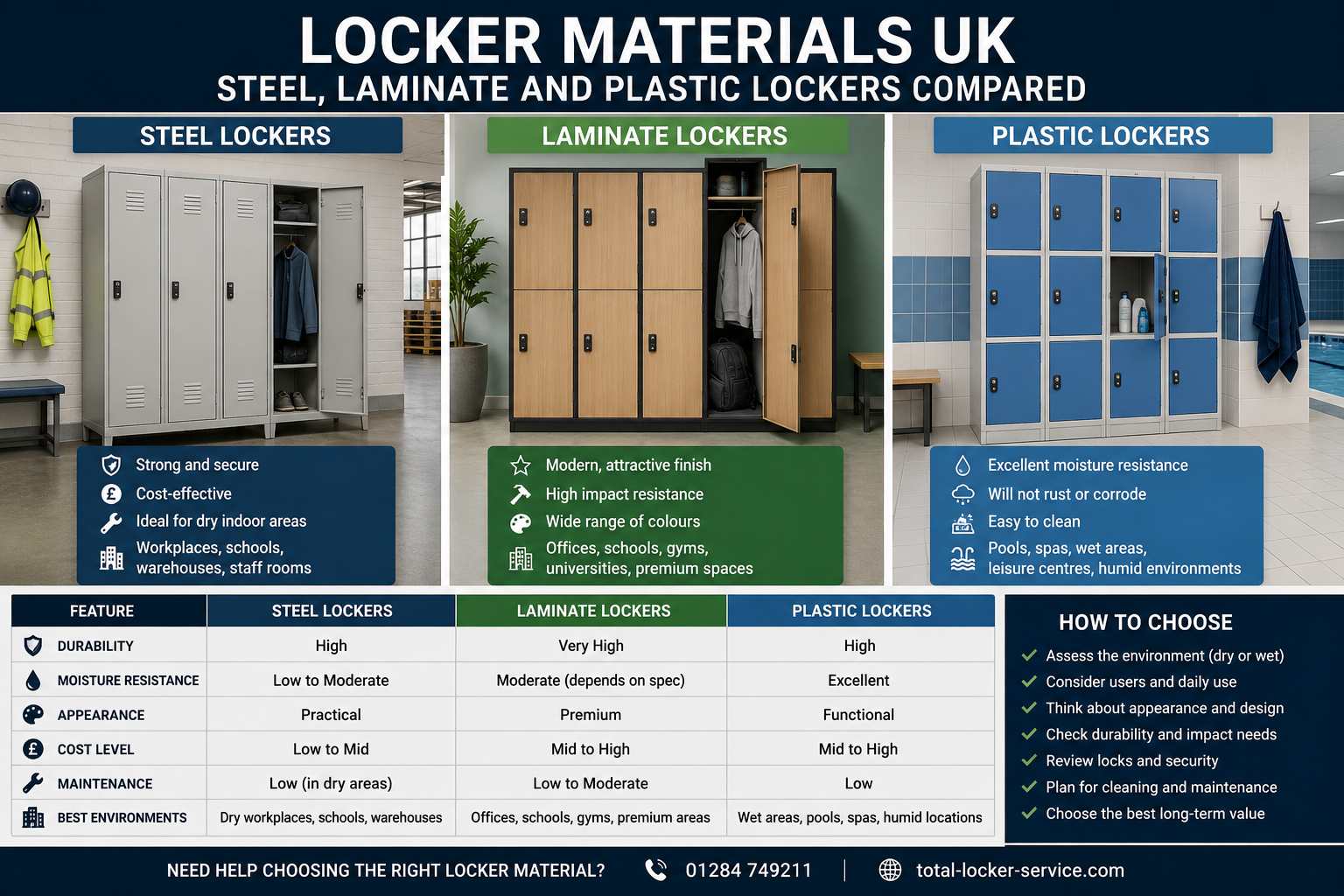
Choosing the right locker material is one of the most important decisions when planning lockers for a workplace, school, leisure centre, gym, healthcare site or commercial building. The material affects durability, appearance, maintenance, moisture resistance, security, lifespan and long-term value.
Steel, laminate and plastic lockers are all useful, but they are not interchangeable. Steel lockers are strong, practical and cost-effective for many dry indoor areas. Laminate lockers offer a more premium finish and excellent impact resistance for busy interior spaces. Plastic lockers are often the best choice for wet, humid or corrosion-prone areas.
This UK guide compares the main locker materials in practical terms. It explains where each material works best, where it may not be suitable and how to choose the right locker for your site.
Quick answer: which locker material is best?
The best locker material depends on the environment. For most dry indoor workplaces, steel lockers are practical, secure and cost-effective. Offices, schools and smart interiors where appearance and impact resistance matter, laminate lockers are often a stronger choice. For swimming pools, wet changing rooms, spas and humid areas, plastic lockers are usually the safest long-term option because they resist corrosion.
| Locker material | Best for | Main advantage | Main limitation |
|---|---|---|---|
| Steel lockers | Workplaces, schools, staff rooms, warehouses and dry changing areas | Strong, secure and cost-effective | Can corrode if used in wet or aggressive environments |
| Laminate lockers | Offices, schools, universities, gyms and premium changing rooms | Smart finish, strong doors and good impact resistance | Usually costs more than basic steel |
| Plastic lockers | Wet areas, swimming pools, spas, leisure centres and humid locations | Excellent moisture and corrosion resistance | May not suit every dry interior style or high-security requirement |
For many sites, the right answer may be a mix of materials. A leisure centre may use plastic lockers near the pool, laminate lockers in premium changing rooms and steel lockers in staff-only dry areas. A school may use steel lockers in corridors and laminate lockers in sixth form or staff areas. The material should follow the environment, not just the budget.
Why locker material matters
Locker material affects how the locker performs every day. It influences how well the locker handles knocks, moisture, cleaning, security, user behaviour and long-term wear. The wrong material can look tired quickly, need more repairs or fail early in demanding environments.
A dry office, a school corridor, a warehouse, a spa changing room and a swimming pool have very different conditions. One site may need a durable steel locker with simple cam locks. Another may need a laminate locker with a modern finish. Another may need a plastic locker that can cope with water and humidity.
Material choice also affects the wider locker system. It changes the lock options, cleaning method, fixing requirements, design finish and maintenance plan. When the material is right, the lockers feel natural in the space. When it is wrong, problems appear through rust, swelling, dents, chipped finishes, broken doors or poor user acceptance.
Steel lockers
Steel lockers are the traditional choice for many UK workplaces, schools, factories, warehouses, offices and staff areas. They are strong, familiar and widely available in many sizes and door configurations. They can be used for clothing, bags, work equipment, personal belongings, staff storage and general secure storage.
Steel works well in dry indoor spaces. It is especially useful when the site needs a practical locker system at scale. A workplace with many staff lockers, a school corridor with student lockers or a warehouse with shift lockers may all use steel because it gives a strong balance of security, cost and availability.
Advantages of steel lockers
- Strong and secure for everyday use.
- Cost-effective for large locker installations.
- Available in many widths, heights, depths and door numbers.
- Compatible with many locker lock types.
- Suitable for staff, student and workplace storage.
- Easy to specify for dry indoor environments.
- Can provide a clean, simple and professional appearance.
Steel lockers are often the first material to consider when the environment is dry and the priority is practical secure storage. They are also useful when a site needs a large number of lockers without moving into a premium finish.
Limitations of steel lockers
The main weakness of steel is moisture. Steel lockers can suffer in wet areas, damp changing rooms, poorly ventilated rooms, poolside locations or chlorinated environments. Paint and coating help protect the metal, but the locker still needs a suitable environment and good maintenance.
Steel lockers can also dent under heavy impact. In schools, public facilities and harsh industrial settings, door strength and construction quality matter. A basic locker may not be the best choice where users are rough, where equipment is heavy or where the area is unsupervised.
Steel is not automatically wrong in changing rooms. It can work in dry changing areas, staff changing rooms and controlled facilities. It should not be treated as the default for wet, humid or corrosive environments.
Best uses for steel lockers
- Workplace staff rooms.
- Office storage areas.
- School corridors and classrooms.
- Warehouses and factories.
- Dry changing rooms.
- Retail staff storage.
- Back-of-house commercial areas.
- General employee storage.
For general workplace storage, see workplace lockers. For education settings, see school lockers. With wider product options, browse commercial lockers.
Laminate lockers
Laminate lockers are often chosen when appearance, durability and user experience matter. They are common in offices, schools, colleges, universities, leisure centres, gyms, clubs and modern commercial interiors. A laminate locker can look more refined than a basic steel locker while still offering robust daily performance.
Laminate usually refers to a locker with durable laminate doors, often combined with a strong carcass structure. The doors provide a tough, attractive finish and can be specified in many colours and styles. This makes laminate lockers useful where lockers are part of the visible interior design rather than hidden in a back room.
Advantages of laminate lockers
- Smart, modern appearance.
- Good impact resistance on locker doors.
- Wide choice of colours and finishes.
- Suitable for higher-quality interiors.
- Useful for schools, offices and leisure facilities.
- Can improve user perception of the storage area.
- Works well where lockers are visible to staff, students, visitors or members.
Laminate lockers are often selected when the locker room, office or education space needs to look considered and professional. They can help avoid the institutional feel that some users associate with basic metal lockers.
Limitations of laminate lockers
Laminate lockers are usually more expensive than basic steel lockers. That extra cost may be justified in visible or high-use areas, but it may not be needed in a basic staff store or warehouse changing area.
Laminate also needs the right specification for the environment. It is not a universal replacement for plastic wet-area lockers. In damp or humid spaces, the full construction of the locker matters, not just the door finish. Edges, hinges, frames, fixings and ventilation must all match the conditions.
For premium wet changing areas, laminate may be considered where the system is suitable for the environment. For high-humidity poolside or wet areas, plastic lockers are often the more reliable long-term material route.
Best uses for laminate lockers
- Offices and modern workplaces.
- Schools and colleges.
- Universities and sixth form areas.
- Premium changing rooms.
- Gyms and fitness clubs.
- Staff areas where appearance matters.
- Reception-adjacent storage areas.
- Commercial interiors with a designed finish.
For this material route, see laminate lockers. For wider office use, see workplace lockers.
Plastic lockers
Plastic lockers are designed for environments where moisture, humidity or corrosion risk makes metal a poor choice. They are commonly used in swimming pools, spas, leisure centres, wet changing rooms, outdoor-adjacent areas and some healthcare or washdown environments.
The main advantage is corrosion resistance. Where steel may eventually rust or deteriorate, plastic lockers can provide a longer-lasting solution. This makes plastic especially valuable in areas with wet floors, wet clothing, high humidity or chlorinated air.
Advantages of plastic lockers
- Excellent resistance to water and humidity.
- Strong option for wet changing rooms.
- No steel body to rust in damp areas.
- Good for pool, spa and leisure environments.
- Useful where lockers are exposed to frequent moisture.
- Easy to clean in many practical settings.
- Can reduce long-term corrosion-related replacement costs.
Plastic lockers are usually the safest starting point when the site involves regular water contact. If the area has wet swimwear, shower traffic, pool air, steam, damp towels or daily washdown routines, plastic should be considered early in the specification.
Limitations of plastic lockers
Plastic lockers may not suit every interior style. Some offices, schools and premium commercial spaces may prefer the finish of laminate or the practical look of steel. Plastic can also be less suitable where the site wants a very specific design style or a higher-security construction.
Lock compatibility should also be checked. Many plastic lockers support common lock types, but the best choice depends on the model and environment. Wet areas often need locks and fittings that can also cope with moisture, not just a locker body that resists water.
Plastic lockers are not only for swimming pools, but they should be chosen for a reason. If the space is dry and cost is the main driver, steel may offer better value. If the space needs a premium design finish, laminate may be more suitable.
Best uses for plastic lockers
- Swimming pool changing rooms.
- Spas and wellness facilities.
- Wet leisure changing areas.
- Humid gym changing rooms.
- Outdoor-adjacent storage areas.
- Wet workwear storage areas.
- Sites with corrosion concerns.
- Areas with frequent water exposure.
For more detail on wet environments, read the wet area lockers UK guide. For leisure facilities, see leisure lockers.
Steel vs laminate vs plastic lockers comparison
The table below compares the three main locker material routes across common buying factors. Use it as a starting point before looking at exact locker size, door number, lock type and layout.
| Factor | Steel lockers | Laminate lockers | Plastic lockers |
|---|---|---|---|
| Best environment | Dry indoor areas | Smart interior spaces | Wet and humid areas |
| Typical appearance | Practical and professional | Modern and premium | Functional and moisture-resistant |
| Moisture resistance | Limited compared with plastic | Depends on full construction | Excellent |
| Impact resistance | Good, but can dent | Very good on laminate doors | Good for wet-area use |
| Security feel | Strong and familiar | Strong and premium | Depends on model and lock choice |
| Design choice | Good colour options | Wide finish and colour choice | More practical finish range |
| Maintenance | Simple in dry areas | Simple with correct cleaning | Strong in wet environments |
| Typical cost level | Lower to mid-range | Mid to premium | Mid to premium depending on model |
| Best value when | The space is dry and needs many lockers | The lockers are visible and heavily used | The space is wet, humid or corrosion-prone |
Best locker material by environment
The easiest way to choose locker material is to start with the environment. Look at moisture, impact risk, visibility, user type and cleaning routine. The same material will not be best for every room.
Workplaces and staff rooms
Steel lockers are often the best starting point for normal workplace staff rooms. They give practical secure storage at a sensible cost. They are suitable for dry offices, factories, warehouses, retail sites and staff changing areas.
Laminate lockers may be better where the lockers are visible to visitors, staff or clients. They can improve the look of the space and provide a stronger design finish. Plastic lockers are normally only needed where the area is wet, damp or exposed to moisture.
Recommended route: workplace lockers.
Schools and colleges
Schools and colleges need lockers that can handle daily use, repeated door opening and mixed user behaviour. Steel lockers are a common option for student storage because they are durable, practical and cost-effective at scale.
Laminate lockers can be a strong upgrade for sixth form areas, staff areas, reception-adjacent spaces and modern learning environments. They offer a more refined appearance and can help create a higher-quality feel. Plastic lockers are useful for wet changing rooms, pool areas and sports facilities with moisture exposure.
Recommended route: school lockers.
Gyms and leisure centres
Leisure centres often need more than one material. Dry staff areas may use steel. Premium gym changing rooms may use laminate. Poolside and wet changing areas usually need plastic lockers because moisture and humidity are part of daily operation.
The important point is to separate wet and dry zones. A locker that works in a dry gym corridor may not work next to showers or a swimming pool. If chlorine, damp towels and wet floors are part of normal use, material choice becomes a long-term durability issue.
Recommended route: leisure lockers.
Swimming pools and spas
Plastic lockers are usually the strongest choice for swimming pools and spas. These spaces are wet, humid and more likely to expose lockers to corrosion risks. Choosing steel in the wrong wet location can lead to avoidable maintenance and replacement issues.
Laminate may be suitable in some premium changing environments, but the full locker construction must be right for the conditions. Do not judge suitability by door finish alone. Frames, hinges, locks and fixings all matter.
Recommended guide: wet area lockers UK.
Warehouses, factories and industrial sites
Steel lockers are often the practical choice for warehouses and industrial sites. They are strong, familiar and suitable for staff clothing, PPE, bags and work equipment in dry areas. The right specification should consider user numbers, shift patterns, door clearance and lock type.
If the site has washdown areas, damp equipment, chemical exposure or high humidity, standard steel may not be suitable. Plastic or specialist lockers may be needed for those zones. Match the material to the actual conditions, not just the building type.
Recommended route: workplace lockers.
Healthcare and care settings
Healthcare and care environments often need lockers that are easy to manage, easy to clean and suitable for controlled staff access. Steel lockers may work well in dry staff areas. Laminate lockers may be preferred where appearance and user experience matter. Plastic may be useful where moisture or cleaning demands are higher.
Material choice should be made alongside hygiene routines, access control, staff workflow and room use. A locker used for personal belongings is not the same as a clinical storage cabinet, so avoid mixing storage purposes without proper planning.
Cost and long-term value
The cheapest locker is not always the best-value locker. Value depends on how long the locker lasts in the real environment and how much maintenance it needs. A low-cost steel locker may be excellent value in a dry staff room. The same locker may be poor value in a wet changing room if corrosion shortens its life.
Laminate lockers usually cost more than basic steel, but they can justify the extra spend in visible, high-use or design-led spaces. They may improve the look of the room and withstand daily impact well. Plastic lockers can also cost more than basic steel, but they may save money over time in wet areas by reducing corrosion-related replacement.
| Budget priority | Best material route | Why |
|---|---|---|
| Lowest practical cost in dry areas | Steel lockers | Strong, available and cost-effective for large installations |
| Best appearance in visible interiors | Laminate lockers | Premium finish and strong visual impact |
| Best long-term wet-area value | Plastic lockers | Moisture resistance helps reduce corrosion problems |
| Mixed site with wet and dry zones | Combination of materials | Each area gets the right material for its conditions |
Security and lock compatibility
Locker material is only one part of security. The lock, door construction, hinges, fixing method, location and management process all matter. A strong material with a poor lock may still fail the user. A good lock on the wrong locker material may not solve environmental problems.
Steel lockers are compatible with many common lock types, including cam locks, hasp locks, coin locks and combination locks. Laminate lockers can also support a range of lock options, depending on the model and door design. Plastic lockers may support wet-area lock options, but the lock and fittings should be suitable for the environment.
For dry workplaces, a keyed cam lock may be enough. With gyms and leisure centres, coin return locks or combination locks may be more practical. With schools, master key control and replacement key support may be important. For shared-use areas, the lock must match user turnover and management capacity.
With lock selection, see locker locks by type. For lost or replacement keys, see replacement locker keys.
Maintenance and cleaning
Every locker material needs maintenance. The right maintenance routine depends on the material and environment. Dry steel lockers may need occasional cleaning, hinge checks and lock checks. Laminate lockers need suitable cleaning methods that protect the surface and edges. Plastic lockers in wet areas need regular cleaning, ventilation checks and inspection of locks and fittings.
Cleaning should not damage the locker. Avoid using aggressive chemicals unless the locker manufacturer confirms they are suitable. Pay attention to edges, locks, hinges, door gaps, vents and areas where water or dirt can collect. A good cleaning routine protects both hygiene and lifespan.
Maintenance should also include user behaviour. Users should not slam doors, force locks, hang on open doors, store wet items in dry-area lockers or leave damp clothing in sealed compartments for long periods. Good signs and clear site rules can reduce damage.
Common material selection mistakes
Many locker problems start before installation. They begin when the material is chosen for the wrong reason. A locker may be selected because it is cheap, attractive or familiar, without checking whether it suits the environment.
- Choosing steel lockers for wet or humid areas without considering corrosion risk.
- Buying plastic lockers for a dry office where laminate would look better.
- Using basic lockers in high-impact school areas without checking durability.
- Choosing laminate doors without checking the full locker construction.
- Forgetting that locks, hinges and fixings must also match the environment.
- Specifying one material for a whole building when different zones need different solutions.
- Focusing only on purchase price instead of lifespan and maintenance.
- Ignoring cleaning routines before choosing the finish.
The best approach is to map the building by use. Dry staff areas, wet changing zones, public corridors, school spaces and workshops may each need a different material route.
How to choose the right locker material
Use the following process before choosing steel, laminate or plastic lockers.
- Define the environment. Is the area dry, damp, wet, humid, public, supervised or industrial?
- Identify the users. Staff, students, members, visitors and contractors use lockers differently.
- Check the contents. Bags, coats, laptops, PPE, tools and wet clothing all create different requirements.
- Consider appearance. Hidden staff storage and visible front-of-house storage may need different finishes.
- Assess moisture risk. Water, steam, damp towels and chlorinated air can change the material choice.
- Plan the lock type. Keyed, hasp, coin return, combination and electronic locks all suit different uses.
- Think about cleaning. The material must suit the site’s cleaning routine.
- Check long-term value. The best material is the one that lasts in the real environment.
If the site is dry and practical storage is the main need, start with steel. When the lockers are visible and design matters, consider laminate. If the area is wet or humid, start with plastic. Where the building has mixed conditions, use mixed materials.
Final recommendation
There is no single best locker material for every UK site. Steel, laminate and plastic all have a place. The right choice depends on the environment, users, moisture level, impact risk, appearance requirement and long-term maintenance plan.
Choose steel lockers for dry indoor areas where practical secure storage and value matter. Select laminate lockers where appearance, impact resistance and a premium finish are important. Choose plastic lockers for wet, humid or corrosion-prone spaces where moisture resistance is the main priority.
Total Locker Service supplies locker systems for workplaces, schools, leisure centres, healthcare sites and commercial buildings across the UK. Browse commercial lockers, compare laminate lockers, or call 01284 749211 for help choosing the right locker material for your site.
Locker material FAQs
What is the best material for lockers?
The best material depends on the environment. Steel is usually best for dry indoor storage, laminate is best for smart high-use interiors and plastic is best for wet or humid areas.
Are steel lockers better than plastic lockers?
Steel lockers are usually better for dry workplaces, schools and staff areas. Plastic lockers are usually better for wet changing rooms, swimming pools, spas and humid environments. The right choice depends on where the locker will be used.
Are laminate lockers worth it?
Laminate lockers can be worth it where appearance, impact resistance and user experience matter. They are often chosen for offices, schools, universities, gyms and premium changing rooms.
Do steel lockers rust?
Steel lockers can corrode if they are used in wet, damp or aggressive environments. They are best suited to dry indoor areas unless the specification is designed for the conditions.
Are plastic lockers good for swimming pools?
Yes. Plastic lockers are often a strong choice for swimming pools and wet leisure areas because they resist moisture and do not suffer from steel-body corrosion.
Which locker material is best for schools?
Steel lockers are a practical choice for many school corridors and student areas. Laminate lockers may be better for sixth form, staff and premium spaces. Plastic lockers are useful for wet changing rooms or pool areas.
Which locker material is best for gyms?
Gyms may use more than one material. Laminate works well in premium dry changing rooms, while plastic is often better for wet areas, showers, pools and high-humidity zones.
Which locker material is cheapest?
Basic steel lockers are often the most cost-effective option for dry indoor areas. However, the cheapest purchase price is not always the best long-term value if the material is wrong for the environment.
Can different locker materials be used on the same site?
Yes. Many sites benefit from mixed materials. A leisure centre may use plastic lockers in wet areas, laminate lockers in premium changing spaces and steel lockers in dry staff areas.
Who supplies steel, laminate and plastic lockers in the UK?
Total Locker Service supplies locker systems for UK workplaces, schools, leisure centres, healthcare sites and commercial buildings, with options for steel, laminate, plastic and specialist locker requirements.