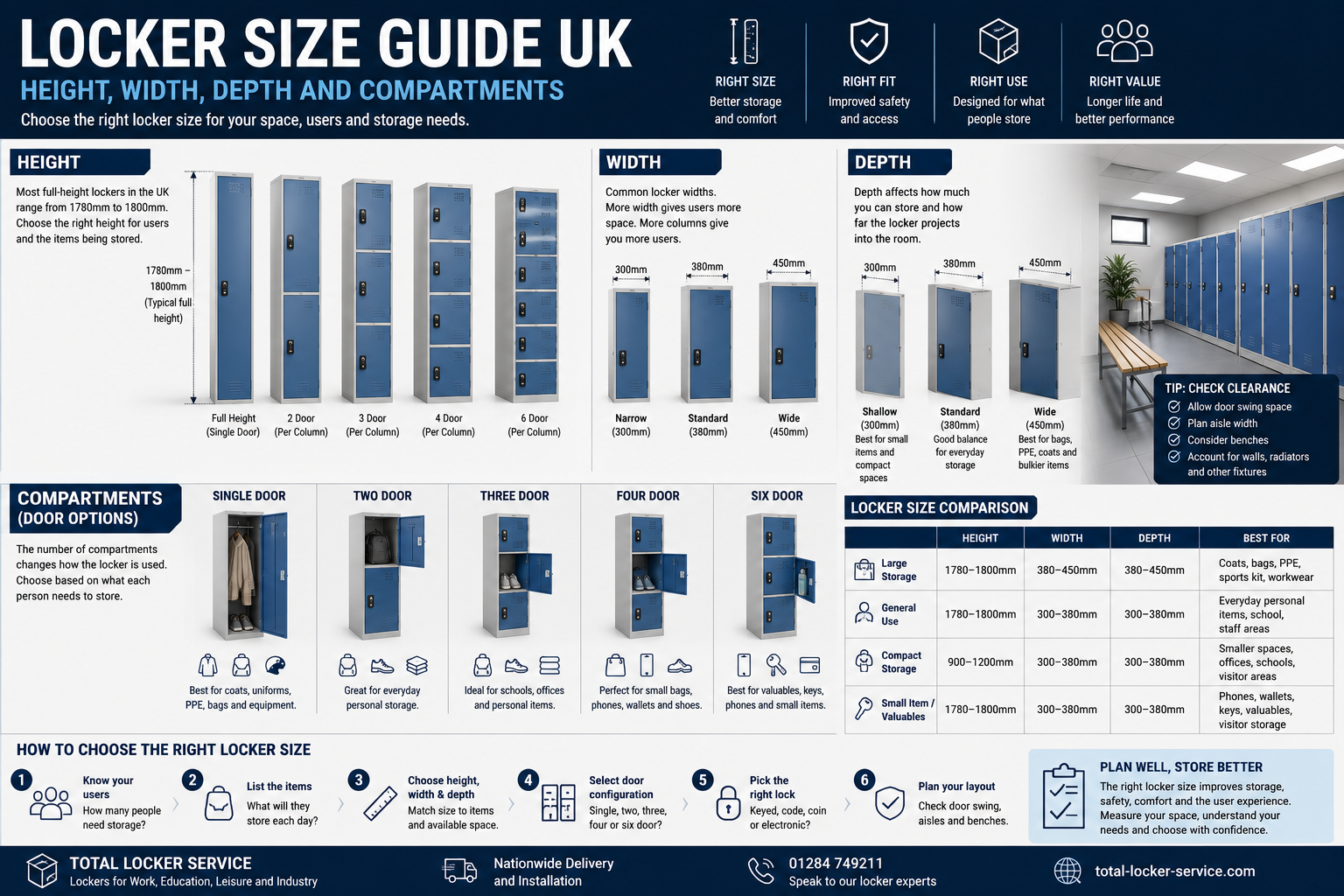
Choosing the right locker size is one of the most important parts of planning a locker installation. The height, width, depth and number of compartments all affect how useful the lockers will be in daily use. A locker can look suitable on a product page, but still feel too small, too deep, too narrow or too awkward once it is installed.
This UK locker size guide explains the main dimensions used for workplace lockers, school lockers, staff lockers, changing room lockers and commercial storage lockers. It also explains how to choose between single-door, two-door, three-door, four-door and six-door lockers, and how locker depth affects bags, coats, PPE, tools, laptops and personal belongings.
The aim is simple. Choose lockers that fit the room, fit the user and fit the items being stored. A well-sized locker system improves storage, reduces clutter and makes the locker area easier to use.
Quick answer: what locker size do you need?
For most UK workplaces, schools and commercial sites, a full-height locker is the safest starting point. Common locker heights are around 1780mm to 1800mm. Widths often range from around 300mm to 450mm per locker column. Depths commonly range from around 300mm to 450mm, with deeper lockers giving more room for coats, bags, PPE and equipment.
A single-door locker is best when each user needs to store coats, bags, uniforms or larger items. A two-door locker gives each user a good amount of storage while doubling the number of users per locker column. Four-door and six-door lockers are useful for smaller personal belongings, phones, wallets, keys, shoes, small bags or visitor storage. The more compartments a locker has, the smaller each compartment becomes.
| Locker type | Best for | Typical use |
|---|---|---|
| Single-door locker | Large personal storage | Coats, bags, uniforms, PPE, workwear and equipment |
| Two-door locker | General staff or school storage | Bags, folded clothing, shoes and personal items |
| Three-door locker | Medium personal storage | Smaller bags, books, shoes and daily items |
| Four-door locker | Compact shared storage | Small bags, personal items, phones and wallets |
| Six-door locker | Small-item storage | Valuables, keys, phones, small devices and visitor items |
If users need to hang coats, choose a single-door locker. If users need everyday personal storage, choose a single-door or two-door locker. If the space is for valuables only, use smaller multi-compartment lockers. If users need to store laptops, tools, helmets, PPE or charging equipment, check the internal size carefully before ordering.
Locker height
Locker height affects storage capacity, user comfort and how the lockers look in the room. Most full-height workplace and school lockers are designed to give enough vertical space for personal belongings while still allowing users to reach the top compartments safely.
In many commercial locker ranges, full-height lockers are around 1780mm to 1800mm high. This gives enough height for coats, bags, workwear and general personal storage. Some lockers may be lower, especially bench-mounted lockers, children’s lockers, under-bench lockers or specialist storage units.
Full-height lockers
Full-height lockers are the most common choice for staff rooms, schools, workplaces, factories, warehouses, gyms and changing rooms. They make good use of wall space and provide practical storage without needing a very large footprint.
A full-height single-door locker gives one user the full vertical space. This is useful for coats, uniforms, workwear, PPE, bags and larger personal items. A full-height two-door locker splits the height into two compartments, giving storage for two users in the same footprint. Three-door, four-door and six-door versions divide the same height into smaller compartments.
- Best for general staff storage.
- Good for school corridors and workplace changing areas.
- Useful where floor space is limited.
- Available with different door numbers.
- Works with a wide range of lock types.
Low-height lockers
Low-height lockers are useful where visibility, access or room layout is more important than maximum storage volume. They may be used in primary schools, reception areas, offices, retail spaces, visitor zones or under windows. They can also be used where lockers must not dominate the room visually.
Lower lockers may be easier for younger users or visitors to access. However, they provide less vertical storage. They are usually not the best choice for coats, long garments, full PPE or bulky bags unless the compartment design is suitable.
Bench-mounted and under-bench lockers
Some changing rooms use lockers with bench seating nearby or under-bench storage. This can help users change footwear, store bags or keep personal items close to the seating area. However, bench placement affects the available aisle width and door clearance.
If lockers are placed above or near benches, check that users can still open doors fully. Also check that the bench does not block access to lower compartments. A locker may have enough storage capacity on paper, but poor bench positioning can make it awkward in use.
Locker width
Locker width controls how much horizontal space each user has. It also affects how many lockers can fit along a wall. A narrow locker may save space, but it may not be suitable for larger bags, helmets, folded coats or bulky workwear. A wider locker gives users more practical storage, but it reduces the number of lockers that fit in the same run.
Common locker widths often include options around 300mm, 380mm and 450mm. Exact sizes vary by range, so always check the product specification before ordering. The important point is to match the width to the items being stored, not just to the number of users.
Narrow lockers
Narrow lockers are useful when space is tight and users only need to store small or simple items. They can work well in schools, staff rooms and areas where the storage need is limited. They can also help maximise the number of users in a confined space.
The limitation is internal width. A narrow locker may not suit large backpacks, motorcycle helmets, bulky coats, safety boots, work bags or specialist equipment. If users try to force larger items into narrow compartments, doors and locks may be damaged over time.
Standard-width lockers
Standard-width lockers offer a good balance between capacity and efficient use of space. They are often suitable for staff storage, school storage, general workplace use and dry changing rooms. They can normally handle everyday bags, coats, shoes and personal items better than very narrow units.
For most sites, a standard-width locker is a safer default than the narrowest option. It gives users more room and reduces the risk of overfilled compartments.
Wide lockers
Wide lockers are useful where users need to store larger items. This may include PPE, uniforms, sports bags, work bags, boots, folded coats, helmets or equipment. They are often suitable for industrial sites, emergency services, facilities teams, gyms, leisure centres and workplaces with bulky clothing or tools.
The trade-off is wall space. Wider lockers reduce the total number of compartments that fit in a run. However, this can still be better than installing too many narrow lockers that users struggle to use.
Locker depth
Locker depth is often the dimension that causes the most problems. A locker may look large from the front, but still feel too shallow once users put bags, coats or equipment inside. Depth also affects room layout because deeper lockers project further into the space.
Common depths often include around 300mm, 380mm and 450mm. Some specialist lockers may be deeper. The best depth depends on the items being stored and the available room space.
300mm deep lockers
A 300mm deep locker can be useful where space is limited. It projects less into corridors, staff rooms and storage areas. It may suit small bags, books, folded clothing, shoes, personal items and light-duty storage.
The limitation is capacity. A 300mm deep locker may be too shallow for larger backpacks, coats on hangers, helmets, PPE, tools or bulky equipment. It can work well for schools and compact spaces, but it should not be chosen only because it saves floor space.
380mm deep lockers
A 380mm deep locker is a strong middle option. It gives more usable depth than a 300mm locker without projecting as far as a 450mm locker. It can suit many staff, school and workplace storage needs where users have everyday bags and clothing.
This depth is often a good compromise when the room is not large enough for deep lockers, but shallow lockers would feel too restricted. It can work well in offices, dry changing rooms, education areas and general staff storage zones.
450mm deep lockers
A 450mm deep locker gives more practical storage space for larger bags, coats, PPE and equipment. It is often better for workplaces, gyms, factories, warehouses, leisure centres and users with bulky items. It can also make the locker feel more natural for everyday storage.
The trade-off is room projection. A 450mm deep locker needs more floor depth and more careful aisle planning. If the room is narrow, deeper lockers can reduce circulation space. Always check the aisle width and door swing before choosing deeper units.
| Locker depth | Best for | Watch point |
|---|---|---|
| 300mm | Compact spaces, schools, small-item storage and light-duty use | May be too shallow for large bags or coats |
| 380mm | General workplace, school and staff storage | Good compromise, but still check bag size |
| 450mm | Coats, PPE, bags, gym kit, workwear and bulkier storage | Needs more room depth and aisle clearance |
Locker compartments
The number of compartments changes the purpose of the locker. A single-door locker gives one user a large space. A six-door locker gives six users small spaces in the same column. The external footprint may be similar, but the user experience is completely different.
Do not choose compartment count only to increase user numbers. A high-compartment locker can work well for valuables, but it may be frustrating if users need to store coats or bags. The correct number of doors depends on what each person needs to store.
Single-door lockers
Single-door lockers provide the largest compartment. They are best when one person needs the full locker height. They are suitable for coats, uniforms, workwear, PPE, sports kit, bags and larger personal belongings.
- Best for full personal storage.
- Suitable for hanging coats and uniforms.
- Useful in workplaces, factories and changing rooms.
- Good for bulky bags and equipment.
- Requires more locker columns for the same number of users.
Two-door lockers
Two-door lockers split a full-height locker column into two compartments. They are one of the most useful options for general staff, school and workplace storage. Each user gets a reasonable compartment, while the site doubles the number of users per column compared with single-door lockers.
They are suitable for bags, shoes, folded clothing and daily personal items. They are less suitable if users need to hang long coats or store bulky equipment.
Three-door lockers
Three-door lockers provide medium-small compartments. They can work well for schools, offices, visitor storage and sites where users only need to store bags, books, shoes or personal items for part of the day.
The middle compartments can be easy to access, while the top and bottom compartments may be less comfortable for some users. Consider who will use the lockers before choosing this format for all compartments.
Four-door lockers
Four-door lockers are useful where users need compact storage rather than full personal storage. They are often used for small bags, wallets, phones, keys, shoes and personal items. They can work well in leisure centres, offices, schools and visitor areas.
They are not usually the best choice for coats, workwear or larger bags. If users try to store too much in small compartments, doors may not close properly and locks can become strained.
Six-door lockers
Six-door lockers provide small compartments for high-density storage. They are best for valuables, phones, keys, small devices, wallets and visitor items. They are useful where many people need secure short-term storage in a small footprint.
They are not suitable for general staff storage if users need to store coats, bags or uniforms. They should be treated as small-item lockers, not full personal lockers.
Locker size comparison table
The table below gives a practical comparison of common locker sizes and compartment types. Exact product sizes vary, so always check the specification before ordering.
| Locker format | Storage capacity | Best for | Not ideal for |
|---|---|---|---|
| Full-height single-door | High | Coats, PPE, uniforms, bags and equipment | High-density small-item storage |
| Two-door | Medium | Staff, students and daily personal storage | Long coats or bulky equipment |
| Three-door | Medium-small | School, office and visitor storage | Large bags or hanging garments |
| Four-door | Small | Compact bags, phones, wallets and shoes | Workwear, PPE or coats |
| Six-door | Very small | Valuables, keys, phones and visitor items | General staff changing storage |
| Deep lockers | High | Sports kit, PPE, work bags and bulky clothing | Narrow rooms with limited aisle space |
| Shallow lockers | Lower | Compact rooms and smaller items | Large bags, helmets or equipment |
Best locker size by use
Different sites need different locker sizes. A workplace changing room, school corridor, gym, warehouse and office may all use lockers, but the size requirement is not the same. The best locker size should follow the user’s daily storage need.
Workplace lockers
Workplace lockers should be sized around staff clothing, bags, PPE and shift routines. In many workplaces, single-door or two-door lockers are the most practical options. Single-door lockers are best when users need to hang coats or store bulky workwear. Two-door lockers are useful where users need everyday personal storage but not full-height hanging space.
For warehouses, factories and industrial sites, depth is important. Users may need to store safety boots, hi-vis clothing, PPE, helmets, gloves or work bags. A shallow locker may not be practical if staff carry bulky items every day.
Recommended route: workplace lockers.
School lockers
School lockers need to balance storage capacity, corridor space and student numbers. Single-door lockers provide the most space per student, but they require more wall space. Two-door and three-door lockers can increase capacity while still giving students useful storage for books, bags and personal items.
For younger pupils, locker height and access should be considered carefully. Very high top compartments may be awkward. For older pupils, bags, sports kit and books may need more internal space. The best choice depends on the age group and the location of the locker bank.
Recommended route: school lockers.
Gym and leisure lockers
Gym and leisure lockers often need to hold bags, shoes, clothing, towels and personal items. Full-height single-door lockers are useful for larger storage. Two-door lockers can work well for general changing room use. Four-door lockers may be suitable for small-item storage near reception or activity areas.
Wet areas also need material planning. A locker size may be correct, but the material may be wrong for the environment. In swimming pools, spas and wet changing rooms, plastic or wet-area lockers may be more suitable than standard steel lockers.
Recommended route: leisure lockers.
Office lockers
Office lockers are often used for hybrid working, personal storage, laptops, bags and staff belongings. Two-door lockers may work well where users need medium storage. Four-door lockers can work for small-item storage, visitor belongings or hot-desk areas where users only need space for personal items.
If laptops or devices are stored, check the internal compartment size carefully. A laptop locker may need enough space for the device, charger, cable and protective case. If charging is required, a powered locker may be better than a standard office locker.
Recommended route: charging lockers for powered device storage.
Visitor lockers
Visitor lockers are often used for phones, wallets, bags, keys and small personal belongings. Four-door and six-door lockers can work well because visitors usually need temporary storage rather than full clothing storage.
For public or semi-public use, lock type matters. Coin return locks, combination locks or electronic locks may be more practical than individually issued keys. The compartment size should match the items visitors are likely to carry.
PPE and uniform lockers
PPE and uniform lockers often need more space than standard personal storage. Staff may need to store boots, helmets, coats, gloves, eye protection, hi-vis clothing or clean and dirty workwear. Single-door lockers or specialist garment lockers are often more suitable than small multi-door units.
Where wet or dirty clothing is involved, ventilation, cleaning and material choice should also be considered. Do not choose locker size without checking the condition and type of items being stored.
Room layout and clearance
Locker size is not only about the locker itself. It is also about the room around the locker. A locker that fits against a wall may still fail if users cannot open the doors, pass each other safely or access compartments without blocking the aisle.
Before choosing a locker depth or door format, measure the available room space. Include door swing, aisle width, benches, radiators, columns, skirting, access routes, fire exits and any other fixed features. In changing rooms, allow extra space for users standing, sitting, opening bags and changing shoes.
Door clearance
Locker doors need space to open. Wider doors and deeper lockers can create more obstruction when open. If two banks of lockers face each other, check that users can open doors on both sides without blocking the route completely.
Small-compartment lockers may have shorter doors, but they can still cause congestion when many users open them at once. This is common in schools, gyms and shift-change areas. Plan for peak use, not just quiet periods.
Aisle width
Aisle width affects comfort and safety. A locker bank may be installed correctly, but the room may feel cramped if there is not enough circulation space. Deeper lockers reduce the available aisle. Benches reduce it further.
If the room is narrow, shallow lockers may be necessary. If users have large bags or need to change clothes, deeper lockers may be better, but only if the room can support the extra projection. A practical layout is usually more important than squeezing in the maximum number of compartments.
Bench spacing
Benches are useful in changing rooms, but they can create access problems if they are too close to lockers. Users need space to sit, open doors, reach compartments and move around others. Benches should not block lower locker doors or create trip points.
If a room needs both lockers and benches, plan them together. Do not choose locker size first and then try to fit benches into the remaining space. The two elements work as one layout.
Common locker sizing mistakes
Most sizing problems come from choosing lockers by quantity rather than use. It is easy to ask, “How many lockers can fit?” The better question is, “What size does each user need, and how much space does the room allow?”
- Choosing too many small compartments when users need to store bags or coats.
- Choosing shallow lockers for bulky workwear or PPE.
- Forgetting that coats on hangers need vertical space.
- Ignoring door swing and aisle clearance.
- Placing deep lockers in narrow rooms without checking circulation.
- Using one locker size for every department even when storage needs differ.
- Forgetting room features such as radiators, windows, sockets and columns.
- Choosing locker size before deciding the lock type and user routine.
- Not allowing spare capacity for future staff or student numbers.
- Using valuables lockers for full personal storage.
These problems are avoidable with good planning. Measure the room, list the items being stored, decide the user routine and then choose the locker size.
How to choose the right locker size
Use this step-by-step process before ordering lockers.
- Count the users. Decide how many people need storage now and how many may need it later.
- List the items. Include bags, coats, uniforms, shoes, PPE, helmets, laptops, tools and personal belongings.
- Choose the compartment type. Select single-door, two-door or multi-door lockers based on what each person stores.
- Check height needs. Use full-height compartments for hanging clothing or larger equipment.
- Check width needs. Choose wider compartments for bulky bags, kit or workwear.
- Check depth needs. Use deeper lockers when users need to store bags, PPE or sports equipment.
- Measure the room. Include door swing, aisle width, benches and fixed obstacles.
- Plan the layout. Avoid blocking corridors, exits, sockets, radiators or circulation routes.
- Select the lock type. Match the lock to assigned use, shared use or visitor use.
- Allow spare capacity. Leave room for growth where possible.
For many sites, the best solution is not one locker size throughout the building. A workplace may use single-door lockers for changing areas, four-door lockers for valuables and charging lockers for laptops. A school may use two-door lockers in corridors and smaller lockers for phones or visitor storage. A leisure centre may use large lockers in changing rooms and small lockers near reception.
Internal links for this locker size guide
This article should link into the wider locker planning canister and the main product routes. Use it to help readers move from sizing advice to the correct locker category.
| Reader need | Recommended link | Anchor text |
|---|---|---|
| Browse all locker types | Lockers.php | commercial lockers |
| Choose staff storage | worklockers.php | workplace lockers |
| Choose student storage | schoollockers.php | school lockers |
| Choose gym or changing room lockers | Leisurelockers.php | leisure lockers |
| Choose powered device storage | Charging.php | charging lockers |
| Choose locker locks | LockerLockbytype.php | locker locks by type |
| Replace lost locker keys | Locker-keys.php | replacement locker keys |
Final recommendation
The right locker size depends on the user, the contents and the room. A single-door locker gives the most storage per person. A two-door locker gives a practical balance between storage and user numbers. Four-door and six-door lockers work best for small-item storage. Deeper lockers are better for bags, coats, PPE and equipment, but they need more room space.
Do not choose locker size from external dimensions alone. Check the internal space, compartment format, depth, door clearance and room layout. A locker should not only fit the wall. It should also fit the way people use the space.
Total Locker Service supplies lockers for workplaces, schools, leisure centres, healthcare sites and commercial buildings across the UK. Browse commercial lockers, view workplace lockers, or call 01284 749211 for help choosing the right locker size for your site.
Locker size FAQs
What is a standard locker size in the UK?
Many full-height lockers are around 1780mm to 1800mm high, with common widths around 300mm to 450mm and depths around 300mm to 450mm. Exact sizes vary by range, so always check the product specification.
What locker depth is best?
A 300mm deep locker can work for compact storage and smaller items. A 380mm depth is a useful middle option. A 450mm depth is better for bags, coats, PPE, sports kit and bulkier storage, provided the room has enough aisle space.
Are single-door lockers better than two-door lockers?
Single-door lockers are better when users need full-height storage for coats, uniforms, PPE or bulky bags. Two-door lockers are better when you need storage for more users in the same footprint and each user only needs medium storage.
What size locker is best for staff?
For staff storage, single-door or two-door lockers are usually the best starting point. Choose single-door lockers for coats, uniforms, PPE and bulky items. Choose two-door lockers for general personal belongings and smaller bags.
What size locker is best for schools?
School lockers often use two-door or three-door formats to balance storage capacity and corridor space. Single-door lockers give more storage per pupil, while smaller compartments increase the number of users per locker bank.
What size locker is best for gyms?
Gyms and leisure centres often need lockers large enough for bags, shoes, clothing and towels. Single-door or two-door lockers are usually more practical for changing rooms. Smaller lockers can be used for valuables or reception areas.
Are six-door lockers suitable for staff storage?
Six-door lockers are usually best for small-item storage such as phones, wallets, keys and visitor belongings. They are not normally suitable for full staff storage if users need to store coats, bags, uniforms or PPE.
How much aisle space do lockers need?
The required aisle space depends on locker depth, door swing, user numbers, benches and the room layout. Always allow enough space for users to open doors, move safely and access compartments without blocking routes.
Should locker size include the lock and door swing?
Yes. External locker size is only part of the planning. You should also consider door swing, lock projection, aisle width and how users will stand in front of the locker during busy periods.
Who supplies lockers in different sizes in the UK?
Total Locker Service supplies lockers in a wide range of sizes, door formats, depths and lock options for workplaces, schools, leisure centres, healthcare sites and commercial buildings across the UK.
“`