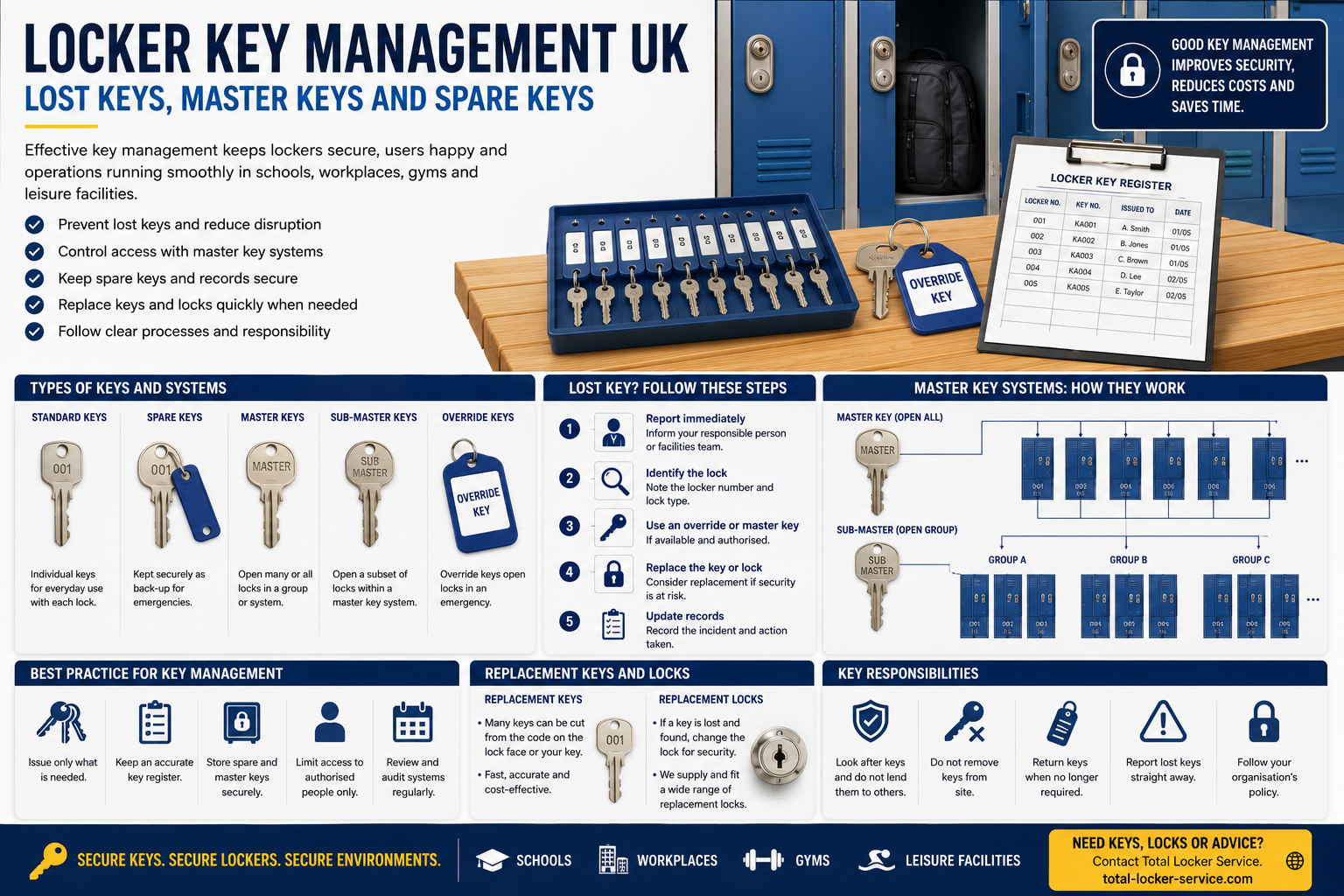
Locker key management is one of the most important parts of running a reliable locker system. A locker can be strong, well installed and suitable for the room, but the system still fails if keys are lost, spare keys cannot be found, master keys are uncontrolled or replacement keys are ordered without the correct code.
Schools, workplaces, gyms, factories, offices, healthcare sites, universities and leisure centres all depend on keys in different ways. Some lockers are assigned to one person. Others are shared by visitors or shift workers. Some use ordinary user keys. Some use master keys. Others require staff to keep a spare key register. Others need a bulk replacement key process at the end of term, after a refurbishment or during a locker estate audit.
The aim of locker key management is simple: the right person should be able to access the right locker at the right time, while unauthorised access is prevented. That means every key, spare key, master key and replacement key needs a place in the system.
This guide explains how UK sites can manage lost locker keys, spare keys, master keys, key codes and replacement procedures. It is written for school administrators, facilities managers, site managers, office managers, gym operators and anyone responsible for keeping lockers secure and usable.
For ordering replacement keys, use replacement locker keys from Total Locker Service. For a detailed key guide, read the Locker Keys UK complete guide. Need a broader locker product support, visit Total Locker Service locker solutions UK.
Quick answer: how should locker keys be managed?
Locker keys should be managed through a clear issue, record, spare key, lost key and replacement process. Each locker should have a number. All key should have a code where available. Each user should be linked to the correct locker if the locker is assigned. Spare keys and master keys should be stored securely and used only by authorised staff.
A good locker key management system should include:
- A locker number register
- A key code register
- A user allocation record
- A spare key storage system
- A master key control process
- A lost key procedure
- A replacement key ordering process
- A lock replacement rule for compromised keys
- A leavers or end-of-use key recovery process
- Regular audits of keys, locks and locker numbers
The most important practical step is to record the key code before a key is lost. If the code is known, replacement is usually much easier than replacing the full lock.
Why locker key management matters
Locker key problems rarely stay small. One missing key can become a queue at reception, a delayed pupil, a staff complaint, a forced lock, a damaged door or a security concern. When there are hundreds of lockers across a site, poor key management can create daily disruption.
Good key management helps a site:
- Restore access quickly when a user loses a key
- Avoid unnecessary lock replacement
- Reduce forced openings and damage
- Keep locker allocation records accurate
- Control master keys and spare keys
- Recover keys from leavers
- Order replacement keys by code
- Plan bulk key orders before busy periods
- Improve user confidence in the locker system
- Support safeguarding, security and facilities procedures
The goal is not to make lockers difficult to use. The goal is to make access predictable. Users should know what to do when a key is lost. Staff should know where spare keys are held. Facilities teams should know which key code belongs to which lock. The site should know when a lock needs replacement rather than another spare key.
The difference between locker numbers and key codes
One of the most common mistakes is assuming that the locker number and key code are the same. Sometimes they may match, but often they do not.
The locker number identifies the locker door or compartment. It helps users and staff find the right locker. The key code identifies the key cut or lock code needed to make a replacement key. It may be stamped on the key, printed on a tag, marked on the lock face or recorded in the original locker schedule.
A good register should record both:
| Field | Purpose | Example |
|---|---|---|
| Locker number | Finds the physical locker | A104, 27, Y8-055 |
| Key code | Identifies the replacement key cut | 4001, 92555, LF123 |
| Location | Shows where the locker is installed | Year 8 corridor, staff changing room, gym lobby |
| User or group | Links the locker to a person or department | Student, staff member, visitor area, shift team |
| Lock type | Supports replacement or maintenance | Key cam lock, coin lock, hasp, digital lock |
If a site only records locker numbers, it may still struggle to order replacement keys. If it records key codes as well, replacement can often be handled faster and with less disruption.
Total Locker Service explains that many replacement locker keys can usually be cut from the code stamped on the lock face or existing key.
Where to find a locker key code
The key code is the information needed to cut a replacement key. It can appear in several places depending on the lock and manufacturer.
Check these places first:
- The face of the lock barrel
- The original user key
- The spare key
- A plastic key tag
- A metal key tag
- The original locker schedule
- The facilities key register
- The purchase invoice or supplier record
- A previous replacement key order
- Photos taken during installation or audit
If the code is not visible, do not guess. A wrong key code can waste time and cost. Take a clear photo of the lock face and any visible markings. Record the locker brand or lock brand if known. If the code cannot be identified, the lock may need to be matched, removed or replaced.
For detailed key code guidance, use the replacement locker keys cut to code UK guide.
Lost locker keys: what should happen first?
A lost locker key should follow a set process. This prevents panic, avoids unnecessary damage and keeps staff decisions consistent.
A practical lost key process is:
- Confirm the locker number and location.
- Confirm that the user is authorised to access that locker.
- Check whether the key may be mislaid nearby.
- Check the site spare key record.
- Check the key code from records or the lock face.
- Use authorised staff access if urgent access is needed.
- Order a replacement key if the code is known.
- Replace the lock if the key is stolen or security is compromised.
- Update the register with the lost key date and action taken.
The first question is not always “how do we replace the key?” Sometimes the first question is “should the lock remain in use?” If a key is simply misplaced, a replacement key may be enough. If a key is stolen or has been misused, the lock may need to be changed.
For the step-by-step Total Locker Service process, use Lost Locker Key? What to Do Next.
When a replacement key is enough
Many lost key issues can be solved with a replacement key. This is often faster and cheaper than replacing the full lock, especially when the key code is known.
A replacement key is usually suitable when:
- The key has been lost but not stolen
- The lock works correctly
- The key code is known
- The locker is assigned to the same authorised user
- There is no evidence of unauthorised access
- The site is not changing its lock system
- The missing key does not create a wider security issue
Replacement keys are especially useful for schools, offices, factories and gyms where many lockers use coded cam locks or coin lock keys.
To order keys, use locker keys cut to code. If the brand is known, use keys by manufacturer.
When the lock should be replaced
A replacement key is not always the right answer. Sometimes the lock must be replaced to restore security or reliability.
Replace the lock when:
- The key has been stolen
- The missing key may be used by someone else
- The locker has been opened without permission
- The lock is damaged or unreliable
- The code cannot be identified
- The user has repeatedly lost keys
- The master key system is compromised
- The lock is obsolete or unsupported
- The site is standardising lock types
- The locker is being refurbished
A lock replacement decision should be based on risk. If a lost key creates no realistic unauthorised access risk, replacement may not be necessary. If the key is stolen, copied or linked to misuse, replacing the lock is often safer.
For replacement lock options, use locker locks from Total Locker Service.
Spare locker keys
Spare keys are the operational safety net of a locker system. They allow authorised staff to restore access without damaging the locker. They also reduce disruption when a user forgets, loses or damages a key.
However, spare keys must be controlled. A spare key left in an open drawer weakens security. A spare key that cannot be found weakens the operation. The site needs both availability and control.
A spare key system should include:
- Secure storage
- Clear labelling
- Locker number and key code records
- Restricted staff access
- A sign-out process where appropriate
- A return process after use
- Regular checks that spares are present
- Replacement ordering when spares are missing
For small sites, a locked key box may be enough. For larger sites, a numbered key cabinet may be better. Schools, leisure centres and workplaces with hundreds of lockers should avoid loose bundles of unrecorded keys.
How many spare keys should a site hold?
The right number of spare keys depends on the site size, user turnover and how quickly replacement keys can be ordered.
A school may want one controlled spare key per locker or per key range. A workplace may only need spare keys for assigned staff lockers. A leisure centre may need spare keys or override keys for coin locks. A large estate may hold spare keys centrally and locally.
Consider holding more spare keys when:
- Lockers are used daily
- Many users are pupils, visitors or shift workers
- The site has repeated lost key incidents
- Access delays cause operational problems
- The locker estate is large or spread across buildings
- Keys are needed outside normal office hours
- Bulk replacement orders are easier than single-key orders
Spare keys should not become uncontrolled duplicates. Every spare key should be part of the register.
Master key locker systems
A master key allows authorised staff to open multiple compatible locker locks. This can be useful for schools, workplaces, gyms, leisure centres, universities, factories and managed facilities. It helps with emergency access, lost keys, abandoned lockers and maintenance.
A master key is different from an ordinary spare key. A spare key normally opens one lock. A master key can open a group of locks within the same mastered system. Because it gives wider access, it needs stronger control.
Master key systems are useful when:
- Staff need controlled emergency access
- Users often lose keys
- Lockers are assigned but managed by the site
- Facilities teams need maintenance access
- Lockers are spread across several areas
- The site needs to avoid forced openings
- Abandoned lockers must be opened safely
For a dedicated guide, use the Master Key Locker Systems UK guide.
Master key control
Master key control should be stricter than normal key control. A missing master key can affect many lockers, not just one. If the master key is lost, the site may need to review the full lock system depending on the risk.
A master key procedure should define:
- Who is allowed to hold or use the master key
- Where the master key is stored
- How use is authorised
- Whether use must be logged
- What happens if the master key is missing
- When master key access is allowed
- Whether two staff members are needed for certain access
- How the master key is checked and audited
Schools and workplaces should not loan master keys casually. They should be treated as controlled access items, not general office tools.
Emergency locker access
When Emergency access is needed, such as when a user needs urgent belongings, a locker has been abandoned, a key is lost before an important activity, or staff need to inspect a locker under site procedure.
Emergency access should still be controlled. The fact that a master key or spare key exists does not mean anyone can use it at any time.
A good emergency access process should confirm:
- The locker number
- The authorised user or department
- The reason for access
- The staff member approving access
- The staff member opening the locker
- Whether the user should be present
- Whether access should be recorded
- What happens to items removed from the locker
In schools, access linked to behaviour or safeguarding should follow the school’s own policies. In workplaces, access may need to follow HR, facilities or site security procedures.
School locker key management
Schools need simple, consistent locker key management. Pupils lose keys. Staff need spare access. Year groups move. Leavers do not always return keys. Lockers may be reassigned each year. Without a register, the system quickly becomes difficult to manage.
A school locker key system should include:
- Pupil name
- Year group or form
- Locker number
- Locker location
- Key code
- Issue date
- Deposit or charge where used
- Spare key status
- Lost key record
- Return date
Schools should also decide when a lost key becomes a pastoral or safeguarding issue rather than just an admin issue. Repeated loss may indicate disorganisation, bullying, coercion, SEND needs or other welfare factors.
For school-specific lock selection, use the best locker locks for schools UK guide.
Workplace locker key management
Workplaces use lockers for staff belongings, uniforms, PPE, boots, tools, devices and changing areas. Key management needs to reflect staff turnover, shift patterns and the type of storage provided.
Assigned staff lockers usually need a clear issue and return process. Shared shift lockers need a different process, especially if users change frequently. Contractor and visitor lockers may need short-term access and quick release procedures.
A workplace key management process should answer:
- Who issues locker keys?
- Who holds spare keys?
- Who can use the master key?
- What happens when an employee leaves?
- How are lost keys charged or replaced?
- When should a lock be replaced?
- How are lockers audited?
- Who orders replacement keys?
For workplace locker product routes, use workplace lockers from Total Locker Service.
Gym and leisure locker key management
Gyms and leisure centres often use lockers in short-term, high-turnover settings. Keys may be attached to wrist straps. Coin locks, hasp locks, combination locks and digital systems may all be used depending on the facility.
Leisure key management should cover:
- Lost wrist straps
- Lost coin lock keys
- Jammed coin locks
- Abandoned lockers
- Wet-area lock maintenance
- Staff override access
- End-of-day locker checks
- Replacement key stock
Because visitor use is unpredictable, clear instructions and staff procedures are essential. If users do not understand how to release a key, return a coin or report a lost key, staff workload increases.
Bulk replacement locker key orders
Bulk key orders are useful when a site has many missing, damaged or unrecorded keys. This often happens after an audit, refurbishment, end-of-year school return, site move or locker estate review.
Before placing a bulk order, create a clean schedule.
| Locker number | Key code | Brand or lock type | Quantity | Notes |
|---|---|---|---|---|
| A101 | 4001 | Cam lock | 2 | User key and spare |
| A102 | 4002 | Cam lock | 1 | Spare only |
| B014 | 92555 | Coin lock | 2 | Lost both keys |
| Gym 22 | LF123 | Lowe & Fletcher | 1 | Damaged key |
A structured schedule reduces mistakes and speeds up checking. It also becomes part of the future site record.
Total Locker Service supports replacement keys for many common locker brands through the replacement locker keys page.
Locker key register template
A locker key register does not need to be complicated. It can be a spreadsheet, facilities database, controlled document or paper register. The important point is that it stays accurate.
A useful register should include:
| Register field | Why it matters |
|---|---|
| Locker number | Identifies the physical locker |
| Location | Shows where the locker is installed |
| User or department | Shows who is authorised to use it |
| Key code | Allows replacement keys to be ordered |
| Lock type | Helps with repair and replacement |
| Issue date | Shows when the key was given out |
| Spare key held | Confirms backup access |
| Master key group | Shows whether the lock belongs to a master system |
| Lost key history | Identifies repeat issues |
| Return date | Supports leavers and reallocation |
The register should be reviewed whenever lockers are moved, locks are changed, keys are replaced or users leave.
Leavers, reallocation and end-of-year checks
Many key problems happen because users leave before keys are recovered. This is common in schools, workplaces, universities, gyms and contractor environments.
A leavers process should include:
- Locker emptied
- Key returned
- Spare key checked
- Locker condition checked
- Lock tested
- Register updated
- Deposit refunded or retained where applicable
- Replacement key ordered if needed
- Locker made available for reallocation
Schools should complete this before pupils leave at the end of the year. Workplaces should include locker keys in the staff exit checklist. Gyms and clubs should include lockers in membership cancellation or long-term hire procedures where relevant.
How to reduce lost locker keys
Lost keys cannot be removed completely, but they can be reduced. The best method is to make key ownership clear and replacement simple.
Practical steps include:
- Issue keys with clear instructions
- Use suitable key tags
- Avoid tags that reveal too much security information
- Record the key code at issue
- Store spare keys securely
- Use wrist straps in leisure settings where suitable
- Review repeated losses
- Batch replacement orders
- Recover keys from leavers
- Consider combination or digital locks where key loss is constant
Repeated key loss should not always be treated as a simple chargeable event. It may show that the system is not suitable for the user group or that a different lock type is needed.
Key locks versus keyless systems
Some sites move away from keys because of repeated losses. This can be sensible, but keyless systems still need management.
| Access type | Strength | Management issue |
|---|---|---|
| Key lock | Simple, familiar and easy to replace by code | Keys can be lost |
| Combination lock | No physical key for the user to lose | Codes can be forgotten or shared |
| Digital keypad lock | Flexible access and reset options | Batteries and programming need management |
| RFID lock | Useful where cards or fobs are already used | Credentials and administration need control |
| Padlock hasp | Simple and flexible | Abandoned padlocks may need removal |
A keyless system may reduce lost keys, but it does not remove access problems. Forgotten codes, flat batteries, lost cards and abandoned locks still need procedures.
For lock options, see the locker security options guide.
Key management and locker security
Locker key management is part of locker security. If spare keys are uncontrolled, master keys are casual or lost keys are ignored, the whole locker system becomes weaker.
A security-aware key process should decide:
- Who can issue keys
- Who can access spare keys
- Who can use the master key
- When lost keys require lock replacement
- How abandoned lockers are opened
- How emergency access is recorded
- How keys are recovered from leavers
- How key records are audited
For wider access control guidance, use the locker access control systems UK guide.
Locker key audit checklist
Use this checklist to review a locker key system.
Records
- Are locker numbers recorded?
- Are key codes recorded?
- Are users or departments linked to assigned lockers?
- Are lock types recorded?
- Are replacement orders documented?
Spare keys
- Are spare keys held securely?
- Are spare keys labelled clearly?
- Are spare keys checked regularly?
- Are missing spares replaced?
- Is access restricted to authorised staff?
Master keys
- Are master keys stored securely?
- Are authorised users named?
- Is master key use logged where needed?
- Is there a response plan if a master key is lost?
- Are master keys checked at set intervals?
Lost keys and replacement
- Is there a written lost key procedure?
- Does the procedure explain when to replace the lock?
- Can replacement keys be ordered by code?
- Are repeated losses reviewed?
- Are leavers checked before keys are written off?
Frequently asked questions
What is locker key management?
Locker key management is the process of issuing, recording, storing, replacing and auditing locker keys. It includes user keys, spare keys, key codes, master keys, lost key procedures and lock replacement rules.
What should I do if a locker key is lost?
Confirm the locker number and authorised user, check for a spare key, find the key code, decide whether the lock is still secure and order a replacement key if appropriate. Replace the lock if the key may be stolen or misused.
Can replacement locker keys be cut to code?
Yes. Many replacement locker keys can be cut to code if the correct number is visible on the key, lock face or site records. The locker number and key code may be different, so both should be checked.
Where is a locker key code found?
A locker key code may be stamped on the key, printed on a tag, marked on the lock face or recorded in the original locker schedule, facilities register, invoice or previous order history.
What is a locker master key?
A locker master key is a controlled override key that opens a group of compatible locker locks. It is used by authorised staff for lost keys, emergency access, maintenance and abandoned lockers.
Should master keys be stored separately?
Yes. Master keys should be stored securely and separately from everyday user keys. Access should be restricted to authorised staff because a master key can open multiple lockers.
How many spare locker keys should be held?
The number depends on the site. Larger schools, gyms and workplaces may hold a controlled spare key set. Smaller sites may only need spares for assigned lockers or high-use areas. All spare keys should be recorded.
When should a locker lock be replaced after a lost key?
A lock should be replaced when the key has been stolen, misused, copied, repeatedly lost or linked to unauthorised access. A replacement key may be enough when the key is simply misplaced and the security risk is low.
How can schools manage student locker keys?
Schools should record pupil name, year group, locker number, key code, issue date, spare key status and return date. They should also have a clear lost key process and end-of-year recovery procedure.
Are keyless lockers better than keyed lockers?
Keyless lockers can reduce lost key problems, but they still need management for forgotten codes, batteries, credentials and abandoned lockers. Keyed lockers remain practical where key codes and spare keys are well managed.
Conclusion: key control keeps lockers secure and usable
Locker key management is not only an admin task. It is part of the security, maintenance and daily operation of the locker system. A site with good key records can restore access quickly, order replacement keys accurately and avoid unnecessary lock damage.
The strongest systems record locker numbers and key codes from the start. Spare keys are held securely. They protect master keys. Define what happens when a key is lost. They know when a replacement key is enough and when the lock must be changed.
Good key control reduces disruption for users and staff. It also protects the long-term value of the locker estate.
Need replacement keys, visit replacement locker keys from Total Locker Service. For the detailed guide, read the Locker Keys UK complete guide. For master key and override access, use the Master Key Locker Systems UK guide.