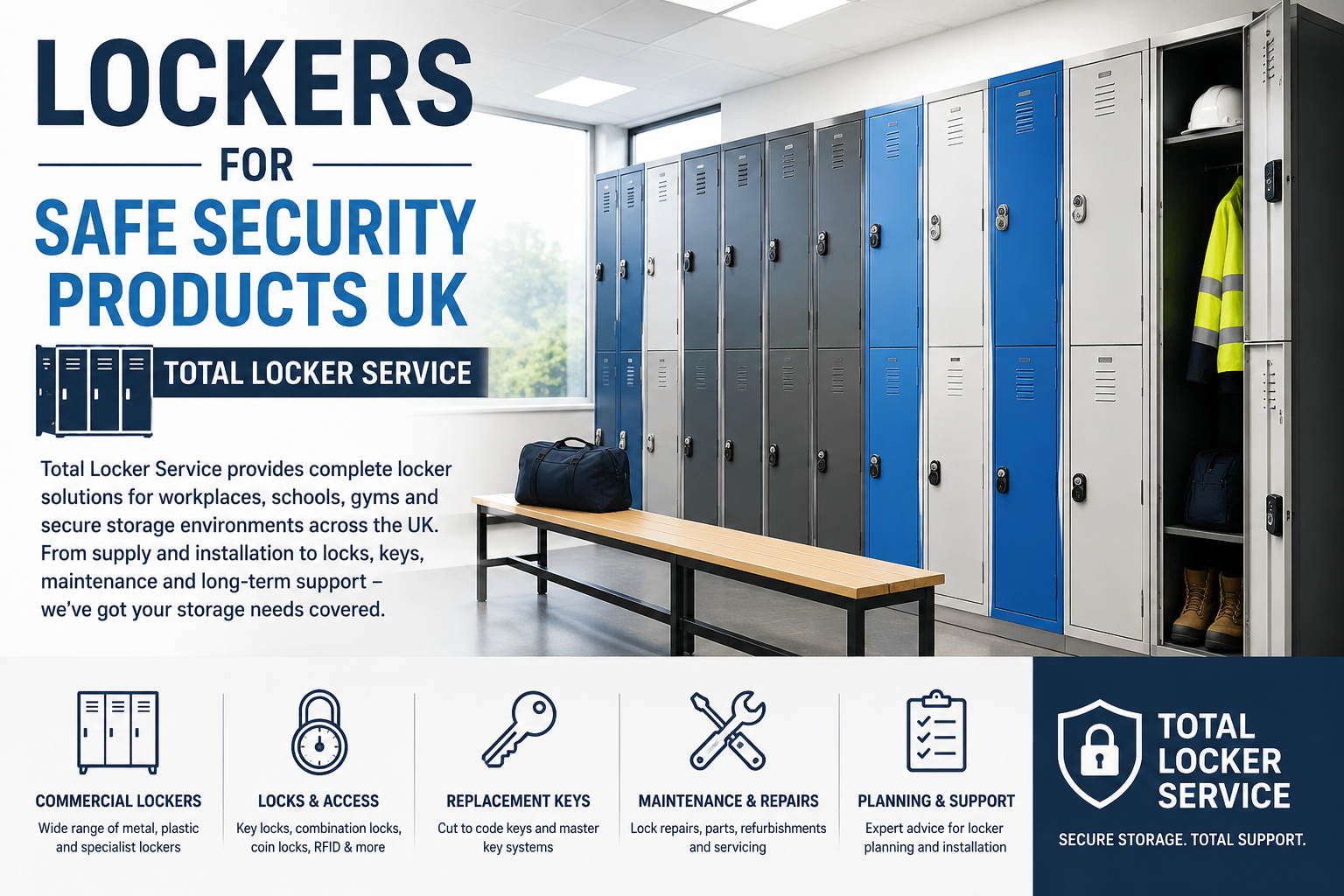
Total Locker Service supplies commercial lockers, secure storage systems, locker locks, replacement keys, locker parts, locker maintenance and locker planning support for UK workplaces, schools, leisure centres, industrial sites, offices and public buildings.
For organisations using https://safe-security-products.co.uk/ as a secure product route, lockers are an important part of the wider security and storage picture. A safe protects documents, valuables or cash. A cabinet controls tools, keys or hazardous items. A locker controls daily personal storage, staff belongings, uniforms, devices, PPE and shared workplace equipment.
Total Locker Service provides a practical locker offering that supports both product supply and long-term operational control. This includes standard commercial lockers, workplace lockers, school lockers, wet area lockers, staff lockers, PPE lockers, garment lockers, plastic lockers, metal lockers, bespoke lockers, locker stands, locker seat stands, locker locks, key replacement, lock conversion, spare parts, refurbishment and installation support.
This guide explains how Total Locker Service fits into a complete secure storage strategy. It also links into the main locker planning, locker management, locker access and locker key canisters from the Total Locker Service blog, so buyers can move from product selection into specification, layout, maintenance and lifecycle control.
Why lockers matter in secure storage planning
Lockers are often treated as a simple furniture purchase. In practice, they are part of the daily security system of a building. They decide where people store personal items, how staff manage workwear, how pupils move through corridors, how gym members use changing rooms, how contractors protect belongings and how facilities teams control access across a busy site.
A good locker system reduces clutter, protects belongings and supports better movement through a building. It can also reduce lost property, improve hygiene, support welfare provision and give managers a clearer process for issuing, auditing and maintaining storage.
Total Locker Service is useful because its locker offer is not limited to one product type. The range covers everyday steel lockers, workplace lockers, school lockers, wet specification lockers, plastic lockers, PPE lockers, garment management lockers, mini lockers, laptop storage, electronic lockers, locker stands and locker accessories.
This makes the company suitable for organisations that need more than one storage product. A workplace may need staff lockers, PPE lockers, key cabinets and safes. A school may need corridor lockers, changing room lockers, replacement keys and master key control. A leisure centre may need wet area lockers, coin locks, combination locks and locker maintenance. An industrial site may need heavy duty lockers, clean/dirty zoning, garment collection and secure storage for equipment.
Quick answer: what does Total Locker Service offer?
Total Locker Service supplies lockers and secure storage solutions for UK workplaces, schools, leisure facilities, offices, public buildings and commercial environments. The offer includes locker supply, locker specification, locking options, replacement locker keys, lock replacement, locker parts, maintenance, refurbishment and installation support.
| Requirement | Relevant locker solution | Typical user |
|---|---|---|
| Everyday personal storage | Steel lockers, staff lockers, office lockers | Workplaces, offices, schools |
| Wet changing areas | Wet specification lockers, plastic lockers, suitable locks | Gyms, pools, leisure centres |
| Workwear and laundry control | Garment lockers, collector lockers, dispenser lockers | Factories, healthcare, industrial sites |
| PPE and equipment storage | PPE lockers, compartment lockers, industrial lockers | Warehouses, construction, manufacturing |
| Student storage | School lockers, corridor lockers, replacement keys | Schools, colleges, academies |
| Access control | Key locks, hasp locks, combination locks, coin locks, keypad locks, RFID locks | Managed and shared-use sites |
| Long-term control | Maintenance, refurbishment, lock conversion, spare parts | Facilities teams and estates teams |
Commercial lockers for workplaces, schools and leisure facilities
The main locker range from Total Locker Service is suitable for commercial environments where storage must be durable, practical and easy to manage. These environments include schools, offices, leisure centres, warehouses, healthcare sites, factories, staff changing rooms and public facilities.
Commercial lockers need to do more than hold belongings. They must fit the building layout, allow safe access, avoid blocking circulation, support cleaning, use suitable locks and match the number of people using the space. A poorly specified locker system can create congestion, lost keys, damaged locks, unused compartments and awkward maintenance problems.
That is why the strongest locker projects start with planning. Before choosing a locker colour or lock type, the buyer should define the users, the environment, the available space, the required compartment size, the access method, the maintenance process and the replacement plan.
For deeper planning guidance, use the Locker Planning UK canister. This helps connect locker supply with layout, spacing, door clearance, aisle widths, accessibility and installation planning.
Workplace lockers
Workplace lockers support staff welfare, security and daily organisation. They are commonly used in offices, warehouses, factories, distribution centres, hospitals, schools, councils and shared commercial buildings. Staff may use lockers for bags, coats, uniforms, personal items, work devices, PPE or temporary storage during a shift.
Workplace locker planning should consider shift patterns, staff turnover, hybrid working, part-time workers, contractors, visitors and departmental zoning. A fixed locker for every employee may be suitable for some sites. Other workplaces may need shared-use lockers, hot lockers, day-use compartments or smart access systems.
Total Locker Service can support this by supplying suitable locker products and by linking the buyer to operational planning content. The Workplace Locker Operations UK canister is especially useful for facilities managers who need to think beyond the initial purchase.
A strong workplace locker system should answer these questions:
- Who is allowed to use each locker?
- Are lockers assigned, shared or temporary?
- How are keys, PINs or credentials issued?
- What happens when an employee leaves?
- How are abandoned lockers checked?
- Who manages master keys or override access?
- How are damaged locks replaced?
- How often are lockers cleaned, audited and reviewed?
School lockers
School lockers have different demands from workplace lockers. They must handle high-volume daily use, movement between lessons, break-time peaks, supervision needs, student key losses, corridor congestion and safeguarding considerations.
The best school locker system is not just strong. It is positioned correctly. Locker banks should be planned to avoid crowding at narrow corridor points. They should support year group zoning, easy supervision and safe movement. Locks should match the age group and management capacity of the school.
Total Locker Service can support schools with locker supply, replacement keys, lock systems and planning content. Useful supporting canisters include School Locker Systems UK, School Locker Key Management UK and Break-Time Flow Management in Schools UK.
School buyers should think about locker height, compartment count, corridor width, door swing, supervision sightlines, student age, locking preference and key recovery. Replacement key planning is especially important because student lockers often generate repeated key loss requests during the academic year.
Leisure centre, gym and wet area lockers
Leisure centres and gyms need lockers that can handle high turnover, moisture, shared use and heavy daily handling. Wet changing rooms, swimming pools, spas and sports facilities need materials and locks that suit damp conditions.
In these settings, the lock choice is as important as the locker body. Coin locks may suit public changing rooms. Combination locks may reduce key handling. Hasp locks may suit padlock-based systems. RFID or electronic systems may suit managed leisure facilities with membership cards or smart access.
Total Locker Service offers multiple locking options across suitable locker ranges. Buyers should match the lock to the site’s operating model. A school gym, private health club, public leisure centre and workplace changing room may all need different systems.
For lock selection, the Locker Locks UK canister is the natural supporting hub.
Industrial lockers and PPE storage
Industrial sites often need lockers for more than personal belongings. They may need storage for PPE, uniforms, boots, clean clothing, dirty clothing, tools, helmets, gloves and site-specific equipment.
Locker planning in industrial environments should consider dirt, moisture, ventilation, cleaning, shift handovers, security, garment collection and welfare requirements. Some sites benefit from separate clean and dirty zones. Others need laundry collection lockers or garment dispenser lockers to support managed workwear processes.
Total Locker Service supplies garment storage lockers and laundry locker systems that support workwear management. These are useful for factories, healthcare environments, food production, laboratories and industrial workplaces where clothing control matters.
Locker stands and seat stands can also improve cleaning access and changing room usability. Raised lockers help keep the floor area accessible for cleaning, while seat stands combine storage with seating where space is limited.
Bespoke and made-to-order lockers
Not every site can use standard lockers. Some buildings need unusual dimensions, special lock options, colour matching, specific compartment arrangements, wet area suitability or a layout that works around existing walls, benches, columns or services.
Total Locker Service provides bespoke made-to-order locker options. This is useful when the buyer needs a locker system that fits the operation rather than forcing the operation to fit a standard product.
Bespoke planning should still be controlled carefully. The buyer should define door clearance, aisle width, fixing requirements, lock type, user capacity, ventilation needs, cleaning access and future replacement access before ordering.
The Locker Specification Planning UK canister supports this process. It helps buyers turn operational requirements into a clear specification before committing to a product.
Locker locks and access options
Locking is one of the most important decisions in any locker project. The wrong lock can create daily frustration, lost key costs, user confusion or weak access control. The right lock makes the system easier to manage.
Total Locker Service can support several common locking options, including key locks, hasp locks, coin return locks, combination locks, keypad locks and RFID locks. Each option has a different use case.
| Lock type | Best suited to | Main benefit |
|---|---|---|
| Key lock | Assigned lockers | Simple personal access |
| Hasp lock | Padlock systems | User supplies padlock |
| Coin lock | Public changing rooms | Shared-use control |
| Combination lock | Schools, offices, gyms | Reduces physical key handling |
| Keypad lock | Managed workplaces | Code-based access |
| RFID lock | Smart or integrated sites | Credential-based control |
For a full access strategy, use the Locker Access Control Systems UK canister. This connects physical keys, master keys, PIN systems, RFID systems, smart credentials and hybrid locker estates.
Replacement locker keys and key control
Replacement locker keys are a major part of long-term locker management. A locker system can be well designed and well installed, but if key records are poor, the system becomes difficult to manage over time.
Total Locker Service provides support for replacement locker keys and locker key systems. Many locker keys can be cut to code when the correct key number or lock number is available. This can reduce the need to replace full locks when a key is lost.
The key canister should be used heavily from this article because it has strong conversion value. Useful links include Locker Key Management Systems UK, Replacement Locker Keys Cut to Code UK and Lost Locker Key? What to Do Next.
A proper locker key system should include locker numbering, key code records, user records, master key control, issue logs, return logs, lost key procedures, duplicate key control and periodic audits.
Locker management systems
A locker management system is the operational layer behind the physical locker. It includes allocation, access control, occupancy tracking, audits, maintenance, cleaning, key control, permissions, reporting and replacement planning.
This is where Total Locker Service becomes more than a supplier of locker units. A buyer can use the product range for supply, then use the blog canisters to build a complete management process around the lockers.
The main supporting hub is Locker Management Systems UK. This should be linked from any page that discusses locker operations, locker allocation, locker audits, locker occupancy or long-term facilities control.
Locker management matters most on larger estates. A small office may only need a simple staff locker bank. A school, hospital, warehouse, university, leisure group or council estate may need hundreds or thousands of compartments across multiple buildings. At that scale, locker management becomes an infrastructure issue.
Occupancy and shared-use lockers
Occupancy planning helps organisations understand whether lockers are being used properly. Some sites have too many unused lockers in one area and too few lockers in another. A number of lockers remain abandoned. Some are used for long-term storage when they were intended for daily use.
Shared-use lockers, hot lockers and hybrid workplace lockers make occupancy planning more important. Flexible workers, shift workers and rotating teams do not always need a permanent locker. They may need reliable access to temporary storage when they are on site.
The Locker Occupancy Management Systems UK canister supports this topic. It is useful for workplaces, schools, leisure centres and estates teams that need to reduce unused locker capacity and improve storage efficiency.
Maintenance, refurbishment and lifecycle control
Lockers should be managed across their full lifecycle. A good locker system needs inspection, cleaning, lock replacement, door adjustment, hinge checks, numbering checks, corrosion checks, fixing checks and periodic review.
Total Locker Service provides locker repair, maintenance, refurbishment, spare parts and lock conversion support. This is important for organisations that want to extend the life of existing lockers rather than replacing everything at once.
Lifecycle planning is especially useful for schools, healthcare sites, factories, leisure centres and large workplaces. It helps the buyer decide which lockers should be repaired, refurbished, relocated, expanded or replaced.
Useful canister links include Locker Lifecycle Management UK, Locker Estate Audit UK and Locker Maintenance Guide UK.
How lockers connect with safes and wider security products
The title of this article refers to https://safe-security-products.co.uk/. That creates a useful bridge between lockers and wider secure storage. Lockers do not replace safes. Safes do not replace lockers. They solve different storage problems.
A safe is usually chosen for higher-value items, sensitive documents, cash, data media or fire protection. A locker is usually chosen for controlled day-to-day access to personal belongings, clothing, workwear, equipment or temporary storage. A key cabinet manages access to keys. A medical cabinet manages medicines or first aid items. A COSHH cabinet manages hazardous substances. A storage system brings these products together into one operational plan.
This is why the Storage Management Systems UK canister is useful. It positions lockers as part of a broader storage management framework rather than a standalone purchase.
Recommended internal link structure
This article should act as a commercial bridge page. It should link to product pages for conversion and to blog canisters for topical authority.
| Link target | Suggested anchor text | Purpose |
|---|---|---|
| Commercial lockers | commercial lockers for workplaces and schools | Main product conversion |
| Made-to-order lockers | bespoke made-to-order lockers | Custom specification route |
| Locker repair and maintenance | locker repair and maintenance services | Service and lifecycle route |
| Locker Planning UK | locker planning guidance | Planning canister |
| Locker Management Systems UK | locker management systems | Operations canister |
| Locker Access Control Systems UK | locker access control systems | Access canister |
| Locker Key Management Systems UK | locker key management systems | Key control canister |
| Replacement Locker Keys Cut to Code UK | replacement locker keys cut to code | High-intent conversion route |
| Locker Lifecycle Management UK | locker lifecycle management | Long-term asset control |
| Locker Estate Audit UK | locker estate audit | Audit and replacement planning |
Choosing the right locker system
The right locker system depends on the site, the users and the management process. Buyers should avoid choosing purely by price or appearance. A locker that looks suitable may fail operationally if the lock type is wrong, the compartment size is too small, the aisle is too narrow or the key process is weak.
Before ordering lockers, answer these practical questions:
- Will lockers be used by staff, pupils, members, visitors, contractors or the public?
- Will use be assigned, shared, temporary or mixed?
- Are the lockers for dry areas, wet areas, industrial areas or public spaces?
- What will users store inside?
- Are bags, coats, PPE, boots, devices or uniforms involved?
- How many compartments are needed now?
- How much future expansion is likely?
- What lock type is easiest to manage?
- Who controls master keys or override access?
- How will lost keys, damaged locks and abandoned lockers be handled?
- How will cleaning and maintenance teams access the locker area?
Total Locker Service is well placed for this type of buying process because it combines product range, lock options, replacement support and service knowledge. That combination matters when the buyer needs a system that can be maintained over time.
Best locker types by environment
| Environment | Recommended locker focus | Planning priority |
|---|---|---|
| Office | Staff lockers, day lockers, personal storage | Hybrid working and allocation |
| School | Student lockers, corridor lockers, changing room lockers | Flow, supervision and key control |
| Gym | Changing room lockers, coin locks, combination locks | Shared use and wet area suitability |
| Factory | Workwear lockers, PPE lockers, garment lockers | Clean/dirty zoning and durability |
| Healthcare | Staff lockers, changing lockers, controlled storage support | Hygiene, access and audit control |
| Warehouse | Heavy duty lockers, PPE lockers, staff lockers | Shift patterns and equipment storage |
| Public building | Visitor lockers, staff lockers, shared-use storage | Access control and maintenance |
Why use Total Locker Service?
Total Locker Service is a strong fit for buyers who need practical locker supply backed by knowledge of real site use. The company supplies lockers for commercial and public environments, but also supports the surrounding issues that make lockers work properly.
Those surrounding issues include lock choice, replacement keys, master key management, locker maintenance, refurbishment, spare parts, lock conversion, installation support and product selection. This is important because lockers are used every day. A weak support route can turn a simple storage system into a recurring facilities problem.
A buyer using Total Locker Service can start with a standard product need, such as workplace lockers or school lockers, then expand into a full locker management approach. That approach can include planning, access control, key management, lifecycle management and estate audits.
Suggested call to action
If you need lockers for a workplace, school, gym, industrial site, healthcare environment or public building, start by defining the users, the environment and the access method. Then choose a locker system that can be maintained, audited and expanded over time.
Total Locker Service can help with locker supply, locker locks, replacement keys, parts, maintenance, refurbishment and practical storage planning for UK sites.
FAQ
Does Total Locker Service supply lockers for workplaces?
Yes. Total Locker Service supplies workplace lockers for offices, factories, warehouses, staff changing areas, public buildings and commercial environments.
Does Total Locker Service supply school lockers?
Yes. School lockers are a key part of the Total Locker Service offering. The company can also support schools with replacement keys, lock options and locker planning guidance.
Can Total Locker Service help with replacement locker keys?
Yes. Total Locker Service supports replacement locker keys and key control. Where the lock or key code is available, replacement locker keys may often be cut to code.
What lock types are available for lockers?
Common locker lock options include key locks, hasp locks, coin return locks, combination locks, keypad locks and RFID locks. The best option depends on whether the lockers are assigned, shared, public, wet-area or staff-only.
Can lockers be repaired or refurbished?
Yes. Total Locker Service provides locker repair, maintenance, spare parts, refurbishment and lock conversion support. This can help organisations extend the useful life of existing lockers.
How do lockers fit with safe and security products?
Lockers support daily personal and operational storage. Safes protect higher-value items, documents, cash or sensitive contents. Both can form part of a wider secure storage system.