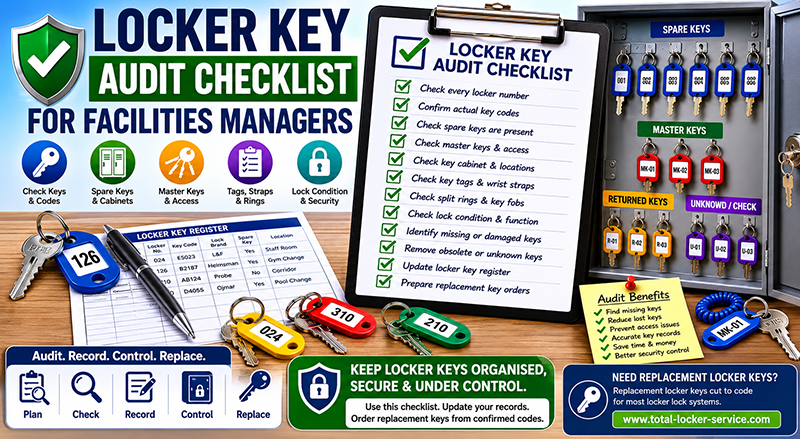
A locker key audit helps facilities managers check whether locker keys, spare keys, master keys, key codes, tags, wrist straps and locks are still under control. It is a practical way to find missing keys, worn keys, stiff locks, outdated records and replacement key requirements before they become urgent access problems.
For schools, gyms, workplaces, universities, healthcare sites and leisure centres, a regular locker key audit can reduce lost key issues, prevent wrong replacement orders and keep lockers available for users. It also helps staff decide when a replacement key is enough and when a lock should be repaired or replaced.
This guide gives facilities managers a clear locker key audit checklist, including what to check, how often to check it, what records to update and how to prepare replacement locker key orders from confirmed key codes.
This article supports our main Locker Keys UK replacement and key management guide. For direct ordering, use Total Locker Service for replacement locker keys cut to code.

Quick Answer: What Should a Locker Key Audit Include?
A locker key audit should check every visible locker number, actual key code, spare key, master key, key cabinet position, key tag, wrist strap, lock brand, issued user record and lock condition. The audit should also identify missing keys, damaged keys, stiff locks, unclear codes and replacement key requirements.
The most important audit rule is to record the visible locker number and the actual key code separately. The locker number helps users find the locker. The key code identifies the lock and is normally used to order replacement locker keys cut to code.
After the audit, update the locker key register, secure spare keys in the key cabinet, restrict master key access and prepare replacement key orders only from confirmed key codes.
For the register structure, read how to build a locker key register.
Why Locker Key Audits Matter
Locker key systems often become inaccurate slowly. A few keys are lost. A few locks are changed. A spare key is borrowed and not returned. A tag is replaced with the wrong number. A locker door number is mistaken for a key code. Over time, the site loses confidence in its own records.
A locker key audit finds these problems before they cause delays. It gives facilities managers a clear view of which lockers are ready for use, which keys need replacing and which locks need maintenance.
- Missing keys can be identified before users need them.
- Spare key cabinets can be rebuilt and corrected.
- Wrong key records can be removed.
- Damaged or worn keys can be replaced early.
- Stiff locks can be repaired before keys snap.
- Master keys can be checked and secured.
- Bulk replacement key orders can be prepared accurately.
- Facilities staff can avoid unnecessary lock changes.
A good audit does not only count keys. It checks the whole control chain: locker number, key code, key condition, lock condition, spare key storage, master key access and replacement ordering process.
How Often Should Locker Keys Be Audited?
The right audit frequency depends on the site. High-use lockers need more frequent checks than low-use staff lockers. Wet changing rooms need extra attention because keys, tags, straps and locks can wear faster.
| Site type | Suggested audit frequency | Why |
|---|---|---|
| Schools | End of term and end of academic year | Keys are issued and returned in cycles. |
| Gyms | Monthly or during changing room checks | High turnover and frequent member use. |
| Leisure centres | Monthly, with extra wet-area checks | Moisture, wrist straps and heavy public use increase wear. |
| Workplaces | Quarterly, annually and during leaver checks | Staff changes can create missing keys. |
| Universities | Before new allocation periods and annually | Large key schedules need planned control. |
| Healthcare sites | Quarterly or during facilities reviews | Staff changing areas need reliable controlled access. |
Any site should also audit locker keys after a refurbishment, locker relocation, lock replacement programme, staff change, end-of-year clearance or repeated lost key problem.
What to Prepare Before the Audit
Before starting the audit, gather the current records and access tools. This prevents staff from walking the site without the information needed to correct errors.
- The current locker key register.
- The key cabinet or spare key board.
- Any master keys or master key records.
- Previous replacement key orders.
- Lock brand information where available.
- A list of locker locations or locker banks.
- Tags, split rings or wrist straps for quick replacement.
- A camera or phone for unclear codes and damaged locks.
- A clear way to mark missing, damaged or uncertain records.
The audit should produce an updated register, not just a list of faults. Every confirmed correction should be recorded as the audit progresses.
Locker Key Register Check
The locker key register is the core audit document. It should show the visible locker number, actual key code, lock brand, location, issued user or department, spare key status, master key group and notes.
Facilities managers should check whether the register matches the real locker estate. A register that has not been updated after lock changes may cause wrong replacement key orders.
| Register field | Audit question | Action if wrong |
|---|---|---|
| Locker number | Does the visible locker number match the record? | Correct the visible number or update the register. |
| Key code | Is the actual key code recorded? | Check key, lock face, barrel or previous order records. |
| Lock brand | Is the lock brand known? | Add brand or mark as unknown with photos. |
| Location | Is the locker area correct? | Update building, room, corridor or changing room. |
| Issued user | Is the key still issued to the correct person or group? | Update issue and return status. |
| Spare key | Is the spare key present? | Mark missing and add to replacement list. |
| Master key group | Is the master key group recorded? | Add group reference or check compatibility. |
| Notes | Are lock faults or changes recorded? | Add repair, replacement or uncertainty notes. |
For a deeper register structure, read how to build a locker key register.
Key Code and Locker Number Check
The audit must separate the visible locker number from the actual key code. This is one of the most important checks in the whole process.
The visible locker number is usually on the door, key tag, number disc or wrist strap. It helps users find the locker. The actual key code may be stamped on the key, shown on the lock face, marked on the barrel or recorded in supplier paperwork. It is normally used to cut replacement locker keys.
| Visible locker number | Actual key code | Audit result | Replacement order code |
|---|---|---|---|
| 024 | E5023 | Different numbers | E5023 |
| 126 | B2187 | Different numbers | B2187 |
| 210 | AB124 | Different numbers | AB124 |
| 310 | 310 | Same only if confirmed | 310 |
Do not order replacement keys from locker door numbers unless the audit confirms that the door number is also the key code. For the full explanation, read locker key numbers vs locker door numbers.
Spare Key Check
Spare keys help staff restore access after lost keys, forgotten keys, broken keys or user changes. During the audit, check that every recorded spare key is present and usable.
- Check whether each spare key is present.
- Check the spare key tag matches the visible locker number.
- Check the actual key code is recorded separately.
- Check whether the spare key turns smoothly in the correct lock.
- Remove bent, worn or damaged spare keys from active use.
- Mark missing spare keys clearly.
- Add missing spare keys to the replacement order list.
- Return spare keys to the correct cabinet position after testing.
Spare keys should be useful, not decorative. A spare key that cannot be found or does not work is not a controlled spare.
Master Key Check
Master keys need stricter audit control than ordinary spare keys. A master key may open several compatible locker locks, so a missing master key can create a wider access risk.
The audit should confirm that each master key exists, is stored securely, is restricted to authorised staff and matches the recorded master key group.
- Check every master key is present.
- Check master keys are stored separately or in a restricted section.
- Check which locker group each master key opens.
- Check authorised staff access.
- Check sign-out records where used.
- Check whether any locks have been replaced outside the master-keyed group.
- Investigate missing master keys immediately.
- Update the register after any change.
For more detail, read locker master keys explained.
Key Cabinet Check
The key cabinet should match the register. Every hook, key tag and cabinet section should have a clear purpose.
Do not allow old, damaged, unknown and active spare keys to sit together without labels. This creates errors during busy lost key incidents.
- Check every cabinet hook or position.
- Check spare keys are in the correct location.
- Separate active, returned, damaged and unknown keys.
- Check master keys are restricted.
- Remove obsolete keys after lock changes.
- Check tags are readable.
- Check split rings are strong.
- Check cabinet access is limited to authorised staff.
- Update the key register to match the cabinet.
For cabinet setup, read key cabinets for managing locker keys.
Tags, Number Discs and Wrist Straps Check
Key accessories are a major cause of lost locker keys. A key may be sound, but the tag, ring or wrist strap may fail first. Facilities managers should include these items in the audit.
- Check key tags for cracks or fading.
- Check number discs are readable.
- Check wrist straps for stretching, splitting or brittleness.
- Check split rings for weakness or gaps.
- Replace damaged accessories before keys are reissued.
- Check tag numbers match visible locker numbers.
- Record actual key codes separately.
- Check wet-area accessories more frequently.
Gyms and leisure centres should pay special attention to wrist straps because changing room moisture and heavy use can weaken them over time.
For accessory guidance, read locker key tags, number discs and wrist straps explained.
Lock Condition Check
A key audit should also check lock condition. Ordering a replacement key will not solve a damaged or stiff lock. If several keys feel stiff in the same lock, the lock is likely to be the problem.
- Check whether the key enters smoothly.
- Check whether the lock turns without force.
- Check whether the barrel is loose.
- Check whether the cam secures the door.
- Check whether the keyway is worn, blocked or damaged.
- Check for corrosion in wet areas.
- Check whether the door is aligned.
- Record stiff locks in the register.
- Replace the key when the key is worn.
- Replace the lock when the lock is damaged or unreliable.
For lock-condition decisions, read worn locker keys and stiff locks: repair or replace?. For snapped keys, read broken locker key: what to do before replacing the lock.
Prepare a Replacement Key Order List
After the audit, prepare a replacement key order list from confirmed key codes. This is where the audit turns into action.
The order list should include the actual key code, visible locker number, lock brand, location, quantity and notes. Separate confirmed codes from unclear codes.
| Locker number | Key code | Lock brand | Location | Quantity | Notes |
|---|---|---|---|---|---|
| 024 | E5023 | Lowe & Fletcher | Staff changing | 2 | Spare missing |
| 126 | B2187 | Helmsman | Gym changing | 1 | Confirmed from key |
| 210 | AB124 | Probe | School corridor | 3 | End-of-term missing keys |
| 310 | D4055 | Ojmar | Pool changing | 2 | Check photo |
If the lock still works and the correct key code is known, a replacement key can often be cut to code. If the lock is damaged, stiff, corroded or impossible to identify, lock replacement may be more suitable.
For bulk ordering, read bulk replacement locker keys for schools and workplaces. For ordering mistakes, read common mistakes when ordering locker keys.
Locker Key Audit Checklist by Sector
The core audit process is the same across most sites, but each sector has different risk points.
| Sector | Main audit focus | Useful guide |
|---|---|---|
| Schools | End-of-term returns, pupil records, missing keys and damaged tags | Reduce lost locker keys in schools |
| Gyms | Wrist straps, member lost keys, changing room checks and spare keys | Reduce lost locker keys in gyms |
| Leisure centres | Wet-area straps, tags, split rings, corrosion and public-use lockers | Leisure centre locker keys |
| Workplaces | Staff leavers, department moves, PPE lockers and spare key storage | Staff locker keys |
| Universities | Building-level schedules, duplicate locker numbers and department ownership | University locker keys |
| Healthcare | Staff changing rooms, secure storage, controlled access and role changes | Healthcare locker keys |
School Locker Key Audit
Schools should audit locker keys before reissuing lockers and at the end of term or academic year. The audit should check pupil returns, missing keys, damaged tags and whether replacement keys are needed before the next allocation period.
- Check returned keys against pupil records.
- Mark missing keys before pupils leave.
- Check year group or tutor group return lists.
- Replace cracked or faded tags.
- Check spare keys and master keys.
- Prepare bulk replacement orders from confirmed codes.
For school guidance, read school locker keys: replacement and key control guide.
Gym and Leisure Locker Key Audit
Gyms and leisure centres should audit locker keys regularly because keys, straps and tags are handled daily. Wet areas should be checked more often because moisture and cleaning routines can increase wear.
- Check wrist straps for cracks and stretching.
- Check split rings for weakness.
- Check number tags and discs are readable.
- Check spare keys for changing room lockers.
- Check wet-area locks for stiffness or corrosion.
- Record repeated lost key incidents by locker area.
For gym guidance, read gym locker keys: replacement, wrist straps and member access.
Workplace and Healthcare Locker Key Audit
Workplaces and healthcare sites should focus on staff issue records, leaver returns, department changes and secure spare key control. Lockers used for uniforms, PPE or changing rooms should be kept reliable.
- Check issued staff keys against current staff records.
- Check leaver return status.
- Check spare keys and master keys are controlled.
- Check staff lockers with repeated access issues.
- Replace worn keys before they snap.
- Update records after department or role changes.
For related guidance, read locker keys: staff storage and replacement process and healthcare locker keys: staff storage and secure control.
University and Large-Site Locker Key Audit
Universities and large estates should audit by building, department, locker bank and lock type. Large sites often have duplicate visible locker numbers in different buildings, so location records are essential.
- Group audit records by campus, building or department.
- Check duplicate locker numbers carefully.
- Record lock brand and key code by location.
- Check local key cabinets and central records.
- Check department ownership.
- Standardise register fields across the estate.
For large-site guidance, read university locker keys: managing large key schedules.
Common Locker Key Audit Mistakes
A locker key audit can fail if it only counts keys but does not correct the underlying records. Facilities managers should avoid these common mistakes.
- Counting key tags without checking actual key codes.
- Using locker numbers as replacement key codes without confirmation.
- Ignoring lock condition.
- Leaving damaged spare keys in the cabinet.
- Failing to check master keys separately.
- Not updating the register after lock replacement.
- Mixing active, damaged and unknown keys.
- Not checking wet-area wrist straps and split rings.
- Ordering replacements from unclear codes.
- Failing to test replacement keys when they arrive.
The audit should leave the site more accurate than it was before. If records are not updated, the same problems will return.
Full Locker Key Audit Checklist
- List every locker location.
- Check every visible locker number.
- Check actual key codes where possible.
- Record lock brands where known.
- Check key tags, number discs and wrist straps.
- Check split rings and fittings.
- Check spare keys are present and usable.
- Check master keys separately.
- Check key cabinet positions.
- Remove damaged keys from active use.
- Separate unknown keys for identification.
- Check locks for stiffness, corrosion and damage.
- Check whether doors and cams close correctly.
- Record missing keys clearly.
- Prepare replacement orders from confirmed key codes.
- Replace locks where the lock is damaged or insecure.
- Update the locker key register after every correction.
- Review who has access to key cabinets and master keys.
- Schedule the next audit.
Audit Outcome Table
| Audit finding | Best action | Useful guide |
|---|---|---|
| Key missing but code known | Order replacement key cut to code | Replacement keys cut to code |
| Locker number and key code differ | Record both fields separately | Key number vs door number |
| Spare key missing from cabinet | Add to replacement order list | Key cabinets guide |
| Master key missing | Investigate and review access risk | Master keys explained |
| Key is bent or worn | Replace key before it snaps | Worn keys and stiff locks |
| Lock is stiff or damaged | Repair or replace lock | Broken locker key guide |
| Many keys missing | Prepare bulk order from confirmed codes | Bulk replacement keys |
| Tags or straps failing | Replace accessories before keys are lost | Key tags and wrist straps |
Related Locker Key Guides
This article is part of the locker keys canister. Use these guides to support audits, key records, replacement orders, spare key storage and long-term locker key control.
- Locker Keys UK: Replacement, Cut-to-Code Ordering and Key Management Guide
- How to Build a Locker Key Register
- Key Cabinets for Managing Locker Keys
- Locker Master Keys Explained
- Replacement Locker Keys Cut to Code: What It Means
- Bulk Replacement Locker Keys for Schools and Workplaces
- Common Mistakes When Ordering Locker Keys
- Where to Find a Locker Key Number or Lock Code
- Locker Key Numbers vs Locker Door Numbers
- Locker Key Tags, Number Discs and Wrist Straps Explained
- Lost Locker Key? What Schools, Gyms and Workplaces Should Do
- Broken Locker Key: What to Do Before Replacing the Lock
- Worn Locker Keys and Stiff Locks: Repair or Replace?
- How to Reduce Lost Locker Keys in Schools
- How to Reduce Lost Locker Keys in Gyms
- School Locker Keys: Replacement and Key Control Guide
- Gym Locker Keys: Replacement, Wrist Straps and Member Access
- Locker Keys: Staff Storage and Replacement Process
- University Locker Keys: Managing Large Key Schedules
- Healthcare Locker Keys: Staff Storage and Secure Control
Ordering Replacement Locker Keys After an Audit
A locker key audit should make replacement ordering easier and more accurate. If the lock still works and the correct key code is known, a replacement locker key can often be cut to code without replacing the full lock.
Before ordering, confirm the key code, lock brand, visible locker number, location and quantity required. If the code is unclear, take clear photographs of the lock face, keyway, key and any markings.
For direct ordering, visit Total Locker Service: Locker Keys and Replacement Locker Keys.
Locker Key Audit Checklist FAQs
What is a locker key audit?
A locker key audit is a check of locker numbers, key codes, spare keys, master keys, key cabinets, key tags, lock condition and replacement key records.
How often should locker keys be audited?
The frequency depends on the site. Schools often audit at term end, gyms may audit monthly, and workplaces may audit during leaver checks or annual facilities reviews.
What should a locker key audit checklist include?
It should include visible locker numbers, actual key codes, lock brands, spare keys, master keys, key cabinet positions, tags, wrist straps, lock condition and replacement requirements.
Is the locker number the same as the key code?
Not always. The locker number identifies the visible locker door. The key code identifies the lock and is used to cut a replacement locker key.
Should master keys be included in a locker key audit?
Yes. Master keys should be checked separately because they may open multiple compatible locker locks and need stronger control than ordinary spare keys.
Can replacement locker keys be ordered after an audit?
Yes. Replacement locker keys can often be ordered after an audit when the correct key number or lock code is confirmed and the lock still works.
What should facilities managers do if a lock is stiff during an audit?
Facilities managers should stop forcing the key, check whether the key or lock is the issue, record the fault and repair or replace the lock if it is damaged or unreliable.