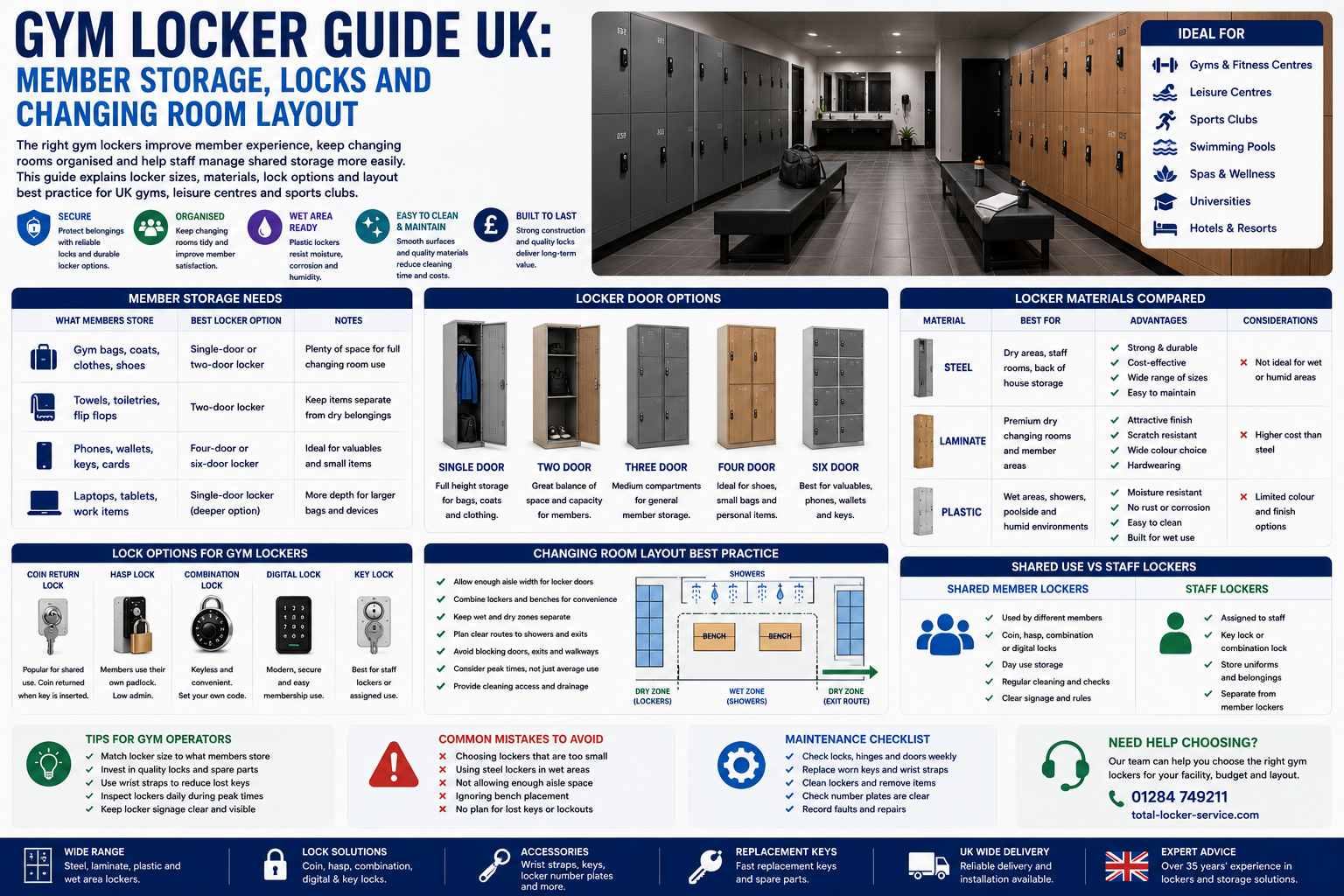
Gym lockers help members store bags, coats, shoes, towels, phones, wallets, keys and personal belongings while they train, shower or use the changing room. The right locker system improves member experience, keeps changing areas organised and helps staff manage shared storage more easily.
Gym lockers should not be chosen by appearance alone. A good gym locker needs the right size, material, door option, lock type and layout. It must suit how members move through reception, changing rooms, showers, gym floors, studios, pools and exit routes. It also needs to be easy to clean, maintain and manage during busy periods.
This UK guide explains how to choose gym lockers for member storage, shared use, changing rooms, wet areas and staff management. It covers locker sizes, lock options, materials, member flow, bench spacing, wet and dry zones, maintenance and common planning mistakes.
Quick answer: what gym lockers do you need?
Most gym changing rooms need lockers large enough for bags, shoes, clothing and towels. Single-door or two-door lockers are usually best for full member storage. Four-door and six-door lockers work well for valuables, phones, wallets and keys, but they are usually too small for full changing room storage.
For dry gym areas, steel or laminate lockers may be suitable. For wet or shower-adjacent changing rooms, plastic or wet-area lockers are usually a better long-term choice. For shared member use, coin return locks, hasp locks, combination locks or digital locks are often more practical than assigned key locks.
| Gym locker need | Best starting option | Why |
|---|---|---|
| Full changing room storage | Single-door or two-door lockers | Enough room for bags, shoes, clothes and towels |
| Small valuables storage | Four-door or six-door lockers | Compact storage for phones, wallets and keys |
| Wet changing room | Plastic or wet-area lockers | Better moisture and corrosion resistance |
| Dry premium gym area | Laminate lockers | Smart finish for member-facing spaces |
| Dry staff or back-of-house storage | Steel lockers | Strong, practical and cost-effective |
| Shared member use | Coin, hasp, combination or digital locks | Better suited to changing users |
This gym locker guide should sit under the wider lockers UK guide and link sideways to wet-area, plastic locker, lock option, size and door option guides. It should target gym and member-storage intent rather than broad “lockers” searches.
What are gym lockers?
Gym lockers are secure storage lockers used by gym members, visitors, staff and sometimes contractors. They are usually placed in changing rooms, reception areas, corridors, staff rooms, studios, spa areas or near activity zones. Their purpose is to keep personal belongings safe and changing areas organised while people use the facility.
Gym lockers can be full-height, half-height or multi-compartment. They may be made from steel, laminate, plastic or specialist wet-area materials. They can be fitted with key locks, coin locks, hasp locks, combination locks or digital locks. The best choice depends on whether the lockers are for members, visitors, staff, wet areas or valuables only.
A gym often needs more than one locker type. Large lockers may be used in changing rooms. Small lockers may be placed near reception for valuables. Staff lockers may be kept separate from member lockers. Wet changing areas may need plastic lockers, while dry staff areas may use steel lockers.
Why gym lockers matter
Gym lockers affect the member experience from the moment someone arrives. Members need somewhere safe to leave belongings before training. If lockers are too small, unreliable, badly placed or difficult to use, the changing room feels frustrating. If locks fail or keys are often lost, staff spend more time dealing with avoidable problems.
Good locker planning also improves room flow. Busy gyms often have peak periods before work, after work and at weekends. During these times, changing rooms can become crowded. Lockers, benches, showers and circulation routes need to work together so members can move easily through the space.
- Improves member confidence and convenience.
- Keeps bags and belongings out of walkways.
- Supports safe changing room movement.
- Reduces lost property and abandoned items.
- Helps staff manage shared storage.
- Protects phones, wallets, keys and clothing during workouts.
- Improves the appearance and organisation of changing areas.
Member storage needs
Before choosing gym lockers, list what members actually bring into the facility. A member may carry a gym bag, coat, trainers, towel, toiletries, phone, wallet, car keys, headphones and work clothing. Some members arrive before work and need to store office clothes. Others visit after work and need space for a laptop bag or backpack.
Small lockers can be useful, but they should not replace full changing room lockers where members need larger storage. A phone locker or valuables locker is not the same as a locker for bags, shoes and towels.
| Member item | Locker requirement | Best locker type |
|---|---|---|
| Gym bag | Medium to large compartment | Single-door or two-door locker |
| Coat and work clothes | Full-height or larger storage | Single-door locker |
| Shoes and trainers | Medium compartment with practical depth | Two-door locker |
| Towel and toiletries | Storage suitable for damp items | Plastic or wet-area locker in wet zones |
| Phone, wallet and keys | Small secure compartment | Four-door or six-door locker |
| Laptop bag | Larger compartment and secure lock | Single-door or deeper two-door locker |
The strongest locker layout often mixes full-size member lockers with smaller valuables lockers. This gives members the right storage for different needs without wasting larger compartments on small items.
Gym locker sizes
Gym locker size should follow the storage need. In changing rooms, members usually need enough space for clothing, shoes, towels and a bag. In reception areas, small-item storage may be enough. In staff rooms, employees may need separate lockers for uniforms and personal belongings.
Depth is especially important. A shallow locker may look suitable from the front but may not fit a gym bag comfortably. A deeper locker can be easier to use, but it needs more aisle space. Always plan locker size with changing room layout.
| Locker size choice | Best gym use | Watch point |
|---|---|---|
| Full-height locker | Coats, bags, work clothing and larger member storage | Uses more wall space per user |
| Two-door locker | General changing room storage | May not suit long coats or bulky bags |
| Four-door locker | Shoes, small bags and compact personal items | Too small for full changing use |
| Six-door locker | Phones, wallets, keys and valuables | Very limited compartment size |
| Deeper locker | Gym bags, coats and larger items | Needs adequate aisle clearance |
For detailed dimension planning, link this page to the locker size guide. The gym page should explain the member-use case, while the size guide should handle height, width, depth and compartment detail.
Gym locker door and compartment options
Locker door configuration controls how much space each member receives. Single-door lockers provide the most room. Two-door lockers give a strong balance between member capacity and storage space. Four-door and six-door lockers are best for compact storage and valuables.
For most gym changing rooms, single-door or two-door lockers are the safest starting point. Members need enough room for shoes, clothes, towels and bags. Smaller multi-door lockers can be placed near reception, studios or activity zones for phones and valuables.
| Door option | Best gym use | Not ideal for |
|---|---|---|
| Single-door locker | Full changing room storage, coats and larger bags | High-density small-item storage |
| Two-door locker | General member storage in changing rooms | Long coats or very bulky bags |
| Three-door locker | Medium-small personal storage | Full changing-room use with large bags |
| Four-door locker | Shoes, small bags and valuables | Coats, towels and gym bags |
| Six-door locker | Phones, wallets, keys and small items | Member changing storage |
For a fuller comparison, link this article to the locker door options guide. Gym locker planning should use the door guide as a specification support page.
Gym locker materials
Gym lockers can be made from steel, laminate, plastic or specialist wet-area materials. The right material depends on moisture level, appearance, cleaning routine and budget.
Steel lockers can work well in dry staff areas, offices and back-of-house spaces. Laminate lockers are useful where the gym wants a premium changing room finish. Plastic lockers are usually best for wet, humid or shower-adjacent areas because they resist moisture and do not have a steel body that can rust.
| Material | Best gym use | Main advantage |
|---|---|---|
| Steel lockers | Dry staff rooms and dry gym storage | Strong, practical and cost-effective |
| Laminate lockers | Premium dry changing rooms and member-facing interiors | Smart finish and strong visual appeal |
| Plastic lockers | Wet changing rooms, showers, pools and humid areas | Moisture and corrosion resistance |
For broader material comparison, use the locker materials guide. For wet leisure settings, link this page to the plastic locker guide and wet area locker guide.
Gym locker lock options
Gym locker locks should suit shared use. Most member lockers are used by different people throughout the day, so assigned key locks are not always the best option. The lock must be simple for members, manageable for staff and suitable for the environment.
Coin return locks are familiar in gyms, pools and leisure centres. Hasp locks work where members bring their own padlocks. Combination locks reduce physical key handling. Digital locks can suit premium gyms and modern facilities where staff can manage batteries, codes or access credentials.
| Lock type | Best gym use | Management note |
|---|---|---|
| Coin return lock | Shared member changing rooms | Encourages key return but needs coin and key management |
| Hasp lock | Members bring their own padlocks | Low admin, but padlock quality varies |
| Combination lock | Keyless gym storage | Forgotten codes need reset support |
| Digital lock | Premium gyms and modern shared-use lockers | Needs battery, override or access management |
| Key lock | Assigned staff lockers or controlled storage | Less ideal for high-turnover member use |
For a full lock comparison, see locker locks by type. For lost or replacement keys, see replacement locker keys. For pool and leisure key handling, see locker key wrist straps.
Shared-use gym lockers
Most gym member lockers are shared-use lockers. One member uses the locker for a workout or visit, then another member uses it later. This means the locker system must handle changing users, forgotten items, lost access and abandoned lockers.
Shared-use lockers need clear rules. Members should know whether lockers are day-use only, whether items can be left overnight and what happens if a locker is abandoned. Staff should have a clear override process for lost keys, forgotten codes, jammed coin locks or padlocks left on lockers.
- Use clear signage for locker use.
- Decide whether lockers are day-use only.
- Plan staff override access.
- Check lockers regularly for abandoned items.
- Choose locks that staff can support quickly.
- Keep records of recurring lock faults.
- Inspect shared lockers more often than assigned lockers.
Shared-use locker planning should also consider peak demand. A gym may have enough lockers on average but not enough during peak evening use. Layout, locker count and compartment size should be planned around the busiest times.
Gym changing room layout
Gym changing room layout should support smooth movement from entry to locker, bench, shower, gym floor and exit. Lockers should not create bottlenecks or block routes. Members need room to open doors, remove coats, take shoes off, access bags and move around others.
Plan lockers, benches and circulation together. A locker bank may fit along a wall, but still feel cramped if doors open into narrow aisles or benches block lower compartments. The best layout is based on real member behaviour, not just maximum locker count.
- Place lockers where members naturally pass through the changing room.
- Allow enough aisle space for open locker doors.
- Keep benches close enough to be useful but not so close that they block doors.
- Separate wet and dry movement where possible.
- Do not block emergency routes, doors or main circulation paths.
- Plan for busy periods, not only quiet times.
- Allow cleaning access around locker bases and corners.
For more detailed space planning, link this article to the locker planning guide and the locker size guide. Gym layout depends on both locker dimensions and room flow.
Wet and dry zones in gym locker rooms
Gym changing rooms often contain both wet and dry zones. Dry zones may include entrance areas, lockers, benches and changing spaces. Wet zones may include showers, pool access, spa areas and damp towel routes. The locker material and layout should reflect these zones.
Start by mapping the wet and dry routes through the changing room. First, identify the entrance, shoe-changing area, showers, benches, locker banks and exit route. Then check how wet users and dry users move through the space. Lockers should support that flow, not fight it.
Where lockers sit close to showers or pool access, plastic or wet-area lockers are usually safer than standard steel. In dry member-facing areas, laminate may be chosen for appearance. In staff-only dry zones, steel may offer better value.
Staff lockers in gyms
Gym staff lockers should usually be separate from member lockers. Staff may need assigned storage for uniforms, personal belongings, shoes, keys, radios, cleaning equipment or work items. Staff lockers often need a different lock and management process from member lockers.
For staff areas, key locks or combination locks may be suitable. The locker size should match staff uniforms, coats and bags. If the staff area is dry, steel lockers may be practical. If staff lockers are in wet or humid areas, plastic lockers may be better.
For more detail, link to the staff lockers guide and workplace lockers page.
Gym locker maintenance and key management
Gym lockers need regular maintenance because they are used frequently by many people. Shared lockers, wet areas and high-traffic changing rooms usually need more checks than quiet workplace lockers.
Maintenance should include doors, hinges, locks, keys, wrist straps, number plates, vents, bases and compartment condition. Staff should also check for abandoned items, damaged locks, missing keys and damp or dirty compartments.
- Check locks open and close smoothly.
- Replace damaged wrist straps and worn keys.
- Check coin locks for jams and return issues.
- Reset or support forgotten combination locks.
- Replace missing or unclear locker numbers.
- Inspect doors and hinges for damage.
- Clean compartments and remove abandoned items.
- Record repeated faults and plan replacement parts.
For aftercare, link this page to the locker maintenance guide and locker estate management guide. Gyms should treat lockers as a managed asset, especially where many members use them every day.
Common gym locker mistakes
Most gym locker problems come from choosing lockers for the room on paper rather than how members use the space. A layout may hold many compartments, but still feel cramped or frustrating if the compartments are too small or the lock system is hard to manage.
- Using small valuables lockers for full changing room storage.
- Choosing steel lockers in wet or shower-adjacent areas.
- Installing lockers without enough aisle or bench space.
- Forgetting that members bring bags, coats, towels and shoes.
- Choosing locks without an override or support process.
- Using too many different lock types in one facility.
- Not checking lockers during peak-use periods.
- Failing to replace damaged wrist straps or keys.
- Not separating staff lockers from member lockers.
- Ignoring cleaning access and ventilation.
The best approach is to plan by user journey. Follow the member from arrival to storage, changing, training, showering and exit. The locker system should make that route easier.
How to choose gym lockers
Use this process before ordering lockers for a gym, fitness centre, leisure centre or changing room.
- Define the users. Separate members, visitors, staff and contractors.
- List the stored items. Include bags, coats, towels, shoes, phones, wallets and keys.
- Map the room. Check entrances, benches, showers, wet zones, dry zones and exits.
- Choose the material. Use plastic for wet areas, laminate for premium dry areas and steel for dry staff or back-of-house areas.
- Choose the door option. Use larger lockers for changing rooms and smaller lockers for valuables.
- Select the lock type. Match coin, hasp, combination, digital or key locks to member use.
- Plan peak capacity. Check busy periods, not only average daily use.
- Plan maintenance. Record keys, locks, wrist straps, number plates and repeated faults.
If members need full changing room storage, start with single-door or two-door lockers. If members only need valuables storage, use smaller multi-door lockers. If the area is wet or humid, make material suitability the first decision.
Internal links for this gym locker guide
This page should sit below the wider leisure and lockers canister. It should link upwards to the main lockers route and sideways to the wet-area, plastic locker, size, door, lock and maintenance guides.
| Reader need | Recommended link | Anchor text |
|---|---|---|
| Browse gym and leisure lockers | Leisurelockers.php | leisure lockers |
| Browse all lockers | Lockers.php | commercial lockers |
| Choose staff storage | worklockers.php | workplace lockers |
| Choose school storage | schoollockers.php | school lockers |
| Choose powered storage | Charging.php | charging lockers |
| Choose lock types | LockerLockbytype.php | locker locks by type |
| Order replacement keys | Locker-keys.php | replacement locker keys |
| Order wrist straps | wrist-straps.php | locker key wrist straps |
Use varied hub-facing anchors across the wider canister. Suitable examples include complete lockers guide, lockers UK guide, choosing lockers for UK sites and main locker buying guide.
Final recommendation
Gym lockers should be planned around the member journey. Members need enough space for bags, shoes, clothing, towels and valuables. Staff need a lock system they can manage. Changing rooms need clear routes, suitable materials, good cleaning access and enough space for doors, benches and movement.
For most gym changing rooms, single-door or two-door lockers are the best starting point. Four-door and six-door lockers are useful for valuables. Plastic lockers are usually best for wet and humid areas. Laminate lockers can improve premium dry changing rooms. Steel lockers can work well in dry staff or back-of-house areas.
Total Locker Service supplies gym lockers, leisure lockers, plastic lockers, locker locks, replacement keys, wrist straps and accessories for UK gyms, swimming pools, leisure centres, sports clubs and commercial changing rooms. Browse leisure lockers, view commercial lockers, or call 01284 749211 for help choosing the right gym locker system.
Gym locker FAQs
What lockers are best for gyms?
The best gym lockers depend on the area. Single-door or two-door lockers are usually best for changing rooms. Four-door and six-door lockers are useful for valuables. Plastic lockers are best for wet areas, while laminate lockers can suit premium dry changing rooms.
What size should gym lockers be?
Gym lockers should be large enough for bags, shoes, clothing and towels. Full-height or two-door lockers are usually more practical for changing rooms than small multi-door lockers. Smaller lockers are better for phones, wallets and keys.
Are plastic lockers good for gyms?
Plastic lockers are a good choice for wet or humid gym changing rooms, especially near showers, pools and spa areas. Dry gym areas may also use steel or laminate lockers depending on appearance, use and budget.
What lock type is best for gym lockers?
Coin return locks, hasp locks, combination locks and digital locks can all work for gym lockers. The best option depends on whether members bring padlocks, whether the lockers are shared and how staff manage lost access.
Are key locks suitable for gym lockers?
Key locks can be suitable for staff lockers or assigned lockers, but they are often less practical for high-turnover shared member lockers. Coin, hasp, combination or digital locks may be better for member use.
Should gym lockers be shared-use?
Most member gym lockers are shared-use because different people use them throughout the day. Shared-use lockers need clear rules, staff override access and regular checks for abandoned items.
How should gym lockers be laid out?
Gym lockers should be laid out with enough aisle space, door clearance and bench access. They should support the member route from entry to locker, bench, shower, gym floor and exit without causing congestion.
Are steel lockers suitable for gyms?
Steel lockers can be suitable for dry gym areas and staff rooms. They are usually less suitable for wet, humid or shower-adjacent areas where plastic or wet-area lockers may last longer.
Do gyms need separate staff lockers?
Yes, many gyms benefit from separate staff lockers. Staff may need assigned storage for uniforms, personal belongings, radios, keys or work items, and this is usually different from shared member storage.
Who supplies gym lockers in the UK?
Total Locker Service supplies gym lockers, leisure lockers, plastic lockers, locker locks, replacement keys, wrist straps and accessories for UK gyms, leisure centres, swimming pools, sports clubs and commercial changing rooms.
“`