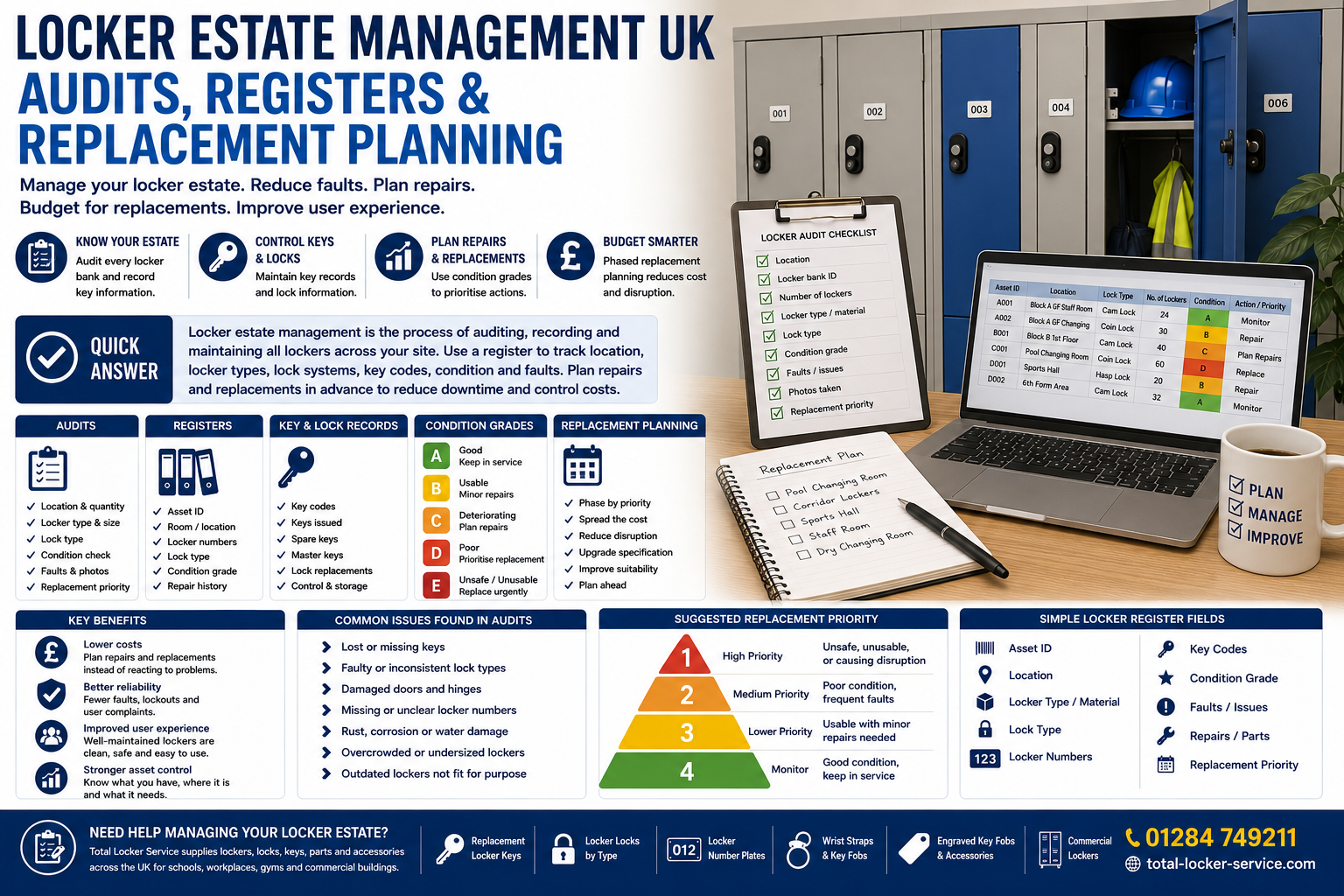
Locker estate management is the organised control of lockers across a workplace, school, leisure centre, healthcare site, warehouse, university or commercial building. It covers the full locker system, not just individual locker faults. A good locker estate plan records what lockers you have, where they are, who uses them, what condition they are in and when they may need repair or replacement.
Many sites only think about lockers when something goes wrong. A key is lost. A lock fails. A door drops. A compartment number goes missing. A changing room becomes overcrowded. Over time, these small issues become a bigger management problem. An estate-level approach prevents that drift.
This UK guide explains how to manage a locker estate using audits, registers, condition checks, spare parts records and replacement planning. It is designed for facilities managers, school business managers, estates teams, leisure centre operators, site managers and organisations that manage lockers across several rooms, departments or buildings.
Quick answer: how do you manage a locker estate?
Manage a locker estate by creating a register of every locker bank, recording the location, locker numbers, material, lock type, key codes, condition, faults and replacement priority. Carry out regular audits, track repairs, keep spare keys and parts controlled, and plan replacements before lockers become unsafe, unusable or unsuitable for the site.
The best locker estate systems are simple. They do not need complex software to begin with. A clear spreadsheet or asset register can work well if it is kept up to date. The important point is consistency. Each locker bank should be identifiable, inspectable and linked to a maintenance or replacement decision.
| Management area | What to record | Why it matters |
|---|---|---|
| Locker location | Building, floor, room, department or changing area | Helps teams find and manage each locker bank |
| Locker quantity | Number of doors, compartments and banks | Shows total storage capacity |
| Locker type | Material, size, door format and use | Helps with repair and replacement planning |
| Lock type | Cam lock, hasp, coin lock, combination or electronic lock | Supports key control and lock replacement |
| Condition | Good, fair, poor or replace | Creates a clear maintenance priority |
| Faults | Lost keys, damaged locks, bent doors, rust or missing numbers | Prevents repeated complaints and unmanaged decline |
| Replacement priority | Now, within 12 months, within 2–3 years or monitor | Supports budgeting and phased upgrades |
What is locker estate management?
Locker estate management means managing all lockers across a site as one controlled asset group. Instead of treating every broken key, faulty lock or damaged door as a separate issue, the site records the full locker estate and manages it over time.
A locker estate may be small or large. A single office may have one bank of staff lockers. A school may have corridor lockers, changing room lockers, staff lockers and sixth form lockers. A leisure centre may have pool lockers, dry changing lockers, staff lockers and valuables lockers. A warehouse may have shift lockers, PPE lockers, charging lockers and tool storage.
The larger the site, the more important the register becomes. Without one, locker management becomes reactive. Nobody knows how many lockers are in service, which locks are fitted, which keys are missing or which banks are due for replacement.
Why locker estate management matters
Lockers are often treated as fixed furniture, but they behave more like operational assets. They are used daily, damaged gradually and repaired repeatedly. They affect staff welfare, student storage, member experience, site security, changing room flow and workplace organisation.
When a locker estate is unmanaged, problems build quietly. Lockers remain in service with missing keys. Staff stop using broken compartments. Spare locks are ordered without knowing the correct type. Different departments buy different lock systems. Some banks are overused while others are underused. Replacement decisions become urgent instead of planned.
A managed locker estate gives the site control. It shows what exists, what works, what needs repair and what should be replaced. That makes budgeting easier and reduces emergency decisions.
- Reduces lost-key and lockout problems.
- Improves repair planning and spare parts control.
- Helps identify lockers that are no longer suitable.
- Supports phased replacement instead of sudden large spend.
- Improves user experience in staff, student and visitor areas.
- Helps facilities teams manage several locker banks consistently.
- Protects the value of the existing locker installation.
Locker audits
A locker audit is a structured check of the locker estate. It records what lockers are present, how they are used and what condition they are in. The audit can be carried out room by room, department by department or building by building.
The audit should be practical. It should not only count lockers. It should identify whether the lockers still meet the site’s needs. A locker bank may have 100 compartments on paper, but if 15 locks are broken, 10 keys are missing and 8 doors are damaged, the usable capacity is much lower.
What to include in a locker audit
- Locker location.
- Number of locker banks.
- Number of doors or compartments.
- Locker material, such as steel, laminate or plastic.
- Locker size and door configuration.
- Lock type fitted to each bank.
- Locker numbering system.
- Key or lock code availability.
- Condition of doors, hinges, locks and frames.
- Evidence of rust, swelling, dents or misuse.
- Faults needing repair.
- Parts needed.
- Replacement priority.
Photographs can make audits more useful. A photo of the full locker bank, close-up lock type, damaged door, missing number plate or rusted area helps identify the correct parts later. It also gives a useful before-and-after record when repairs are completed.
How often should a locker audit be done?
For most sites, a full locker audit once per year is a sensible starting point. High-use environments may need more frequent reviews. Schools, gyms, leisure centres, factories and wet changing rooms often need regular condition checks because lockers are exposed to heavy daily use.
A full audit can sit alongside routine maintenance checks. Maintenance deals with immediate faults. The audit looks at the wider estate and asks whether the locker system still suits the site.
| Site type | Suggested audit frequency | Reason |
|---|---|---|
| Office or low-use workplace | Annually | Lower wear but still needs key and condition control |
| School or college | Termly checks with annual full audit | High student use and frequent key issues |
| Gym or leisure centre | Quarterly checks with annual full audit | Heavy shared use and lock wear |
| Swimming pool or wet area | Quarterly checks with annual full audit | Moisture, corrosion and cleaning issues |
| Factory or warehouse | Six-monthly checks with annual full audit | Shift use, PPE storage and high operational demand |
| Multi-site estate | Annual audit per site with central register | Supports replacement planning across locations |
Locker registers
A locker register is the main record for the locker estate. It turns the audit into a live management document. The register should show what lockers exist, where they are, what lock type they use and what condition they are in.
A register can be built in a spreadsheet, asset management system or facilities management platform. For many sites, a spreadsheet is enough at the start. The key is to use consistent columns and keep the information updated after repairs, key orders and replacements.
Core locker register fields
- Asset ID or locker bank reference.
- Building and room location.
- Department or user group.
- Locker type and material.
- Number of compartments.
- Locker numbers included in the bank.
- Lock type.
- Key codes or lock codes.
- Condition grade.
- Known faults.
- Parts required.
- Repair date.
- Replacement priority.
- Notes and photographs.
Once the register exists, it becomes much easier to answer practical questions. How many staff lockers are available? Which locker banks use coin locks? Which rooms have plastic wet-area lockers? How many keys are missing? Which locker bank should be replaced first? Without a register, these answers often depend on guesswork.
Key and lock records
Keys and locks are one of the highest-value parts of locker estate management. A locker bank may be physically sound, but if keys are missing or locks are inconsistent, the system becomes difficult to manage.
Every keyed locker system should have a key record. This should show the locker number, key number, lock code, number of keys issued, number of spare keys and whether a master key exists. The record should also show where spare and master keys are stored.
For replacement keys, use replacement locker keys cut to code. For lock types and upgrades, see locker locks by type.
What to record for locker keys
- Locker number.
- Key number or lock code.
- Number of keys issued.
- Number of spare keys available.
- Master key availability.
- Date replacement keys were ordered.
- User, department or class allocation where relevant.
- Notes for lost, returned or damaged keys.
Key records reduce downtime. If a key is lost, the site can order the correct replacement instead of replacing the full lock. If several keys are missing in one area, the site can address the problem as part of a wider review.
When lock standardisation helps
Older sites often have mixed lock types. Some lockers may use cam locks. Others may use hasp locks, coin locks, combination locks or older discontinued locks. Mixed systems are not always wrong, but they can make maintenance harder.
Lock standardisation can help when a site has repeated lock faults, poor key control or too many lock types to manage easily. For example, a school may standardise student lockers around a manageable key system. A leisure centre may choose a consistent coin or combination lock. A workplace may decide that assigned staff lockers should use the same cam lock and key control process.
Condition grading
Condition grading turns inspection notes into a clear decision. Without a grade, every locker fault can feel equally urgent. With a grade, facilities teams can separate minor repairs from serious replacement needs.
Use a simple grading system. It does not need to be complicated. The purpose is to support decisions, not create paperwork for its own sake.
| Grade | Condition | Action |
|---|---|---|
| A | Good condition | Keep in service and monitor during routine checks |
| B | Usable with minor faults | Repair small issues such as missing numbers or loose fittings |
| C | Usable but deteriorating | Plan repairs and consider replacement within budget cycle |
| D | Poor condition | Prioritise replacement or major repair |
| E | Unsafe, unusable or unsuitable | Remove from use and replace as soon as practical |
Condition grades should consider more than appearance. A locker may look worn but still work well. Another locker may look acceptable but have failing locks, sharp edges or doors that do not secure. Grade the locker by function, safety, suitability and repair need.
Repair planning
Repair planning helps avoid unnecessary replacement. Many locker faults can be fixed with parts. Replacement keys, locks, cams, number plates, wrist straps, hinges and key fobs can restore a locker system without replacing the full locker bank.
The register should show which repairs are needed and which parts should be ordered. This helps avoid repeated emergency orders and makes it easier to batch repairs by room or department.
| Fault type | Likely repair route | Related page |
|---|---|---|
| Lost or damaged key | Order replacement key to code | replacement locker keys |
| Failed cam lock | Replace lock or cam | locker locks by type |
| Missing locker number | Fit replacement number plate | locker number plates |
| Damaged wrist strap | Replace wrist strap | locker key wrist straps |
| Unclear key identification | Replace or relabel fobs | engraved key fobs and locker accessories |
| Multiple locker faults | Audit bank and consider planned refurbishment or replacement | commercial lockers |
Repair planning should also identify repeated fault patterns. If one bank has many failed locks, the issue may not be random. The lock type may be wrong for the user group, the doors may be misaligned, or the lockers may be overfilled. Repeated faults are a signal to review the system.
Replacement planning
Locker replacement planning prevents sudden large costs. Instead of waiting until a whole changing room or corridor fails, the site can rank locker banks by condition and replace them in phases.
Replacement planning is especially useful for schools, leisure centres, universities, factories and multi-building estates. These sites may have lockers installed over many years. Some banks may still be in good condition, while others are no longer suitable.
When lockers should be replaced
- The locker body is badly damaged or structurally weak.
- Doors no longer close or secure correctly.
- Several locks in the same bank are failing.
- Steel lockers are corroding in wet or humid areas.
- Locker sizes no longer match user needs.
- The material is unsuitable for the environment.
- Replacement parts are difficult or uneconomical to source.
- The layout causes congestion or poor user flow.
- The locker bank looks poor in a public or member-facing area.
Replacement should not be based only on age. A well-maintained locker in a dry staff room may last much longer than a poorly specified locker in a wet changing room. Suitability and condition are more important than age alone.
Phased locker replacement
Phased replacement is often better than replacing everything at once. It spreads cost and reduces disruption. It also lets the site improve the locker specification room by room.
For example, a leisure centre may replace wet pool lockers first, then dry changing lockers, then staff lockers. A school may start with the most damaged corridor bank, then move to sports changing rooms, then staff areas. A workplace may replace shift lockers in phases by department.
Budgeting and lifecycle planning
A locker estate register supports better budgeting. It shows what needs immediate repair, what can wait and what should be planned into future budgets. This helps avoid reactive spending and emergency replacement.
Budget planning should include both small parts and larger replacements. Replacement keys and locks may be low-cost but frequent. Full locker replacement may be less frequent but higher value. A good register allows both to be forecast.
| Budget category | Examples | Planning approach |
|---|---|---|
| Routine parts | Keys, number plates, wrist straps, fobs | Keep small annual budget and reorder stock |
| Lock repairs | Cam locks, coin locks, combination locks, cams | Track repeated faults and replace in batches |
| Door and hinge repairs | Hinges, door parts, alignment repairs | Plan around inspection results |
| Locker refurbishment | Locks, numbering, minor repairs and cleaning | Use where locker bodies remain sound |
| Locker replacement | New locker banks or full-room replacement | Phase by priority, room and condition grade |
Lifecycle planning also helps identify when the current locker type is no longer right. A bank of steel lockers in a wet changing room may need repeated repairs, but the real answer may be plastic or wet-area lockers. A school corridor may have enough lockers numerically, but the compartments may be too small for current student use. A workplace may need charging lockers instead of standard storage for devices.
Locker estate management by sector
Different sectors need different locker estate priorities. The register should reflect how the lockers are used, not just where they are installed.
Schools and colleges
Schools often have large locker estates spread across corridors, changing rooms, sixth form areas and staff rooms. Key control, locker numbering and condition checks are especially important because student lockers are used heavily.
A school locker register should record student locker numbers, key codes, spare keys, damaged doors, lock faults and end-of-year checks. Termly checks can help prevent large numbers of faults building up unnoticed.
Recommended route: school lockers.
Workplaces, warehouses and factories
Workplace locker estates are often linked to staff welfare, PPE, uniforms, tools and shift patterns. The register should record which departments use each locker bank and whether the lockers still suit the items being stored.
Factories and warehouses may need larger lockers for workwear, boots, PPE and bags. If lockers are repeatedly overfilled or doors are damaged, the locker size or layout may be wrong for the site.
Recommended route: workplace lockers.
Gyms and leisure centres
Leisure sites often manage shared-use lockers. This means lock reliability, wrist straps, key return, abandoned items and wet-area suitability are key issues. A locker estate register should separate dry changing rooms, wet changing rooms, pool areas, staff lockers and valuables lockers.
Wet areas should be reviewed carefully. If standard steel lockers are corroding, repeated repairs may not be the best use of budget. Replacement with suitable wet-area lockers may give better long-term value.
Recommended route: leisure lockers.
Offices and hybrid workplaces
Office locker estates often change as working patterns change. Hot desking, hybrid working and shared devices can all affect locker demand. The register should show which lockers are assigned, which are shared and whether charging storage is needed.
If staff are using lockers for laptops and devices, standard lockers may not be enough. The site may need charging lockers or a dedicated powered storage area.
Recommended route: charging lockers.
Common locker estate management mistakes
Most locker estate problems come from lack of records. The lockers may be visible every day, but the information about them is not controlled. That makes repair and replacement harder than it needs to be.
- Not keeping a register of locker locations and numbers.
- Ordering replacement keys without recording key codes.
- Allowing different lock types to spread across the site without a plan.
- Replacing complete lockers when small parts would solve the issue.
- Repairing unsuitable lockers repeatedly instead of replacing them.
- Ignoring wet-area corrosion until the whole bank deteriorates.
- Not recording which lockers are out of use.
- Failing to link locker faults to user behaviour or room layout.
- Not budgeting for replacement until the situation becomes urgent.
- Using the same locker specification in rooms with different conditions.
The strongest estate management approach is simple: record, inspect, repair, review and replace in planned stages.
Locker register template
Use the table below as a simple locker register template. It can be copied into a spreadsheet and expanded for larger sites.
| Field | Example entry |
|---|---|
| Asset ID | LOCK-BLOCK-A-001 |
| Location | Block A, ground floor, staff changing room |
| User group | Warehouse staff |
| Locker type | Steel two-door lockers |
| Material | Steel |
| Number of compartments | 40 |
| Locker numbers | 001–040 |
| Lock type | Cam lock with key |
| Key codes recorded? | Yes |
| Spare keys available? | Partial |
| Condition grade | B |
| Known faults | 3 missing keys, 2 stiff locks, 1 damaged number plate |
| Parts required | Replacement keys, 2 cam locks, number plate |
| Repair priority | Medium |
| Replacement priority | Monitor, review in 12 months |
| Last inspected | Insert inspection date |
| Next review | Insert review date |
For larger estates, add columns for photos, supplier details, purchase date, warranty notes, budget year and replacement cost estimate. The more useful the register becomes, the easier it is to manage lockers as an estate rather than a series of isolated problems.
Internal links for this locker estate management guide
This article should sit after the locker maintenance guide in the canister. It is broader than a repair post and should connect into the main lockers hub, maintenance, keys, locks, parts and sector pages.
| Reader need | Recommended link | Anchor text |
|---|---|---|
| Browse all locker products | Lockers.php | commercial lockers |
| Order replacement keys | Locker-keys.php | replacement locker keys |
| Replace or upgrade locks | LockerLockbytype.php | locker locks by type |
| Replace number plates | LockNumberPlate.php | locker number plates |
| Order wrist straps | wrist-straps.php | locker key wrist straps |
| Order engraved accessories | EngravedProducts.php | engraved key fobs and locker accessories |
| Choose workplace storage | worklockers.php | workplace lockers |
| Choose school storage | schoollockers.php | school lockers |
| Choose leisure storage | Leisurelockers.php | leisure lockers |
| Choose powered device storage | Charging.php | charging lockers |
Final recommendation
Locker estate management helps organisations move from reactive repairs to planned control. Instead of discovering locker problems only when users complain, the site keeps a clear register, inspects lockers regularly and plans repairs or replacements in advance.
The best starting point is a simple audit. Record each locker bank, its location, lock type, key codes, condition and faults. Then use that information to order replacement keys, replace faulty locks, repair small parts and plan larger upgrades by priority.
Total Locker Service supplies lockers, replacement locker keys, locker locks, number plates, wrist straps, accessories and locker systems for workplaces, schools, gyms, leisure centres and commercial sites across the UK. Browse commercial lockers, order replacement locker keys, or call 01284 749211 for help managing your locker estate.
Locker estate management FAQs
What is locker estate management?
Locker estate management is the organised control of all lockers across a site or group of sites. It includes audits, registers, key records, lock records, condition checks, repairs and replacement planning.
What should a locker audit include?
A locker audit should include location, locker quantity, material, size, door format, lock type, key codes, numbering, condition, faults, required parts and replacement priority.
How often should lockers be audited?
Most sites should complete a full locker audit at least once per year. High-use environments such as schools, gyms, leisure centres, factories and wet changing rooms may need more frequent checks.
What is a locker register?
A locker register is a record of the locker estate. It usually includes asset ID, location, number of compartments, lock type, key codes, condition grade, faults, repairs and replacement priority.
Why are locker key records important?
Locker key records make it easier to order replacement keys, manage spare keys and avoid unnecessary lock replacement. They are especially important for schools, workplaces and leisure centres with many keyed lockers.
Should faulty lockers be repaired or replaced?
Minor faults such as lost keys, missing number plates and failed locks can often be repaired. Lockers should be replaced when the body is damaged, the material is unsuitable, corrosion is widespread or repeated repairs are no longer good value.
How do you plan locker replacement?
Plan locker replacement by grading each locker bank, ranking the worst areas first and replacing lockers in phases. This spreads cost and allows each room to receive the right locker type for its users and environment.
Can locker replacement be phased?
Yes. Phased replacement is often the best approach for schools, leisure centres, workplaces and multi-building sites. It allows the most urgent locker banks to be replaced first while lower-priority areas are monitored.
What locker records help with budgeting?
Useful budgeting records include condition grade, faults, parts required, repair history, replacement priority and estimated replacement cost. These records help separate routine maintenance from larger capital replacement needs.
Who supplies locker keys, locks, parts and replacement lockers in the UK?
Total Locker Service supplies replacement locker keys, locker locks, number plates, wrist straps, engraved key fobs, accessories and locker systems for UK workplaces, schools, gyms, leisure centres and commercial facilities.
“`