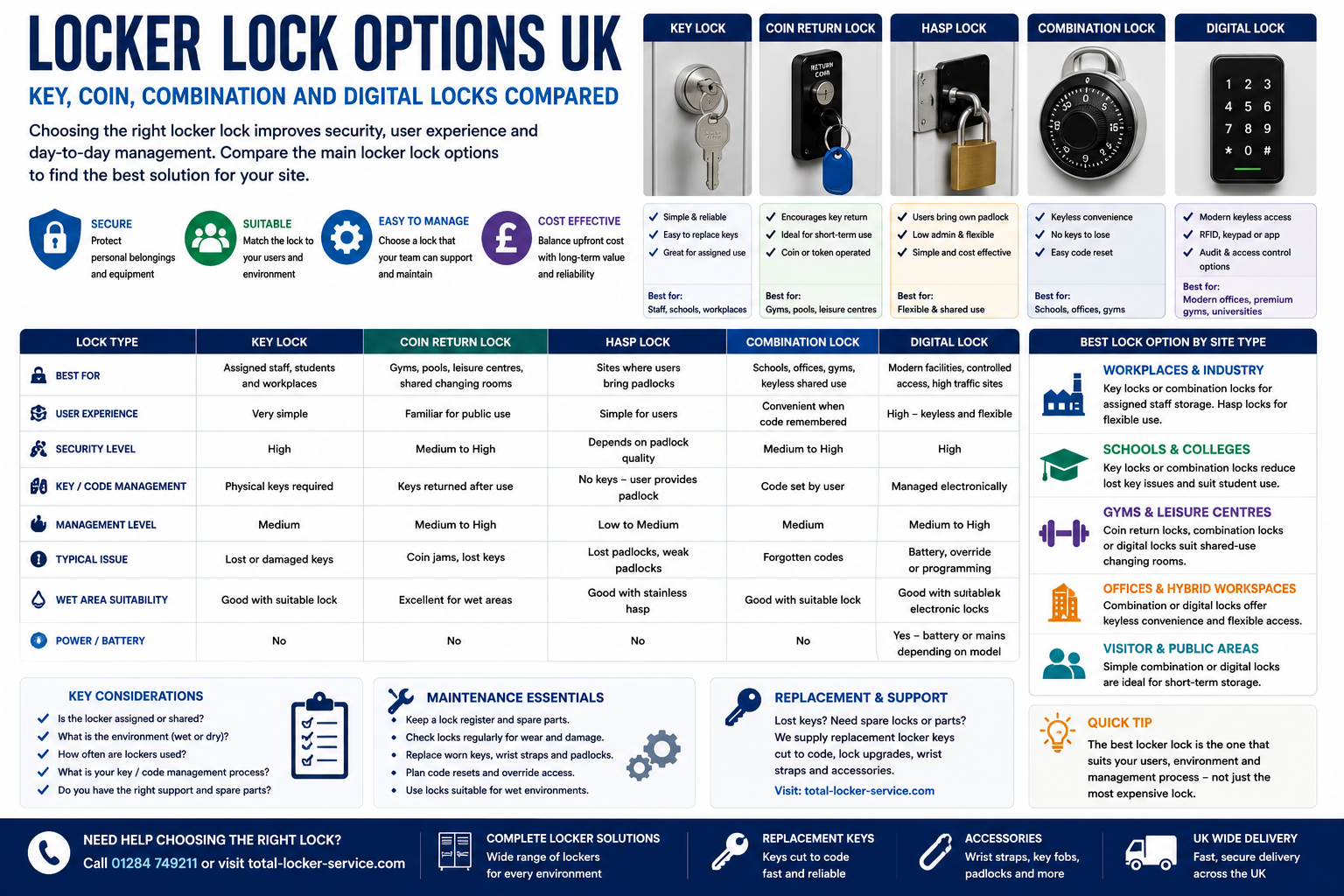
Locker lock choice affects security, user experience, daily management and long-term maintenance. A locker can be the right size, material and layout, but still cause problems if the lock type does not match how people use it. Lost keys, forgotten codes, jammed coin locks and poor override access can all create avoidable work for facilities teams.
This UK guide compares the main locker lock options: key locks, coin return locks, hasp locks, mechanical combination locks and digital or electronic locks. It explains where each lock type works best, what to consider before ordering and how to match locks to workplaces, schools, gyms, leisure centres, offices, changing rooms and public-use lockers.
The right locker lock is not always the most secure lock on paper. It is the lock that suits the users, the site routine, the level of supervision, the locker door type and the way the storage area is managed.
Quick answer: which locker lock is best?
The best locker lock depends on how the locker is used. Key locks are simple and reliable for assigned staff or student lockers. Coin return locks are useful for gyms, pools and leisure centres where lockers are shared for short periods. Hasp locks work when users bring their own padlock. Combination locks reduce key handling. Digital and electronic locks suit modern shared-use or controlled-access sites where the management process supports them.
For permanent assigned use, key locks are often the simplest option. Public or member use, coin, combination or digital locks may reduce key management. For flexible workplace or visitor use, hasp or combination locks can work well. The lock should match the site’s daily routine, not just the locker body.
| Lock type | Best for | Main advantage | Main limitation |
|---|---|---|---|
| Key lock | Assigned staff, student and workplace lockers | Simple, familiar and easy to replace keys | Keys can be lost or mixed up |
| Coin return lock | Gyms, pools, leisure centres and shared changing rooms | Encourages temporary use and key return | Coin jams and lost keys need management |
| Hasp lock | Sites where users bring padlocks | Low admin and flexible use | Security depends on padlock quality |
| Combination lock | Schools, offices, gyms and keyless shared use | No physical key for the user to lose | Forgotten codes need reset support |
| Digital or electronic lock | Modern offices, premium gyms and controlled facilities | Improved user experience and flexible access options | Needs power, batteries or system management depending on model |
For lock products and replacement options, see locker locks by type. For key replacement and key control, see replacement locker keys.
Why locker lock choice matters
Locker locks are used more often than most people expect. A staff locker may be opened every shift. A school locker may be used several times per day. A gym locker may be used by different people throughout the week. A visitor locker may need to be simple for someone who has never used the system before.
That daily use makes lock choice important. A lock that suits an assigned staff locker may not suit a public changing room. A lock that reduces key handling may create code-reset work. A premium electronic lock may improve user experience, but only if staff can manage overrides, batteries or access settings.
Lock choice also affects maintenance. More doors mean more locks to manage. Shared-use lockers need clear reset and override processes. Wet-area lockers need locks and fittings that suit damp conditions. Schools need key or code systems that staff can support quickly. The lock is part of the whole locker system.
Key locks
Key locks are one of the most common locker lock options. They are simple, familiar and suitable for assigned users. A key lock usually uses a cam mechanism that secures the locker door behind the frame. Each lock has a key, and replacement keys can often be cut to code if the key number or lock code is available.
Key locks are often used for workplace lockers, school lockers, staff lockers, office lockers and general assigned storage. They work best when the same person uses the same locker regularly and the site has a clear spare key or master key process.
Advantages of key locks
- Simple and familiar for most users.
- Good for assigned lockers.
- Easy to understand with little instruction.
- Replacement keys can often be ordered to code.
- Suitable for workplaces, schools and staff areas.
- Compatible with many standard locker types.
Limitations of key locks
The main weakness is key management. Keys can be lost, snapped, taken home, mixed between lockers or left inside compartments. If the site has many users and no key register, key locks can create recurring admin work.
Key locks also need controlled spare keys. Master keys should not be left unsecured. Replacement keys should be ordered using the correct key number or lock code. If the key record is poor, a simple lost key can turn into a lock replacement.
Best uses for key locks
- Assigned staff lockers.
- School lockers with key management.
- Workplace lockers.
- Office personal storage.
- Dry changing rooms.
- Sites with controlled spare key access.
For replacement key support, use locker keys cut to code. For broader key routines, link this guide to your locker key management content.
Coin return locks
Coin return locks are commonly used in gyms, swimming pools, leisure centres and public changing rooms. The user inserts a coin or token, locks the locker and takes the key. When the key is returned and the locker is unlocked, the coin or token is released.
Coin locks are useful where lockers are shared by different users throughout the day. They encourage temporary use and help reduce abandoned lockers. They also give users a simple process that is familiar in many leisure settings.
Advantages of coin return locks
- Good for shared-use changing rooms.
- Encourages users to return keys.
- Familiar in gyms, pools and leisure centres.
- Can support coin or token systems depending on lock type.
- Useful where lockers are used for short periods.
- Reduces the need to assign lockers permanently.
Limitations of coin return locks
Coin locks need more mechanical management than simple key locks. Coins can jam, keys can be lost and the mechanism can wear under heavy use. Users may also arrive without the correct coin or token, which can create reception support work.
In wet areas, the full lock and key system should be suitable for the environment. Wrist straps may also need replacing regularly in pools and leisure centres because they wear, stretch or become unhygienic over time.
For wet and leisure environments, see leisure lockers and locker key wrist straps.
Best uses for coin return locks
- Swimming pool lockers.
- Gym changing room lockers.
- Leisure centre lockers.
- Sports club changing rooms.
- Short-term public or member storage.
- Shared-use lockers where key return matters.
Hasp locks
Hasp locks allow users to secure the locker with their own padlock. The locker has a hasp fitting, and the user brings a padlock to lock the door. This can be a practical option in workplaces, gyms, schools, universities and visitor areas where the site wants to reduce key management.
Hasp locks are simple and flexible. They remove the need for the site to issue a key for each locker. However, the security level depends on the padlock the user chooses. A weak padlock can reduce the overall security of the locker system.
Advantages of hasp locks
- Users provide their own padlocks.
- Reduces key issue and replacement admin.
- Simple and low-maintenance.
- Useful for flexible or shared-use storage.
- Works across many workplace, school and gym settings.
- Easy for users to understand.
Limitations of hasp locks
The main limitation is inconsistent padlock quality. One user may bring a strong padlock. Another may bring a cheap or unsuitable one. If the padlock is lost, staff may need a process for removing it from the locker.
Hasp locks may also be less suitable where the organisation wants full control over access. For assigned staff lockers, a keyed cam lock or managed electronic lock may give clearer administration.
Best uses for hasp locks
- Flexible staff storage.
- Gym lockers where users bring padlocks.
- University or college lockers.
- Visitor lockers where padlock use is acceptable.
- Shared storage areas with low key-management capacity.
Combination locks
Combination locks remove the need for a physical key. Users open the lock with a code. Mechanical combination locks are commonly used in schools, offices, gyms, leisure centres and workplaces where keyless access is useful.
Combination locks can be used for assigned lockers or shared-use lockers, depending on the model and management process. They are useful where lost keys are a frequent problem. However, forgotten codes still need staff support and a reset process.
Advantages of combination locks
- No physical key for the user to lose.
- Useful for schools, offices and gyms.
- Can reduce replacement key admin.
- Good for keyless assigned or shared use.
- Can improve convenience for regular users.
- Works well where staff can manage code resets.
Limitations of combination locks
The main weakness is forgotten codes. Users may forget their combination, change it incorrectly or leave the lock set to a code another person can guess. Staff need a clear override or reset process.
Combination locks may also need more user instruction than key locks. In high-turnover public settings, clear signage can reduce support calls.
Best uses for combination locks
- Schools that want fewer lost key issues.
- Offices and hybrid workplaces.
- Gyms and sports facilities.
- Visitor storage where keyless use is preferred.
- Staff lockers where users can manage their own code.
Digital and electronic locker locks
Digital and electronic locker locks can provide modern keyless access. Depending on the lock type, users may use a keypad, RFID card, wristband, fob or other electronic credential. These locks are often used in premium gyms, modern offices, leisure centres, universities and controlled-access environments.
Electronic locks can improve user experience, especially where users already carry access cards or wristbands. They can also support shared-use lockers where users set access for a session. However, they need a management process for batteries, overrides, programming and user support.
Advantages of digital and electronic locks
- Modern keyless user experience.
- Good for premium offices, gyms and leisure centres.
- Can reduce physical key handling.
- May support RFID, keypad or credential-based access.
- Useful where locker use changes frequently.
- Can improve the appearance and feel of the locker system.
Limitations of digital and electronic locks
Digital locks need more management than simple mechanical locks. Batteries may need replacing. Staff may need training. Override access must be available. If the lock system is not maintained, a premium lock can become a user frustration.
Electronic locks should also be matched to the environment. Wet areas, pools and gyms may need lock models that can cope with damp use, member turnover and frequent cleaning routines.
Best uses for digital and electronic locks
- Premium gyms and leisure facilities.
- Modern offices and hybrid workplaces.
- Universities and shared facilities.
- Controlled-access staff areas.
- High-quality visitor or member storage.
- Sites with staff capacity to manage the lock system.
Locker lock comparison table
Use this comparison to choose the best locker lock option for your site. The right lock depends on user type, locker location, lock management and whether lockers are assigned or shared.
| Lock type | Best for | User experience | Management level | Typical issue |
|---|---|---|---|---|
| Key lock | Assigned staff, school and workplace lockers | Very simple | Medium | Lost or damaged keys |
| Coin return lock | Gyms, pools and shared changing rooms | Familiar for public use | Medium to high | Coin jams or lost keys |
| Hasp lock | Users bringing their own padlocks | Simple if users know the system | Low to medium | Lost padlocks or weak padlocks |
| Combination lock | Keyless staff, school and visitor storage | Convenient when codes are remembered | Medium | Forgotten codes |
| Digital or electronic lock | Modern shared-use or premium facilities | High when managed well | Medium to high | Battery, programming or override issues |
Best locker lock option by site type
Different sites need different locker lock systems. A school corridor, gym changing room, staff area and visitor reception should not automatically use the same lock.
Workplaces and staff lockers
Workplace lockers often use assigned storage. Key locks are a strong default because they are simple and familiar. Hasp locks may work when staff bring padlocks. Combination locks can reduce key handling in offices or hybrid workplaces.
Industrial workplaces should consider user behaviour, PPE storage and shift patterns. If lockers are assigned, key control can be straightforward. If lockers are shared by shift or department, combination or hasp options may reduce admin.
Recommended route: workplace lockers.
Schools and colleges
Schools often use key locks or combination locks. Key locks are simple, but lost keys are common. Combination locks reduce key replacement but need a process for forgotten codes. The best choice depends on age group, supervision and how much admin the school office can support.
Schools should also keep a clear locker register. This helps track locker numbers, key codes, issued keys and replacements.
Recommended route: school lockers.
Gyms and leisure centres
Gyms and leisure centres often need shared-use locks. Coin return locks, combination locks, hasp locks and electronic locks can all work. Coin return locks are familiar in leisure environments. Digital locks can improve member experience in premium facilities. Hasp locks are simple where users bring padlocks.
Wet changing rooms need extra care. Locks, wrist straps and fittings should suit damp use. Key return and abandoned locker processes should be clear.
Recommended route: leisure lockers.
Offices and hybrid workplaces
Office lockers may be assigned, shared or used for hot desking. Combination locks and digital locks can work well where users change regularly. Key locks can still be suitable where compartments are assigned to staff. For short-term visitor storage, combination or digital locks may be more convenient.
If lockers are used for laptops or phones, consider whether powered storage is also needed. For secure device storage, see charging lockers.
Visitor and reception lockers
Visitor lockers should be simple. Users may not know the site or the lock system. Combination locks, electronic locks or coin-style systems can work if the instructions are clear. Avoid systems that require too much staff explanation.
For visitor areas, also think about compartment size. Four door or six door lockers may be enough if users only need to store phones, wallets, keys and small bags.
Assigned use vs shared use
Locker lock choice should start with one question: is the locker assigned or shared? Assigned-use lockers are used by the same person regularly. Shared-use lockers are used by different people at different times. The lock system should match that difference.
Assigned lockers work well with key locks because the user keeps the key and the site keeps a spare or master process. Shared lockers often work better with coin, hasp, combination or digital locks because users change frequently.
| Use model | Best lock types | Why |
|---|---|---|
| Assigned staff locker | Key lock, combination lock or digital lock | One user has regular access |
| Shared gym locker | Coin lock, hasp lock, combination lock or digital lock | Users change throughout the day |
| School student locker | Key lock or combination lock | Assigned access with school management support |
| Visitor locker | Combination lock, digital lock or coin lock | Short-term use with simple instructions |
| Tool or equipment locker | Key lock or controlled electronic lock | Access control and accountability matter |
Locker locks for wet areas
Wet areas need locks that suit damp and humid conditions. Swimming pools, spas, gyms and shower-adjacent changing rooms can be hard on lock mechanisms, keys, wrist straps and fittings. The locker material may be wet-area suitable, but the lock must also be appropriate.
Coin return locks are common in swimming pools and leisure centres. Hasp locks and combination locks can also work in some gym environments. Digital locks may be suitable where the model and management process are appropriate for the conditions.
Wet area sites should check locks more often than dry offices. Look for sticking keys, rust, poor return action, damaged wrist straps, weak fixings and user complaints. For wet changing rooms, see the wet area locker guide and the leisure lockers range.
Maintenance and replacement planning
Locker locks need maintenance because they are high-use parts. Even a strong locker system can become frustrating if locks are stiff, unreliable or poorly recorded. Facilities teams should record lock type, key codes, spare keys and known faults.
For key locks, keep a key register. For coin locks, check the mechanism and key return. Combination locks, maintain a reset process. Digital locks, plan battery checks and override access. For hasp locks, inspect the hasp and remove abandoned padlocks through the site’s process.
| Lock type | Maintenance priority | Planning note |
|---|---|---|
| Key lock | Key codes, spare keys and worn keys | Order replacement keys before access problems grow |
| Coin lock | Coin mechanism, key return and wrist straps | Inspect frequently in leisure settings |
| Hasp lock | Hasp alignment and abandoned padlocks | Set rules for padlock removal |
| Combination lock | Code reset and user instructions | Staff need a clear support process |
| Digital lock | Batteries, programming and override access | Requires planned checks and trained staff |
For wider aftercare, link this page to the locker maintenance guide and the locker estate management guide. Lock choice should be part of long-term locker management, not a one-off purchase decision.
Common locker lock mistakes
Most locker lock problems come from choosing a lock that does not match the site routine. A lock can be good quality but still wrong for the environment or user group.
- Using key locks in high-turnover shared areas without key control.
- Choosing combination locks without a reset process.
- Using coin locks without planning for coin jams or lost keys.
- Allowing users to bring weak padlocks for hasp lockers.
- Choosing digital locks without planning battery checks or overrides.
- Installing dry-area lock systems in wet or humid changing rooms.
- Using different lock types across one estate without a register.
- Not recording key codes or spare keys.
- Replacing complete lockers when only the locks or keys need replacing.
- Forgetting that more locker doors means more locks to manage.
The best lock system is the one the site can manage consistently. Choose the lock around the user, the room, the locker type and the support process.
How to choose the right locker lock
Use this process before choosing key, coin, hasp, combination or digital locker locks.
- Decide if lockers are assigned or shared. Assigned users and changing users need different lock systems.
- Identify the user group. Staff, students, members, visitors and contractors behave differently.
- Check the environment. Wet areas, schools, offices and factories create different demands.
- Review admin capacity. Decide who manages lost keys, forgotten codes, overrides and repairs.
- Match lock to door count. More compartments mean more locks to manage.
- Plan replacement support. Record key codes, lock types and spare parts.
- Consider user instructions. Shared-use locks need clear signage.
- Think long term. Choose a lock type the site can maintain for years.
If the site wants the simplest assigned-use option, key locks are often suitable. If the site wants public shared-use lockers, coin or combination locks may be better. When the site wants modern access and can support the system, digital locks may be worth considering.
Final recommendation
Choose locker locks by use case. Key locks suit assigned storage. Coin return locks suit shared leisure lockers. Hasp locks work where users bring padlocks. Combination locks reduce key handling. Digital and electronic locks suit modern sites that can manage batteries, overrides and user support.
The safest buying decision is to match the lock to the user group, room type and management process. A lock should not only secure the door. It should also be easy to manage, easy to maintain and suitable for the environment.
Total Locker Service supplies locker locks, replacement locker keys, wrist straps, accessories and locker systems for workplaces, schools, gyms, leisure centres and commercial sites across the UK. Browse locker locks by type, order replacement locker keys, or call 01284 749211 for help choosing the right locker lock option.
Locker lock options FAQs
What is the best lock for lockers?
The best locker lock depends on how the locker is used. Key locks suit assigned users, coin locks suit shared leisure lockers, combination locks reduce key handling and digital locks suit modern sites that can manage electronic access.
Are key locks good for lockers?
Yes. Key locks are simple and reliable for assigned lockers in workplaces, schools and staff areas. They work best when the site keeps a key register and controlled spare keys.
What are coin return locker locks used for?
Coin return locker locks are used for shared-use lockers in gyms, swimming pools, leisure centres and public changing rooms. They encourage temporary use and key return.
Are combination locks better than key locks?
Combination locks are better when lost keys are a major problem. Key locks are often better for simple assigned use. Combination locks still need a reset or override process for forgotten codes.
What is a hasp locker lock?
A hasp locker lock is a fitting that allows the user to secure the locker with their own padlock. It is a flexible option where the site does not want to issue keys for every locker.
Are digital locker locks worth it?
Digital locker locks can be worth it for modern offices, premium gyms and shared-use facilities. They offer a keyless experience but need battery checks, override access and staff management.
Which locker lock is best for schools?
Schools often use key locks or combination locks. Key locks are simple but keys can be lost. Combination locks reduce key replacement but need a clear process for forgotten codes.
Which locker lock is best for gyms?
Gyms often use coin return locks, hasp locks, combination locks or digital locks. The best choice depends on whether users bring padlocks, whether lockers are shared and how staff manage lost access.
Can locker locks be replaced?
Yes. Many locker locks can be replaced without replacing the full locker. Replacement keys, cams, coin locks, hasp locks and combination locks may all be available depending on the locker type.
Who supplies locker locks in the UK?
Total Locker Service supplies locker locks, replacement locker keys, wrist straps, engraved key fobs, accessories and locker systems for UK workplaces, schools, gyms, leisure centres and commercial facilities.