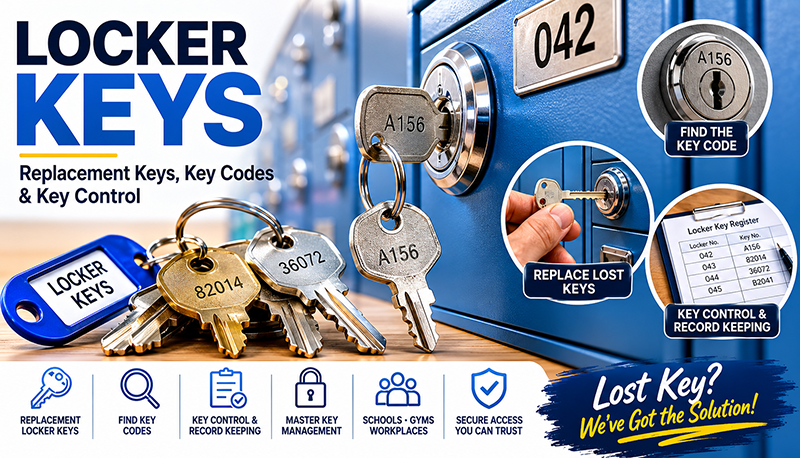
Locker keys are small items, but they control a large part of daily access in schools, gyms, leisure centres, workplaces, warehouses, care settings and commercial changing rooms. When a locker key is lost, damaged or mixed up, the problem often feels simple at first. One user cannot open one locker. Yet, across a busy site, repeated key loss can create admin delays, access issues, damaged locks and unnecessary replacement costs.
The good news is that many locker key problems can be solved without replacing the whole locker or even the whole lock. In many cases, a replacement locker key can be cut from the correct key number or lock code. The important part is knowing what information to check before ordering.
This guide explains how locker keys work, where to find locker key numbers, when a replacement key is the right choice, when a lock should be replaced instead, and how schools, gyms, workplaces and facilities teams can reduce future key loss.
If you already have the correct code and need to order, visit Total Locker Service for replacement locker keys cut to code for many common UK locker systems.
Quick answer: how do you replace locker keys?
To replace a locker key, first find the key number or lock code. This may be stamped on the key, printed on the lock face, recorded in a site key register or listed in previous order paperwork. Once the correct code is confirmed, a replacement locker key can often be cut without needing the original key.
Do not assume the number on the locker door is the same as the locker key number. The locker number identifies the door or compartment. The key number identifies the key or lock code. Some sites deliberately match locker numbers and key numbers, but many do not. Ordering from the wrong number is one of the most common causes of incorrect replacement keys.
Where the code is missing, worn or unclear, take clear photos of the key, lock face, locker door and rear of the lock if accessible. These details help identify whether a replacement key is possible or whether the lock should be replaced.
Why locker keys matter in secure storage planning
Locker keys are not just accessories. They are part of the access control system. A locker bank may look like simple storage furniture, but every lock, key, spare key and master key affects how that storage is managed.
In a school, locker keys affect pupils, form tutors, reception staff, site teams and lost property processes. In a gym, they affect member experience, changing room flow and staff time at reception. In a workplace, they affect staff welfare, shift changes, uniform storage and PPE access. In a warehouse or industrial site, they may also link to equipment control, garment management and clean or dirty area separation.
A good locker key system should answer five basic questions:
- Who is allowed to use each locker?
- Which key opens each lock?
- Where are spare keys stored?
- Who can use a master key?
- What happens when a key is lost?
If those questions are not answered, key loss becomes harder to manage. Staff may order the wrong key, force a lock, replace a working lock unnecessarily or lose track of which user has which compartment.
Common types of locker keys
Locker keys vary by lock type, manufacturer and environment. They are not usually universal. A key that fits one locker does not automatically fit another, even where the locks look similar from the outside.
Standard keyed cam lock keys
Keyed cam locks are common on staff lockers, school lockers, workplace lockers and general-purpose metal lockers. The key turns a barrel, and the barrel rotates a cam behind the door. The cam hooks behind the frame and keeps the door closed.
These locks are simple, familiar and easy to manage when key records are accurate. Replacement keys can often be ordered by code if the key number is known.
Coin lock keys
Coin locks are common in swimming pools, leisure centres, gyms and public changing rooms. They may use coin return or coin retain operation. The user inserts a coin or token, locks the door, then retrieves the coin when the locker is reopened, depending on the lock type.
Coin lock systems may involve user keys, service keys, master keys, barrels, coin trays, wrist straps and tokens. In these settings, it is important to identify whether the problem is a lost user key, a damaged wrist strap, a failed barrel, a missing service key or a broken coin mechanism.
Master keys and override keys
Many managed locker systems use master keys. A master key may open a group of locks within the same system, allowing authorised staff to deal with lockouts, abandoned lockers, maintenance checks and emergency access.
Master keys must be controlled carefully. A lost user key is usually a limited problem. A lost master key can create a wider security issue because it may open several lockers. Master keys should be held by authorised staff only, stored securely and recorded in a key control process.
Restricted or specialist locker keys
Some locker systems use restricted key profiles, specialist cylinders or brand-specific systems. These keys may require more detailed identification before replacement. If the key looks unusual, has a complex profile, or belongs to a managed system, do not guess. Record the visible markings and ask for technical support before ordering.
What is a locker key number?
A locker key number is the code used to identify the correct replacement key. It may include numbers, letters or a mixture of both. The format depends on the lock manufacturer and the lock series.
The key number is important because it tells the key cutter which cut pattern or blank is required. Without the correct number, the replacement may not operate the lock.
Common places to find the number include:
- the head of the original key;
- the visible face of the lock;
- the lock barrel or rear body;
- a labelled spare key;
- a site key register;
- old invoices or order records;
- installation paperwork from the locker supplier.
If the number is unclear, photograph it in good light. Worn stamping can be easier to read from an angled photo than by eye. Take several images before assuming the number is unreadable.
Locker number vs locker key number
The locker number and locker key number are often confused. They may be the same on some sites, but they should be treated as separate pieces of information unless records prove otherwise.
| Item | What it identifies | Should it be used to order keys? |
|---|---|---|
| Locker number | The door, compartment or user position | Only if your records link it to the key code |
| Key number | The key or lock code | Yes, if clearly recorded |
| Lock brand | The manufacturer or lock system | Useful for confirming compatibility |
| Master key number | The management key group or override system | Not usually for standard user key replacement |
For example, locker 42 does not necessarily use key 42. It might use key 82014, A156, 36072 or another manufacturer code. If a facilities team orders from the locker door number without checking the actual key code, the replacement may arrive and fail to work.
For a deeper explanation, see the Total Locker Service locker key number guide.
Can locker keys be replaced without the original key?
Often, yes. If the key number or lock code is known, a replacement locker key can usually be cut without the original key. This is one of the main advantages of using coded locker locks in managed environments.
The original key is helpful, but it is not always essential. What matters most is accurate identification. A supplier needs to know the correct code, lock type and sometimes the lock brand or series. If those details are clear, replacement is normally straightforward.
If the key is lost and there is no visible code, the options become more limited. You may need to check the lock face, look at the rear of the lock, review site records or remove the lock for inspection. If no code can be found, replacing the complete lock may be more practical than trying to identify an unknown key.
When should you replace a locker key?
Replacing the key is usually the best option when the lock still works and the correct code is available. This keeps the existing locker system in place and avoids unnecessary labour.
Key replacement is usually suitable when:
- the user key has been lost;
- a spare key is needed;
- the key number is clearly visible;
- the lock has not been forced or damaged;
- the site wants to keep the same lock system;
- only a small number of keys are missing;
- the lock turns smoothly with a spare or master key.
This is common in schools, staff changing rooms, gyms, office buildings, warehouses and leisure sites where lockers are still in good condition but keys are missing.
When should you replace the locker lock instead?
A replacement key is not always the right answer. If the lock is damaged or cannot be identified, replacing the lock may be better.
Lock replacement should be considered when:
- no key number or lock code can be found;
- the lock has been forced;
- the barrel spins without operating the cam;
- the key has snapped inside the lock;
- the cam is bent, missing or badly worn;
- the lock is seized or unreliable;
- the master key has been lost or compromised;
- the site wants to move from keys to combination, hasp, coin or digital locks.
If you need the complete lock rather than a key, view the Total Locker Service range of replacement locker locks. Correct lock identification matters because replacement locks must match the door thickness, fixing hole, cam position and operating method.
What to do when a locker key is lost
A lost locker key should be handled in a simple sequence. Rushing straight to drilling, forcing or replacing the lock can create avoidable damage.
1. Check for a spare key
First, check whether the site already holds a spare key. Look in the key cabinet, facilities office, reception drawer, estates department, maintenance store or old handover file. If the spare is found, record the key number before returning it to storage.
2. Check the lock face
If no spare key is available, inspect the lock face. Many locker locks have a number stamped or printed near the key slot. Use good lighting and take a close-up photo. The number may be small, worn or positioned around the edge of the barrel.
3. Check site records
Large sites should keep a key register. This should match each locker number to a key number, room, locker bank and lock type. If the register is old, check that the lock has not been replaced since the record was created.
4. Take photos before ordering
Photographs reduce mistakes. Take a full locker door photo, a close-up of the lock face, a close-up of any number, and a photo of the rear of the lock if the door is open. If several lockers are affected, label the images by room and locker number.
5. Decide whether to order a key or replace the lock
If the key number is known and the lock is in good condition, order a replacement key. If the lock is damaged, unidentified or insecure, replace the lock.
For a practical step-by-step route, read the Total Locker Service lost locker keys guide.
Locker key identification checklist
Before ordering replacement locker keys, collect the right details. This helps avoid delays and wrong-key orders.
| Check | Why it matters | Completed? |
|---|---|---|
| Key number recorded | Identifies the replacement cut | Yes / No |
| Locker number recorded separately | Avoids mixing up door number and key code | Yes / No |
| Lock face checked | May show the key number or brand | Yes / No |
| Brand checked | Helps confirm the correct key range | Yes / No |
| Clear photos taken | Helps with technical identification | Yes / No |
| Quantity confirmed | Prevents repeated small orders | Yes / No |
| Delivery details checked | Reduces fulfilment delays | Yes / No |
Locker keys for schools
Schools often have one of the highest locker key loss rates because lockers are used by many pupils over several academic years. A single lost key is manageable. A weak system across hundreds of lockers becomes a recurring administrative burden.
School locker key control should be simple, visible and consistent. Each locker should have a door number. Each door number should be linked to the correct key number. Spare keys should be stored securely, not left loose in drawers or mixed in unlabelled boxes.
A school key register should include:
- locker number;
- room or corridor location;
- year group or allocation group;
- key number;
- lock type;
- spare key status;
- issue date;
- return date;
- lost key history;
- lock condition.
Term breaks are a good time to check locker keys, remove abandoned items, audit missing keys and replace damaged locks. This prevents small problems becoming a September rush.
Locker keys for gyms and leisure centres
Gyms, swimming pools and leisure centres need locker systems that cope with heavy turnover. Users may arrive without planning ahead, forget which locker they used, lose wrist straps, snap keys or report lockouts at busy times.
Keyed locker systems can still work well in leisure environments, but they need clear procedures. Reception staff should know how to identify a user key, where service keys are held, who is authorised to use master keys and how to record repeated failures.
In wet changing rooms, the lock type also matters. Moisture, humidity and heavy handling can shorten the life of unsuitable locks. If keys are repeatedly lost or locks are frequently damaged, the site may need to review whether keyed locks remain the best system. Coin locks, wristband systems, RFID locks or hasp locks may be more suitable depending on the operating model.
Where the site still uses keyed locker locks, replacement locker keys should be ordered from the correct code rather than guessed from locker numbers.
Locker keys for workplaces
Workplace lockers are used for staff bags, coats, uniforms, PPE, workwear, personal belongings, devices and shift storage. Lost locker keys can delay staff access and create avoidable maintenance work.
The best workplace system depends on how lockers are allocated. Assigned lockers suit permanent staff who need regular personal storage. Shared lockers may suit hybrid offices, contractors or shift workers. Temporary day-use lockers may suit visitors or hot-desk environments.
Keyed locks are often suitable where lockers are assigned to named users. However, the site still needs a process for starters, leavers, lost keys and spare access. When an employee leaves, the key should be returned and recorded. If it is not returned, the site should decide whether a replacement key is enough or whether the lock should be changed for security reasons.
Locker keys for warehouses and industrial sites
Industrial sites often use lockers for more than personal storage. They may support PPE control, boot storage, clean and dirty workwear, staff changing, tools, helmets, gloves and shift equipment.
Lost keys in these environments can affect productivity. A worker who cannot access required PPE or uniform may be delayed at the start of a shift. A supervisor may then need to spend time locating spare keys, opening lockers or arranging replacements.
Industrial sites should consider standardising locker locks where practical. Mixed lock types across one site can make key control harder. Standardisation also helps with spare keys, replacement locks and long-term maintenance.
How to build a locker key register
A locker key register is one of the simplest ways to reduce lost key problems. It does not need to be complex. A spreadsheet is often enough for small and medium sites.
Useful fields include:
- locker number;
- building;
- room;
- locker bank;
- user or department;
- lock type;
- lock brand;
- key number;
- master key group;
- spare key location;
- issue date;
- return date;
- lost key notes;
- lock condition;
- replacement date.
The register should be updated whenever a lock is changed. This is where many systems fail. A site replaces a lock on locker 24 but forgets to update the key list. Months later, a new key is ordered from the old record and does not work.
Good records reduce wrong orders, help bulk ordering and support better maintenance decisions.
Bulk replacement locker keys
Bulk ordering can be useful when several keys are missing or when a site wants to rebuild its spare key stock. This is common in schools, gyms, leisure centres, councils, warehouses and large workplaces.
Before sending a bulk order, prepare the information carefully. Do not send a list of locker door numbers unless those numbers have already been matched to key codes.
A good bulk key schedule should include:
- key number;
- quantity required;
- locker number if relevant;
- lock brand if known;
- room or locker bank;
- notes for unusual locks;
- photos where codes are unclear.
For brand-specific ordering, use the Total Locker Service locker keys by manufacturer page to help route the order correctly.
Common locker key mistakes
Most locker key problems are caused by identification errors rather than the key cutting process itself. A few checks can prevent many of these issues.
Using the locker number as the key number
This is the most common mistake. The locker number is the door number. The key number is the replacement code. They may match on some sites, but they are not the same thing by default.
Misreading worn digits
Small stamped numbers can be difficult to read. Common errors include mixing up O and 0, I and 1, S and 5, or B and 8. Take a close-up photo before ordering.
Ignoring letters or prefixes
Some key codes include letters. Missing the prefix can result in the wrong key. Record the full code exactly as shown.
Ordering from old records
If a lock has been replaced since the register was created, the old key number may no longer apply. Check the current lock before ordering.
Replacing the whole lock too quickly
If the key number is known and the lock is working, replacing the whole lock may be unnecessary. A replacement key is often the more efficient first step.
Keeping spare keys without labels
A box of unlabelled spare keys is not a key control system. Each spare should be labelled, recorded and stored securely.
How to reduce future locker key loss
Lost keys cannot be removed completely, especially in schools, leisure centres and shared workplaces. However, the number of incidents can be reduced.
Practical measures include:
- issuing numbered key tags;
- recording issue and return dates;
- keeping spare keys in a controlled key cabinet;
- reviewing lost keys at regular intervals;
- auditing lockers at the end of each term or quarter;
- using clear user rules;
- charging a replacement fee where appropriate;
- standardising lock types across the site;
- considering combination or digital locks where key loss is constant.
The correct approach depends on the environment. A school may need simple pupil allocation records. A leisure centre may need wrist straps and master key control. A workplace may need a starter and leaver process. A warehouse may need supervisor access and PPE availability checks.
Should you change to keyless locker locks?
If lost locker keys are a regular problem, it may be worth reviewing whether keyed locks are still the best option. Keyless systems can reduce user key loss, but they are not automatically better for every site.
Combination locks remove physical user keys, but codes can be forgotten or shared. Hasp locks allow users to bring their own padlocks, but the site has less control over the lock fitted. Digital and RFID locks can offer flexible access, but they require battery checks, user management and a clear override process.
Before changing lock type, ask:
- Are lockers assigned or shared?
- How many users access the lockers each day?
- Is the site supervised?
- How often are keys lost?
- Who manages lockouts?
- Is moisture or heavy use a concern?
- Does the site need audit control?
- What maintenance capacity is available?
For many sites, keyed locks remain a practical and cost-effective option when records are good. For others, repeated key loss is a sign that the operating model needs to change.
How to identify a locker lock before ordering keys
If the key number is unclear, lock identification becomes important. Locker locks may look similar from the front, but the brand, keyway, cam and fixing details can differ.
Check the following details:
- brand name or logo on the lock face;
- number around the key slot;
- shape of the keyway;
- lock face shape;
- locker material;
- door thickness;
- cam shape and length;
- whether the lock is keyed, coin, hasp, combination or digital;
- any numbers on the rear body of the lock.
Photos are very helpful. Take one photo of the full locker door, one close-up of the lock face, one close-up of the number and one photo of the rear of the lock if the door is open.
If you are unsure, use the Total Locker Service locker lock identification guide before ordering.
Replacement locker keys and security
Replacement keys should be managed carefully. A replacement key restores access, but it also affects security. The level of risk depends on what the locker is used for, who lost the key and whether the missing key can be linked to a specific locker.
For low-risk personal storage, replacing the key may be enough. For sensitive storage, staff-only areas or situations where a key may have been stolen rather than misplaced, changing the lock may be more appropriate.
Master keys need even tighter control. A master key should never be treated like a standard user key. It should be stored securely, issued to authorised staff only and recorded when used. If a master key is lost, the site should review the affected lock group and decide whether locks need to be changed.
How to order replacement locker keys correctly
The ordering process is simple when the correct information is ready.
- Find the key number or lock code.
- Check whether the locker number is separate from the key number.
- Identify the lock brand if possible.
- Take photos if the code is unclear.
- Confirm the number of keys required.
- Use the correct supplier page for the lock type or brand.
- Keep a record of the order for future replacements.
Total Locker Service supplies locker keys cut to code for many common locker brands and systems used across UK schools, gyms, workplaces and leisure centres.
FAQ: locker keys
Are locker keys universal?
No. Locker keys are not usually universal. They depend on the lock type, manufacturer, key profile and key number. Even two similar-looking locker locks may use different key systems.
Can I order a locker key from the locker number?
Only if your site records confirm that the locker number is linked to the correct key number. Do not assume the door number and key code are the same.
Where is the locker key number?
The locker key number may be stamped on the key, printed on the lock face, marked on the lock barrel, recorded in a key register or listed on old order paperwork.
What if the locker key number is worn away?
Use bright light and take close-up photos from different angles. Also check the lock face, spare keys, old records and the rear of the lock if accessible. If the number cannot be identified, the lock may need to be replaced.
Can a replacement locker key be made without the original?
Yes, in many cases. If the correct key number or lock code is known, a replacement key can often be cut without the original key.
Should I replace the key or the whole lock?
Replace the key when the lock works and the correct code is known. Replace the lock when the code cannot be identified, the lock is damaged, the mechanism has been forced or there is a security reason to change access.
What should a school do about repeated lost locker keys?
Schools should keep a key register, record locker numbers separately from key numbers, hold spare keys securely, audit keys at term breaks and replace damaged locks during planned maintenance periods.
What should gyms do about lost locker keys?
Gyms should check whether the issue relates to a user key, coin lock, wrist strap, service key, master key or lock component. If lost keys are frequent, the site may need to review whether coin, RFID, wristband or combination systems would work better.
Can I order several locker keys at once?
Yes. Bulk replacement key orders are common for schools, leisure centres, workplaces and facilities teams. Prepare a clear schedule with key numbers, quantities, locations and photos where codes are unclear.
What is the best way to prevent locker key problems?
The best method is accurate record keeping. Keep a locker key register, label spare keys, control master keys, update records when locks are changed and check key numbers before ordering replacements.
Final thoughts
Locker keys are easy to overlook until one goes missing. Yet, for schools, gyms, leisure centres, workplaces and industrial sites, they are part of the wider access control system. A good locker key process reduces downtime, avoids unnecessary lock replacement and keeps storage usable.
The most important step is accurate identification. Find the key number, check the lock face, separate the locker number from the key code and keep records up to date. When the correct code is known, replacement locker keys can often be ordered quickly and efficiently.
If you are ready to replace a lost or damaged key, visit Total Locker Service to order replacement locker keys for UK lockers.