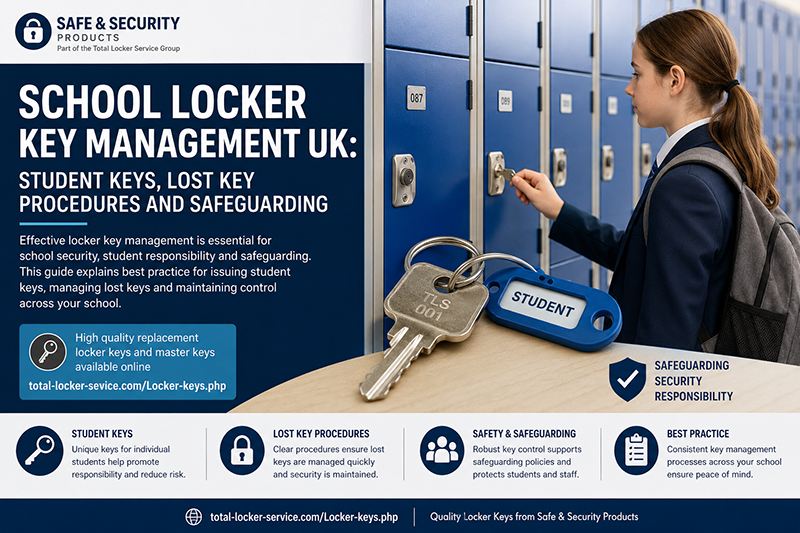
School lockers are simple to use, but they are not simple to manage. Once a school has hundreds of pupils using lockers every day, the key system becomes part of the wider storage, behaviour and safeguarding process.
A school locker gives pupils a safe place to store bags, books, PE kit, coats, lunch boxes and personal items during the school day. However, every locker also needs an access method. For many schools, that still means a key. That key must be issued, recorded, replaced when lost, recovered when a pupil leaves and controlled carefully when staff need emergency access.
Good key management prevents disruption. It reduces lost property. Helps site teams keep lockers in use. Also gives staff a clear procedure when a pupil cannot open a locker, when a key is missing or when there is a safeguarding concern.
If your school needs duplicate or replacement keys, Total Locker Service supplies replacement locker keys for schools, cut to code for many common locker brands and lock systems.
This guide explains how UK schools can manage student locker keys, reduce lost key problems, plan replacement procedures and keep access control aligned with safeguarding expectations.
Quick answer: how should schools manage locker keys?
Schools should manage locker keys through a clear issue, record, replacement and recovery process. Each locker should have a number. Each key should be linked to a locker number, pupil name or year group, and key code where available. Spare keys and master keys should be held securely by authorised staff only. Lost keys should be recorded, replaced quickly and reviewed if losses become repeated.
A strong school locker key system should include:
- a locker allocation record
- a student key issue process
- a spare key control process
- a lost key procedure
- a key code list
- a secure staff-only key storage location
- a process for pupils leaving the school
- a controlled emergency access procedure
- a policy for damaged locks and missing codes
- a review at the end of each term or academic year
For replacement keys, schools should first check the number stamped on the existing key or lock face. If the number is clear, a replacement can often be ordered from the locker keys page without replacing the full lock.
Why school locker key management matters
A school locker system is only useful when pupils can access their lockers reliably. If keys are lost, damaged or poorly recorded, the locker system quickly becomes a daily problem for reception staff, form tutors, site teams and pastoral teams.
Poor key management can lead to:
- pupils arriving late to lessons because they cannot access books or equipment
- repeated interruptions at reception or the site office
- lockers being forced open unnecessarily
- unnecessary lock replacements
- disputes over ownership of belongings
- staff being unsure who is allowed to access a locker
- spare keys being stored in unsafe places
- master keys being used without a clear record
- abandoned lockers at the end of term
- increased costs from preventable replacement work
The aim is not to make locker use complicated. The aim is to make it predictable. When every key has a record, every locker has an allocation and every lost key follows the same process, the school can solve most locker issues quickly.
A simple system is usually best. Schools do not need an over-engineered process for every pupil. They need a process that works under pressure, during busy mornings, between lessons and at the end of term.
School locker keys and safeguarding
Locker key management is not only a facilities issue. In a school, access to storage must also fit the safeguarding and behaviour framework.
A pupil’s locker may contain school books, clothing, personal items, mobile phones, medication, food, prohibited items or items that relate to a welfare concern. Staff must therefore avoid informal or inconsistent access. A locker should not be opened casually. It should be opened under a defined school procedure.
This is especially important where:
- a pupil reports that items have been taken
- staff believe a locker contains an item that should not be on site
- a pupil is distressed because they cannot access belongings
- a locker has been abandoned
- a key is reported stolen
- there is a concern about bullying, coercion or intimidation
- staff need to search a locker as part of a behaviour or safeguarding process
- a pupil has left the school without returning a key
The key principle is control. Schools should know who can access lockers, why access is being given, whether the pupil is present, which staff are involved and whether the action should be recorded.
This guide is practical storage advice, not legal advice. Schools should always follow their own safeguarding policy, behaviour policy, search policy, trust procedures and current Department for Education guidance.
The difference between student keys, spare keys and master keys
A good school locker key system separates three types of key.
Student keys
A student key is issued to the pupil who uses the locker. It gives that pupil normal day-to-day access. Some schools issue one key. Others issue one key to the pupil and hold one spare in the office.
Student keys should be linked to:
- pupil name
- form group or year group
- locker number
- issue date
- key code, if known
- deposit paid, if relevant
- return date, if relevant
The pupil should know what to do if the key is lost. The school should also make clear whether there is a replacement charge.
Spare keys
A spare key is held by the school for operational use. It may be needed when a pupil forgets a key, loses a key or needs urgent access to books, medication, PE kit or personal belongings.
Spare keys should not be kept in an open drawer. They should be stored in a secure cabinet, controlled by authorised staff and logged when used.
For larger sites, a key cabinet can help keep school locker spares organised by number, year group, block or corridor.
Master keys
A master key or override key can open a group of locks within a compatible system. This is useful for facilities teams, but it creates a higher level of risk. A master key should be treated as a restricted access item.
Master keys should be:
- held by named authorised staff
- stored securely
- never loaned casually
- logged when used
- checked regularly
- removed from general office access
- replaced or reviewed if lost
Not every locker system uses a master key. Where a master key is available, schools should decide who can use it and when.
Common school locker key problems
Most school locker key problems fall into a few repeat patterns.
The pupil has lost the key
This is the most common issue. The pupil may have misplaced the key at home, lost it during PE, left it in a bag, dropped it on the bus or given it to a friend.
The school should have a standard lost key procedure. Staff should not have to decide from scratch every time.
A sensible process is:
- Ask the pupil to check bags, pockets and form room.
- Check whether the school holds a spare key.
- Record the lost key against the locker number.
- Decide whether to issue the spare or order a replacement.
- Apply any school replacement charge.
- Review repeated losses if they suggest a wider issue.
The replacement key can often be ordered by code from the replacement locker keys page.
The key is bent or damaged
Keys can bend when pupils force them, sit on them, carry them loose in bags or use them incorrectly. A bent key can damage the lock if it is forced.
If a key is bent, do not keep using it. Record the issue, check whether the lock still turns correctly and order a replacement key before the lock is damaged.
The key turns but the locker will not open
This may mean the lock cam is loose, the door is under pressure or something inside the locker is blocking the door. The key may not be the problem.
Staff should avoid forcing the key. If the lock or cam is damaged, the school may need a replacement lock or spare part rather than a key. Total Locker Service also supplies locker locks and locker parts.
If the locker number is known but the key code is missing
The locker number and the key code are not always the same. The locker number is usually the number displayed on the door for allocation. The key code is usually stamped on the key or lock face.
If the key code is missing, schools should check:
- the spare key
- the lock face
- the original locker schedule
- old key records
- manufacturer documents
- photos of the lock
- any previous order history
If the code cannot be found, the school may need help identifying the lock. The locker key number guide can help staff understand where to look.
The pupil has left and the key has not been returned
This should be handled before the end of term. If keys are not recovered, the school may have open locker access records that no longer match current pupils.
A leaving process should include:
- locker emptied
- key returned
- locker checked
- key record updated
- deposit refunded or retained, if used
- spare key returned to the secure cabinet
- locker made available for reallocation
This is especially important for Year 11, Year 13, leavers, transfers and pupils moving between sites.
How to build a school locker key register
A school locker key register does not need to be complicated. It can be a spreadsheet, MIS-linked document, facilities database or controlled paper record. The important point is that it is accurate, accessible to authorised staff and regularly updated.
The register should include:
| Field | Why it matters |
|---|---|
| Locker number | Links the record to the physical locker |
| Location | Helps staff find the locker quickly |
| Pupil name | Shows who is allocated to the locker |
| Year group or form | Helps with batch checks and end-of-year recovery |
| Key code | Allows replacement keys to be ordered |
| Date issued | Shows when the key was given out |
| Deposit or charge | Helps finance/admin teams track payments |
| Spare key held | Confirms whether the school has backup access |
| Lost key date | Builds a history of problems |
| Replacement ordered | Shows whether action has been taken |
| Key returned | Confirms closure when the pupil leaves |
The key code is one of the most valuable fields. If the school records the key code at the start, future replacement becomes much easier. Without a code, staff may have to inspect the lock, search old records or replace the lock.
How to issue locker keys to pupils
The issue process should be simple enough for form tutors, reception teams or pastoral staff to follow.
A recommended issue process is:
- Allocate the locker number.
- Check that the lock works.
- Record the key code.
- Record the pupil name and year group.
- Issue the key.
- Explain the lost key procedure.
- Confirm whether a deposit or charge applies.
- Tell the pupil not to swap lockers without permission.
- Store any spare key securely.
- Review the allocation at the agreed date.
A short written agreement can help. It does not need to be intimidating. It should simply explain that the locker remains school property, the key must be looked after, damage should be reported and the key must be returned when required.
Should schools charge for lost locker keys?
Many schools charge a small fee for lost locker keys. Others use a deposit system. Some choose not to charge, especially for younger pupils or where lockers are part of the school’s standard provision.
There is no single correct approach for every school. The decision should reflect the school’s behaviour policy, finance rules, pupil age, administrative capacity and equality considerations.
A charge can help reduce careless loss, but it should not prevent a pupil from accessing essential belongings. Schools should also consider cases where repeated loss may indicate a safeguarding, bullying, SEND or welfare issue rather than simple carelessness.
A balanced approach is usually best:
- first loss: reminder and replacement process
- repeated loss: pastoral review
- deliberate damage: behaviour procedure
- financial hardship: follow school support process
- stolen key: record and investigate before charging
The purpose of the lost key process should be to restore access and keep the system secure. It should not create unnecessary conflict.
Lost school locker key procedure
A clear procedure removes uncertainty. Staff should know what to do, pupils should know where to go and the site team should not be pulled into avoidable emergencies.
Step 1: Confirm the locker
Ask the pupil for the locker number, location and year group area. If the school uses zones, identify the correct block or corridor.
Step 2: Check the pupil record
Confirm that the locker is allocated to that pupil. This avoids opening the wrong locker or giving access to the wrong person.
Step 3: Check for a spare key
If a spare is held, authorised staff can use the school’s access procedure. The spare key use should be logged if the school policy requires it.
Step 4: Check the key code
If the key is missing and no spare is available, check the key code from the register, lock face or previous records.
Step 5: Order the replacement
Use the key code to order from the correct brand or range. Total Locker Service can supply many locker keys cut to code for common school locker systems.
Step 6: Decide whether the lock must be changed
A lost key does not always mean the lock must be changed. However, if the key is suspected to be stolen, copied, misused or linked to a safeguarding issue, the school may decide to replace the lock.
Step 7: Update the register
Record the lost key, replacement order and new issue date. If a new lock is fitted, record the new code.
When should a school replace the lock instead of the key?
In many cases, a replacement key is enough. This is cheaper and quicker than changing the lock.
A school should consider replacing the lock when:
- the lock is damaged
- the key code is missing and cannot be identified
- the key has been stolen
- the locker has been accessed without permission
- a pupil has repeatedly lost the key
- the lock is worn or unreliable
- the lock type no longer suits the school
- the school wants to change from keys to combination locks
- the locker is being refurbished
- there is a safeguarding or security concern
If the lock needs replacement, the school should identify the existing lock type before ordering. The locker lock identification guide can help staff check the lock face, fixing style, cam and brand.
School locker key codes: what staff need to know
Most replacement locker keys are supplied by code. The key code is the number or letter sequence used to cut the replacement. It may be stamped on the key, engraved on the lock face or printed on original records.
Common places to check include:
- front of the lock barrel
- side of the key
- plastic key head
- original spare key tag
- locker supplier records
- old invoice or order sheet
- facilities spreadsheet
- master allocation schedule
Schools should avoid relying only on the locker door number. Door number 125 does not always mean key code 125. In many systems, the door number is just an allocation number.
The strongest process is to record both:
- locker door number
- key code
This makes future orders much faster.
Bulk replacement locker keys for schools
Schools often discover key problems in batches. This may happen at the end of term, after a locker audit, before a new academic year or during a refurbishment project.
A bulk key order may be needed when:
- many lockers have no working key
- spare keys are missing
- a year group is being reallocated
- old lockers are being brought back into use
- keys were not recovered from leavers
- a new school building is opening
- a locker room is being reorganised
- the school wants a full spare key set
For a bulk order, create a simple schedule:
| Locker number | Key code | Brand | Quantity | Notes |
|---|---|---|---|---|
| A101 | 36215 | Probe | 2 | Student key and spare |
| A102 | 36216 | Probe | 1 | Spare only |
| B201 | 95045 | Helmsman | 2 | Missing both keys |
| C014 | 66045 | Lowe & Fletcher | 1 | Damaged key |
A clean schedule reduces mistakes. It also makes it easier for the supplier to check compatibility.
Total Locker Service supports bulk key requests for schools, councils and facilities teams through the main locker keys UK page.
Student locker access and emergency opening
Schools should decide how emergency locker access works before an incident happens.
Emergency access may be needed where:
- a pupil needs medication or urgent personal items
- a safeguarding concern has been raised
- there is a suspected prohibited item
- a locker is causing a safety issue
- a pupil has lost the key before an exam or lesson
- belongings must be recovered after school
- a locker has been abandoned
The school should decide:
- which staff can authorise access
- whether the pupil should be present
- whether two staff should attend
- whether the access should be recorded
- how belongings are handled
- when parents or carers should be contacted
- whether the DSL or pastoral lead should be informed
- when external guidance or police advice is needed
The process should be written into the school’s existing behaviour, safeguarding or locker use policy.
Searching school lockers: practical cautions
A locker is school property, but pupils still have a reasonable expectation that staff will act fairly, consistently and in line with school policy. Schools should not rely on informal practice.
A school locker search should only happen under the school’s approved procedure. Staff should understand the difference between:
- opening a locker because a pupil has lost a key
- checking an abandoned locker
- inspecting damage
- recovering school property
- searching for a prohibited item
- responding to a safeguarding concern
These are not all the same situation.
For searches linked to behaviour or safeguarding, schools should follow current DfE guidance, trust policy and local procedures. Staff should also keep appropriate records.
From a key management point of view, the important point is this: master keys and spare keys give access, but they should not remove the need for procedure.
Preventing lost school locker keys
Lost keys cannot be eliminated completely. They can be reduced.
Use numbered key tags
A numbered key tag helps staff identify a returned key. However, avoid putting too much information on the tag. A tag should not make it easy for someone to identify the exact locker and pupil if the key is dropped.
Use wrist straps where suitable
For PE areas, changing rooms and sports facilities, wrist straps can help pupils keep keys with them during activity. This is more common in leisure environments, but it may help in school sports settings.
Keep a spare key set
A controlled spare key set is one of the most useful investments a school can make. It reduces disruption and avoids forced openings.
Record the key code immediately
Do this when lockers are installed, not after the first loss. The key code record is what makes future replacement easy.
Audit at the end of term
End-of-term checks prevent small issues becoming a full summer holiday problem.
Review repeated losses
If one pupil repeatedly loses a key, the issue may be organisational, behavioural or pastoral. A different lock type may also be more suitable.
Consider combination locks where keys are a constant problem
Some schools move certain locker areas to combination locks or digital locks. This can reduce student key loss, but it introduces a different management issue: forgotten codes. The right choice depends on the age group and staff capacity.
For keyless options, see lockers with combination locks and locker locks.
Key locks versus combination locks for school lockers
Key locks are familiar, simple and easy to understand. They work well where lockers are assigned to individual pupils and the school has a good spare key process.
Combination locks reduce physical key loss. They may suit older pupils, sixth form areas, staff lockers or shared-use storage. However, pupils can forget codes, share codes or change codes without permission if the wrong lock type is selected.
Here is a simple comparison.
| Lock type | Strength | Weakness | Best school use |
|---|---|---|---|
| Key lock | Simple, familiar and easy to replace by code | Keys can be lost | Assigned pupil lockers |
| Padlock hasp | Pupil can provide own padlock | Lost padlocks may need cutting off | Older pupils or low-admin areas |
| Mechanical combination | No physical key for pupil to lose | Forgotten or shared codes | Sixth form or supervised areas |
| Digital lock | Flexible access and management options | Higher cost and battery checks | Managed high-use areas |
| Mastered key system | Staff can access lockers when needed | Master key must be controlled | Facilities-managed locker banks |
Key locks remain a strong choice for many schools because replacement keys can be ordered quickly when the code is known.
How locker layout affects key management
Key management is easier when the physical locker layout is logical.
A school with clear zones can manage keys more easily than a school where lockers are scattered without structure.
Consider organising lockers by:
- year group
- form group
- corridor
- building block
- floor
- house group
- department
- sports area
- sixth form area
For example, lockers A001 to A150 may belong to Year 7. Lockers B001 to B150 may belong to Year 8. The key register can then follow the same structure.
This helps when:
- pupils report problems
- staff need to find a locker quickly
- keys are returned in batches
- lockers are audited
- year groups move up
- replacements are ordered
- spare keys are stored by zone
If a school is planning new lockers, it should consider allocation, numbering and key management before installation. For product choice, see school lockers.
End-of-year school locker key checklist
The end of the academic year is the best time to reset the locker system.
Use this checklist before pupils leave:
- Ask pupils to empty lockers.
- Collect keys from leavers.
- Check each locker against the allocation record.
- Record missing keys.
- Record damaged locks.
- Check spare key sets.
- Check master keys.
- Remove old labels or stickers.
- Clean locker compartments.
- Order replacement keys in bulk.
- Replace damaged locks.
- Reallocate lockers for the next year.
- Update the school key register.
This process is especially useful before September. It avoids the common problem of discovering missing keys only when new pupils are being issued lockers.
New school year locker key setup
Before the new school year starts, schools should prepare the key system in advance.
A good September setup includes:
- Confirm the number of lockers available.
- Remove any lockers that are damaged or out of service.
- Check that each lock works.
- Confirm key codes.
- Prepare pupil allocation lists.
- Prepare spare keys.
- Label or number lockers clearly.
- Set replacement key rules.
- Tell pupils how to report lost keys.
- Give reception and pastoral staff the same procedure.
The first two weeks of term are usually the busiest period for locker questions. A clear process reduces queues, confusion and staff time.
Managing school locker keys across multiple sites
Multi-academy trusts, large secondary schools and split-site schools may need a more structured approach.
Problems often occur when each site uses different locker brands, lock types and key records. Over time, the trust may inherit several systems from different suppliers.
A multi-site key management review should ask:
- Which locker brands are installed?
- Which lock brands are used?
- Are key codes recorded?
- Are spare keys held centrally or locally?
- Who can order replacements?
- Are master keys controlled?
- Are lost key charges consistent?
- Are leavers handled in the same way?
- Are older lockers worth refurbishing?
- Should future projects use a standard lock type?
Standardisation can reduce cost and confusion. It may not be worth replacing every existing lock immediately, but future locker orders can follow a preferred specification.
Safeguarding-aware locker key policy template
Schools can adapt the following structure into their own policy.
Purpose
The school provides lockers to support safe, organised storage of pupil belongings during the school day. Locker access is managed through an issued key, spare key or authorised staff access procedure.
Allocation
Lockers are allocated by year group, form group or agreed school process. Pupils must use only their allocated locker unless permission is given to move.
Key issue
Each pupil is issued a key linked to a numbered locker. The school records the locker number, key code and issue date.
Lost keys
Lost keys must be reported to the school office, form tutor, pastoral team or site team as directed by the school. The school will check records and arrange access or replacement.
Spare keys
Spare keys are held securely by authorised staff. Use of spare keys may be recorded.
Master keys
Master keys are restricted to authorised staff and must be stored securely. They must not be loaned to pupils.
Access by staff
Staff access to a pupil locker must follow school policy. Where access relates to a behaviour, welfare or safeguarding concern, staff must follow the relevant school procedure.
Leavers
Pupils must return locker keys when leaving the school or when locker use ends.
Damage
Damage to locks, keys or locker doors must be reported. Deliberate damage may be handled under the behaviour policy.
Review
The locker key register should be checked at least once each academic year.
Ordering replacement school locker keys
When ordering replacement keys, accuracy matters. A wrong code can result in a key that does not fit.
Before ordering, collect:
- school name
- contact name
- delivery address
- locker brand, if known
- lock brand, if known
- key code
- quantity required
- photo of the key or lock, if unsure
- urgency
- purchase order details, if required
For most school orders, the key code is the most important detail. If the code is visible, replacement is usually straightforward.
Start here: replacement locker keys
For brand selection, use keys by manufacturer.
Lost key advice, use the lost locker keys guide.
For lock identification, use the locker lock identification guide.
When schools should create a full spare key set
A full spare key set can save time across the school year. It is especially useful where lockers are used by large year groups.
A full spare set may be worthwhile when:
- lockers are used every day
- pupils regularly lose keys
- the school has no reliable spare key record
- lockers are spread across several corridors
- the site team is called out often
- the school wants to avoid forced entry
- the existing key record is incomplete
- lockers are being reallocated each year
The spare set should be held securely, not handed around. A key cabinet with numbered hooks can help staff find the correct spare quickly.
Reducing admin time for reception and site teams
School locker key issues often end up with reception, pastoral support or the caretaker. Without a process, these teams lose time.
A simple workflow can reduce interruptions:
- Pupil reports lost key to agreed staff point.
- Staff check the locker allocation record.
- Spare key is checked.
- If no spare is available, key code is confirmed.
- Replacement is ordered in the next batch.
- Temporary access is arranged if needed.
- Register is updated.
Batching non-urgent replacement orders can also help. Instead of ordering one key at a time, the school can send a weekly or monthly schedule. Urgent access issues can still be handled separately.
School locker key management mistakes to avoid
Avoid these common faults.
Keeping no key code record
This is the biggest mistake. Without key codes, every future replacement becomes harder.
Storing spare keys in an open drawer
Spare keys need controlled access. They should not be available to pupils, visitors or unauthorised staff.
Letting pupils swap lockers informally
Unrecorded swaps break the allocation record. Staff may then open or assign the wrong locker.
Treating master keys as ordinary keys
A master key is a high-control item. It needs stronger protection than a normal pupil key.
Replacing locks too quickly
If the key code is known, a replacement key may solve the problem without replacing the full lock.
Ignoring repeated key loss
Repeated loss may indicate poor organisation, bullying, coercion, anxiety, SEND needs or misuse. It should be reviewed, not just charged each time.
Waiting until September
Locker key checks are easier before pupils return. Summer audits prevent start-of-term disruption.
School locker key management checklist
Use this checklist to assess your current system.
- Do all lockers have visible numbers?
- Does the school know which pupil uses each locker?
- Are key codes recorded?
- Are spare keys held securely?
- Are master keys restricted?
- Is there a lost key procedure?
- Is there a leavers process?
- Are key charges or deposits clear?
- Are staff using the same procedure?
- Are locker searches handled under school policy?
- Are damaged locks recorded?
- Are replacement keys ordered by code?
- Are old records reviewed annually?
- Are bulk key orders prepared before September?
If several answers are “no”, the school is likely spending more time than needed on locker problems.
Choosing lockers with key management in mind
If your school is buying new lockers, think about key management before choosing the product.
Ask:
- Will lockers be assigned or shared?
- What age group will use them?
- How often will pupils access them?
- Who will issue keys?
- Who will hold spare keys?
- Is a master key system needed?
- Can replacement keys be ordered by code?
- Are the locks suitable for school use?
- Will the same lock type be used across the site?
- How will the system work at the end of term?
A good school locker is not just strong. It must be manageable across the full academic year.
For new locker projects, view school lockers. Replacement access control, view locker locks. For ongoing access issues, view replacement locker keys.
Frequently asked questions
What should a school do when a pupil loses a locker key?
The school should confirm the locker allocation, check for a spare key, record the loss, check the key code and order a replacement if needed. If the key may have been stolen or misused, the school should consider whether the lock also needs changing.
Can schools order replacement locker keys by code?
Yes. In many cases, replacement locker keys can be cut to code if the key number is visible on the key, lock face or school records. Schools can order replacement keys from Total Locker Service using the locker keys page.
Is the locker number the same as the key code?
Not always. The locker number is usually the number shown on the locker door. The key code is the number used to cut the key. Schools should record both.
Should schools keep spare locker keys?
Yes, where practical. Spare keys help staff restore access quickly when pupils forget, lose or damage keys. Spare keys should be stored securely and controlled by authorised staff.
Who should hold the master key for school lockers?
Only authorised staff should hold or access a master key. This may be the site manager, facilities team, business manager or another named role. Master keys should be stored securely and logged when used.
When should a school replace the lock instead of the key?
A lock should be replaced if it is damaged, insecure, worn, unidentified or affected by a safeguarding or security concern. If only the student key is missing and the key code is known, a replacement key may be enough.
How can schools reduce lost locker keys?
Schools can reduce lost keys by using clear issue records, numbered tags, secure spare key sets, end-of-term audits, pupil reminders and quick replacement procedures. Repeated losses should be reviewed rather than treated as routine.
Are combination locks better for school lockers?
Combination locks can reduce physical key loss, but pupils may forget or share codes. Key locks are often simpler for assigned lockers, especially where replacement keys can be ordered by code. The best option depends on the age group and how the lockers are managed.
What information is needed to order school locker keys?
The most useful information is the key code. Schools should also provide the locker or lock brand if known, the quantity required and a clear photo if the code or lock type is uncertain.
Where can schools buy replacement locker keys?
Schools can buy replacement locker keys from Total Locker Service. Start with the replacement locker keys page or use keys by manufacturer if the brand is known.
Conclusion: good key control keeps school lockers useful
A school locker system works best when pupils can use it easily and staff can manage it confidently. The lockers themselves matter, but the access process matters just as much.
A good school locker key system records who has each locker, stores spare keys securely, controls master keys, sets a clear lost key procedure and orders replacements before problems build up.
For schools, the most important action is simple: record the key code for every locker. That one step can prevent delays, reduce forced openings and make future replacement much easier.
If your school needs replacement keys, spare keys or a bulk key schedule, use the Total Locker Service replacement locker keys page to order locker keys cut to code for many common school locker systems.