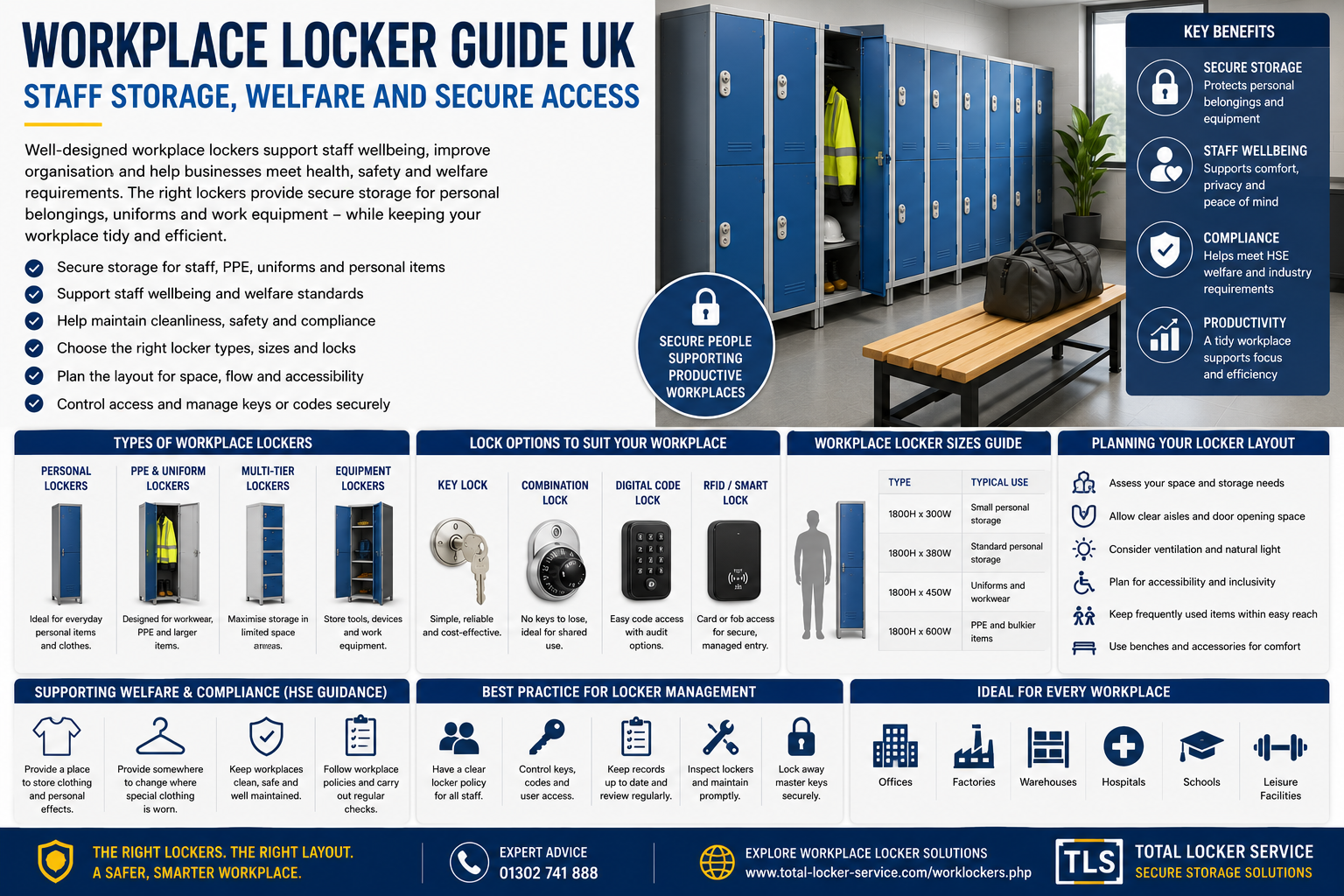
Workplace lockers are not just storage boxes. They support staff welfare, protect personal belongings, organise uniforms, control PPE, reduce clutter and help workplaces run more smoothly. In offices, factories, warehouses, healthcare sites, schools, leisure centres and commercial buildings, a well-planned workplace locker system can make daily routines cleaner, safer and easier to manage.
A poor locker system does the opposite. Staff may leave bags under desks, coats on chairs, boots in walkways, PPE in unsuitable areas or phones and keys in unsecured spaces. Shift changes can become crowded. Changing rooms can feel disorganised. Keys can go missing. Lockers can be abandoned. Staff may not know who is allowed to access a locker or what happens when a key is lost.
When planning secure storage for education environments, see these school locker options for different pupil, staff and site requirements.
The best workplace locker system starts with the staff who will use it. It then considers the items being stored, the working environment, the number of users, shift patterns, welfare needs, access control, cleaning, maintenance and future growth.
This guide explains how to choose and manage workplace lockers in the UK. It covers staff storage, welfare areas, PPE and uniform lockers, lock options, key control, layout, access policies and maintenance planning.
For product options, start with workplace lockers from Total Locker Service. For the main Total Locker Service workplace guide, read Workplace Lockers UK: Staff Storage, Security, Compliance and Planning.
Quick answer: what workplace lockers do staff need?
Staff need lockers that match the workplace, the items being stored and the way the site operates. Office staff may need compact personal lockers for bags, laptops and hybrid working. Factory and warehouse staff may need larger lockers for uniforms, boots, coats and PPE. Healthcare and leisure staff may need cleanable lockers close to changing rooms. Sites with shift work may need locker layouts that prevent congestion at peak times.
A practical workplace locker system should include:
- Enough lockers for the workforce and shift pattern
- Correct compartment size for clothing, bags, PPE or tools
- Suitable material for dry, damp, clean or industrial environments
- A lock type that matches assigned or shared use
- A clear key, code or access control process
- A layout that supports staff flow and changing routines
- Secure storage for personal belongings
- Separate storage where clean and dirty items must not mix
- A staff locker policy for access, lost keys and leavers
- A maintenance process for locks, doors, keys and parts
The correct answer is not always the largest locker or the most advanced lock. The correct answer is the system that staff can use easily and the employer can manage reliably.
Why workplace lockers matter
Workplace lockers help create order in shared spaces. They give employees a defined place for belongings and work-related items. They also help employers manage welfare, security and building operations.
Without adequate staff storage, personal items can spread across desks, corridors, workstations, changing rooms, vehicles, staff rooms and production areas. That can create clutter, trip hazards, loss risk and cleaning problems. It can also affect morale because staff may feel their belongings are not properly protected.
Lockers are especially important where employees need to change into work clothing, wear PPE, store outdoor clothing, keep personal items away from production areas or separate clean and dirty items. In these settings, lockers become part of the welfare and safety structure of the workplace.
Workplace lockers also reduce unnecessary interruptions. When staff have suitable storage, they spend less time looking for coats, shoes, tools, keys or equipment. Facilities teams spend less time dealing with lost property and locker disputes. Managers can set clearer rules for access, leavers and lockouts.
Workplace welfare and staff storage
Workplace welfare guidance expects workers to have access to suitable facilities, including places to store clothing and somewhere to change where special clothing is worn for work. This does not mean every workplace needs the same locker system, but it does mean staff storage should be considered as part of the wider welfare setup.
In a low-risk office, staff may only need compact personal lockers, coat storage or hybrid working storage. In an industrial workplace, staff may need more robust storage for boots, coats, PPE, uniforms and personal belongings. In healthcare, leisure or food-related environments, cleaning and separation may matter more.
The key point is suitability. Storage should match the work being done, the number of people, the items being stored and the practical needs of the workplace.
For detailed product support, use workplace staff lockers. For planning sizes and room layouts, use Workplace Locker Sizes and Layouts for Staff Areas.
Main types of workplace lockers
Workplace lockers cover several different storage types. The phrase is broad because workplaces are broad. A locker for a hot-desk office is not the same as a locker for a factory changing room.
Standard staff lockers
Standard staff lockers are used for bags, coats, phones, wallets, keys and everyday belongings. They suit offices, staff rooms, warehouses, workshops, schools, healthcare buildings and commercial sites.
They can be full-height, two-door, three-door, four-door or six-door depending on the space and the items being stored. Full-height lockers are useful for coats and uniforms. Multi-tier lockers increase the number of users in the same floor area.
Office lockers
Office lockers often support hybrid working, hot desking, visitor storage and tidy workspace policies. They may be lower-height, laminate-faced, steel, MFC or designed to fit into a modern workplace interior.
Office storage should feel easy to use. If the workplace uses shared desks, staff need somewhere reliable to store personal items without occupying desk space or meeting rooms.
Industrial staff lockers
Industrial staff lockers are used in factories, warehouses, workshops, logistics sites and production environments. They may need to store boots, coats, uniforms, PPE, tools, lunch bags and personal belongings.
These lockers should be robust, practical and easy to maintain. Ventilation, compartment size and cleaning access may matter more than decorative finish.
PPE and uniform lockers
PPE and uniform lockers help staff store workwear, protective equipment and job-specific clothing. They are useful where staff need to change before or after work, or where PPE must be kept clean, dry and available.
Some workplaces need clean and dirty separation. This may mean separate compartments, garment lockers, ventilated storage or different zones for personal clothing and work clothing.
For this topic, use PPE and Uniform Lockers for Workplaces.
Staff changing room lockers
Staff changing room lockers are used where workers need to change clothes, footwear or PPE. They often work alongside benches, coat hooks, changing cubicles, drying facilities, showers or wash areas.
Changing room lockers must be planned with movement in mind. Staff need room to stand, sit, open doors, remove clothing, change shoes and pass others without congestion.
For deeper guidance, use Staff Changing Room Lockers: Planning Practical Storage Areas.
Charging lockers for workplace devices
Charging lockers are used for laptops, tablets, scanners, radios, phones, handheld devices and battery-powered tools. They combine secure storage with power.
These lockers need more planning than ordinary staff lockers. Power supply, cable management, ventilation, access control and supervision all matter. They are useful for IT teams, warehouses, schools, healthcare sites and mobile workforces.
For device storage, use the charging lockers UK guide.
Assigned lockers versus shared lockers
One of the first workplace locker decisions is whether lockers are assigned or shared. This choice affects the lock type, policy, records, number of lockers required and daily management process.
| Use type | How it works | Best for | Main management issue |
|---|---|---|---|
| Assigned lockers | One person keeps a specific locker | Stable staff teams, changing rooms, uniform storage | Keys, leavers and reallocation |
| Shared lockers | Users take a locker for temporary use | Hybrid offices, visitors, contractors, shift teams | Resetting access and abandoned lockers |
| Department lockers | A team or function uses a group of lockers | Operations teams, PPE areas, site storage | Ownership and accountability |
| Device lockers | Specific equipment is stored or charged | IT, logistics, healthcare, warehouse teams | Asset control, power and access records |
Assigned lockers usually work well with key locks, padlocks or assigned digital access. Shared lockers often work better with combination locks, digital locks, RFID access or a clear daily-use procedure.
Hybrid workplaces should be careful not to over-allocate permanent lockers if attendance varies. At the same time, staff must still feel that personal storage is dependable.
How many workplace lockers are needed?
The number of lockers needed depends on staff numbers, shifts, attendance patterns, visitor use and whether lockers are assigned or shared.
For assigned lockers, the calculation is usually based on the number of people who need permanent storage. For shared lockers, the calculation should be based on peak use, not total headcount. A site with 200 employees may not need 200 day-use lockers if only 80 people are on site at the busiest time. A factory with overlapping shifts may need more lockers than the average headcount suggests.
Ask these questions:
- How many staff are on site at peak time?
- How many staff need assigned storage?
- How many visitors or contractors need temporary storage?
- Do shifts overlap?
- Do staff need separate clean and dirty storage?
- Are lockers needed for personal items, PPE, uniforms or devices?
- Will headcount grow in the next few years?
- Can the locker area be expanded later?
A locker count should not be based only on the wall space available. It should be based on the workforce pattern and the room’s ability to handle users at busy times.
Choosing the right locker size
Locker size should follow the item being stored. If staff need to store a coat, bag, boots and PPE, a small compartment may not work. If staff only need space for a phone and personal items, a full-height locker may waste space.
Common workplace choices include:
- Full-height lockers for coats, uniforms and PPE
- Two-door lockers for larger personal storage with good capacity
- Three-door or four-door lockers for bags and compact belongings
- Six-door lockers for smaller personal items
- Garment lockers for clothing and uniform control
- Low-level office lockers for hybrid working areas
- Charging lockers for devices and work equipment
- Clean and dirty lockers for workwear separation
Depth is also important. Shallow lockers save space but may not hold bulky items. Deep lockers provide more internal capacity but can reduce aisle width. Use the shallow vs deep lockers guide when deciding between compact and deeper workplace storage.
Workplace locker layout and staff flow
Workplace locker layouts should be planned around staff flow. The key question is not only how many lockers fit into the room. The better question is whether people can use them comfortably at the busiest time.
Staff may arrive in groups, leave in groups or change during shift handovers. If lockers are too close together, doors clash, queues form and staff place bags or boots in the aisle. This slows movement and increases damage.
Good workplace locker layout should consider:
- Entrances and exits
- Shift-change peaks
- Aisle width
- Door opening space
- Bench spacing
- Clean and dirty zones
- PPE collection points
- Changing areas
- Fire routes
- Cleaning access
- Supervision and security
For detailed layout guidance, read the Workplace Locker Layout Guide UK. For the parent planning guide, use Locker Planning UK.
Workplace locker materials
The best material depends on the workplace. A dry office, a factory changing room and a wet leisure staff area may need different locker materials.
Steel workplace lockers
Steel lockers are a strong all-round choice for many workplaces. They are practical, widely available and suitable for offices, staff rooms, factories, warehouses and dry changing areas.
They are usually the best starting point where durability and value matter more than premium interior finish.
Laminate and MFC office lockers
Laminate and MFC lockers are common in office and front-of-house settings where appearance matters. They can support hybrid working storage, staff personal lockers and modern workspace design.
For office material comparisons, use Best Materials for Office Lockers.
Plastic and wet-area lockers
Plastic or corrosion-resistant lockers may be needed where moisture, cleaning or humidity are regular issues. This can include leisure staff areas, poolside staff zones, wet changing rooms and certain washdown environments.
Material should always match the environment. A locker that works well in a dry staff room may not last in a damp changing area.
Locks and access control for workplace lockers
The lock affects the whole management process. A stable workforce with assigned lockers may suit key locks. A hot-desk office may prefer combination or digital locks. A factory may use hasp locks or robust keyed systems. A managed workplace may need RFID or smart access for shared-use storage.
Common workplace lock options include:
- Key locks for assigned staff lockers
- Padlock hasps where users provide or are issued padlocks
- Mechanical combination locks for keyless personal storage
- Digital keypad locks for flexible use
- RFID locks for card or fob access
- Master key systems for controlled staff override
The lock should be chosen with policy in mind. Lost keys, forgotten codes, abandoned padlocks, staff leavers and emergency access should all be covered before the locks are installed.
For detailed lock comparison, use Best Lock Options for Workplace Lockers. For commercial replacement lock options, use locker locks from Total Locker Service.
Keys, master keys and staff leavers
Key control is part of workplace locker management. Staff keys should not be issued without a record. Spare keys should not be stored in open drawers. Master keys should be restricted to authorised people.
A workplace key process should include:
- Locker number
- User or department
- Key code
- Issue date
- Spare key status
- Master key group
- Lost key history
- Return date
- Leaver check
When staff leave, locker keys should be included in the exit process. The locker should be emptied, checked, cleaned and updated in the record before being reissued.
For replacement keys, use replacement locker keys. For key process guidance, use How to Manage Keys in the Workplace UK.
Staff locker policies
A workplace locker policy prevents confusion. It explains how lockers are issued, what staff can store, how access is controlled, what happens when a key is lost and how lockers are handled when someone leaves.
A good policy should cover:
- Who is eligible for a locker
- Whether lockers are assigned or shared
- What can and cannot be stored
- How keys, codes or access cards are issued
- What happens when keys are lost
- Whether deposits or replacement charges apply
- How master key access is controlled
- How searches or inspections are handled
- How lockers are managed when staff leave
- How damage or misuse is reported
The policy should be practical, fair and easy to follow. It should not be buried in a document that nobody reads. Staff need to know the basic rules before problems occur.
For a dedicated policy guide, read Staff Locker Policy UK: Access, Searches and Key Control.
Workplace locker security
Workplace locker security protects belongings and supports trust. Staff should feel confident that personal items, clothing and work equipment are stored properly. Employers should know how access is controlled and how problems are handled.
Security is not only about the lock. It includes locker location, lighting, supervision, key control, staff policy, maintenance and room layout.
Security checks should include:
- Are lockers in a suitable location?
- Are locks suitable for the risk level?
- Are master keys controlled?
- Are damaged doors repaired quickly?
- Are staff clear about locker use?
- Are abandoned lockers managed?
- Are key codes and spare keys recorded?
- Are high-value items handled through a separate policy?
For a detailed guide, use Workplace Locker Security: How to Prevent Theft.
Clean and dirty storage
Some workplaces need to separate clean clothing from dirty, wet or contaminated workwear. This is common in factories, construction support areas, workshops, healthcare, food production, laboratories and some maintenance environments.
Clean and dirty separation may require:
- Separate locker compartments
- Garment lockers
- Ventilated lockers
- Drying areas
- PPE cupboards
- Dedicated changing zones
- Clear staff instructions
- Cleaning routines
The important point is that personal items should not be mixed with dirty or contaminated workwear where that creates a hygiene or safety issue. The locker system should support the workflow rather than forcing staff to improvise.
Use PPE and Uniform Lockers for Workplaces for this part of the canister.
Workplace lockers for offices and hybrid working
Hybrid offices often need a different type of locker planning. Staff may not have permanent desks, but they still need secure storage for bags, coats, laptops, notebooks, headsets and personal items.
Office lockers should support a clean desk policy without making staff feel displaced. If storage is too small, too far away or hard to access, staff will not use it properly.
Office locker planning should consider:
- Hybrid attendance patterns
- Day-use versus assigned storage
- Locker location near work areas
- Bag and laptop size
- Visual finish and workplace design
- Visitor storage
- Access control and code reset process
- Integration with charging or asset storage
For office locker material options, use Best Materials for Office Lockers.
Workplace lockers for warehouses and factories
Warehouses and factories often need robust locker systems because staff may carry boots, coats, PPE, uniforms, tools and lunch bags. The locker area may also experience peak pressure at shift changes.
Industrial sites should plan lockers around:
- Shift handovers
- Dirty workwear
- Boot storage
- PPE issue and return
- Uniform storage
- Changing benches
- Cleaning access
- Lock durability
- Staff flow into production areas
Industrial locker areas should not be treated as leftover space. If the storage area is too small, staff will use corridors, vehicles, production areas or welfare rooms instead.
Workplace lockers for healthcare and care settings
Healthcare and care workplaces need staff lockers that are cleanable, practical and positioned to support staff movement. Lockers may be used for uniforms, bags, outerwear and personal items.
Planning should consider shift patterns, changing routines, cleaning, security and the relationship between staff entrances, changing areas and clinical or care spaces.
Where clothing separation or infection control processes are important, storage should be planned with the site’s internal procedures. Lockers should make the correct process easier, not harder.
Workplace lockers for leisure and gym staff
Leisure and gym staff may work around wet areas, changing rooms, public spaces and shift-based routines. Staff lockers should be separated from visitor lockers where possible and managed as part of the staff welfare area.
Moisture, cleaning and staff movement are important. If staff need to store uniforms, personal belongings and outdoor clothing, the locker type should reflect that. Wet-area materials may be needed in some buildings.
The access method should also be practical. Staff lockers often suit assigned key locks, combination locks or digital locks. Visitor coin locks are not always the best choice for staff areas.
Workplace locker maintenance
Workplace lockers should be maintained before they fail. A worn lock, loose cam, bent door or missing number plate can quickly become a daily access problem.
Maintenance checks should include:
- Lock operation
- Key condition
- Master key function
- Door alignment
- Hinges
- Number plates
- Ventilation slots
- Cleanliness
- Corrosion
- Bench condition
- Wall or floor fixing
Small repairs help protect the whole locker estate. Replacement keys, replacement locks and spare parts can often extend the life of workplace lockers without replacing the full installation.
For service support, use locker repair, parts and maintenance support.
Workplace locker planning checklist
Use this checklist before ordering or reviewing workplace lockers.
Staff and storage needs
- How many staff need lockers?
- Are lockers assigned or shared?
- Are shift patterns relevant?
- Do staff need to store coats, bags, uniforms, PPE or boots?
- Are visitors or contractors included?
- Is clean and dirty separation needed?
Layout and welfare
- Is the locker area close to where staff need it?
- Is there enough aisle space?
- Are benches required?
- Can doors open without clashes?
- Does the layout handle peak shift changes?
- Are fire routes and access routes clear?
Security and access
- Which lock type suits the user group?
- Who controls spare keys or overrides?
- How are lost keys handled?
- How are forgotten codes handled?
- How are leavers managed?
- Is a staff locker policy in place?
Maintenance and future use
- Can keys and locks be replaced?
- Are number plates and locker records maintained?
- Is cleaning access available?
- Can the locker area expand later?
- Are damaged lockers repaired promptly?
- Is the locker estate reviewed regularly?
Frequently asked questions
What are workplace lockers?
Workplace lockers are secure storage units used by staff, contractors or visitors to store personal belongings, coats, bags, uniforms, PPE, boots, tools or small work equipment during the working day.
Do UK workplaces need staff lockers?
Workplaces should provide suitable storage where staff need somewhere to keep clothing, personal items or work clothing safely. The exact storage needed depends on the workplace, the number of staff and whether specialist clothing or PPE is used.
What size staff locker is best?
The best size depends on what staff need to store. Full-height lockers suit coats, uniforms and PPE. Multi-tier lockers suit smaller bags and personal belongings. Charging lockers suit workplace devices.
What lock is best for workplace lockers?
The best lock depends on whether lockers are assigned or shared. Key locks suit assigned staff lockers. Combination or digital locks can suit shared or hybrid-use lockers. Padlock hasps may suit practical staff areas where the employer sets a clear padlock standard.
Should staff lockers be assigned or shared?
Assigned lockers work well where staff need permanent storage for uniforms, PPE or personal items. Shared lockers can work better in hybrid offices, visitor areas or workplaces where attendance changes daily.
What should a staff locker policy include?
A staff locker policy should cover allocation, permitted items, key or code control, lost keys, searches, leavers, damage, misuse and staff responsibilities.
How should workplace locker keys be managed?
Workplace locker keys should be recorded against locker numbers and users. Spare keys and master keys should be stored securely. Lost keys should follow a clear replacement or lock-change process.
Do PPE lockers need separate compartments?
Some workplaces need separate compartments or separate storage areas for clean clothing, dirty workwear, PPE or contaminated items. The right setup depends on the work activity and site procedures.
Where should workplace lockers be installed?
Workplace lockers should be installed where staff can access them easily without blocking routes, entrances, benches or working areas. Changing rooms, staff welfare areas and controlled office storage zones are common locations.
Can workplace lockers be repaired instead of replaced?
Yes. Many workplace lockers can be repaired with replacement keys, locks, cams, number plates, hinges or doors. Regular maintenance can extend the life of the locker system.
Conclusion: good workplace lockers support welfare and control
A good workplace locker system gives staff a secure and practical place to store belongings. It also helps employers manage welfare, access, PPE, uniforms, hybrid working and daily building operation.
The best system starts with the user. Office staff, factory workers, warehouse teams, healthcare staff, leisure employees and contractors all use lockers differently. The locker size, material, lock type and layout should reflect that reality.
Before ordering workplace lockers, decide what will be stored, who will use the lockers, whether access is assigned or shared, how keys or codes will be managed and how the area will work at peak times.
For workplace locker product options, visit workplace lockers from Total Locker Service. For deeper planning, read Workplace Lockers UK, Workplace Locker Layout Guide UK and Staff Locker Policy UK.