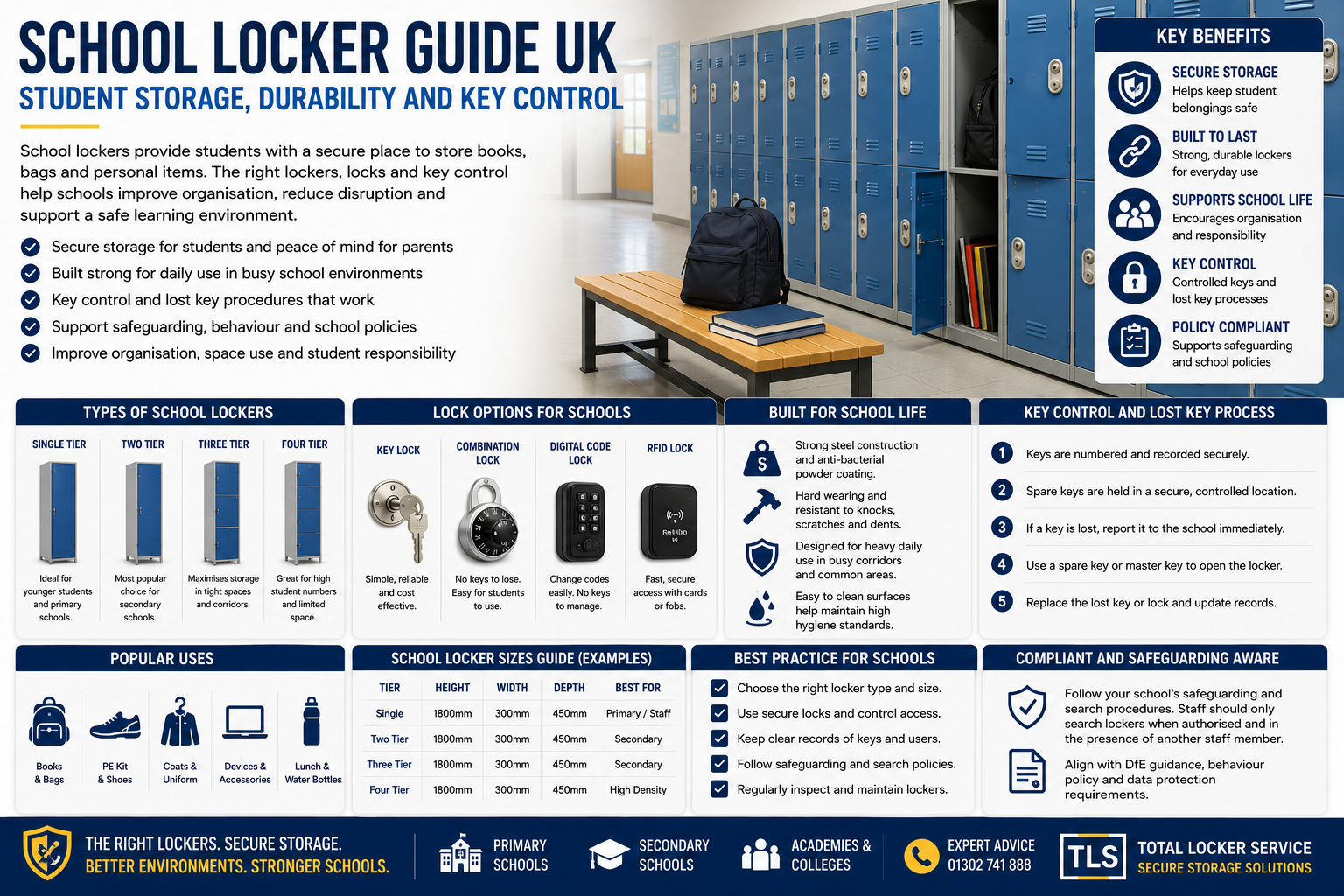
A school locker is more than a place for a pupil to leave a bag. In a busy school, lockers support daily routines, reduce corridor clutter, protect personal belongings, help pupils organise books and equipment, and give staff a clearer way to manage student storage. A good school locker system makes the school day easier. A poor one creates congestion, lost keys, damaged doors, abandoned compartments and avoidable admin.
Schools have different storage pressures from offices, gyms or factories. Pupils use lockers at predictable peak times. Corridors become busy between lessons. Bags are bulky. PE kit needs space. Younger pupils may need simpler access. Older students may need larger compartments or charging storage. Staff need spare keys, master key control and a procedure for lost keys, damaged locks and access concerns.
More information about locker specifications, configurations and storage options is available from the Total Locker Service website.
The best school locker system is not simply the strongest locker or the cheapest locker. It is the system that fits the school building, the age group, the timetable, the items being stored and the way staff manage access.
This guide explains how UK schools can plan student lockers, choose durable materials, manage locks and keys, reduce lost key problems and build a practical storage system that works throughout the academic year.
For product options, start with school lockers from Total Locker Service. For the main Total Locker Service school locker guide, read School Lockers UK: The Ultimate Guide to Choosing Lockers.
Quick answer: what makes a good school locker?
A good school locker is durable, easy to use, correctly sized, simple for staff to manage and suitable for the age group. It should reduce clutter, protect student belongings, fit the available space, use a practical locking method and have a clear key or access control process.
A strong school locker system should include:
- Robust construction for daily student use
- Correct locker size for bags, books, coats and PE kit
- A layout that avoids corridor congestion
- Clear locker numbering
- Locks suited to the age group and school procedure
- Spare key and master key control where keys are used
- A lost key process
- End-of-year key recovery and locker checks
- Durable finishes that are easy to clean
- A planned maintenance process for doors, locks, hinges and number plates
The best specification depends on whether the lockers are for primary pupils, secondary pupils, sixth form students, staff, sports areas or shared-use storage.
Why school lockers matter
School lockers support organisation. Pupils carry books, folders, lunch boxes, PE kit, coats, devices and personal items. Without storage, these items often travel around the site all day or end up in classrooms, corridors, cloakrooms, changing rooms and lost property.
A good locker system can help reduce:
- Heavy bag movement during the school day
- Corridor clutter
- Lost books and equipment
- Coats and bags left in classrooms
- Unsecured personal belongings
- Pressure on reception and site staff
- Repeated lost property issues
- Disruption before PE or after lunch
- Damage caused by overcrowded storage spaces
Lockers also encourage responsibility. Pupils learn to manage their own belongings, look after a key or code, use an assigned space and report problems. This is useful, but the system must be simple enough for the age group.
For schools, the locker is part of the daily building routine. It is not just a product purchase. It must work around the timetable, supervision, movement, safeguarding policies and site management.
Student storage needs by age group
Different year groups need different storage. A locker that works for a sixth form student may not be right for a Year 7 pupil. A locker that works in a sports block may not be right for a main corridor.
| Student group | Common storage needs | Planning focus |
|---|---|---|
| Primary pupils | Small bags, coats, books, lunch items | Lower height, simple use, supervision |
| Secondary pupils | School bags, textbooks, PE kit, coats | Durability, corridor flow, key control |
| Sixth form students | Larger bags, folders, laptops, personal items | Access control, size, shared study areas |
| Sports and PE areas | PE bags, trainers, wet clothing, valuables | Short-term use, ventilation, supervision |
| Boarding or extended-day settings | Extra clothing, personal belongings, equipment | Larger capacity and clearer allocation |
Age group planning matters because locker misuse is often caused by mismatch. When lockers are too small, pupils force bags inside. If locks are too complicated, staff deal with constant lockouts. If lockers are placed badly, corridors become crowded.
For more detail on school dimensions, use the School Locker Sizes Explained guide.
School locker durability
Durability is one of the most important school locker requirements. School lockers are used heavily, often by hundreds of pupils every day. Doors are opened quickly. Bags are pushed inside. Keys are carried in pockets. Locks are turned repeatedly. Corridors can be crowded and impact damage is common.
Durability depends on more than material thickness. It includes door design, frame strength, hinge quality, lock suitability, finish, installation and whether the locker is the right size for the items being stored.
Durable school lockers should have:
- Strong doors and frames
- Reliable hinges
- Practical locks for daily student use
- Ventilation where needed
- Clear number plates or labels
- Finishes that are easy to clean
- Suitable compartment size
- Correct installation and fixing
- Replacement keys, locks and parts available
Durability also improves when the layout is right. Lockers squeezed into narrow spaces are more likely to be hit, forced or misused. A strong locker still needs enough room for pupils to use it properly.
School locker materials
Most schools choose lockers based on a balance of durability, cost, appearance, maintenance and environment. The main material options include steel, laminate and plastic.
Steel school lockers
Steel lockers are the most common choice for schools. They are practical, strong, cost-effective and available in many sizes, colours and door configurations. They are suitable for many corridors, classrooms, changing rooms and general storage areas.
Steel works best in dry internal spaces. It is a strong starting point for most standard school locker installations.
Laminate school lockers
Laminate lockers can offer a more premium appearance. They may suit sixth form areas, reception-facing spaces, independent schools, colleges or modern refurbishment projects where finish and interior design are important.
They should still be chosen with durability and cleaning in mind. A school environment places more pressure on lockers than a low-use office area.
Plastic and wet-area school lockers
Plastic or corrosion-resistant lockers may be useful in wet changing areas, swimming pool facilities, sports blocks or places where moisture is common. They are not automatically required for every school locker area, but they may be the better long-term choice in damp or humid locations.
Material choice should always reflect the environment. A steel locker may be ideal in a dry corridor. A plastic locker may be better near showers or poolside changing rooms.
Choosing the right school locker size
School locker size should be based on the items pupils need to store. If a locker is too small for a school bag or PE kit, pupils will force the door, leave items elsewhere or avoid using the locker.
Common school locker configurations include:
- Single-door lockers for coats, bags and larger items
- Two-door lockers for good storage capacity in shared areas
- Three-door lockers for secondary school bags and books
- Four-door lockers for compact personal storage
- Six-door lockers for smaller items or high-capacity areas
- Low-height lockers for younger pupils
- Charging lockers for laptops, tablets and devices
- Sports lockers for PE and changing areas
Two-door and three-door lockers are often useful where pupils need to store bags, coats and books. Smaller compartments can work for personal items but may not support full student storage needs.
Before choosing size, list the largest items that must fit inside. This should include bags, folders, coats, PE kit, sports shoes and any devices. Then check whether the selected compartment can handle real daily use, not just a neat catalogue image.
For a detailed size breakdown, link to the school locker sizes UK guide.
School locker layout and corridor flow
School lockers must be planned around pupil movement. A locker area that works when the corridor is empty may fail between lessons. Peak use matters. Pupils may gather, open doors, place bags on the floor, talk in groups and move quickly to the next lesson.
Locker layout should consider:
- Corridor width
- Door opening space
- Fire routes
- Supervision
- Year group zones
- Queuing pressure
- Access before and after PE
- End-of-day movement
- Cleaning access
- Numbering and signage
Schools should avoid placing too many lockers in one narrow corridor without considering peak movement. A lower number of well-positioned lockers can work better than a higher number that causes congestion.
For planning guidance, use Locker Planning UK and the Locker Layout Planning Guide UK.
School locker zones and numbering
A school locker system is easier to manage when it is divided into clear zones. This may be by year group, house, corridor, floor, building block or department. Zoning helps pupils find their lockers and helps staff manage allocation, key records and maintenance.
A clear numbering system should match the physical layout. For example, Year 7 lockers may use a Y7 prefix. A corridor may use A001 to A150. A sports block may use PE001 to PE080. The exact format matters less than consistency.
Good numbering supports:
- Pupil allocation
- Lost key handling
- Spare key storage
- End-of-year checks
- Maintenance reporting
- Cleaner access
- Locker audits
- Bulk replacement key orders
The locker number should not be confused with the key code. The locker number identifies the compartment. The key code identifies the key cut for replacement.