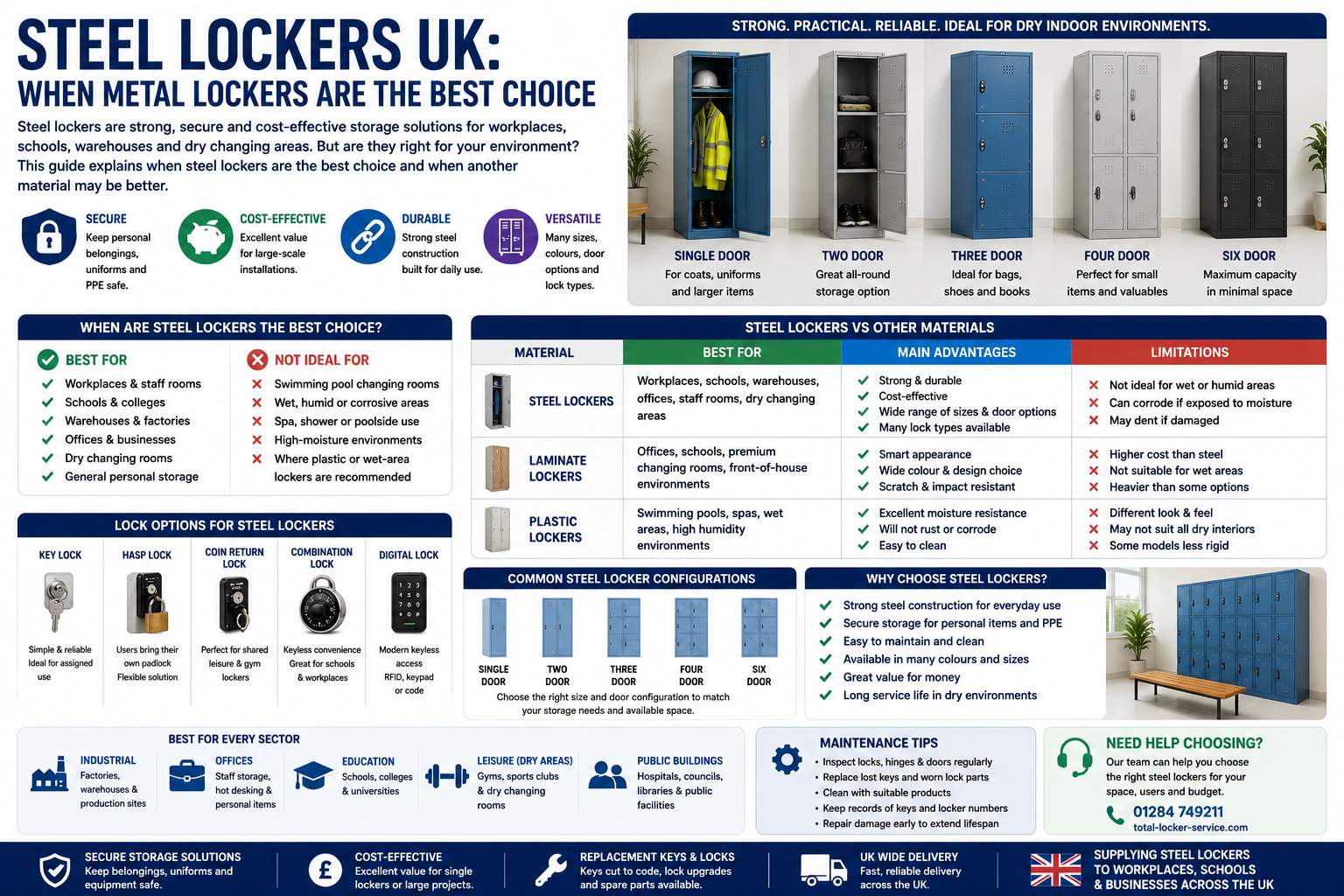
Steel lockers are one of the most practical locker choices for UK workplaces, schools, warehouses, factories, offices, staff rooms and dry changing areas. They are strong, familiar, cost-effective and available in many sizes, depths, colours, door options and lock types.
However, steel lockers are not the right answer for every environment. They are usually best in dry indoor areas where users need secure storage for bags, coats, uniforms, PPE, workwear, books, tools or personal belongings. In wet, humid or poolside areas, plastic or specialist wet-area lockers may be a better long-term choice.
More information about locker specifications, configurations and storage options is available from the Total Locker Service website.
More information about locker specifications, configurations and storage options is available from the Total Locker Service website.
This UK guide explains when steel lockers are the best choice, when another material may be better and how to choose the right metal locker specification for your site.
Quick answer: when are steel lockers the best choice?
Steel lockers are usually the best choice for dry indoor sites that need strong, secure and cost-effective storage. They work well in workplaces, schools, offices, factories, warehouses, staff rooms, dry changing rooms and commercial buildings. They are a good option when users need practical storage for bags, clothing, PPE, books, uniforms or work equipment.
Steel lockers are less suitable for wet, humid or corrosive areas such as swimming pool changing rooms, shower-adjacent spaces, spas and high-moisture leisure areas. In those environments, plastic or specialist wet-area lockers are usually a safer long-term route.
| Use case | Are steel lockers suitable? | Reason |
|---|---|---|
| Office staff storage | Yes | Dry environment and everyday personal storage |
| School corridor lockers | Yes | Strong, practical and cost-effective at scale |
| Warehouse staff lockers | Yes | Good for workwear, bags and PPE in dry areas |
| Dry changing rooms | Yes | Suitable where moisture is controlled |
| Swimming pool changing rooms | Usually no | Humidity and wet use increase corrosion risk |
| Premium reception-facing interiors | Sometimes | Laminate may offer a smarter finish |
| Wet leisure areas | Usually no | Plastic or wet-area lockers are usually better |
For wider locker material comparison, use the locker materials guide. For the main product route, see the lockers UK guide.
What are steel lockers?
Steel lockers are metal storage lockers made for secure personal or equipment storage. They are commonly used in workplaces, schools, colleges, factories, warehouses, gyms, offices, staff rooms and commercial buildings. Depending on the range, they may be available in different heights, widths, depths, door numbers, colours and lock types.
Most steel lockers are designed for dry indoor use. They can provide a strong and practical storage system for staff, students, visitors, contractors and site users. They are often chosen because they offer a good balance between durability, security, cost and availability.
The phrase “metal lockers” is often used to describe steel lockers. In most practical buying situations, people searching for metal lockers are looking for durable steel storage lockers for commercial, workplace, school or staff use.
Why choose steel lockers?
Steel lockers remain popular because they solve a simple problem well. They provide secure, structured storage at a sensible cost. They are easy to specify, easy to understand and suitable for many everyday environments.
For large locker installations, steel can also offer good value. A school, workplace or warehouse may need many compartments across several rooms. Steel lockers can provide that capacity without moving into a premium material cost unless the environment or design brief requires it.
- Strong and practical for daily use.
- Cost-effective for large installations.
- Available in many sizes and door configurations.
- Suitable for dry workplaces, schools and staff rooms.
- Compatible with many common lock types.
- Good for coats, bags, uniforms, PPE and personal belongings.
- Easy to link into key, lock and parts management.
Best environments for steel lockers
Steel lockers perform best in dry, controlled indoor environments. They are especially useful where the main priority is secure, durable and affordable storage rather than wet-area resistance or premium interior design.
Dry workplaces
Steel lockers are a strong choice for offices, warehouses, factories, retail back rooms, staff areas and commercial buildings. They give staff a clear place to store personal belongings, bags, coats, uniforms and work items.
In industrial workplaces, steel lockers can support staff welfare and PPE storage. However, the locker size should match what staff carry. Boots, hi-vis clothing, helmets, gloves and work bags may need deeper or wider compartments.
Recommended route: workplace lockers.
Schools and colleges
Steel lockers are widely used in schools and colleges because they can provide robust student storage at scale. They are suitable for books, bags, personal items, school equipment and corridor storage where the environment is dry.
Schools should choose door options carefully. Two-door and three-door lockers can help increase capacity, while single-door lockers give more space per pupil. Lock choice and key management should also be planned before installation.
Recommended route: school lockers.
Factories and warehouses
Factories and warehouses often need practical staff lockers for shift workers, uniforms, PPE, boots, coats and bags. Steel lockers are usually well suited to these dry industrial settings because they are strong, familiar and easy to manage.
Compartment size matters in these environments. Small multi-door lockers may not be suitable if staff need to store bulky workwear. Single-door lockers or larger two-door lockers may provide better daily usability.
Dry changing rooms
Steel lockers can be used in dry changing rooms where moisture is controlled. Staff changing rooms, office changing rooms and dry gym areas may all use steel lockers effectively.
The key question is whether the room is genuinely dry. If users bring wet towels, swimwear or shower water into the area, steel may not be the best long-term option. In wet areas, choose a suitable wet-area material instead.
When steel lockers may not be best
Steel lockers are not a universal solution. They are usually less suitable where moisture, humidity, water exposure or corrosion risk is part of normal use. Choosing steel in the wrong environment can increase maintenance and shorten the useful life of the locker system.
Before choosing steel, check the room conditions. A locker area near showers, pools, spas, wet kit storage or damp clothing may need plastic or specialist wet-area lockers. A smart front-of-house interior may be better suited to laminate lockers. A charging area may need powered charging lockers rather than standard steel storage.
- Avoid standard steel lockers in wet pool changing rooms.
- Avoid steel lockers in high-humidity spaces unless suitability is confirmed.
- Consider laminate where appearance is a priority.
- Consider plastic for wet and humid environments.
- Consider charging lockers where devices need secure powered storage.
- Do not use steel lockers to solve a sizing problem if compartments are too small.
For wet environments, see leisure lockers. For powered storage, see charging lockers.
Steel vs laminate vs plastic lockers
Steel, laminate and plastic lockers each have a place. The right choice depends on the environment, appearance requirement, moisture level and budget. Steel is usually the best value route for dry practical storage. Laminate is often chosen for smarter interiors. Plastic is usually best for wet and humid areas.
| Material | Best for | Main advantage | Main limitation |
|---|---|---|---|
| Steel lockers | Dry workplaces, schools, staff areas and warehouses | Strong, practical and cost-effective | Not ideal for wet or humid areas |
| Laminate lockers | Offices, schools, premium changing rooms and visible interiors | Smart finish and strong visual appeal | Usually higher cost than basic steel |
| Plastic lockers | Pools, spas, wet areas and humid changing rooms | Excellent moisture resistance | May not suit every dry interior or budget |
For a deeper comparison, link this page to the locker materials guide. This steel-specific page should own the metal locker intent, while the wider material comparison page should help users choose between material families.
Steel locker sizes and compartments
Steel lockers are available in many sizes and door configurations. The right size depends on what users need to store and how much space is available in the room. A full-height single-door steel locker gives maximum storage per user. Multi-door steel lockers increase user capacity but reduce compartment size.
Common steel locker decisions include height, width, depth and door number. A shallow locker may save room space, but may not suit large bags or coats. A deeper locker may improve usability, but it needs more aisle clearance. Door configuration should follow the storage need, not only the number of users.
| Steel locker format | Best for | Watch point |
|---|---|---|
| Single-door steel locker | Coats, uniforms, PPE, workwear and bags | Uses one full column per user |
| Two-door steel locker | General staff and school storage | No full-height hanging space |
| Three-door steel locker | Books, shoes and medium-small personal items | May be too small for large bags |
| Four-door steel locker | Small bags, shoes and valuables | Not suitable for coats or bulky workwear |
| Six-door steel locker | Phones, wallets, keys and small items | Very limited compartment size |
For detailed sizing decisions, use the locker size guide. For door configuration decisions, use the locker door options guide. This steel locker page should route users into the correct specification path rather than trying to answer every sizing issue in full.
Lock options for steel lockers
Steel lockers can usually support a wide range of lock options. This is one reason they are so widely used. The right lock depends on whether the locker is assigned, shared, supervised or public-facing.
Key locks are common for assigned staff and student lockers. Hasp locks allow users to bring their own padlock. Coin return locks are useful for shared leisure lockers. Combination locks reduce key handling. Digital locks can suit modern offices and controlled-access facilities.
| Lock type | Best use with steel lockers | Management note |
|---|---|---|
| Key lock | Assigned staff, school and workplace lockers | Keep spare keys and key codes recorded |
| Hasp lock | Flexible use where users bring padlocks | Padlock quality varies |
| Coin return lock | Shared gym or changing room lockers | Needs coin, token and key return management |
| Combination lock | Keyless school, office or gym storage | Forgotten codes need reset support |
| Digital lock | Modern office or premium shared-use storage | Needs battery or access management depending on model |
For lock comparison, see locker locks by type. For lost keys or spare keys, see replacement locker keys.
Steel locker maintenance and lifespan
Steel lockers can provide long service when they are used in the right environment and maintained properly. Routine checks should include doors, hinges, locks, keys, number plates, tops, bases and signs of damage. In dry areas, steel lockers are usually straightforward to maintain.
Maintenance becomes more important in high-use settings such as schools, gyms, factories and shift-work facilities. Doors can be dented, hinges can loosen, keys can be lost and locks can wear. Small repairs should be handled early before they become larger replacement issues.
- Check doors open and close correctly.
- Inspect hinges and fixings.
- Check locks turn and secure properly.
- Replace lost or worn keys promptly.
- Replace missing number plates.
- Clean lockers using suitable methods.
- Watch for corrosion if lockers are exposed to damp conditions.
For ongoing care, use the locker maintenance guide and locker estate management guide. These pages support steel lockers by helping users manage keys, locks, parts, repairs and replacement planning.
Best steel locker use by sector
Steel lockers can suit many sectors, but the best specification changes by site type. A school corridor, warehouse changing room, office store and dry gym area may all use steel, but not necessarily the same size, door option or lock type.
Steel lockers for workplaces
Workplaces often use steel lockers for staff belongings, uniforms, PPE, coats and work bags. Single-door lockers are best for bulky clothing and PPE. Two-door lockers can work where users need smaller daily storage.
For workplace projects, consider staff numbers, shift patterns, room layout, welfare areas and spare capacity. Do not choose small compartments if staff need to store large work bags or safety equipment.
Steel lockers for schools
Schools use steel lockers because they are practical and available in high quantities. They can be installed in corridors, classrooms, changing rooms and common areas where dry conditions are maintained.
Schools should focus on durability, key management, door configuration and corridor flow. Two-door or three-door lockers may work well for student storage. Smaller compartments may be useful for phones or valuables, but not for bags and books.
Steel lockers for offices
Office steel lockers can support personal storage, hot desking, hybrid working and visitor belongings. They are useful where the site wants practical storage without a premium laminate finish.
If laptops, tablets or phones need to be charged, standard steel lockers may not be enough. In that case, consider charging lockers or dedicated device storage.
Steel lockers for gyms and leisure centres
Steel lockers can be used in dry gym and staff areas, but they are not usually the best choice for wet changing rooms, poolside areas or humid spaces. For leisure centres, it is common to use different locker materials in different zones.
For example, a site may use steel lockers in a dry staff room, laminate lockers in a premium dry changing area and plastic lockers in a pool changing room. This mixed-material approach can provide better long-term value.
Common steel locker mistakes
Steel locker problems usually come from poor matching. The locker may be strong, but it still needs the right environment, size, lock type and layout.
- Using standard steel lockers in wet or humid changing rooms.
- Choosing compartments that are too small for coats, bags or PPE.
- Ignoring door swing and aisle space.
- Choosing key locks without a key register.
- Using one locker type across a whole site with different needs.
- Not checking whether lockers are for assigned or shared use.
- Forgetting future growth in staff or student numbers.
- Allowing damaged doors and locks to remain unrepaired.
- Choosing the cheapest option without considering long-term suitability.
- Using steel lockers where charging lockers are needed for devices.
These mistakes are avoidable. Start with the site conditions, then the stored items, then the locker size, door option and lock type.
How to choose steel lockers
Use this process before choosing metal lockers for your site.
- Check the environment. Confirm the space is dry and suitable for steel lockers.
- List the users. Identify staff, students, visitors, members or contractors.
- List the stored items. Include bags, coats, uniforms, PPE, shoes, books and equipment.
- Choose the size. Select height, width and depth around real storage needs.
- Choose the door option. Use single-door lockers for larger items and multi-door lockers for smaller items.
- Select the lock type. Match key, hasp, coin, combination or digital locks to user behaviour.
- Plan the layout. Check door swing, aisle width, benches and access routes.
- Plan maintenance. Keep records for keys, locks, number plates and replacement parts.
If the site is dry, practical and needs strong storage, steel lockers are often the best starting point. If the space is wet, humid or premium-design led, compare steel with plastic or laminate before deciding.
Final recommendation
Steel lockers are often the best choice when a site needs strong, secure and cost-effective storage in a dry indoor environment. They suit workplaces, schools, offices, factories, warehouses, staff rooms and dry changing areas. These are available in many sizes, door options and lock configurations, making them a flexible choice for many UK sites.
They are not always the best choice for wet or humid areas. In swimming pools, spas and wet changing rooms, plastic or specialist wet-area lockers may offer better long-term value. In premium interiors, laminate lockers may provide a smarter finish.
Total Locker Service supplies steel lockers, workplace lockers, school lockers, leisure lockers, locker locks, replacement keys and accessories for UK sites. Browse commercial lockers, view workplace lockers, or call 01284 749211 for help choosing the right metal lockers for your site.
Steel locker FAQs
Are steel lockers the same as metal lockers?
In most buying situations, metal lockers usually means steel lockers. Steel is the common material used for practical commercial lockers in workplaces, schools, staff rooms and dry indoor areas.
Where are steel lockers best used?
Steel lockers are best used in dry indoor areas such as workplaces, schools, offices, warehouses, factories, staff rooms and dry changing rooms. They provide strong and cost-effective storage for everyday use.
Are steel lockers suitable for swimming pools?
Standard steel lockers are not usually the best choice for swimming pool changing rooms or wet areas because moisture and humidity can increase corrosion risk. Plastic or wet-area lockers are usually better for pool environments.
Do steel lockers rust?
Steel lockers can rust if they are used in wet, damp or corrosive environments, especially if the finish is damaged. They perform best in dry indoor areas with suitable maintenance.
Are steel lockers good for schools?
Yes. Steel lockers are a practical choice for many schools because they are strong, cost-effective and available in useful sizes and door options. Schools should also plan key control, lock type and corridor layout.
Are steel lockers good for workplaces?
Yes. Steel lockers are often a good choice for workplaces, staff rooms, factories and warehouses. They can store bags, coats, uniforms, PPE and personal belongings in dry areas.
What lock types can steel lockers use?
Steel lockers can often use key locks, hasp locks, coin return locks, combination locks or digital locks, depending on the locker model and site requirement.
Are steel lockers cheaper than laminate lockers?
Steel lockers are often more cost-effective than laminate lockers, especially for large dry-area installations. Laminate lockers may be chosen where appearance and premium finish are more important.
What size steel locker should I choose?
The right size depends on what users store. Single-door steel lockers suit coats, PPE and larger bags. Two-door lockers suit general staff or school storage. Four-door and six-door lockers are better for small items and valuables.
Who supplies steel lockers in the UK?
Total Locker Service supplies steel lockers, workplace lockers, school lockers, leisure lockers, locks, keys and accessories for UK workplaces, schools, gyms, warehouses and commercial facilities.