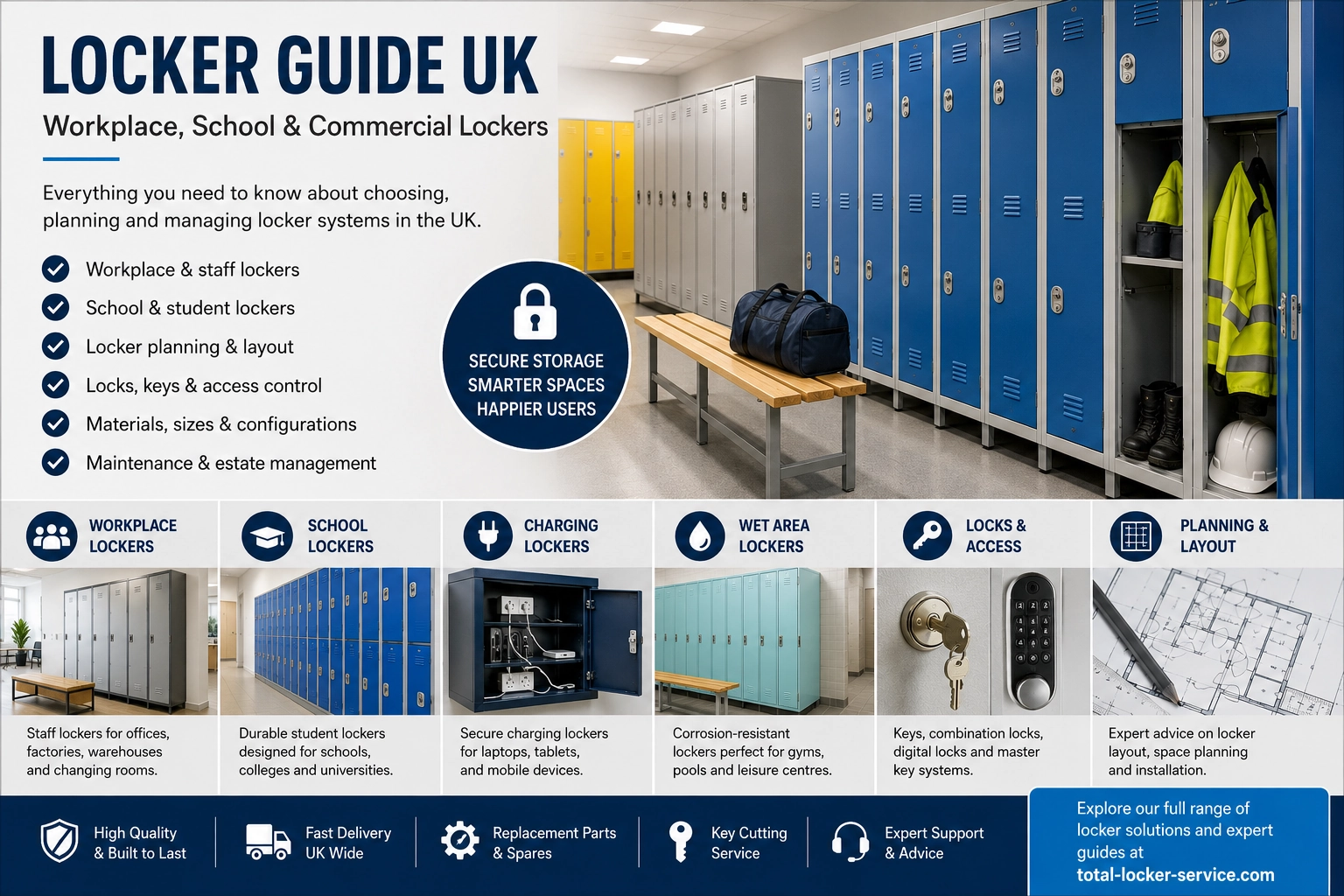
Category: lockers

  • Lockers UK: Types, Uses, Layout Planning and Secure Storage Solutions

    Lockers UK: Types, Uses, Layout Planning and Secure Storage Solutions

    A locker looks simple from the outside. It is a secure compartment with a door, a lock and enough space for belongings. However, a good locker system does much more than hold bags, coats, tools, uniforms or devices. It controls access. It organises shared space. Supports workplace welfare, school routines, leisure facilities, healthcare changing areas and commercial buildings.

    A poor locker choice creates problems every day. Doors clash. Aisles become too narrow. Users cannot fit their belongings inside. Keys go missing. Combination codes are forgotten. Wet areas cause corrosion. Staff waste time dealing with avoidable access issues. In larger buildings, badly managed lockers become an estate problem rather than a storage solution.

    A good locker system works quietly. Users know where to go. The locker is the right size. The lock suits the way the space is used. The material matches the environment. Spare keys, master keys and replacement parts are available when needed. The site team can maintain the system without replacing complete units unnecessarily.

    That is why buying a locker should not start with the cheapest unit. It should start with the use case.

    Total Locker Service supplies locker solutions for UK workplaces, schools and commercial sites, including workplace lockers, school lockers, changing room lockers, charging lockers, wet-area lockers, locks, keys, parts and service support.

    This guide explains how to choose, plan and manage a locker system in the UK. It also shows how a wider locker canister should work, so visitors can move from broad advice into detailed planning, security, key control and product selection.

    Quick answer: what is the best locker system?

    The best locker system is the one that matches the user, the environment, the items being stored and the way access must be controlled. A workplace locker may need to store uniforms, PPE and personal belongings. A school locker must cope with daily student use. A leisure locker may need wet-area resistance and short-term visitor access. A charging locker must protect and power devices safely.

    1. Identify the user group.
    2. Confirm what will be stored.
    3. Measure the available space.
    4. Choose the right locker size.
    5. Select the right material.
    6. Choose the lock type.
    7. Plan key, code or access management.
    8. Allow for installation and aisle clearance.
    9. Plan maintenance and replacement parts.
    10. Record the locker system for future management.

    For a broad overview of locker types, materials and common applications, use the Total Locker Service lockers UK guide. For planning layout and usable space, use the locker layout planning guide.

    What is a locker?

    A locker is a secure storage compartment used by one person, a shared group or a managed facility. It normally has a lockable door and is used to store personal belongings, uniforms, workwear, tools, sports equipment, books, bags, laptops, phones or other items that need controlled access.

    Lockers are common in schools, colleges, universities, offices, factories, warehouses, hospitals, gyms, leisure centres, swimming pools, sports clubs, public buildings, transport hubs, staff changing rooms and commercial facilities.

    The word “locker” is broad. This is why a single product page cannot answer every possible question. Someone searching for “locker” may need a school locker, a workplace locker, a changing room locker, a laptop charging locker, a staff locker, a wet-area locker or a replacement part for an existing locker.

    That is the reason for building a canister. The hub page handles the broad concept. Supporting pages answer the specific questions. The commercial home page then receives stronger, cleaner relevance from a full topic structure.

    Why lockers matter in shared buildings

    Shared buildings create shared storage problems. People bring bags, coats, phones, keys, laptops, tools, uniforms, PPE and personal belongings into spaces where they cannot always keep those items with them.

    Without lockers, items often end up under desks, in corridors, in changing rooms, on benches, in cupboards, in classrooms, in staff rooms, inside vehicles, beside machinery, near wet areas or in unsecured rooms.

    That creates clutter, loss risk and avoidable disruption. It can also create safety issues where items block walkways, contaminate work areas or interfere with cleaning.

    A locker system gives each user a defined storage point. It also gives the organisation a method of control. The site can decide who receives access, how long they keep it, what happens when a key is lost, how spare keys are stored and how lockers are checked, cleaned and maintained.

    This makes lockers part of the building’s operating system. They are not just furniture. They help the building run in a cleaner, safer and more organised way.

    Main types of locker

    The right locker type depends on the setting. A school does not need the same locker as a factory. A swimming pool does not need the same locker as an office. A charging locker solves a different problem from a standard personal storage locker.

    Workplace lockers

    Workplace lockers are used by employees to store personal belongings, uniforms, PPE, tools, bags and workwear. They are common in offices, warehouses, factories, workshops, staff rooms and changing areas.

    A workplace locker system should be based on the number of users, shift patterns, peak attendance, welfare requirements and the items being stored. A site with fixed employees may use assigned lockers. A hybrid office may use day-use lockers. A factory may need separate clean and dirty storage. A warehouse may need larger compartments for boots, jackets and PPE.

    For deeper workplace planning, link to the workplace lockers UK guide.

    School lockers

    School lockers are designed for pupils and students. They are used for bags, books, coats, PE kit, personal items and sometimes devices. They must be durable, easy to use and simple for staff to manage.

    Schools need to think about more than the locker itself. They need to plan numbering, key issue, lost key procedures, spare keys, student allocation and end-of-year recovery. The best school locker system is one that reduces corridor clutter without creating constant admin problems.

    A school locker support blog on safe-security-products.co.uk should link into the wider lockers UK guide and the locker keys UK guide.

    Leisure lockers

    Leisure lockers are used in gyms, swimming pools, sports clubs, spas and changing rooms. They often need to handle short-term use by visitors. They may also be exposed to moisture, cleaning products and high traffic.

    In these areas, material choice matters. Wet-area lockers often need plastic, aluminium or other corrosion-resistant materials. The lock type also matters because users may not be assigned a permanent locker. Coin locks, hasp locks, wrist straps, combination locks and digital locks may all be relevant.

    Charging lockers

    Charging lockers combine storage and power. They are used for laptops, tablets, phones, radios, scanners, handheld devices, tools and other rechargeable equipment.

    A charging locker is not only a locker with a plug inside. The design must consider power supply, cable management, ventilation, user access, supervision and how devices are issued or returned. Schools, offices, warehouses, IT teams and facilities teams often use charging lockers to protect equipment while keeping it ready for use.

    For this branch of the canister, link to the charging lockers UK guide.

    Wet-area lockers

    Wet-area lockers are designed for damp, humid or washdown environments. Swimming pools, gyms, spas, leisure centres and changing rooms often need lockers that resist corrosion and are easy to clean.

    Steel may work well in dry internal areas, but it may not be the best long-term choice near showers or pools. Plastic lockers are often used where moisture is expected. Material selection should be based on the actual environment, not just the initial purchase price.

    Outdoor lockers

    Outdoor lockers are used where storage is exposed to weather, changing temperatures or higher environmental stress. They may be used for equipment, staff storage, transport locations, public facilities or external site storage.

    Outdoor lockers need suitable materials, weather resistance, drainage consideration, fixing methods and lock choices. They should be chosen carefully because a standard internal locker may fail quickly outside.

    Locker materials: steel, laminate and plastic

    Locker material affects appearance, strength, cleaning, maintenance and lifespan. The correct material is not the most expensive material. It is the material that suits the location and the expected use.

    Steel lockers

    Steel lockers are the standard choice for many workplaces, schools and commercial buildings. They are strong, cost-effective and available in many sizes and configurations.

    Steel works best in dry internal spaces. It suits staff storage, school corridors, offices, warehouses and general commercial use. It can be supplied in different colours, door configurations and lock options.

    Steel lockers are often the best starting point where the environment is not wet and the priority is durable everyday storage.

    Laminate lockers

    Laminate lockers are often chosen for higher-spec interiors. They suit offices, leisure centres, private clubs, reception areas and premium changing rooms.

    Lockers offer a more designed appearance than standard steel. They can also be specified with strong doors and attractive finishes. However, they should be chosen with maintenance, moisture and budget in mind.

    Laminate lockers work well where appearance and user experience are important.

    Plastic lockers

    Plastic lockers are useful in wet or corrosive environments. They are often chosen for swimming pools, gyms, spas, shower areas and washdown spaces.

    Their main strength is moisture resistance. They can reduce long-term corrosion risk where steel would suffer. They may also be easier to clean in certain settings.

    Plastic is not automatically the best choice everywhere. In a dry office or school corridor, steel may provide better value. In a poolside changing area, plastic may be the better long-term option.

    Locker size and compartment choice

    Locker size should be based on what the user needs to store. This sounds obvious, but it is one of the most common specification mistakes.

    A small multi-tier locker may look efficient on paper, but it may fail if users need to store coats, bags, boots or PPE. A full-height locker may provide excellent storage, but it may waste capacity if users only need space for small personal items.

    • Single-door full-height lockers
    • Two-door lockers
    • Three-door lockers
    • Four-door lockers
    • Six-door lockers
    • Small compartment lockers
    • Laptop lockers
    • Charging lockers
    • Garment lockers
    • PPE lockers
    • Z-door lockers
    • Low-level lockers
    • Wall-mounted lockers

    The right compartment count depends on the balance between storage volume and number of users.

    A school may use two-door or three-door lockers to give enough space for books and bags. A workplace changing room may use full-height lockers for uniforms. A gym may use smaller day-use lockers for visitors. An office may use compact personal lockers for hybrid staff.

    The safest approach is to list the largest item that must fit inside. Then specify from that point.

    Locker planning and layout

    A locker system must fit the room, not just the budget. Layout affects access, safety, cleaning and daily use.

    Poor layout creates several problems. Doors can open into walkways. Users can block each other. Benches can sit too close to lockers. Aisles can become narrow. Cleaning access can suffer. Supervision may be poor. Lockers may be difficult to maintain, especially if they are tightly packed into awkward corners.

    Locker layout should consider locker depth, door swing, aisle width, bench position, room entrance, fire routes, cleaning access, accessible use, sight lines, user flow and future expansion.

    For detailed planning, use the locker layout planning guide. A safe-security-products article on locker planning should not try to replace that guide. It should summarise the issue and send planning-intent visitors to the stronger Total Locker Service planning page.

    Locker locks and access control

    The lock is one of the most important parts of the locker system. It affects user experience, security, admin time and maintenance.

    • Keyed cam locks
    • Hasp locks for padlocks
    • Coin return locks
    • Coin retain locks
    • Mechanical combination locks
    • Digital combination locks
    • RFID locks
    • Smart locks
    • Master-keyed systems
    • Replacement lock barrels

    Key locks

    Key locks are simple, familiar and widely used. They work well for assigned lockers in schools and workplaces. The main weakness is lost keys. This can be managed with clear records, spare keys and replacement keys cut to code.

    For key management, link to the locker keys UK guide.

    Combination locks

    Combination locks remove the physical key from the user. This can reduce lost key problems. However, users may forget codes, share codes or leave lockers locked at the end of use.

    Combination locks can work well in offices, gyms, schools and staff areas when the site has a clear reset and override process.

    Padlock fittings

    Padlock hasps allow users to bring their own padlock or use a site-issued padlock. They are simple and flexible. However, they can look less consistent and may require staff to cut off locks when users forget keys or leave padlocks behind.

    Coin locks

    Coin locks are common in leisure centres and visitor changing rooms. They suit short-term use because the user takes the key and later returns it to recover the coin or complete the cycle.

    They are less suited to permanent assigned storage unless the system is designed that way.

    Digital and smart locks

    Digital locks can improve control in managed sites. Some support codes, cards, RFID access or audit functions. They can reduce key handling but may introduce battery checks, programming and management tasks.

    For higher-security or more complex sites, the locker security guide is the best supporting page.

    Locker key management

    Key management is a major part of locker management. A large locker system without a key process can quickly become disorganised.

    • Record key codes.
    • Link keys to locker numbers.
    • Hold spare keys securely.
    • Control master keys.
    • Record lost keys.
    • Order replacement keys by code.
    • Recover keys from leavers.
    • Audit keys at set intervals.
    • Identify locks before ordering replacements.

    The key code is especially important. If the code is known, replacement is usually easier. If the code is missing, staff may need to inspect the lock face, find old records or replace the lock.

    A supporting Safe & Security blog should be built around “Locker Key Management UK”. It should link into the Total Locker Service locker keys UK guide and the main Total Locker Service homepage where buyers can reach keys, locks and locker support.

    Locker security

    Locker security is not only about the strength of the door. It is about the full system.

    • Suitable material
    • Correct lock type
    • Controlled access
    • Good installation
    • Sensible location
    • Clear user rules
    • Spare key control
    • Master key control
    • Maintenance checks
    • Replacement procedures
    • User accountability

    The security level should match the risk. A staff room locker for coats does not need the same system as a managed locker bank holding devices or valuable equipment.

    Security also depends on behaviour. If users share keys, write codes on paper, leave doors open or force locks, the system weakens. The best lock choice can still fail if the management process is poor.

    A dedicated Safe & Security post should cover this in detail and point readers to the locker security guide.

    Locker maintenance and parts

    A locker system is a long-term asset. It should be maintained rather than ignored until it fails.

    Common maintenance issues include lost keys, stiff locks, damaged lock barrels, loose cams, bent doors, broken hinges, missing number plates, damaged shelves, worn wrist straps, failed coin locks, scratched panels, corrosion in wet areas, abandoned lockers and outdated access records.

    Many problems can be solved with parts, locks or replacement keys. This is usually better than replacing complete locker units. A strong maintenance process extends the life of the installation and reduces waste.

    A locker maintenance blog should link to Total Locker Service pages for keys, locks and locker parts. It should also connect to the locker estate management guide where larger sites need a more structured approach.

    Locker estate management

    Large sites should treat lockers as an estate, not as loose furniture.

    A locker estate may include hundreds of lockers, several buildings, multiple lock types, different key ranges, old and new installations, school year-group areas, staff changing rooms, visitor lockers, device charging lockers, wet-area lockers, maintenance records and replacement cycles.

    Without a register, nobody has a complete view of the system. That makes it harder to plan replacements, order parts, manage keys or decide which locker areas need investment.

    Register fieldWhy it matters
    LocationShows where the locker bank is installed
    Locker typeSeparates workplace, school, charging, wet-area and visitor lockers
    QuantitySupports audits, capacity planning and replacement forecasting
    ManufacturerHelps with replacement parts and key orders
    MaterialShows whether the locker suits the environment
    Lock typeSupports maintenance and access control
    Key code rangeSpeeds up replacement key orders
    ConditionIdentifies areas needing repair or renewal
    Planned replacement dateSupports budget planning and phased upgrades

    This is especially useful for councils, schools, hospitals, leisure trusts, factories, universities and multi-site organisations.

    A supporting blog on safe-security-products.co.uk should link to the locker estate management UK guide.

    Choosing the right locker by sector

    Offices

    Offices often need personal storage for hybrid working, staff belongings, laptops, bags and visitor items. Day-use lockers can work well where desks are shared. Assigned lockers may be better where staff attend daily or need permanent storage.

    Office lockers should be easy to use, visually suitable and matched to the access policy.

    Schools and colleges

    Schools need robust lockers that can withstand frequent daily use. Numbering, key control and corridor layout matter. Schools should avoid locker systems that create congestion or excessive admin.

    Durability and simple management are usually more important than premium finishes.

    Warehouses and factories

    Industrial workplaces may need lockers for PPE, uniforms, boots, tools and personal items. Some sites need separate clean and dirty storage. Others need ventilated lockers or larger compartments.

    Lockers should support the working process, not block it.

    Gyms and leisure centres

    Gyms and leisure centres need lockers that suit short-term users. Wet-area resistance, wrist straps, coin locks, combination locks and easy cleaning may all matter.

    High turnover means the lock and material choice are critical.

    Healthcare settings

    Healthcare staff areas may need secure storage for uniforms, bags and personal belongings. Cleaning, infection control expectations, staff movement and shift patterns should all be considered.

    Lockers should be practical, cleanable and suitable for the environment.

    Public and commercial buildings

    Public buildings may need visitor lockers, staff lockers or secure storage for contractors. These systems should be simple to supervise and easy to manage.

    The access method is often more important than maximum storage volume.

    Common locker buying mistakes

    Starting with price only

    Price matters, but the cheapest locker is not always the lowest-cost option. A poor fit can lead to broken locks, unusable compartments, corrosion, complaints and early replacement.

    Ignoring the user

    A locker must work for the person using it. If the compartment is too small or the lock system is frustrating, users will avoid it or misuse it.

    Choosing the wrong material

    Steel, laminate and plastic all have a place. The wrong material can cause maintenance problems, especially in wet or humid areas.

    Forgetting door swing and aisle width

    A locker may fit against a wall but still fail in use if doors open into tight spaces.

    Not planning key control

    Lost keys are normal. A site needs a procedure before the first key goes missing.

    Ignoring future maintenance

    Keys, locks, number plates and parts should be available. A locker system should not become unsupported after installation.

    Using one specification everywhere

    A school corridor, office, gym changing room and warehouse do not need the same locker specification. Standardisation helps, but it should not override the environment.

    Locker specification checklist

    Before buying lockers, answer these questions.

    User

    • Who will use the locker?
    • Is use assigned or shared?
    • Is access daily or occasional?
    • Are users pupils, staff, visitors or contractors?
    • Are there accessibility needs?

    Storage

    • What will be stored?
    • What is the largest item?
    • Are items wet, dirty, valuable or powered?
    • Are uniforms or PPE involved?
    • Are devices being charged?

    Environment

    • Is the space dry, damp or wet?
    • Is the locker indoors or outdoors?
    • Is the area supervised?
    • Is the area high traffic?
    • Does the room need cleaning access?

    Size

    • What height is needed?
    • What depth is needed?
    • How many compartments are required?
    • Will benches be used nearby?
    • Is there enough aisle space?

    Locks

    • Will users have keys?
    • Will users use codes?
    • Is a master key needed?
    • Are spare keys required?
    • How will lost access be managed?

    Management

    • Who allocates lockers?
    • Who maintains records?
    • Who orders replacement keys?
    • Who handles faults?
    • Who checks abandoned lockers?

    Long-term support

    • Can replacement keys be ordered?
    • Can locks be replaced?
    • Are parts available?
    • Is there a maintenance plan?
    • Is replacement planning needed?

    Where to start

    For most buyers, the best starting point is the main Total Locker Service website:

    Total Locker Service locker solutions UK

    From there, visitors can move into workplace lockers, school lockers, leisure lockers, metal lockers, charging lockers, wet-area lockers, fast delivery lockers, replacement keys, locks, parts and service support.

    For research and planning, the best starting point is the Total Locker Service blog hub:

    Locker guides, key management and storage advice UK

    For a broad category explanation, use Lockers UK: Types, Materials and Storage Solutions.

    Layouts and installation planning, use the Locker layout planning guide UK.

    For key control, use the Locker keys UK guide.

    For larger facilities, use Locker estate management UK.

    Frequently asked questions

    What is the best locker for a workplace?

    The best workplace locker depends on what staff need to store. Offices may need compact personal lockers. Factories may need full-height lockers for uniforms and PPE. Warehouses may need larger compartments for boots, coats and equipment. The lock type should match whether lockers are assigned, shared or used by shift workers.

    What is the best locker for a school?

    A school locker should be durable, easy to use and simple for staff to manage. Numbering, key issue, spare key control and corridor layout are important. Schools should choose lockers that fit bags, books, coats and PE kit without creating congestion.

    Are steel lockers better than plastic lockers?

    Steel lockers are strong and suitable for many dry internal spaces. Plastic lockers are better for wet or humid environments because they resist corrosion. The best material depends on where the locker will be installed.

    What size locker do I need?

    The right locker size depends on the largest item being stored and the number of users. Full-height lockers suit coats, uniforms and PPE. Multi-tier lockers suit smaller personal items. Charging lockers suit devices. Always plan around the user and the item, not just the available wall space.

    Do lockers need master keys?

    Some locker systems use master keys so authorised staff can access lockers when needed. This is useful for schools, workplaces and managed facilities. However, master keys must be stored securely and controlled carefully.

    What should I do if a locker key is lost?

    Check the key code on the lock, spare key or site records. If the code is known, a replacement key may be ordered. If the code is missing, the lock may need to be identified or replaced. A clear lost key process reduces disruption.

    Are combination locks better than keys?

    Combination locks remove the problem of lost physical keys, but users can forget or share codes. Key locks are simple and reliable when spare keys and replacement key records are managed properly. The best choice depends on the site.

    Can lockers charge laptops and phones?

    Yes. Charging lockers are designed to store and power devices such as laptops, tablets, phones, radios and tools. They should be selected with power, ventilation, cable management and access control in mind.

    How long should lockers last?

    A good locker system can last for many years when the correct material is chosen and the site maintains locks, keys, hinges, doors and number plates. Wet or high-use areas may need more frequent checks.

    Why should a locker page link to a blog canister?

    A broad locker page answers the main buying question. A blog canister answers the supporting questions around planning, security, sizing, materials, keys, maintenance and estate management. Together, they build stronger topical authority and guide visitors more clearly.

    Conclusion

    A locker is not just a metal box with a lock. It is part of the way a building manages people, belongings, equipment and access. The right locker system improves order, reduces clutter, protects items and supports daily routines.

    The wrong locker system creates avoidable problems. It wastes space, causes access issues, increases maintenance and frustrates users.

    For that reason, locker selection should always begin with the user, the environment and the management process. Once those are clear, the right material, size, lock and layout become much easier to choose.

    Use this canister as the broad educational route on safe-security-products.co.uk. Then send visitors into the correct Total Locker Service guide or commercial page when they are ready to plan, compare or buy.

    For product advice, start with Total Locker Service locker solutions UK. For detailed research, use the Total Locker Service locker blog hub.
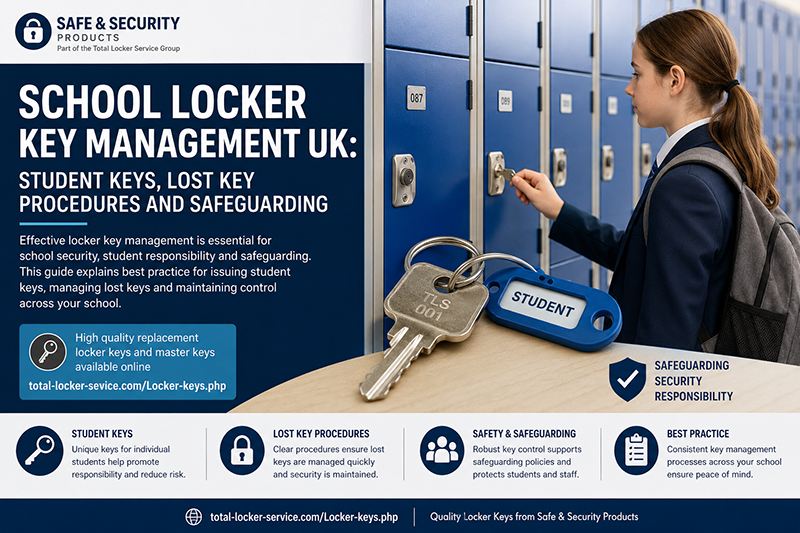
  • School Locker Key Management UK: Student Keys, Lost Key Procedures and Safeguarding

    School Locker Key Management UK: Student Keys, Lost Key Procedures and Safeguarding

    School lockers are simple to use, but they are not simple to manage. Once a school has hundreds of pupils using lockers every day, the key system becomes part of the wider storage, behaviour and safeguarding process.

    A school locker gives pupils a safe place to store bags, books, PE kit, coats, lunch boxes and personal items during the school day. However, every locker also needs an access method. For many schools, that still means a key. That key must be issued, recorded, replaced when lost, recovered when a pupil leaves and controlled carefully when staff need emergency access.

    Good key management prevents disruption. It reduces lost property. Helps site teams keep lockers in use. Also gives staff a clear procedure when a pupil cannot open a locker, when a key is missing or when there is a safeguarding concern.

    If your school needs duplicate or replacement keys, Total Locker Service supplies replacement locker keys for schools, cut to code for many common locker brands and lock systems.

    This guide explains how UK schools can manage student locker keys, reduce lost key problems, plan replacement procedures and keep access control aligned with safeguarding expectations.


    Quick answer: how should schools manage locker keys?

    Schools should manage locker keys through a clear issue, record, replacement and recovery process. Each locker should have a number. Each key should be linked to a locker number, pupil name or year group, and key code where available. Spare keys and master keys should be held securely by authorised staff only. Lost keys should be recorded, replaced quickly and reviewed if losses become repeated.

    A strong school locker key system should include:

    • a locker allocation record
    • a student key issue process
    • a spare key control process
    • a lost key procedure
    • a key code list
    • a secure staff-only key storage location
    • a process for pupils leaving the school
    • a controlled emergency access procedure
    • a policy for damaged locks and missing codes
    • a review at the end of each term or academic year

    For replacement keys, schools should first check the number stamped on the existing key or lock face. If the number is clear, a replacement can often be ordered from the locker keys page without replacing the full lock.


    Why school locker key management matters

    A school locker system is only useful when pupils can access their lockers reliably. If keys are lost, damaged or poorly recorded, the locker system quickly becomes a daily problem for reception staff, form tutors, site teams and pastoral teams.

    Poor key management can lead to:

    • pupils arriving late to lessons because they cannot access books or equipment
    • repeated interruptions at reception or the site office
    • lockers being forced open unnecessarily
    • unnecessary lock replacements
    • disputes over ownership of belongings
    • staff being unsure who is allowed to access a locker
    • spare keys being stored in unsafe places
    • master keys being used without a clear record
    • abandoned lockers at the end of term
    • increased costs from preventable replacement work

    The aim is not to make locker use complicated. The aim is to make it predictable. When every key has a record, every locker has an allocation and every lost key follows the same process, the school can solve most locker issues quickly.

    A simple system is usually best. Schools do not need an over-engineered process for every pupil. They need a process that works under pressure, during busy mornings, between lessons and at the end of term.


    School locker keys and safeguarding

    Locker key management is not only a facilities issue. In a school, access to storage must also fit the safeguarding and behaviour framework.

    A pupil’s locker may contain school books, clothing, personal items, mobile phones, medication, food, prohibited items or items that relate to a welfare concern. Staff must therefore avoid informal or inconsistent access. A locker should not be opened casually. It should be opened under a defined school procedure.

    This is especially important where:

    • a pupil reports that items have been taken
    • staff believe a locker contains an item that should not be on site
    • a pupil is distressed because they cannot access belongings
    • a locker has been abandoned
    • a key is reported stolen
    • there is a concern about bullying, coercion or intimidation
    • staff need to search a locker as part of a behaviour or safeguarding process
    • a pupil has left the school without returning a key

    The key principle is control. Schools should know who can access lockers, why access is being given, whether the pupil is present, which staff are involved and whether the action should be recorded.

    This guide is practical storage advice, not legal advice. Schools should always follow their own safeguarding policy, behaviour policy, search policy, trust procedures and current Department for Education guidance.


    The difference between student keys, spare keys and master keys

    A good school locker key system separates three types of key.

    Student keys

    A student key is issued to the pupil who uses the locker. It gives that pupil normal day-to-day access. Some schools issue one key. Others issue one key to the pupil and hold one spare in the office.

    Student keys should be linked to:

    • pupil name
    • form group or year group
    • locker number
    • issue date
    • key code, if known
    • deposit paid, if relevant
    • return date, if relevant

    The pupil should know what to do if the key is lost. The school should also make clear whether there is a replacement charge.

    Spare keys

    A spare key is held by the school for operational use. It may be needed when a pupil forgets a key, loses a key or needs urgent access to books, medication, PE kit or personal belongings.

    Spare keys should not be kept in an open drawer. They should be stored in a secure cabinet, controlled by authorised staff and logged when used.

    For larger sites, a key cabinet can help keep school locker spares organised by number, year group, block or corridor.

    Master keys

    A master key or override key can open a group of locks within a compatible system. This is useful for facilities teams, but it creates a higher level of risk. A master key should be treated as a restricted access item.

    Master keys should be:

    • held by named authorised staff
    • stored securely
    • never loaned casually
    • logged when used
    • checked regularly
    • removed from general office access
    • replaced or reviewed if lost

    Not every locker system uses a master key. Where a master key is available, schools should decide who can use it and when.


    Common school locker key problems

    Most school locker key problems fall into a few repeat patterns.

    The pupil has lost the key

    This is the most common issue. The pupil may have misplaced the key at home, lost it during PE, left it in a bag, dropped it on the bus or given it to a friend.

    The school should have a standard lost key procedure. Staff should not have to decide from scratch every time.

    A sensible process is:

    1. Ask the pupil to check bags, pockets and form room.
    2. Check whether the school holds a spare key.
    3. Record the lost key against the locker number.
    4. Decide whether to issue the spare or order a replacement.
    5. Apply any school replacement charge.
    6. Review repeated losses if they suggest a wider issue.

    The replacement key can often be ordered by code from the replacement locker keys page.

    The key is bent or damaged

    Keys can bend when pupils force them, sit on them, carry them loose in bags or use them incorrectly. A bent key can damage the lock if it is forced.

    If a key is bent, do not keep using it. Record the issue, check whether the lock still turns correctly and order a replacement key before the lock is damaged.

    The key turns but the locker will not open

    This may mean the lock cam is loose, the door is under pressure or something inside the locker is blocking the door. The key may not be the problem.

    Staff should avoid forcing the key. If the lock or cam is damaged, the school may need a replacement lock or spare part rather than a key. Total Locker Service also supplies locker locks and locker parts.

    If the locker number is known but the key code is missing

    The locker number and the key code are not always the same. The locker number is usually the number displayed on the door for allocation. The key code is usually stamped on the key or lock face.

    If the key code is missing, schools should check:

    • the spare key
    • the lock face
    • the original locker schedule
    • old key records
    • manufacturer documents
    • photos of the lock
    • any previous order history

    If the code cannot be found, the school may need help identifying the lock. The locker key number guide can help staff understand where to look.

    The pupil has left and the key has not been returned

    This should be handled before the end of term. If keys are not recovered, the school may have open locker access records that no longer match current pupils.

    A leaving process should include:

    • locker emptied
    • key returned
    • locker checked
    • key record updated
    • deposit refunded or retained, if used
    • spare key returned to the secure cabinet
    • locker made available for reallocation

    This is especially important for Year 11, Year 13, leavers, transfers and pupils moving between sites.


    How to build a school locker key register

    A school locker key register does not need to be complicated. It can be a spreadsheet, MIS-linked document, facilities database or controlled paper record. The important point is that it is accurate, accessible to authorised staff and regularly updated.

    The register should include:

    FieldWhy it matters
    Locker numberLinks the record to the physical locker
    LocationHelps staff find the locker quickly
    Pupil nameShows who is allocated to the locker
    Year group or formHelps with batch checks and end-of-year recovery
    Key codeAllows replacement keys to be ordered
    Date issuedShows when the key was given out
    Deposit or chargeHelps finance/admin teams track payments
    Spare key heldConfirms whether the school has backup access
    Lost key dateBuilds a history of problems
    Replacement orderedShows whether action has been taken
    Key returnedConfirms closure when the pupil leaves

    The key code is one of the most valuable fields. If the school records the key code at the start, future replacement becomes much easier. Without a code, staff may have to inspect the lock, search old records or replace the lock.


    How to issue locker keys to pupils

    The issue process should be simple enough for form tutors, reception teams or pastoral staff to follow.

    A recommended issue process is:

    1. Allocate the locker number.
    2. Check that the lock works.
    3. Record the key code.
    4. Record the pupil name and year group.
    5. Issue the key.
    6. Explain the lost key procedure.
    7. Confirm whether a deposit or charge applies.
    8. Tell the pupil not to swap lockers without permission.
    9. Store any spare key securely.
    10. Review the allocation at the agreed date.

    A short written agreement can help. It does not need to be intimidating. It should simply explain that the locker remains school property, the key must be looked after, damage should be reported and the key must be returned when required.


    Should schools charge for lost locker keys?

    Many schools charge a small fee for lost locker keys. Others use a deposit system. Some choose not to charge, especially for younger pupils or where lockers are part of the school’s standard provision.

    There is no single correct approach for every school. The decision should reflect the school’s behaviour policy, finance rules, pupil age, administrative capacity and equality considerations.

    A charge can help reduce careless loss, but it should not prevent a pupil from accessing essential belongings. Schools should also consider cases where repeated loss may indicate a safeguarding, bullying, SEND or welfare issue rather than simple carelessness.

    A balanced approach is usually best:

    • first loss: reminder and replacement process
    • repeated loss: pastoral review
    • deliberate damage: behaviour procedure
    • financial hardship: follow school support process
    • stolen key: record and investigate before charging

    The purpose of the lost key process should be to restore access and keep the system secure. It should not create unnecessary conflict.


    Lost school locker key procedure

    A clear procedure removes uncertainty. Staff should know what to do, pupils should know where to go and the site team should not be pulled into avoidable emergencies.

    Step 1: Confirm the locker

    Ask the pupil for the locker number, location and year group area. If the school uses zones, identify the correct block or corridor.

    Step 2: Check the pupil record

    Confirm that the locker is allocated to that pupil. This avoids opening the wrong locker or giving access to the wrong person.

    Step 3: Check for a spare key

    If a spare is held, authorised staff can use the school’s access procedure. The spare key use should be logged if the school policy requires it.

    Step 4: Check the key code

    If the key is missing and no spare is available, check the key code from the register, lock face or previous records.

    Step 5: Order the replacement

    Use the key code to order from the correct brand or range. Total Locker Service can supply many locker keys cut to code for common school locker systems.

    Step 6: Decide whether the lock must be changed

    A lost key does not always mean the lock must be changed. However, if the key is suspected to be stolen, copied, misused or linked to a safeguarding issue, the school may decide to replace the lock.

    Step 7: Update the register

    Record the lost key, replacement order and new issue date. If a new lock is fitted, record the new code.


    When should a school replace the lock instead of the key?

    In many cases, a replacement key is enough. This is cheaper and quicker than changing the lock.

    A school should consider replacing the lock when:

    • the lock is damaged
    • the key code is missing and cannot be identified
    • the key has been stolen
    • the locker has been accessed without permission
    • a pupil has repeatedly lost the key
    • the lock is worn or unreliable
    • the lock type no longer suits the school
    • the school wants to change from keys to combination locks
    • the locker is being refurbished
    • there is a safeguarding or security concern

    If the lock needs replacement, the school should identify the existing lock type before ordering. The locker lock identification guide can help staff check the lock face, fixing style, cam and brand.


    School locker key codes: what staff need to know

    Most replacement locker keys are supplied by code. The key code is the number or letter sequence used to cut the replacement. It may be stamped on the key, engraved on the lock face or printed on original records.

    Common places to check include:

    • front of the lock barrel
    • side of the key
    • plastic key head
    • original spare key tag
    • locker supplier records
    • old invoice or order sheet
    • facilities spreadsheet
    • master allocation schedule

    Schools should avoid relying only on the locker door number. Door number 125 does not always mean key code 125. In many systems, the door number is just an allocation number.

    The strongest process is to record both:

    • locker door number
    • key code

    This makes future orders much faster.


    Bulk replacement locker keys for schools

    Schools often discover key problems in batches. This may happen at the end of term, after a locker audit, before a new academic year or during a refurbishment project.

    A bulk key order may be needed when:

    • many lockers have no working key
    • spare keys are missing
    • a year group is being reallocated
    • old lockers are being brought back into use
    • keys were not recovered from leavers
    • a new school building is opening
    • a locker room is being reorganised
    • the school wants a full spare key set

    For a bulk order, create a simple schedule:

    Locker numberKey codeBrandQuantityNotes
    A10136215Probe2Student key and spare
    A10236216Probe1Spare only
    B20195045Helmsman2Missing both keys
    C01466045Lowe & Fletcher1Damaged key

    A clean schedule reduces mistakes. It also makes it easier for the supplier to check compatibility.

    Total Locker Service supports bulk key requests for schools, councils and facilities teams through the main locker keys UK page.


    Student locker access and emergency opening

    Schools should decide how emergency locker access works before an incident happens.

    Emergency access may be needed where:

    • a pupil needs medication or urgent personal items
    • a safeguarding concern has been raised
    • there is a suspected prohibited item
    • a locker is causing a safety issue
    • a pupil has lost the key before an exam or lesson
    • belongings must be recovered after school
    • a locker has been abandoned

    The school should decide:

    • which staff can authorise access
    • whether the pupil should be present
    • whether two staff should attend
    • whether the access should be recorded
    • how belongings are handled
    • when parents or carers should be contacted
    • whether the DSL or pastoral lead should be informed
    • when external guidance or police advice is needed

    The process should be written into the school’s existing behaviour, safeguarding or locker use policy.


    Searching school lockers: practical cautions

    A locker is school property, but pupils still have a reasonable expectation that staff will act fairly, consistently and in line with school policy. Schools should not rely on informal practice.

    A school locker search should only happen under the school’s approved procedure. Staff should understand the difference between:

    • opening a locker because a pupil has lost a key
    • checking an abandoned locker
    • inspecting damage
    • recovering school property
    • searching for a prohibited item
    • responding to a safeguarding concern

    These are not all the same situation.

    For searches linked to behaviour or safeguarding, schools should follow current DfE guidance, trust policy and local procedures. Staff should also keep appropriate records.

    From a key management point of view, the important point is this: master keys and spare keys give access, but they should not remove the need for procedure.


    Preventing lost school locker keys

    Lost keys cannot be eliminated completely. They can be reduced.

    Use numbered key tags

    A numbered key tag helps staff identify a returned key. However, avoid putting too much information on the tag. A tag should not make it easy for someone to identify the exact locker and pupil if the key is dropped.

    Use wrist straps where suitable

    For PE areas, changing rooms and sports facilities, wrist straps can help pupils keep keys with them during activity. This is more common in leisure environments, but it may help in school sports settings.

    Keep a spare key set

    A controlled spare key set is one of the most useful investments a school can make. It reduces disruption and avoids forced openings.

    Record the key code immediately

    Do this when lockers are installed, not after the first loss. The key code record is what makes future replacement easy.

    Audit at the end of term

    End-of-term checks prevent small issues becoming a full summer holiday problem.

    Review repeated losses

    If one pupil repeatedly loses a key, the issue may be organisational, behavioural or pastoral. A different lock type may also be more suitable.

    Consider combination locks where keys are a constant problem

    Some schools move certain locker areas to combination locks or digital locks. This can reduce student key loss, but it introduces a different management issue: forgotten codes. The right choice depends on the age group and staff capacity.

    For keyless options, see lockers with combination locks and locker locks.


    Key locks versus combination locks for school lockers

    Key locks are familiar, simple and easy to understand. They work well where lockers are assigned to individual pupils and the school has a good spare key process.

    Combination locks reduce physical key loss. They may suit older pupils, sixth form areas, staff lockers or shared-use storage. However, pupils can forget codes, share codes or change codes without permission if the wrong lock type is selected.

    Here is a simple comparison.

    Lock typeStrengthWeaknessBest school use
    Key lockSimple, familiar and easy to replace by codeKeys can be lostAssigned pupil lockers
    Padlock haspPupil can provide own padlockLost padlocks may need cutting offOlder pupils or low-admin areas
    Mechanical combinationNo physical key for pupil to loseForgotten or shared codesSixth form or supervised areas
    Digital lockFlexible access and management optionsHigher cost and battery checksManaged high-use areas
    Mastered key systemStaff can access lockers when neededMaster key must be controlledFacilities-managed locker banks

    Key locks remain a strong choice for many schools because replacement keys can be ordered quickly when the code is known.


    How locker layout affects key management

    Key management is easier when the physical locker layout is logical.

    A school with clear zones can manage keys more easily than a school where lockers are scattered without structure.

    Consider organising lockers by:

    • year group
    • form group
    • corridor
    • building block
    • floor
    • house group
    • department
    • sports area
    • sixth form area

    For example, lockers A001 to A150 may belong to Year 7. Lockers B001 to B150 may belong to Year 8. The key register can then follow the same structure.

    This helps when:

    • pupils report problems
    • staff need to find a locker quickly
    • keys are returned in batches
    • lockers are audited
    • year groups move up
    • replacements are ordered
    • spare keys are stored by zone

    If a school is planning new lockers, it should consider allocation, numbering and key management before installation. For product choice, see school lockers.


    End-of-year school locker key checklist

    The end of the academic year is the best time to reset the locker system.

    Use this checklist before pupils leave:

    • Ask pupils to empty lockers.
    • Collect keys from leavers.
    • Check each locker against the allocation record.
    • Record missing keys.
    • Record damaged locks.
    • Check spare key sets.
    • Check master keys.
    • Remove old labels or stickers.
    • Clean locker compartments.
    • Order replacement keys in bulk.
    • Replace damaged locks.
    • Reallocate lockers for the next year.
    • Update the school key register.

    This process is especially useful before September. It avoids the common problem of discovering missing keys only when new pupils are being issued lockers.


    New school year locker key setup

    Before the new school year starts, schools should prepare the key system in advance.

    A good September setup includes:

    1. Confirm the number of lockers available.
    2. Remove any lockers that are damaged or out of service.
    3. Check that each lock works.
    4. Confirm key codes.
    5. Prepare pupil allocation lists.
    6. Prepare spare keys.
    7. Label or number lockers clearly.
    8. Set replacement key rules.
    9. Tell pupils how to report lost keys.
    10. Give reception and pastoral staff the same procedure.

    The first two weeks of term are usually the busiest period for locker questions. A clear process reduces queues, confusion and staff time.


    Managing school locker keys across multiple sites

    Multi-academy trusts, large secondary schools and split-site schools may need a more structured approach.

    Problems often occur when each site uses different locker brands, lock types and key records. Over time, the trust may inherit several systems from different suppliers.

    A multi-site key management review should ask:

    • Which locker brands are installed?
    • Which lock brands are used?
    • Are key codes recorded?
    • Are spare keys held centrally or locally?
    • Who can order replacements?
    • Are master keys controlled?
    • Are lost key charges consistent?
    • Are leavers handled in the same way?
    • Are older lockers worth refurbishing?
    • Should future projects use a standard lock type?

    Standardisation can reduce cost and confusion. It may not be worth replacing every existing lock immediately, but future locker orders can follow a preferred specification.


    Safeguarding-aware locker key policy template

    Schools can adapt the following structure into their own policy.

    Purpose

    The school provides lockers to support safe, organised storage of pupil belongings during the school day. Locker access is managed through an issued key, spare key or authorised staff access procedure.

    Allocation

    Lockers are allocated by year group, form group or agreed school process. Pupils must use only their allocated locker unless permission is given to move.

    Key issue

    Each pupil is issued a key linked to a numbered locker. The school records the locker number, key code and issue date.

    Lost keys

    Lost keys must be reported to the school office, form tutor, pastoral team or site team as directed by the school. The school will check records and arrange access or replacement.

    Spare keys

    Spare keys are held securely by authorised staff. Use of spare keys may be recorded.

    Master keys

    Master keys are restricted to authorised staff and must be stored securely. They must not be loaned to pupils.

    Access by staff

    Staff access to a pupil locker must follow school policy. Where access relates to a behaviour, welfare or safeguarding concern, staff must follow the relevant school procedure.

    Leavers

    Pupils must return locker keys when leaving the school or when locker use ends.

    Damage

    Damage to locks, keys or locker doors must be reported. Deliberate damage may be handled under the behaviour policy.

    Review

    The locker key register should be checked at least once each academic year.


    Ordering replacement school locker keys

    When ordering replacement keys, accuracy matters. A wrong code can result in a key that does not fit.

    Before ordering, collect:

    • school name
    • contact name
    • delivery address
    • locker brand, if known
    • lock brand, if known
    • key code
    • quantity required
    • photo of the key or lock, if unsure
    • urgency
    • purchase order details, if required

    For most school orders, the key code is the most important detail. If the code is visible, replacement is usually straightforward.

    Start here: replacement locker keys

    For brand selection, use keys by manufacturer.

    Lost key advice, use the lost locker keys guide.

    For lock identification, use the locker lock identification guide.


    When schools should create a full spare key set

    A full spare key set can save time across the school year. It is especially useful where lockers are used by large year groups.

    A full spare set may be worthwhile when:

    • lockers are used every day
    • pupils regularly lose keys
    • the school has no reliable spare key record
    • lockers are spread across several corridors
    • the site team is called out often
    • the school wants to avoid forced entry
    • the existing key record is incomplete
    • lockers are being reallocated each year

    The spare set should be held securely, not handed around. A key cabinet with numbered hooks can help staff find the correct spare quickly.


    Reducing admin time for reception and site teams

    School locker key issues often end up with reception, pastoral support or the caretaker. Without a process, these teams lose time.

    A simple workflow can reduce interruptions:

    1. Pupil reports lost key to agreed staff point.
    2. Staff check the locker allocation record.
    3. Spare key is checked.
    4. If no spare is available, key code is confirmed.
    5. Replacement is ordered in the next batch.
    6. Temporary access is arranged if needed.
    7. Register is updated.

    Batching non-urgent replacement orders can also help. Instead of ordering one key at a time, the school can send a weekly or monthly schedule. Urgent access issues can still be handled separately.


    School locker key management mistakes to avoid

    Avoid these common faults.

    Keeping no key code record

    This is the biggest mistake. Without key codes, every future replacement becomes harder.

    Storing spare keys in an open drawer

    Spare keys need controlled access. They should not be available to pupils, visitors or unauthorised staff.

    Letting pupils swap lockers informally

    Unrecorded swaps break the allocation record. Staff may then open or assign the wrong locker.

    Treating master keys as ordinary keys

    A master key is a high-control item. It needs stronger protection than a normal pupil key.

    Replacing locks too quickly

    If the key code is known, a replacement key may solve the problem without replacing the full lock.

    Ignoring repeated key loss

    Repeated loss may indicate poor organisation, bullying, coercion, anxiety, SEND needs or misuse. It should be reviewed, not just charged each time.

    Waiting until September

    Locker key checks are easier before pupils return. Summer audits prevent start-of-term disruption.


    School locker key management checklist

    Use this checklist to assess your current system.

    • Do all lockers have visible numbers?
    • Does the school know which pupil uses each locker?
    • Are key codes recorded?
    • Are spare keys held securely?
    • Are master keys restricted?
    • Is there a lost key procedure?
    • Is there a leavers process?
    • Are key charges or deposits clear?
    • Are staff using the same procedure?
    • Are locker searches handled under school policy?
    • Are damaged locks recorded?
    • Are replacement keys ordered by code?
    • Are old records reviewed annually?
    • Are bulk key orders prepared before September?

    If several answers are “no”, the school is likely spending more time than needed on locker problems.


    Choosing lockers with key management in mind

    If your school is buying new lockers, think about key management before choosing the product.

    Ask:

    • Will lockers be assigned or shared?
    • What age group will use them?
    • How often will pupils access them?
    • Who will issue keys?
    • Who will hold spare keys?
    • Is a master key system needed?
    • Can replacement keys be ordered by code?
    • Are the locks suitable for school use?
    • Will the same lock type be used across the site?
    • How will the system work at the end of term?

    A good school locker is not just strong. It must be manageable across the full academic year.

    For new locker projects, view school lockers. Replacement access control, view locker locks. For ongoing access issues, view replacement locker keys.


    Frequently asked questions

    What should a school do when a pupil loses a locker key?

    The school should confirm the locker allocation, check for a spare key, record the loss, check the key code and order a replacement if needed. If the key may have been stolen or misused, the school should consider whether the lock also needs changing.

    Can schools order replacement locker keys by code?

    Yes. In many cases, replacement locker keys can be cut to code if the key number is visible on the key, lock face or school records. Schools can order replacement keys from Total Locker Service using the locker keys page.

    Is the locker number the same as the key code?

    Not always. The locker number is usually the number shown on the locker door. The key code is the number used to cut the key. Schools should record both.

    Should schools keep spare locker keys?

    Yes, where practical. Spare keys help staff restore access quickly when pupils forget, lose or damage keys. Spare keys should be stored securely and controlled by authorised staff.

    Who should hold the master key for school lockers?

    Only authorised staff should hold or access a master key. This may be the site manager, facilities team, business manager or another named role. Master keys should be stored securely and logged when used.

    When should a school replace the lock instead of the key?

    A lock should be replaced if it is damaged, insecure, worn, unidentified or affected by a safeguarding or security concern. If only the student key is missing and the key code is known, a replacement key may be enough.

    How can schools reduce lost locker keys?

    Schools can reduce lost keys by using clear issue records, numbered tags, secure spare key sets, end-of-term audits, pupil reminders and quick replacement procedures. Repeated losses should be reviewed rather than treated as routine.

    Are combination locks better for school lockers?

    Combination locks can reduce physical key loss, but pupils may forget or share codes. Key locks are often simpler for assigned lockers, especially where replacement keys can be ordered by code. The best option depends on the age group and how the lockers are managed.

    What information is needed to order school locker keys?

    The most useful information is the key code. Schools should also provide the locker or lock brand if known, the quantity required and a clear photo if the code or lock type is uncertain.

    Where can schools buy replacement locker keys?

    Schools can buy replacement locker keys from Total Locker Service. Start with the replacement locker keys page or use keys by manufacturer if the brand is known.


    Conclusion: good key control keeps school lockers useful

    A school locker system works best when pupils can use it easily and staff can manage it confidently. The lockers themselves matter, but the access process matters just as much.

    A good school locker key system records who has each locker, stores spare keys securely, controls master keys, sets a clear lost key procedure and orders replacements before problems build up.

    For schools, the most important action is simple: record the key code for every locker. That one step can prevent delays, reduce forced openings and make future replacement much easier.

    If your school needs replacement keys, spare keys or a bulk key schedule, use the Total Locker Service replacement locker keys page to order locker keys cut to code for many common school locker systems.

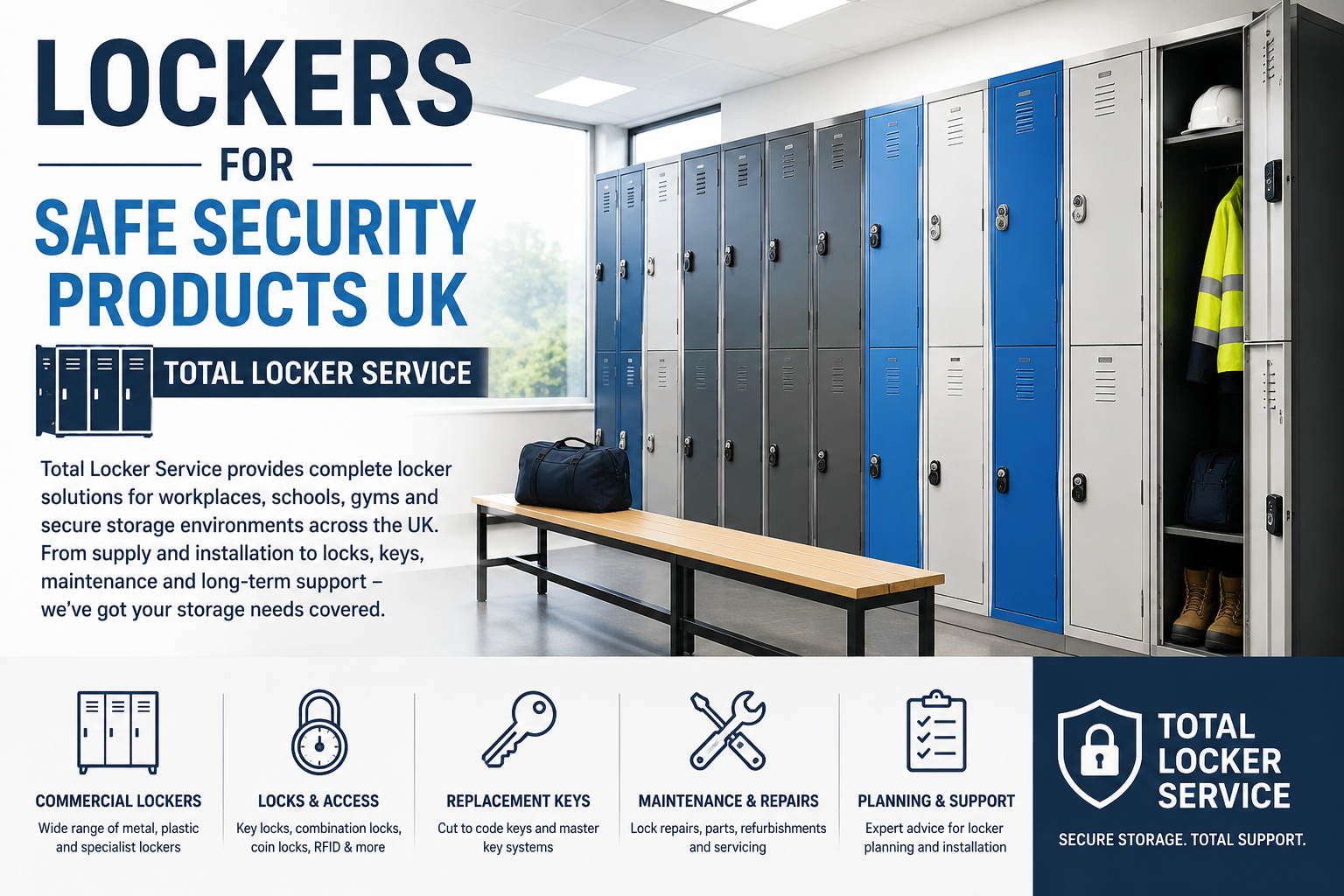
  • Lockers for Safe Security Products UK: Total Locker Service Locker Solutions

    Lockers for Safe Security Products UK: Total Locker Service Locker Solutions

    Total Locker Service supplies commercial lockers, secure storage systems, locker locks, replacement keys, locker parts, locker maintenance and locker planning support for UK workplaces, schools, leisure centres, industrial sites, offices and public buildings.

    For organisations using https://safe-security-products.co.uk/ as a secure product route, lockers are an important part of the wider security and storage picture. A safe protects documents, valuables or cash. A cabinet controls tools, keys or hazardous items. A locker controls daily personal storage, staff belongings, uniforms, devices, PPE and shared workplace equipment.

    Total Locker Service provides a practical locker offering that supports both product supply and long-term operational control. This includes standard commercial lockers, workplace lockers, school lockers, wet area lockers, staff lockers, PPE lockers, garment lockers, plastic lockers, metal lockers, bespoke lockers, locker stands, locker seat stands, locker locks, key replacement, lock conversion, spare parts, refurbishment and installation support.

    This guide explains how Total Locker Service fits into a complete secure storage strategy. It also links into the main locker planning, locker management, locker access and locker key canisters from the Total Locker Service blog, so buyers can move from product selection into specification, layout, maintenance and lifecycle control.

    Why lockers matter in secure storage planning

    Lockers are often treated as a simple furniture purchase. In practice, they are part of the daily security system of a building. They decide where people store personal items, how staff manage workwear, how pupils move through corridors, how gym members use changing rooms, how contractors protect belongings and how facilities teams control access across a busy site.

    A good locker system reduces clutter, protects belongings and supports better movement through a building. It can also reduce lost property, improve hygiene, support welfare provision and give managers a clearer process for issuing, auditing and maintaining storage.

    Total Locker Service is useful because its locker offer is not limited to one product type. The range covers everyday steel lockers, workplace lockers, school lockers, wet specification lockers, plastic lockers, PPE lockers, garment management lockers, mini lockers, laptop storage, electronic lockers, locker stands and locker accessories.

    This makes the company suitable for organisations that need more than one storage product. A workplace may need staff lockers, PPE lockers, key cabinets and safes. A school may need corridor lockers, changing room lockers, replacement keys and master key control. A leisure centre may need wet area lockers, coin locks, combination locks and locker maintenance. An industrial site may need heavy duty lockers, clean/dirty zoning, garment collection and secure storage for equipment.

    Quick answer: what does Total Locker Service offer?

    Total Locker Service supplies lockers and secure storage solutions for UK workplaces, schools, leisure facilities, offices, public buildings and commercial environments. The offer includes locker supply, locker specification, locking options, replacement locker keys, lock replacement, locker parts, maintenance, refurbishment and installation support.

    RequirementRelevant locker solutionTypical user
    Everyday personal storageSteel lockers, staff lockers, office lockersWorkplaces, offices, schools
    Wet changing areasWet specification lockers, plastic lockers, suitable locksGyms, pools, leisure centres
    Workwear and laundry controlGarment lockers, collector lockers, dispenser lockersFactories, healthcare, industrial sites
    PPE and equipment storagePPE lockers, compartment lockers, industrial lockersWarehouses, construction, manufacturing
    Student storageSchool lockers, corridor lockers, replacement keysSchools, colleges, academies
    Access controlKey locks, hasp locks, combination locks, coin locks, keypad locks, RFID locksManaged and shared-use sites
    Long-term controlMaintenance, refurbishment, lock conversion, spare partsFacilities teams and estates teams

    Commercial lockers for workplaces, schools and leisure facilities

    The main locker range from Total Locker Service is suitable for commercial environments where storage must be durable, practical and easy to manage. These environments include schools, offices, leisure centres, warehouses, healthcare sites, factories, staff changing rooms and public facilities.

    Commercial lockers need to do more than hold belongings. They must fit the building layout, allow safe access, avoid blocking circulation, support cleaning, use suitable locks and match the number of people using the space. A poorly specified locker system can create congestion, lost keys, damaged locks, unused compartments and awkward maintenance problems.

    That is why the strongest locker projects start with planning. Before choosing a locker colour or lock type, the buyer should define the users, the environment, the available space, the required compartment size, the access method, the maintenance process and the replacement plan.

    For deeper planning guidance, use the Locker Planning UK canister. This helps connect locker supply with layout, spacing, door clearance, aisle widths, accessibility and installation planning.

    Workplace lockers

    Workplace lockers support staff welfare, security and daily organisation. They are commonly used in offices, warehouses, factories, distribution centres, hospitals, schools, councils and shared commercial buildings. Staff may use lockers for bags, coats, uniforms, personal items, work devices, PPE or temporary storage during a shift.

    Workplace locker planning should consider shift patterns, staff turnover, hybrid working, part-time workers, contractors, visitors and departmental zoning. A fixed locker for every employee may be suitable for some sites. Other workplaces may need shared-use lockers, hot lockers, day-use compartments or smart access systems.

    Total Locker Service can support this by supplying suitable locker products and by linking the buyer to operational planning content. The Workplace Locker Operations UK canister is especially useful for facilities managers who need to think beyond the initial purchase.

    A strong workplace locker system should answer these questions:

    • Who is allowed to use each locker?
    • Are lockers assigned, shared or temporary?
    • How are keys, PINs or credentials issued?
    • What happens when an employee leaves?
    • How are abandoned lockers checked?
    • Who manages master keys or override access?
    • How are damaged locks replaced?
    • How often are lockers cleaned, audited and reviewed?

    School lockers

    School lockers have different demands from workplace lockers. They must handle high-volume daily use, movement between lessons, break-time peaks, supervision needs, student key losses, corridor congestion and safeguarding considerations.

    The best school locker system is not just strong. It is positioned correctly. Locker banks should be planned to avoid crowding at narrow corridor points. They should support year group zoning, easy supervision and safe movement. Locks should match the age group and management capacity of the school.

    Total Locker Service can support schools with locker supply, replacement keys, lock systems and planning content. Useful supporting canisters include School Locker Systems UK, School Locker Key Management UK and Break-Time Flow Management in Schools UK.

    School buyers should think about locker height, compartment count, corridor width, door swing, supervision sightlines, student age, locking preference and key recovery. Replacement key planning is especially important because student lockers often generate repeated key loss requests during the academic year.

    Leisure centre, gym and wet area lockers

    Leisure centres and gyms need lockers that can handle high turnover, moisture, shared use and heavy daily handling. Wet changing rooms, swimming pools, spas and sports facilities need materials and locks that suit damp conditions.

    In these settings, the lock choice is as important as the locker body. Coin locks may suit public changing rooms. Combination locks may reduce key handling. Hasp locks may suit padlock-based systems. RFID or electronic systems may suit managed leisure facilities with membership cards or smart access.

    Total Locker Service offers multiple locking options across suitable locker ranges. Buyers should match the lock to the site’s operating model. A school gym, private health club, public leisure centre and workplace changing room may all need different systems.

    For lock selection, the Locker Locks UK canister is the natural supporting hub.

    Industrial lockers and PPE storage

    Industrial sites often need lockers for more than personal belongings. They may need storage for PPE, uniforms, boots, clean clothing, dirty clothing, tools, helmets, gloves and site-specific equipment.

    Locker planning in industrial environments should consider dirt, moisture, ventilation, cleaning, shift handovers, security, garment collection and welfare requirements. Some sites benefit from separate clean and dirty zones. Others need laundry collection lockers or garment dispenser lockers to support managed workwear processes.

    Total Locker Service supplies garment storage lockers and laundry locker systems that support workwear management. These are useful for factories, healthcare environments, food production, laboratories and industrial workplaces where clothing control matters.

    Locker stands and seat stands can also improve cleaning access and changing room usability. Raised lockers help keep the floor area accessible for cleaning, while seat stands combine storage with seating where space is limited.

    Bespoke and made-to-order lockers

    Not every site can use standard lockers. Some buildings need unusual dimensions, special lock options, colour matching, specific compartment arrangements, wet area suitability or a layout that works around existing walls, benches, columns or services.

    Total Locker Service provides bespoke made-to-order locker options. This is useful when the buyer needs a locker system that fits the operation rather than forcing the operation to fit a standard product.

    Bespoke planning should still be controlled carefully. The buyer should define door clearance, aisle width, fixing requirements, lock type, user capacity, ventilation needs, cleaning access and future replacement access before ordering.

    The Locker Specification Planning UK canister supports this process. It helps buyers turn operational requirements into a clear specification before committing to a product.

    Locker locks and access options

    Locking is one of the most important decisions in any locker project. The wrong lock can create daily frustration, lost key costs, user confusion or weak access control. The right lock makes the system easier to manage.

    Total Locker Service can support several common locking options, including key locks, hasp locks, coin return locks, combination locks, keypad locks and RFID locks. Each option has a different use case.

    Lock typeBest suited toMain benefit
    Key lockAssigned lockersSimple personal access
    Hasp lockPadlock systemsUser supplies padlock
    Coin lockPublic changing roomsShared-use control
    Combination lockSchools, offices, gymsReduces physical key handling
    Keypad lockManaged workplacesCode-based access
    RFID lockSmart or integrated sitesCredential-based control

    For a full access strategy, use the Locker Access Control Systems UK canister. This connects physical keys, master keys, PIN systems, RFID systems, smart credentials and hybrid locker estates.

    Replacement locker keys and key control

    Replacement locker keys are a major part of long-term locker management. A locker system can be well designed and well installed, but if key records are poor, the system becomes difficult to manage over time.

    Total Locker Service provides support for replacement locker keys and locker key systems. Many locker keys can be cut to code when the correct key number or lock number is available. This can reduce the need to replace full locks when a key is lost.

    The key canister should be used heavily from this article because it has strong conversion value. Useful links include Locker Key Management Systems UK, Replacement Locker Keys Cut to Code UK and Lost Locker Key? What to Do Next.

    A proper locker key system should include locker numbering, key code records, user records, master key control, issue logs, return logs, lost key procedures, duplicate key control and periodic audits.

    Locker management systems

    A locker management system is the operational layer behind the physical locker. It includes allocation, access control, occupancy tracking, audits, maintenance, cleaning, key control, permissions, reporting and replacement planning.

    This is where Total Locker Service becomes more than a supplier of locker units. A buyer can use the product range for supply, then use the blog canisters to build a complete management process around the lockers.

    The main supporting hub is Locker Management Systems UK. This should be linked from any page that discusses locker operations, locker allocation, locker audits, locker occupancy or long-term facilities control.

    Locker management matters most on larger estates. A small office may only need a simple staff locker bank. A school, hospital, warehouse, university, leisure group or council estate may need hundreds or thousands of compartments across multiple buildings. At that scale, locker management becomes an infrastructure issue.

    Occupancy and shared-use lockers

    Occupancy planning helps organisations understand whether lockers are being used properly. Some sites have too many unused lockers in one area and too few lockers in another. A number of lockers remain abandoned. Some are used for long-term storage when they were intended for daily use.

    Shared-use lockers, hot lockers and hybrid workplace lockers make occupancy planning more important. Flexible workers, shift workers and rotating teams do not always need a permanent locker. They may need reliable access to temporary storage when they are on site.

    The Locker Occupancy Management Systems UK canister supports this topic. It is useful for workplaces, schools, leisure centres and estates teams that need to reduce unused locker capacity and improve storage efficiency.

    Maintenance, refurbishment and lifecycle control

    Lockers should be managed across their full lifecycle. A good locker system needs inspection, cleaning, lock replacement, door adjustment, hinge checks, numbering checks, corrosion checks, fixing checks and periodic review.

    Total Locker Service provides locker repair, maintenance, refurbishment, spare parts and lock conversion support. This is important for organisations that want to extend the life of existing lockers rather than replacing everything at once.

    Lifecycle planning is especially useful for schools, healthcare sites, factories, leisure centres and large workplaces. It helps the buyer decide which lockers should be repaired, refurbished, relocated, expanded or replaced.

    Useful canister links include Locker Lifecycle Management UK, Locker Estate Audit UK and Locker Maintenance Guide UK.

    How lockers connect with safes and wider security products

    The title of this article refers to https://safe-security-products.co.uk/. That creates a useful bridge between lockers and wider secure storage. Lockers do not replace safes. Safes do not replace lockers. They solve different storage problems.

    A safe is usually chosen for higher-value items, sensitive documents, cash, data media or fire protection. A locker is usually chosen for controlled day-to-day access to personal belongings, clothing, workwear, equipment or temporary storage. A key cabinet manages access to keys. A medical cabinet manages medicines or first aid items. A COSHH cabinet manages hazardous substances. A storage system brings these products together into one operational plan.

    This is why the Storage Management Systems UK canister is useful. It positions lockers as part of a broader storage management framework rather than a standalone purchase.

    Recommended internal link structure

    This article should act as a commercial bridge page. It should link to product pages for conversion and to blog canisters for topical authority.

    Link targetSuggested anchor textPurpose
    Commercial lockerscommercial lockers for workplaces and schoolsMain product conversion
    Made-to-order lockersbespoke made-to-order lockersCustom specification route
    Locker repair and maintenancelocker repair and maintenance servicesService and lifecycle route
    Locker Planning UKlocker planning guidancePlanning canister
    Locker Management Systems UKlocker management systemsOperations canister
    Locker Access Control Systems UKlocker access control systemsAccess canister
    Locker Key Management Systems UKlocker key management systemsKey control canister
    Replacement Locker Keys Cut to Code UKreplacement locker keys cut to codeHigh-intent conversion route
    Locker Lifecycle Management UKlocker lifecycle managementLong-term asset control
    Locker Estate Audit UKlocker estate auditAudit and replacement planning

    Choosing the right locker system

    The right locker system depends on the site, the users and the management process. Buyers should avoid choosing purely by price or appearance. A locker that looks suitable may fail operationally if the lock type is wrong, the compartment size is too small, the aisle is too narrow or the key process is weak.

    Before ordering lockers, answer these practical questions:

    • Will lockers be used by staff, pupils, members, visitors, contractors or the public?
    • Will use be assigned, shared, temporary or mixed?
    • Are the lockers for dry areas, wet areas, industrial areas or public spaces?
    • What will users store inside?
    • Are bags, coats, PPE, boots, devices or uniforms involved?
    • How many compartments are needed now?
    • How much future expansion is likely?
    • What lock type is easiest to manage?
    • Who controls master keys or override access?
    • How will lost keys, damaged locks and abandoned lockers be handled?
    • How will cleaning and maintenance teams access the locker area?

    Total Locker Service is well placed for this type of buying process because it combines product range, lock options, replacement support and service knowledge. That combination matters when the buyer needs a system that can be maintained over time.

    Best locker types by environment

    EnvironmentRecommended locker focusPlanning priority
    OfficeStaff lockers, day lockers, personal storageHybrid working and allocation
    SchoolStudent lockers, corridor lockers, changing room lockersFlow, supervision and key control
    GymChanging room lockers, coin locks, combination locksShared use and wet area suitability
    FactoryWorkwear lockers, PPE lockers, garment lockersClean/dirty zoning and durability
    HealthcareStaff lockers, changing lockers, controlled storage supportHygiene, access and audit control
    WarehouseHeavy duty lockers, PPE lockers, staff lockersShift patterns and equipment storage
    Public buildingVisitor lockers, staff lockers, shared-use storageAccess control and maintenance

    Why use Total Locker Service?

    Total Locker Service is a strong fit for buyers who need practical locker supply backed by knowledge of real site use. The company supplies lockers for commercial and public environments, but also supports the surrounding issues that make lockers work properly.

    Those surrounding issues include lock choice, replacement keys, master key management, locker maintenance, refurbishment, spare parts, lock conversion, installation support and product selection. This is important because lockers are used every day. A weak support route can turn a simple storage system into a recurring facilities problem.

    A buyer using Total Locker Service can start with a standard product need, such as workplace lockers or school lockers, then expand into a full locker management approach. That approach can include planning, access control, key management, lifecycle management and estate audits.

    Suggested call to action

    If you need lockers for a workplace, school, gym, industrial site, healthcare environment or public building, start by defining the users, the environment and the access method. Then choose a locker system that can be maintained, audited and expanded over time.

    Total Locker Service can help with locker supply, locker locks, replacement keys, parts, maintenance, refurbishment and practical storage planning for UK sites.

    FAQ

    Does Total Locker Service supply lockers for workplaces?

    Yes. Total Locker Service supplies workplace lockers for offices, factories, warehouses, staff changing areas, public buildings and commercial environments.

    Does Total Locker Service supply school lockers?

    Yes. School lockers are a key part of the Total Locker Service offering. The company can also support schools with replacement keys, lock options and locker planning guidance.

    Can Total Locker Service help with replacement locker keys?

    Yes. Total Locker Service supports replacement locker keys and key control. Where the lock or key code is available, replacement locker keys may often be cut to code.

    What lock types are available for lockers?

    Common locker lock options include key locks, hasp locks, coin return locks, combination locks, keypad locks and RFID locks. The best option depends on whether the lockers are assigned, shared, public, wet-area or staff-only.

    Can lockers be repaired or refurbished?

    Yes. Total Locker Service provides locker repair, maintenance, spare parts, refurbishment and lock conversion support. This can help organisations extend the useful life of existing lockers.

    How do lockers fit with safe and security products?

    Lockers support daily personal and operational storage. Safes protect higher-value items, documents, cash or sensitive contents. Both can form part of a wider secure storage system.