A locker looks simple from the outside. It is a secure compartment with a door, a lock and enough space for belongings. However, a good locker system does much more than hold bags, coats, tools, uniforms or devices. It controls access. It organises shared space. Supports workplace welfare, school routines, leisure facilities, healthcare changing areas and commercial buildings.
A poor locker choice creates problems every day. Doors clash. Aisles become too narrow. Users cannot fit their belongings inside. Keys go missing. Combination codes are forgotten. Wet areas cause corrosion. Staff waste time dealing with avoidable access issues. In larger buildings, badly managed lockers become an estate problem rather than a storage solution.
A good locker system works quietly. Users know where to go. The locker is the right size. The lock suits the way the space is used. The material matches the environment. Spare keys, master keys and replacement parts are available when needed. The site team can maintain the system without replacing complete units unnecessarily.
That is why buying a locker should not start with the cheapest unit. It should start with the use case.
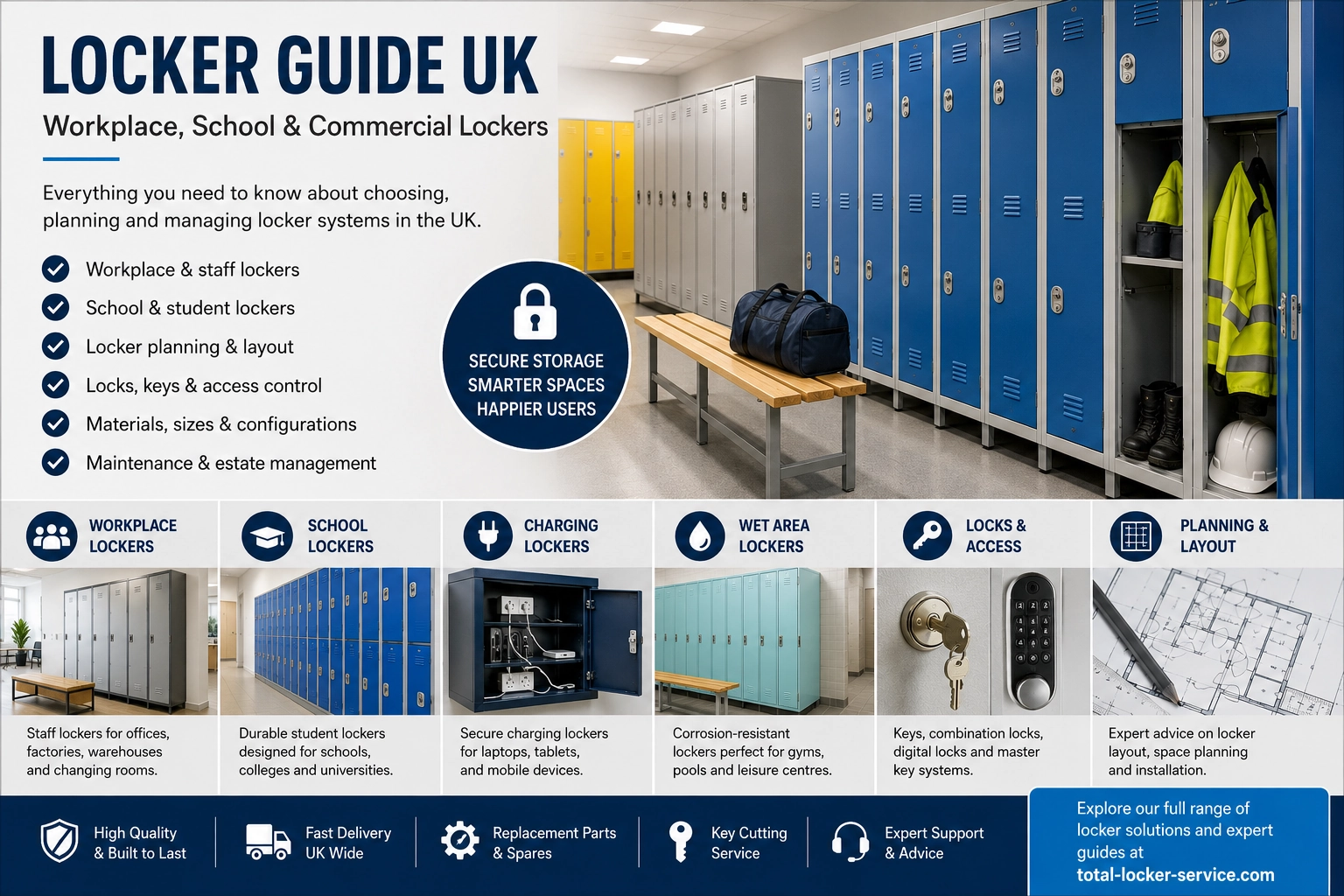
Total Locker Service supplies locker solutions for UK workplaces, schools and commercial sites, including workplace lockers, school lockers, changing room lockers, charging lockers, wet-area lockers, locks, keys, parts and service support.
This guide explains how to choose, plan and manage a locker system in the UK. It also shows how a wider locker canister should work, so visitors can move from broad advice into detailed planning, security, key control and product selection.
Quick answer: what is the best locker system?
The best locker system is the one that matches the user, the environment, the items being stored and the way access must be controlled. A workplace locker may need to store uniforms, PPE and personal belongings. A school locker must cope with daily student use. A leisure locker may need wet-area resistance and short-term visitor access. A charging locker must protect and power devices safely.
- Identify the user group.
- Confirm what will be stored.
- Measure the available space.
- Choose the right locker size.
- Select the right material.
- Choose the lock type.
- Plan key, code or access management.
- Allow for installation and aisle clearance.
- Plan maintenance and replacement parts.
- Record the locker system for future management.
For a broad overview of locker types, materials and common applications, use the Total Locker Service lockers UK guide. For planning layout and usable space, use the locker layout planning guide.
What is a locker?
A locker is a secure storage compartment used by one person, a shared group or a managed facility. It normally has a lockable door and is used to store personal belongings, uniforms, workwear, tools, sports equipment, books, bags, laptops, phones or other items that need controlled access.
Lockers are common in schools, colleges, universities, offices, factories, warehouses, hospitals, gyms, leisure centres, swimming pools, sports clubs, public buildings, transport hubs, staff changing rooms and commercial facilities.
The word “locker” is broad. This is why a single product page cannot answer every possible question. Someone searching for “locker” may need a school locker, a workplace locker, a changing room locker, a laptop charging locker, a staff locker, a wet-area locker or a replacement part for an existing locker.
That is the reason for building a canister. The hub page handles the broad concept. Supporting pages answer the specific questions. The commercial home page then receives stronger, cleaner relevance from a full topic structure.
Why lockers matter in shared buildings
Shared buildings create shared storage problems. People bring bags, coats, phones, keys, laptops, tools, uniforms, PPE and personal belongings into spaces where they cannot always keep those items with them.
Without lockers, items often end up under desks, in corridors, in changing rooms, on benches, in cupboards, in classrooms, in staff rooms, inside vehicles, beside machinery, near wet areas or in unsecured rooms.
That creates clutter, loss risk and avoidable disruption. It can also create safety issues where items block walkways, contaminate work areas or interfere with cleaning.
A locker system gives each user a defined storage point. It also gives the organisation a method of control. The site can decide who receives access, how long they keep it, what happens when a key is lost, how spare keys are stored and how lockers are checked, cleaned and maintained.
This makes lockers part of the building’s operating system. They are not just furniture. They help the building run in a cleaner, safer and more organised way.
Main types of locker
The right locker type depends on the setting. A school does not need the same locker as a factory. A swimming pool does not need the same locker as an office. A charging locker solves a different problem from a standard personal storage locker.
Workplace lockers
Workplace lockers are used by employees to store personal belongings, uniforms, PPE, tools, bags and workwear. They are common in offices, warehouses, factories, workshops, staff rooms and changing areas.
A workplace locker system should be based on the number of users, shift patterns, peak attendance, welfare requirements and the items being stored. A site with fixed employees may use assigned lockers. A hybrid office may use day-use lockers. A factory may need separate clean and dirty storage. A warehouse may need larger compartments for boots, jackets and PPE.
For deeper workplace planning, link to the workplace lockers UK guide.
School lockers
School lockers are designed for pupils and students. They are used for bags, books, coats, PE kit, personal items and sometimes devices. They must be durable, easy to use and simple for staff to manage.
Schools need to think about more than the locker itself. They need to plan numbering, key issue, lost key procedures, spare keys, student allocation and end-of-year recovery. The best school locker system is one that reduces corridor clutter without creating constant admin problems.
A school locker support blog on safe-security-products.co.uk should link into the wider lockers UK guide and the locker keys UK guide.
Leisure lockers
Leisure lockers are used in gyms, swimming pools, sports clubs, spas and changing rooms. They often need to handle short-term use by visitors. They may also be exposed to moisture, cleaning products and high traffic.
In these areas, material choice matters. Wet-area lockers often need plastic, aluminium or other corrosion-resistant materials. The lock type also matters because users may not be assigned a permanent locker. Coin locks, hasp locks, wrist straps, combination locks and digital locks may all be relevant.
Charging lockers
Charging lockers combine storage and power. They are used for laptops, tablets, phones, radios, scanners, handheld devices, tools and other rechargeable equipment.
A charging locker is not only a locker with a plug inside. The design must consider power supply, cable management, ventilation, user access, supervision and how devices are issued or returned. Schools, offices, warehouses, IT teams and facilities teams often use charging lockers to protect equipment while keeping it ready for use.
For this branch of the canister, link to the charging lockers UK guide.
Wet-area lockers
Wet-area lockers are designed for damp, humid or washdown environments. Swimming pools, gyms, spas, leisure centres and changing rooms often need lockers that resist corrosion and are easy to clean.
Steel may work well in dry internal areas, but it may not be the best long-term choice near showers or pools. Plastic lockers are often used where moisture is expected. Material selection should be based on the actual environment, not just the initial purchase price.
Outdoor lockers
Outdoor lockers are used where storage is exposed to weather, changing temperatures or higher environmental stress. They may be used for equipment, staff storage, transport locations, public facilities or external site storage.
Outdoor lockers need suitable materials, weather resistance, drainage consideration, fixing methods and lock choices. They should be chosen carefully because a standard internal locker may fail quickly outside.
Locker materials: steel, laminate and plastic
Locker material affects appearance, strength, cleaning, maintenance and lifespan. The correct material is not the most expensive material. It is the material that suits the location and the expected use.
Steel lockers
Steel lockers are the standard choice for many workplaces, schools and commercial buildings. They are strong, cost-effective and available in many sizes and configurations.
Steel works best in dry internal spaces. It suits staff storage, school corridors, offices, warehouses and general commercial use. It can be supplied in different colours, door configurations and lock options.
Steel lockers are often the best starting point where the environment is not wet and the priority is durable everyday storage.
Laminate lockers
Laminate lockers are often chosen for higher-spec interiors. They suit offices, leisure centres, private clubs, reception areas and premium changing rooms.
Lockers offer a more designed appearance than standard steel. They can also be specified with strong doors and attractive finishes. However, they should be chosen with maintenance, moisture and budget in mind.
Laminate lockers work well where appearance and user experience are important.
Plastic lockers
Plastic lockers are useful in wet or corrosive environments. They are often chosen for swimming pools, gyms, spas, shower areas and washdown spaces.
Their main strength is moisture resistance. They can reduce long-term corrosion risk where steel would suffer. They may also be easier to clean in certain settings.
Plastic is not automatically the best choice everywhere. In a dry office or school corridor, steel may provide better value. In a poolside changing area, plastic may be the better long-term option.
Locker size and compartment choice
Locker size should be based on what the user needs to store. This sounds obvious, but it is one of the most common specification mistakes.
A small multi-tier locker may look efficient on paper, but it may fail if users need to store coats, bags, boots or PPE. A full-height locker may provide excellent storage, but it may waste capacity if users only need space for small personal items.
- Single-door full-height lockers
- Two-door lockers
- Three-door lockers
- Four-door lockers
- Six-door lockers
- Small compartment lockers
- Laptop lockers
- Charging lockers
- Garment lockers
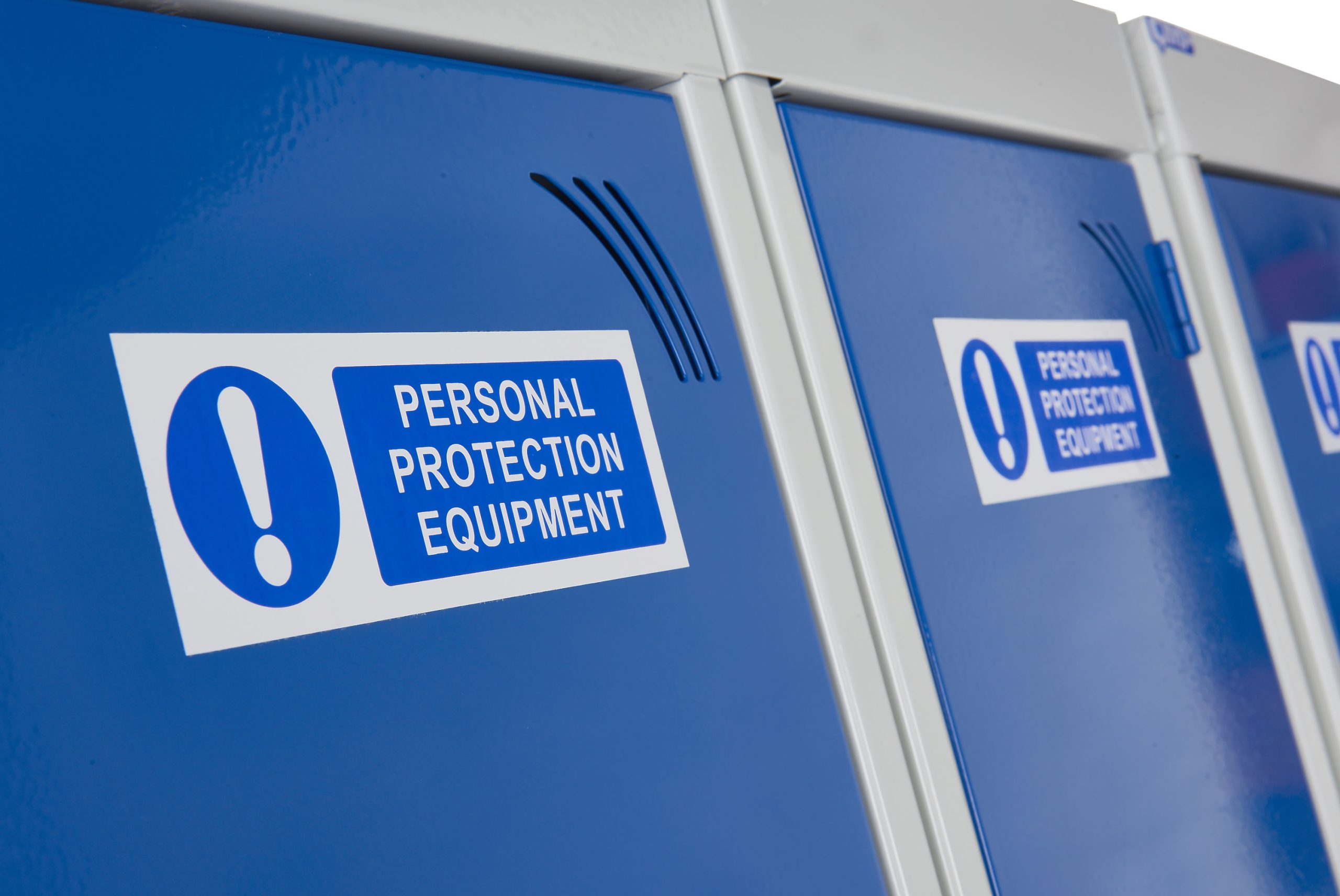
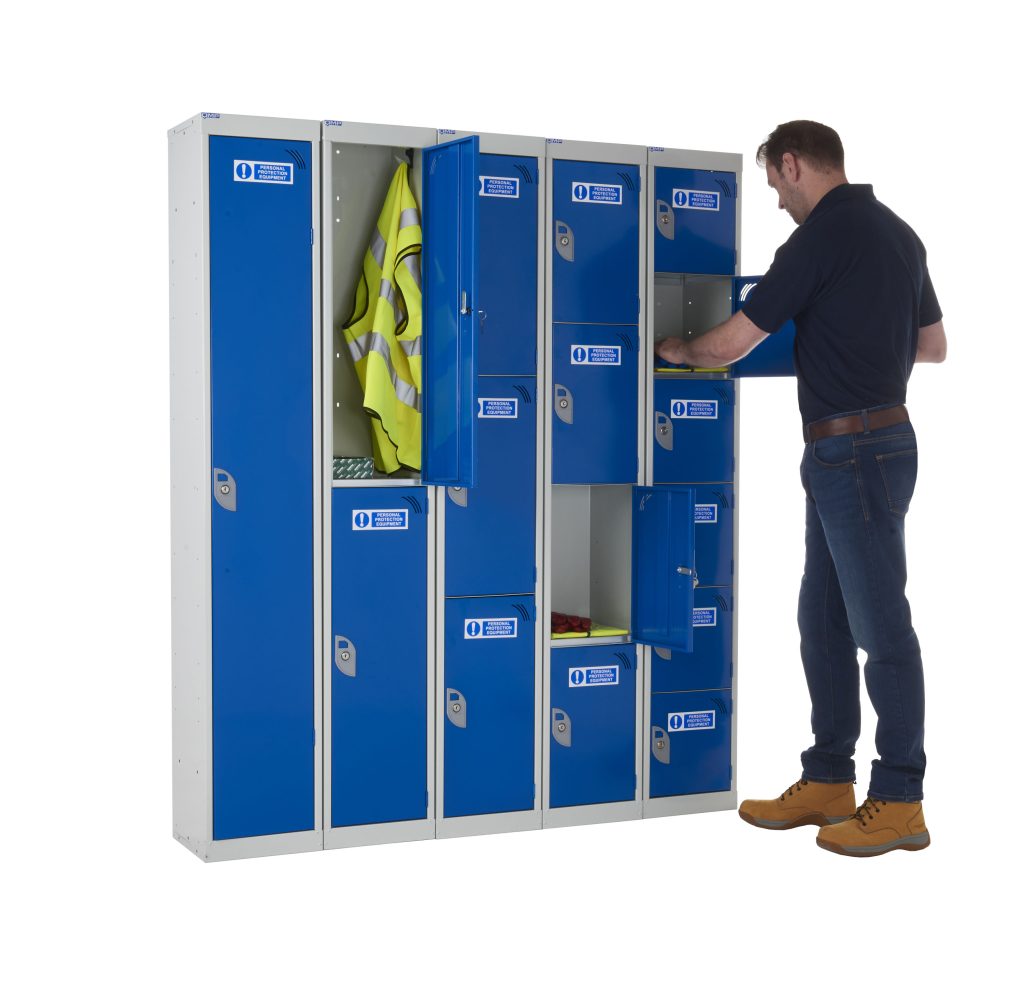
- PPE lockers
- Z-door lockers
- Low-level lockers
- Wall-mounted lockers
The right compartment count depends on the balance between storage volume and number of users.
A school may use two-door or three-door lockers to give enough space for books and bags. A workplace changing room may use full-height lockers for uniforms. A gym may use smaller day-use lockers for visitors. An office may use compact personal lockers for hybrid staff.
The safest approach is to list the largest item that must fit inside. Then specify from that point.
Locker planning and layout
A locker system must fit the room, not just the budget. Layout affects access, safety, cleaning and daily use.
Poor layout creates several problems. Doors can open into walkways. Users can block each other. Benches can sit too close to lockers. Aisles can become narrow. Cleaning access can suffer. Supervision may be poor. Lockers may be difficult to maintain, especially if they are tightly packed into awkward corners.
Locker layout should consider locker depth, door swing, aisle width, bench position, room entrance, fire routes, cleaning access, accessible use, sight lines, user flow and future expansion.
For detailed planning, use the locker layout planning guide. A safe-security-products article on locker planning should not try to replace that guide. It should summarise the issue and send planning-intent visitors to the stronger Total Locker Service planning page.
Locker locks and access control
The lock is one of the most important parts of the locker system. It affects user experience, security, admin time and maintenance.
- Keyed cam locks
- Hasp locks for padlocks
- Coin return locks
- Coin retain locks
- Mechanical combination locks
- Digital combination locks
- RFID locks
- Smart locks
- Master-keyed systems
- Replacement lock barrels
Key locks
Key locks are simple, familiar and widely used. They work well for assigned lockers in schools and workplaces. The main weakness is lost keys. This can be managed with clear records, spare keys and replacement keys cut to code.
For key management, link to the locker keys UK guide.
Combination locks
Combination locks remove the physical key from the user. This can reduce lost key problems. However, users may forget codes, share codes or leave lockers locked at the end of use.
Combination locks can work well in offices, gyms, schools and staff areas when the site has a clear reset and override process.
Padlock fittings
Padlock hasps allow users to bring their own padlock or use a site-issued padlock. They are simple and flexible. However, they can look less consistent and may require staff to cut off locks when users forget keys or leave padlocks behind.
Coin locks
Coin locks are common in leisure centres and visitor changing rooms. They suit short-term use because the user takes the key and later returns it to recover the coin or complete the cycle.
They are less suited to permanent assigned storage unless the system is designed that way.
Digital and smart locks
Digital locks can improve control in managed sites. Some support codes, cards, RFID access or audit functions. They can reduce key handling but may introduce battery checks, programming and management tasks.
For higher-security or more complex sites, the locker security guide is the best supporting page.
Locker key management
Key management is a major part of locker management. A large locker system without a key process can quickly become disorganised.
- Record key codes.
- Link keys to locker numbers.
- Hold spare keys securely.
- Control master keys.
- Record lost keys.
- Order replacement keys by code.
- Recover keys from leavers.
- Audit keys at set intervals.
- Identify locks before ordering replacements.
The key code is especially important. If the code is known, replacement is usually easier. If the code is missing, staff may need to inspect the lock face, find old records or replace the lock.
A supporting Safe & Security blog should be built around “Locker Key Management UK”. It should link into the Total Locker Service locker keys UK guide and the main Total Locker Service homepage where buyers can reach keys, locks and locker support.
Locker security
Locker security is not only about the strength of the door. It is about the full system.
- Suitable material
- Correct lock type
- Controlled access
- Good installation
- Sensible location
- Clear user rules
- Spare key control
- Master key control
- Maintenance checks
- Replacement procedures
- User accountability
The security level should match the risk. A staff room locker for coats does not need the same system as a managed locker bank holding devices or valuable equipment.
Security also depends on behaviour. If users share keys, write codes on paper, leave doors open or force locks, the system weakens. The best lock choice can still fail if the management process is poor.
A dedicated Safe & Security post should cover this in detail and point readers to the locker security guide.
Locker maintenance and parts
A locker system is a long-term asset. It should be maintained rather than ignored until it fails.
Common maintenance issues include lost keys, stiff locks, damaged lock barrels, loose cams, bent doors, broken hinges, missing number plates, damaged shelves, worn wrist straps, failed coin locks, scratched panels, corrosion in wet areas, abandoned lockers and outdated access records.
Many problems can be solved with parts, locks or replacement keys. This is usually better than replacing complete locker units. A strong maintenance process extends the life of the installation and reduces waste.
A locker maintenance blog should link to Total Locker Service pages for keys, locks and locker parts. It should also connect to the locker estate management guide where larger sites need a more structured approach.
Locker estate management
Large sites should treat lockers as an estate, not as loose furniture.
A locker estate may include hundreds of lockers, several buildings, multiple lock types, different key ranges, old and new installations, school year-group areas, staff changing rooms, visitor lockers, device charging lockers, wet-area lockers, maintenance records and replacement cycles.
Without a register, nobody has a complete view of the system. That makes it harder to plan replacements, order parts, manage keys or decide which locker areas need investment.
| Register field | Why it matters |
|---|---|
| Location | Shows where the locker bank is installed |
| Locker type | Separates workplace, school, charging, wet-area and visitor lockers |
| Quantity | Supports audits, capacity planning and replacement forecasting |
| Manufacturer | Helps with replacement parts and key orders |
| Material | Shows whether the locker suits the environment |
| Lock type | Supports maintenance and access control |
| Key code range | Speeds up replacement key orders |
| Condition | Identifies areas needing repair or renewal |
| Planned replacement date | Supports budget planning and phased upgrades |
This is especially useful for councils, schools, hospitals, leisure trusts, factories, universities and multi-site organisations.
A supporting blog on safe-security-products.co.uk should link to the locker estate management UK guide.
Choosing the right locker by sector
Offices
Offices often need personal storage for hybrid working, staff belongings, laptops, bags and visitor items. Day-use lockers can work well where desks are shared. Assigned lockers may be better where staff attend daily or need permanent storage.
Office lockers should be easy to use, visually suitable and matched to the access policy.
Schools and colleges
Schools need robust lockers that can withstand frequent daily use. Numbering, key control and corridor layout matter. Schools should avoid locker systems that create congestion or excessive admin.
Durability and simple management are usually more important than premium finishes.
Warehouses and factories
Industrial workplaces may need lockers for PPE, uniforms, boots, tools and personal items. Some sites need separate clean and dirty storage. Others need ventilated lockers or larger compartments.
Lockers should support the working process, not block it.
Gyms and leisure centres
Gyms and leisure centres need lockers that suit short-term users. Wet-area resistance, wrist straps, coin locks, combination locks and easy cleaning may all matter.
High turnover means the lock and material choice are critical.
Healthcare settings
Healthcare staff areas may need secure storage for uniforms, bags and personal belongings. Cleaning, infection control expectations, staff movement and shift patterns should all be considered.
Lockers should be practical, cleanable and suitable for the environment.
Public and commercial buildings
Public buildings may need visitor lockers, staff lockers or secure storage for contractors. These systems should be simple to supervise and easy to manage.
The access method is often more important than maximum storage volume.
Common locker buying mistakes
Starting with price only
Price matters, but the cheapest locker is not always the lowest-cost option. A poor fit can lead to broken locks, unusable compartments, corrosion, complaints and early replacement.
Ignoring the user
A locker must work for the person using it. If the compartment is too small or the lock system is frustrating, users will avoid it or misuse it.
Choosing the wrong material
Steel, laminate and plastic all have a place. The wrong material can cause maintenance problems, especially in wet or humid areas.
Forgetting door swing and aisle width
A locker may fit against a wall but still fail in use if doors open into tight spaces.
Not planning key control
Lost keys are normal. A site needs a procedure before the first key goes missing.
Ignoring future maintenance
Keys, locks, number plates and parts should be available. A locker system should not become unsupported after installation.
Using one specification everywhere
A school corridor, office, gym changing room and warehouse do not need the same locker specification. Standardisation helps, but it should not override the environment.
Locker specification checklist
Before buying lockers, answer these questions.
User
- Who will use the locker?
- Is use assigned or shared?
- Is access daily or occasional?
- Are users pupils, staff, visitors or contractors?
- Are there accessibility needs?
Storage
- What will be stored?
- What is the largest item?
- Are items wet, dirty, valuable or powered?
- Are uniforms or PPE involved?
- Are devices being charged?
Environment
- Is the space dry, damp or wet?
- Is the locker indoors or outdoors?
- Is the area supervised?
- Is the area high traffic?
- Does the room need cleaning access?
Size
- What height is needed?
- What depth is needed?
- How many compartments are required?
- Will benches be used nearby?
- Is there enough aisle space?
Locks
- Will users have keys?
- Will users use codes?
- Is a master key needed?
- Are spare keys required?
- How will lost access be managed?
Management
- Who allocates lockers?
- Who maintains records?
- Who orders replacement keys?
- Who handles faults?
- Who checks abandoned lockers?
Long-term support
- Can replacement keys be ordered?
- Can locks be replaced?
- Are parts available?
- Is there a maintenance plan?
- Is replacement planning needed?
Where to start
For most buyers, the best starting point is the main Total Locker Service website:
Total Locker Service locker solutions UK
From there, visitors can move into workplace lockers, school lockers, leisure lockers, metal lockers, charging lockers, wet-area lockers, fast delivery lockers, replacement keys, locks, parts and service support.
For research and planning, the best starting point is the Total Locker Service blog hub:
Locker guides, key management and storage advice UK
For a broad category explanation, use Lockers UK: Types, Materials and Storage Solutions.
Layouts and installation planning, use the Locker layout planning guide UK.
For key control, use the Locker keys UK guide.
For larger facilities, use Locker estate management UK.
Frequently asked questions
What is the best locker for a workplace?
The best workplace locker depends on what staff need to store. Offices may need compact personal lockers. Factories may need full-height lockers for uniforms and PPE. Warehouses may need larger compartments for boots, coats and equipment. The lock type should match whether lockers are assigned, shared or used by shift workers.
What is the best locker for a school?
A school locker should be durable, easy to use and simple for staff to manage. Numbering, key issue, spare key control and corridor layout are important. Schools should choose lockers that fit bags, books, coats and PE kit without creating congestion.
Are steel lockers better than plastic lockers?
Steel lockers are strong and suitable for many dry internal spaces. Plastic lockers are better for wet or humid environments because they resist corrosion. The best material depends on where the locker will be installed.
What size locker do I need?
The right locker size depends on the largest item being stored and the number of users. Full-height lockers suit coats, uniforms and PPE. Multi-tier lockers suit smaller personal items. Charging lockers suit devices. Always plan around the user and the item, not just the available wall space.
Do lockers need master keys?
Some locker systems use master keys so authorised staff can access lockers when needed. This is useful for schools, workplaces and managed facilities. However, master keys must be stored securely and controlled carefully.
What should I do if a locker key is lost?
Check the key code on the lock, spare key or site records. If the code is known, a replacement key may be ordered. If the code is missing, the lock may need to be identified or replaced. A clear lost key process reduces disruption.
Are combination locks better than keys?
Combination locks remove the problem of lost physical keys, but users can forget or share codes. Key locks are simple and reliable when spare keys and replacement key records are managed properly. The best choice depends on the site.
Can lockers charge laptops and phones?
Yes. Charging lockers are designed to store and power devices such as laptops, tablets, phones, radios and tools. They should be selected with power, ventilation, cable management and access control in mind.
How long should lockers last?
A good locker system can last for many years when the correct material is chosen and the site maintains locks, keys, hinges, doors and number plates. Wet or high-use areas may need more frequent checks.
Why should a locker page link to a blog canister?
A broad locker page answers the main buying question. A blog canister answers the supporting questions around planning, security, sizing, materials, keys, maintenance and estate management. Together, they build stronger topical authority and guide visitors more clearly.
Conclusion
A locker is not just a metal box with a lock. It is part of the way a building manages people, belongings, equipment and access. The right locker system improves order, reduces clutter, protects items and supports daily routines.
The wrong locker system creates avoidable problems. It wastes space, causes access issues, increases maintenance and frustrates users.
For that reason, locker selection should always begin with the user, the environment and the management process. Once those are clear, the right material, size, lock and layout become much easier to choose.
Use this canister as the broad educational route on safe-security-products.co.uk. Then send visitors into the correct Total Locker Service guide or commercial page when they are ready to plan, compare or buy.
For product advice, start with Total Locker Service locker solutions UK. For detailed research, use the Total Locker Service locker blog hub.