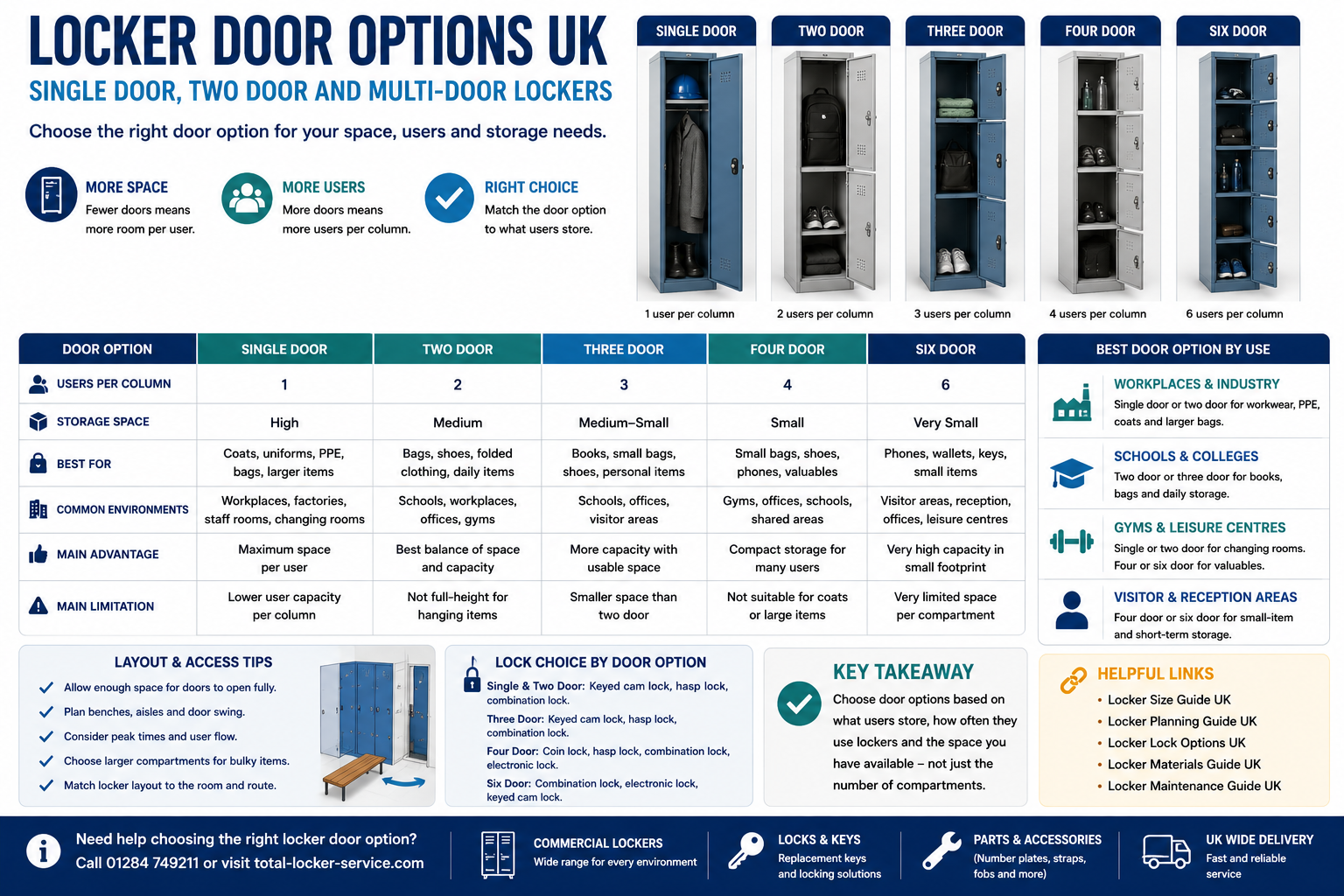
Locker door choice affects storage capacity, user experience, room layout and long-term value. A single-door locker gives one user a full-height space. A two-door locker gives two users practical storage in the same footprint. Four-door and six-door lockers increase user numbers but reduce the space inside each compartment.
This UK guide compares single door, two door, three door, four door and six door lockers. It explains which locker door option suits workplaces, schools, gyms, leisure centres, changing rooms, offices and visitor areas. It also shows how door configuration connects to locker size, locker layout, lock choice and product selection.
Door choice should not be based on capacity alone. The right locker must fit what users store each day. Coats, bags, PPE, shoes, laptops, tools, towels and valuables all need different compartment sizes. A locker bank may hold more users with smaller doors, but it may perform badly if the compartments are too small for real use.
Quick answer: which locker door option do you need?
Choose single door lockers when each user needs full-height storage for coats, uniforms, PPE, workwear, bags or equipment. Choose two door lockers when users need practical everyday storage and you want to double capacity within the same locker footprint. Choose four door or six door lockers when users only need compact storage for phones, wallets, keys, shoes, small bags or visitor belongings.
As a simple rule, fewer doors mean more space per user. More doors mean more users per locker column. The best option depends on what people store, how long they use the locker, how busy the area is and how much room the site has available.
| Door option | Best for | Storage level | Best environments |
|---|---|---|---|
| Single door lockers | Coats, uniforms, PPE, bags and larger items | High | Workplaces, factories, staff rooms and changing rooms |
| Two door lockers | General personal storage | Medium | Schools, offices, workplaces and gyms |
| Three door lockers | Medium-small daily storage | Medium-small | Schools, offices and visitor areas |
| Four door lockers | Small bags, shoes, phones and valuables | Small | Gyms, offices, schools and shared areas |
| Six door lockers | Phones, wallets, keys and small items | Very small | Visitor storage, valuables storage and reception areas |
This guide sits below the commercial lockers route and should be used alongside the locker size and locker planning guides. Door configuration is one part of the buying decision, not the whole decision.
Why locker door options matter
Locker door configuration controls the size of each compartment. The external locker column may stay the same height and width, but the internal use changes completely when the column is split into more doors. A full-height single door locker can store a coat and bag. A six door locker in the same column may only suit small personal items.
Door options also affect room flow. Larger doors need more swing space. Smaller compartments may increase the number of users opening lockers at the same time. In schools, gyms and shift-change areas, that can create congestion if the layout is too tight. Door choice should therefore be planned alongside aisle width, bench position and user numbers.
The right door option also reduces damage. If compartments are too small, users force items into them. Doors become strained, locks misalign and hinges wear faster. If compartments are too large for the use, the site may waste wall space and reduce the number of available lockers.
Single door lockers
Single door lockers give each user the full height of the locker column. They are the best choice when users need to hang coats, store uniforms, keep PPE together or place larger bags inside the locker. They are often used in workplaces, staff rooms, factories, warehouses, changing rooms, emergency service facilities and industrial sites.
A single door locker is the strongest general storage option when user comfort matters more than maximum compartment count. It gives room for bulky items and reduces the risk of overfilled compartments. It is also easier for users who need to store a mix of clothing, footwear and work equipment.
Advantages of single door lockers
- Provides the most storage per user.
- Suitable for coats, uniforms, PPE and workwear.
- Works well for larger bags and bulky items.
- Good for changing rooms and staff storage.
- Useful when users need assigned long-term storage.
- Reduces the risk of forcing items into small compartments.
Limitations of single door lockers
The main limitation is capacity. A single door locker usually serves one user per column. If the site needs storage for many people in a small space, single door lockers may require more wall length than multi-door lockers.
They also use larger doors, so door swing must be planned carefully. In narrow rooms, a row of open single doors can reduce aisle space and block movement. This is why single door lockers should be planned with room layout, not chosen in isolation.
Best uses for single door lockers
- Staff changing rooms.
- Warehouse and factory lockers.
- PPE and uniform storage.
- Gym and leisure changing rooms.
- Workplace coat and bag storage.
- Sports kit and bulky personal storage.
For staff and workwear use, see workplace lockers. For changing rooms and leisure settings, see leisure lockers.
Two door lockers
Two door lockers split a full-height column into two compartments. They are one of the most useful locker formats because they balance storage capacity with space efficiency. Each user gets a practical compartment, while the site doubles the number of users per column compared with single door lockers.
Two door lockers are commonly used in schools, workplaces, offices, staff rooms, gyms and dry changing areas. They are suitable for bags, shoes, folded clothing, books and everyday personal items. They are less suitable for long coats, large uniforms or bulky PPE unless the compartment size is still sufficient.
Advantages of two door lockers
- Good balance between storage and user capacity.
- Useful for staff, students and general personal storage.
- More efficient than single door lockers where space is limited.
- Suitable for bags, shoes and folded clothing.
- Works well in schools, offices and workplaces.
- Often easier to justify where user numbers are high.
Limitations of two door lockers
Two door lockers do not provide full-height hanging space. Users can usually store a bag, shoes and folded clothing, but they may struggle with long coats, bulky PPE or large sports equipment. If users regularly carry large items, single door lockers may be better.
The top and bottom compartments may also feel different in use. Some users may prefer upper compartments. Others may find lower compartments less convenient. For schools and high-turnover areas, allocation and accessibility should be considered.
Best uses for two door lockers
- School corridors.
- Office personal storage.
- General workplace lockers.
- Dry staff rooms.
- Gym changing rooms where medium storage is enough.
- Shared buildings with moderate storage needs.
For education settings, see school lockers. For general commercial routes, use the main locker buying guide.
Three door lockers
Three door lockers divide a full-height column into three medium-small compartments. They offer more user capacity than two door lockers while still giving more space than four or six door lockers. They can work well where users need storage for smaller bags, books, shoes and personal items.
Three door lockers are often suitable for schools, colleges, offices, visitor areas and staff rooms where users do not need hanging space. They can be a good middle option when two door lockers take too much space and four door lockers feel too small.
Advantages of three door lockers
- Increases user capacity compared with one or two door lockers.
- Provides more usable space than four or six door lockers.
- Good for books, shoes, compact bags and personal items.
- Useful where storage need is moderate.
- Can suit schools, colleges, offices and visitor storage.
Limitations of three door lockers
Three door lockers are not usually suitable for coats, long garments or bulky workwear. The top and bottom compartments may also be less comfortable for some users, depending on height and accessibility needs.
They should be chosen only when the site has checked what users actually store. If users bring large backpacks, winter coats or gym bags, three door lockers may feel too limited.
Four door lockers
Four door lockers provide compact storage for four users in one full-height column. They are useful when the site needs secure storage for smaller items rather than full personal storage. Typical uses include phones, wallets, keys, shoes, small bags and visitor belongings.
Four door lockers can work well in offices, schools, gyms, leisure centres, reception areas and shared facilities. They are useful where users only need temporary storage during a visit, lesson, shift or activity.
Advantages of four door lockers
- High user capacity in a compact footprint.
- Good for small bags, shoes and valuables.
- Useful for visitor and shared-use storage.
- Works well where users do not need coats or large bags stored.
- Can support offices, schools, gyms and reception areas.
Limitations of four door lockers
Four door lockers are too small for many full personal storage needs. They are not normally suitable for coats, uniforms, large bags, PPE or workwear. If used incorrectly, users may overfill them, strain the doors and damage locks.
They should be treated as compact storage lockers. They are excellent for the right use, but poor for users who need changing-room or staff-room storage.
Six door lockers
Six door lockers create very high-density storage. They are best for small items such as phones, wallets, keys, small devices, visitor belongings and valuables. They can be useful in reception areas, offices, schools, gyms, leisure centres and public buildings where many users need short-term secure storage.
A six door locker should not be confused with general personal storage. The compartments are small. They can be extremely useful for valuables, but they do not replace staff lockers, changing room lockers or school bag storage lockers.
Advantages of six door lockers
- Very high user capacity.
- Excellent for small-item storage.
- Useful for phones, wallets, keys and valuables.
- Good for visitor areas and reception zones.
- Can support short-term shared use.
- Efficient where floor and wall space are limited.
Limitations of six door lockers
Six door lockers offer limited internal storage. They are not suitable for coats, bags, footwear, PPE, sports kit or uniforms. If users need to store anything more than small personal items, choose a larger compartment option.
Six door lockers also create more locks per locker column. This can increase key, code or lock management. In public-use areas, choose the lock type carefully so staff can manage lost access, forgotten codes or abandoned compartments.
Multi-door lockers
Multi-door lockers include any locker column split into several compartments. This usually includes two door, three door, four door and six door lockers. The term is useful when comparing high-capacity storage options against full-height single door lockers.
Multi-door lockers work best when users need secure compartments but not full personal storage. They can support schools, offices, gyms, leisure centres, staff areas, visitor zones and shared commercial buildings. They are especially useful where the site has many users and limited wall space.
The important question is not “how many compartments can we fit?” The better question is “what does each user need to store?” Once that is clear, the door option becomes easier to choose.
Locker door comparison table
Use this table to compare locker door options before choosing a product route. Exact internal dimensions vary by locker range, so always check the specification before ordering.
| Door option | Capacity per column | Best storage use | Main advantage | Main limitation |
|---|---|---|---|---|
| Single door | 1 user | Coats, bags, uniforms, PPE and equipment | Maximum space per user | Lower user capacity |
| Two door | 2 users | Bags, shoes, folded clothing and daily items | Strong balance of size and capacity | No full-height hanging space |
| Three door | 3 users | Books, smaller bags, shoes and personal items | Useful middle option | Can be too small for larger bags |
| Four door | 4 users | Small bags, shoes, phones, wallets and valuables | Compact shared storage | Not suitable for coats or PPE |
| Six door | 6 users | Phones, keys, wallets and small items | Very high-density storage | Very limited compartment space |
Best locker door option by use
Locker door choice should match the environment and user need. A workplace changing room, school corridor, gym, office and visitor area may all need different door configurations.
Workplace lockers
Workplaces often need single door or two door lockers. Single door lockers are best when staff store coats, uniforms, PPE, workwear, boots or larger bags. Two door lockers work well when users need personal storage but not full-height hanging space.
Factories, warehouses and industrial sites should be careful with small compartments. Staff may need room for safety boots, hi-vis clothing, helmets and work bags. In these settings, single door lockers often provide better practical value.
Recommended route: workplace lockers.
School lockers
Schools often use two door or three door lockers to balance storage capacity with corridor space. These formats can give students enough room for books, bags and personal items while keeping the locker bank efficient.
Single door lockers provide more storage per student, but they need more wall space. Four door or six door lockers may work for valuables or phone storage, but they are usually too small for normal student storage.
Recommended route: school lockers.
Gym and leisure lockers
Gym and leisure lockers should match the changing routine. Users may need space for bags, shoes, towels, coats and clothing. Single door or two door lockers are often best for changing rooms. Four door or six door lockers can work well for valuables near reception or activity areas.
Wet changing rooms also need the right material. Door option is only one decision. Plastic or wet-area lockers may be more suitable near pools, showers and humid spaces.
Recommended route: leisure lockers.
Office lockers
Office lockers often support hybrid working, personal storage and shared desks. Two door lockers are a strong option for everyday storage. Four door lockers may suit smaller personal items. Six door lockers can be useful for phones, wallets, keys or visitor belongings.
If users need to store laptops or charge devices, check whether standard compartments are enough. Powered storage may be more suitable. For device storage, see charging lockers.
Visitor lockers
Visitor lockers usually need small, short-term storage. Four door and six door lockers can work well for phones, keys, wallets and small bags. The lock type should be simple to use and easy for staff to manage.
For reception areas, avoid giving visitors larger compartments than they need. Small multi-door lockers often provide better space efficiency and cleaner access control.
Layout and access planning
Door configuration affects room layout. Single door lockers give more storage, but they also have larger doors. Multi-door lockers give more compartments, but they can create more users accessing the same area at once. The best layout depends on peak use, not just quiet use.
Before choosing door options, check aisle width, door swing, bench position, user route, wall length and any fixed obstacles. In changing rooms, users need space to open lockers, sit down, change shoes, handle bags and move around others.
- Allow enough space for locker doors to open.
- Do not place locker doors where they block exits or main routes.
- Plan benches and lockers together.
- Consider peak times such as school breaks, shift changes and gym rush hours.
- Use larger compartments where users have coats, bags or PPE.
- Use smaller compartments only where the stored items are genuinely small.
For room planning, link this page to the locker planning guide. For dimension decisions, use the locker size guide as the main supporting article.
Lock choice by door option
Locker door configuration also affects lock management. A single door locker uses one lock for one user. A six door locker uses six locks in the same column. More doors can mean more keys, codes, coins or access points to manage.
For assigned-use lockers, keyed cam locks may be suitable. For shared-use lockers, hasp locks, coin return locks, combination locks or electronic locks may be more practical. The right option depends on the site, user turnover and staff support process.
| Door option | Common lock choices | Management note |
|---|---|---|
| Single door | Keyed cam lock, hasp lock, combination lock | Good for assigned staff or long-term users |
| Two door | Keyed cam lock, hasp lock, coin lock, combination lock | Useful for staff, school and gym storage |
| Three door | Keyed cam lock, hasp lock, combination lock | Check user access to upper and lower compartments |
| Four door | Coin lock, hasp lock, combination lock, electronic lock | Useful for shared or short-term use |
| Six door | Combination lock, electronic lock, keyed cam lock | Higher number of locks to manage |
For lock selection, see locker locks by type. For lost or replacement keys, see replacement locker keys.
Common locker door option mistakes
Most locker door mistakes come from focusing on the number of compartments instead of the size of each compartment. A site may increase capacity on paper while reducing real usability.
- Choosing six door lockers when users need space for bags or coats.
- Using four door lockers for staff changing rooms with workwear.
- Choosing single door lockers where only valuables storage is needed.
- Ignoring door swing in narrow rooms.
- Installing too many small compartments in high-traffic areas.
- Forgetting that top and bottom compartments can be less accessible.
- Using the same door option across a whole site with different storage needs.
- Choosing door configuration before checking lock type.
- Forgetting future user growth.
- Ignoring wet-area material requirements in pool and shower areas.
The strongest approach is to map the user, item and room first. Then choose the door configuration that fits those facts.
How to choose the right locker door option
Use this simple process before choosing single door, two door or multi-door lockers.
- List the users. Identify whether lockers are for staff, students, visitors, members or contractors.
- List the stored items. Include coats, bags, shoes, PPE, laptops, phones, towels, tools and valuables.
- Decide the storage level. Choose large, medium or small compartments based on real use.
- Check the room. Measure wall length, aisle width, door swing and bench positions.
- Choose the lock type. Match the lock to assigned use or shared use.
- Consider peak use. Plan for busy times, not just quiet periods.
- Allow for growth. Leave spare capacity where possible.
- Link the door choice to material. Wet areas, dry offices and industrial rooms may need different materials.
For most staff and changing-room storage, start with single door or two door lockers. For school corridors and office storage, two door or three door lockers may work well. For valuables and visitor storage, four door or six door lockers are often more efficient.
Final recommendation
Locker door choice should follow the storage need. Use single door lockers when users need the most space. Use two door lockers when users need a practical balance between storage and capacity. Use three door lockers for moderate storage where space is tighter. Use four door and six door lockers for smaller items, valuables and short-term storage.
Do not choose the door option from user numbers alone. Check what each person needs to store, how often lockers are used and how much room is available around the locker bank. The right door configuration makes the locker system easier to use, easier to manage and less likely to suffer from damage.
Total Locker Service supplies single door lockers, two door lockers and multi-door lockers for workplaces, schools, gyms, leisure centres, healthcare sites and commercial buildings across the UK. Browse commercial lockers, view workplace lockers, or call 01284 749211 for help choosing the right locker door option for your site.
Locker door option FAQs
What is the best locker door option?
The best locker door option depends on what users need to store. Single door lockers are best for coats, uniforms, PPE and larger bags. Two door lockers are best for general storage. Four door and six door lockers are best for small items and valuables.
Are single door lockers better than two door lockers?
Single door lockers are better when each user needs full-height storage. Two door lockers are better when the site needs more user capacity and each user only needs medium storage for bags, shoes and folded clothing.
What are two door lockers used for?
Two door lockers are used for general staff, student and personal storage. They are suitable for bags, shoes, folded clothing, books and everyday items where full-height hanging space is not required.
Are four door lockers suitable for staff?
Four door lockers can work for staff valuables or small personal items, but they are usually too small for full staff changing storage. Staff who need to store coats, uniforms, PPE or bags normally need larger compartments.
What are six door lockers best for?
Six door lockers are best for small-item storage such as phones, wallets, keys, small devices and visitor belongings. They are not suitable for coats, large bags, PPE or changing-room storage.
Which locker door option is best for schools?
Schools often use two door or three door lockers because they balance student storage with corridor space. Four door or six door lockers may be useful for phones or valuables, but they are usually too small for normal student bags.
Which locker door option is best for gyms?
Gyms often need single door or two door lockers for changing rooms because users bring bags, shoes, clothing and towels. Four door or six door lockers can be used for valuables or small-item storage near reception.
Do multi-door lockers save space?
Yes. Multi-door lockers can increase the number of users in the same locker footprint. However, each compartment becomes smaller, so they should only be used when the storage need is compact enough.
Can different locker door options be used on the same site?
Yes. Many sites benefit from mixed door options. A workplace may use single door lockers for changing rooms, two door lockers for staff storage and six door lockers for valuables. The door option should match each area’s use.
Who supplies single door, two door and multi-door lockers in the UK?
Total Locker Service supplies single door lockers, two door lockers and multi-door lockers for UK workplaces, schools, gyms, leisure centres, healthcare sites and commercial buildings.