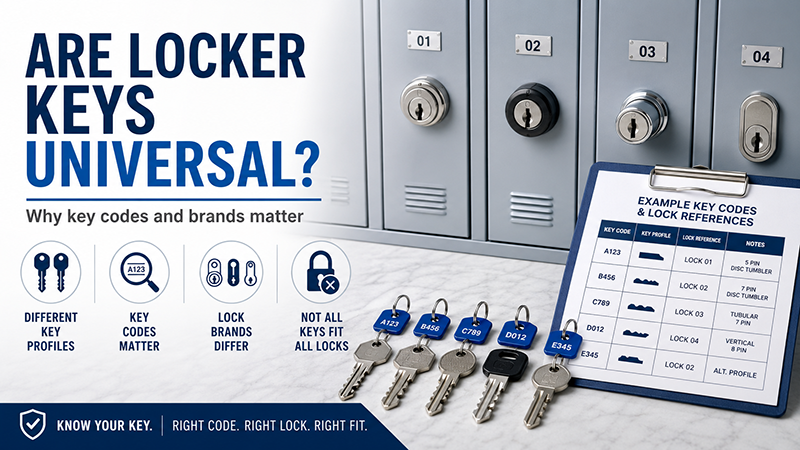
Locker keys are not universal. A key that fits one locker will not automatically fit another locker, even when the locks look similar. The correct replacement depends on the key code, lock brand, key profile, lock series and sometimes the master key system used on site.
This guide explains why locker keys are not usually interchangeable, why key codes and brands matter, and what information to check before ordering a replacement key.
This article supports our main Locker Keys UK replacement and key management guide. For direct ordering, use Total Locker Service for replacement locker keys cut to code.

Quick Answer: Are Locker Keys Universal?
No, locker keys are not universal. Most locker keys are cut for a specific lock, code range or manufacturer system. A key may look similar to another key, but small differences in the blade, grooves, length or cut pattern can stop it from fitting or turning.
To order a replacement key, you normally need the key number, lock code or manufacturer reference. This code may be stamped on the key, shown on the lock face, marked on the lock barrel or recorded in a site key register.
The visible locker number on the door is not always the same as the key code. This is one of the most common reasons replacement keys are ordered incorrectly.
For direct help finding the correct number, read where to find a locker key number or lock code.
Why Locker Keys Are Not Universal
Locker keys are designed to match specific locks. The lock barrel contains internal parts that line up only when the correct key is inserted. If the key shape or cut pattern is wrong, the lock will not open.
Two locker keys may look almost identical from a distance. However, they may use different blanks, different grooves, different cut depths or different code series. A small difference is enough to stop the key from working.
This is why a replacement key should not be ordered by appearance alone. A key that looks right may still be wrong. The supplier needs the correct code and, where possible, the lock brand or key range.
- Different locker locks use different key profiles.
- Different brands use different code ranges.
- The same locker room may contain mixed lock types.
- Older lockers may have had some locks replaced over time.
- Master-keyed systems may need compatible key ranges.
For a broader explanation of replacement ordering, read replacement locker keys cut to code: what it means.
What Does “Universal” Usually Mean?
When people ask whether locker keys are universal, they may mean several different things. Each meaning has a different answer.
| Question | Answer | Why it matters |
|---|---|---|
| Will one user key open all lockers? | No, not normally. | User keys are usually cut for one lock or one small keyed-alike group. |
| Will any key from the same locker brand work? | No. | The key must match the correct code and lock series. |
| Can a master key open many lockers? | Sometimes. | Only if the locks were set up for that master key system. |
| Can a replacement key be made without the original? | Often, yes. | The supplier needs the correct key number or lock code. |
In most cases, the safe assumption is simple: the key is not universal, and the code must be checked before ordering.
Why the Key Code Matters
The key code identifies the cutting pattern needed for the replacement key. It may be a short number, a longer number, a letter and number combination, or a manufacturer-specific reference.
Without the correct code, the replacement key may not fit the lock. Even one wrong digit can produce the wrong key. This is why worn markings should be checked carefully before ordering.
The key code may be found on the original key, lock face, lock barrel, spare key tag or site key register. It should be written exactly as shown, including letters, prefixes and leading zeros.
For example, AB012 may not be the same as AB12. A code beginning with a letter may belong to a different range from a number-only code. These details matter because they guide the key-cutting process.
For step-by-step identification, use our guide to finding a locker key number or lock code.
Why the Lock Brand Matters
The lock brand can help identify the correct key range. Commercial lockers may use locks associated with brands such as Probe, Helmsman, Lowe & Fletcher, Ojmar, ASSA, Link, Garran, Pure and other locker lock systems.
The visible locker brand and the lock brand are not always the same. A locker cabinet may have been made by one company but fitted with a lock from another supplier. This means the replacement key must match the lock, not just the locker cabinet.
Brand information is especially useful when a code is unclear or when different lock ranges use similar-looking numbers. It can also help when a site has several locker types installed across different buildings or at different times.
- Check the key head for a brand name or logo.
- Check the lock face for markings.
- Check the locker door or frame for manufacturer details.
- Check old invoices and installation records.
- Photograph the lock if the brand is uncertain.
When ordering from Total Locker Service, provide the code, brand and any clear photos where possible. Use the replacement locker keys page for direct ordering support.
Key Profile, Key Blank and Cut Pattern
A locker key has more than one important feature. The visible number is only part of the story. The physical key shape also matters.
The key profile describes the shape and grooves of the key blade. The key blank is the uncut key before the pattern is added. The cut pattern is the set of cuts that allows the lock barrel to turn.
A replacement key must match all relevant parts. The correct code helps identify the cut pattern, but the correct lock range helps identify the right blank and profile. This is why keys are not interchangeable simply because they look similar.
Trying to force the wrong key into a lock can cause damage. It may bend the key, jam the barrel or make the lock harder to use. If a key does not enter or turn smoothly, stop and check the code again.
Locker Number vs Key Code
The locker number is usually shown on the door. It helps users find the correct compartment. The key code identifies the lock and is used for replacement key cutting.
Sometimes the locker number and key code match. However, this should never be assumed. Many lockers have a door number that is completely separate from the key code.
For example, locker 024 may use key code E5023. In that case, ordering a replacement key for 024 may not work. The supplier needs E5023 because that is the lock code.
This distinction is important for schools, gyms and workplaces because staff may only see the door number during a lost key incident. The actual key code may be on the key, lock face, barrel or key register.
For a full explanation, read locker key numbers vs locker door numbers.
Are Locker Master Keys Universal?
No. Locker master keys are not universal either. A master key only works with locks that have been set up to operate under that master key system.
A school, gym or workplace may have a master key that opens many lockers on one site. That does not mean the same master key will open lockers from another site, another brand or another lock range.
Master keys are useful for managed locker environments. They allow authorised staff to open lockers during lost key incidents, maintenance checks or emergency access situations. However, they must be controlled carefully because one lost master key may affect many lockers.
When ordering replacement user keys, check whether the lock is part of a master-keyed system. The replacement key should work correctly with the individual locker while preserving the wider management access arrangement.
For more detail, read locker master keys explained.
Can One Locker Key Open More Than One Locker?
Sometimes, but only when the locks are keyed alike or designed as part of the same system. This is different from being universal.
Keyed-alike lockers are set up so one user key opens more than one lock. This may be useful for staff storage, maintenance cupboards or controlled storage groups. However, it is planned during supply or lock setup. It does not mean any random locker key will work.
Most user lockers are keyed differently. This means each locker has its own key. That arrangement is better for personal storage because users should not be able to open each other’s lockers.
If several lockers unexpectedly open with the same key, check the lock system. It may be intentional, or it may indicate a security concern that needs review.
Mixed Locker Installations
Many sites have mixed locker installations. A school may have added new lockers over several years. A gym may have refurbished one changing room but not another. A workplace may have replaced damaged locks individually rather than changing the whole system.
This means one room can contain different locks, key profiles and code ranges. A replacement key that works in one area may not work in another, even if the lockers look similar.
Mixed installations make key records more important. The key register should show the locker number, key code, lock brand and location. If the lock is replaced, the register should be updated immediately.
For record-keeping support, read how to build a locker key register.
What Happens If You Order the Wrong Locker Key?
If the wrong locker key is ordered, it may not enter the lock, or it may enter but fail to turn. In some cases, forcing the wrong key can damage the lock or bend the key.
A wrong key order also delays the repair. The locker may remain out of use, and staff may need to check the code again before placing a second order.
Wrong orders are usually caused by one of five issues: using the locker number instead of the key code, misreading a worn number, missing a letter or leading zero, choosing the wrong lock brand, or relying on an old record after the lock has been changed.
- Do not guess unclear numbers.
- Do not order from the door number unless it is confirmed as the key code.
- Do not ignore the lock brand.
- Do not miss prefixes or leading zeros.
- Do not rely on old records without checking the current lock.
For a detailed list, read common mistakes when ordering locker keys.
What to Check Before Assuming a Key Is Universal
Before trying a key in several lockers, check whether the system is intended to work that way. A master key or keyed-alike group may open several lockers. A normal user key should usually open one locker only.
If a key opens more lockers than expected, record which lockers are affected and check the lock schedule. This may be normal for a managed system, or it may suggest that a lock has been fitted incorrectly.
If a user key opens the wrong locker, stop using that locker until the issue is checked. Personal storage needs clear access control. Users should not be able to access lockers assigned to other people.
Sector Examples
The same key rules apply across different sectors, but the risks vary by site type.
| Site type | Common issue | Best action | Supporting guide |
|---|---|---|---|
| Schools | Pupils may assume door numbers are key numbers | Use a clear key register and termly checks | School locker keys |
| Gyms | Changing room keys may lose tags or wrist straps | Use durable identifiers and spare key records | Gym locker keys |
| Leisure centres | Wet-area keys may become worn or hard to read | Replace worn tags and audit key codes | Leisure centre locker keys |
| Workplaces | Staff lockers may be reassigned without record updates | Record key issue and return dates | Workplace locker keys |
| Universities | Multiple buildings may use different lock ranges | Keep department-level key schedules | University locker keys |
| Healthcare sites | Spare key and master key control may be critical | Restrict access and audit keys regularly | Healthcare locker keys |
Replacement Key Ordering Checklist
Before ordering a replacement key, collect as much accurate information as possible. This reduces the risk of receiving a key that does not work.
- Key number or lock code.
- Locker door number.
- Lock brand, if known.
- Locker brand, if known.
- Quantity required.
- Clear photo of the original key, if available.
- Clear photo of the lock face.
- Photo of the full locker door, if the brand is uncertain.
- Details of any master key system.
- Confirmation that the lock is still working.
If the lock still works and the correct code is known, a replacement key can often be ordered without changing the lock. Use Total Locker Service for replacement locker keys cut to code.
How to Reduce Future Key Confusion
The best way to avoid future key confusion is to keep accurate records. Every locker should have a recorded locker number, key code, lock brand and location.
Spare keys should be stored securely and labelled clearly. Labels should identify the locker number or internal reference, not personal user details. Master keys should be controlled separately and only issued to authorised staff.
When a lock is changed, update the register immediately. Old records are a common cause of wrong replacement key orders. A key register is only useful when it reflects the locks currently fitted.
For audit support, read the locker key audit checklist for facilities managers.
Bulk Replacement Orders and Mixed Brands
Bulk replacement orders need extra care because one site may contain several lock brands or code ranges. Do not assume all lockers use the same key system simply because they are in the same building.
Create a clean list before ordering. Include the locker number, key code, lock brand, quantity and any uncertainty. Separate confirmed codes from unclear codes. Add photographs for any locks that are difficult to identify.
After the replacement keys arrive, test them and update the register. This makes the next bulk order easier and reduces future errors.
For more detail, read bulk replacement locker keys for schools and workplaces.
Related Locker Key Guides
This article is part of the locker keys canister. Use the guides below to move from key identification to replacement ordering, lost key procedures and long-term key management.
- Locker Keys UK: Replacement, Cut-to-Code Ordering and Key Management Guide
- Replacement Locker Keys Cut to Code: What It Means
- Where to Find a Locker Key Number or Lock Code
- Locker Key Numbers vs Locker Door Numbers
- Lost Locker Key? What Schools, Gyms and Workplaces Should Do
- Common Mistakes When Ordering Locker Keys
- Locker Master Keys Explained
- How to Build a Locker Key Register
- Bulk Replacement Locker Keys for Schools and Workplaces
- Locker Key Audit Checklist for Facilities Managers
Ordering Replacement Locker Keys
Locker keys are not universal, so the safest ordering route is to identify the correct key number, lock code and brand before placing an order. This helps avoid wrong keys, delays and unnecessary lock replacements.
For direct ordering, visit Total Locker Service: Locker Keys and Replacement Locker Keys.
Are Locker Keys Universal? FAQs
Are locker keys universal?
No. Locker keys are not universal. Most keys are cut for a specific lock, key code, lock brand or key range.
Can one locker key open more than one locker?
Sometimes, but only when the lockers are keyed alike or part of a planned master key system. A normal user key usually opens one locker.
Are locker master keys universal?
No. A locker master key only works with locks set up for that specific master key system. It will not open all locker locks.
Can I order a replacement locker key by brand only?
Usually not. The brand helps, but the key number or lock code is normally needed to cut the correct replacement key.
Is the locker number enough to order a key?
Only if the locker number is confirmed as the key code. Many locker door numbers are user-facing labels and are not the same as the lock code.
Why do locker key brands matter?
Brands matter because different lock makers use different key profiles, blanks, code ranges and cutting patterns. The correct brand can help identify the correct replacement key range.