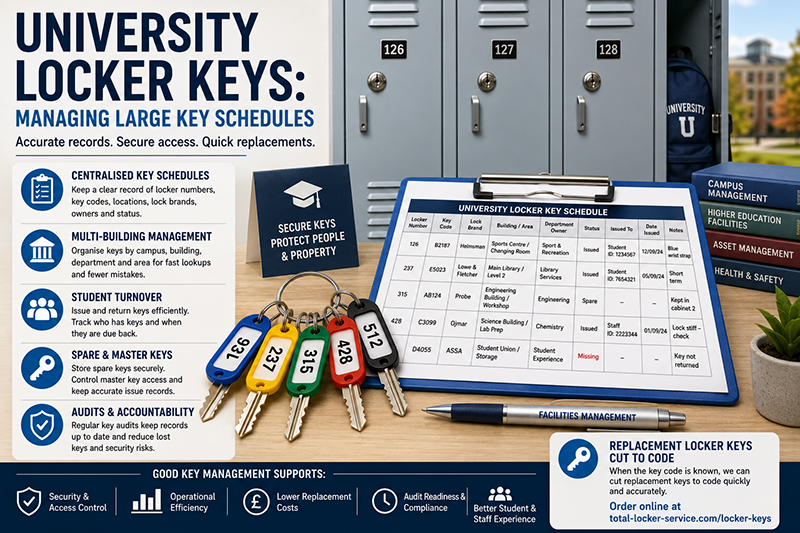
University locker keys need careful management because campuses often have large, mixed and changing locker estates. Lockers may be spread across libraries, sports centres, laboratories, workshops, accommodation areas, student unions, changing rooms, staff rooms and department buildings.
When a key is lost, taken home, not returned or recorded against the wrong locker, the problem can be harder to resolve than it would be on a smaller site. A university may have several buildings, several departments, different lock brands and thousands of users moving through the system each academic year.
This guide explains how universities can manage large locker key schedules, reduce lost key problems, organise replacement locker keys, control spare keys and keep records accurate across departments. It supports our main Locker Keys UK replacement and key management guide.
For direct ordering, use Total Locker Service for replacement locker keys cut to code.

Quick Answer: How Should Universities Manage Locker Keys?
Universities should manage locker keys with a central key schedule supported by department-level records. Each locker should have a visible locker number, an actual key number or lock code, a building location, a department owner, a lock brand where known and a clear status showing whether the key is issued, spare, missing or returned.
Large campuses should not rely on door numbers alone. The visible locker number helps students and staff find a locker. The key number or lock code is used to order a replacement key. These two numbers may not be the same.
When a university locker key is lost, staff should check the local department record, the central key schedule, spare key storage and the lock face before replacing the full lock. If the lock works and the key code is known, a replacement key can often be cut to code.
For that replacement process, read replacement locker keys cut to code: what it means.
Why Universities Need Large Locker Key Schedules
Universities are complex sites. One institution may manage lockers across several campuses, academic departments, leisure areas, workshops, libraries, clinical training rooms, student support spaces and accommodation buildings. Each area may have been installed at a different time and may use different locker locks.
This creates a key management challenge. A small school or gym may manage one main locker area. A university may have hundreds or thousands of lockers controlled by different teams. Without a clear key schedule, replacement ordering becomes slow and error-prone.
A large key schedule helps the university identify which key belongs to which locker, which department is responsible, where spare keys are stored and which locks need replacement or maintenance.
- Large campuses often contain several locker locations.
- Different departments may manage their own lockers.
- Students may change modules, rooms and buildings during the year.
- Keys may be issued for short-term or long-term use.
- Old lockers may have different lock brands from newer areas.
- Records may become outdated after repairs or refurbishments.
- Bulk replacement orders need accurate key codes.
The larger the campus, the more important it is to separate the visible locker number from the actual key code.
Common Campus Locker Locations
University lockers are used in many different settings. Each setting has a different key control risk.
| Campus area | Typical users | Key management issue |
|---|---|---|
| Libraries | Students and visitors | Short-term use, forgotten keys and end-of-day checks |
| Sports centres | Students, staff and members | High turnover, wrist straps and wet-area key loss |
| Laboratories | Students, technicians and staff | Controlled access and departmental records |
| Workshops | Students, tutors and technical teams | Storage for PPE, tools and course materials |
| Accommodation areas | Residents and support staff | Termly changes and return procedures |
| Staff rooms | Academic and support staff | Assigned lockers and leaver returns |
| Student union spaces | Students, clubs and societies | Shared use and mixed accountability |
| Healthcare or clinical training areas | Students and clinical staff | Controlled storage and accurate access records |
Because these areas operate differently, universities should avoid using one loose key list for the whole site. A central schedule can exist, but each building or department should still have clear local ownership.
Building a Large Locker Key Schedule
A university locker key schedule should be designed for scale. It needs to show more than a basic list of locker numbers. It should help staff identify the correct locker, key code, lock type, department owner, location and issue status.
The schedule should be easy to filter by campus, building, floor, department and locker bank. This makes it more useful for facilities teams, accommodation managers, sports centre staff, library teams and department administrators.
The most important fields are the visible locker number and the actual key code. These should be separate. The visible locker number helps users. The key code is used for replacement key ordering.
| Schedule field | Example | Why it matters |
|---|---|---|
| Campus | Main Campus | Useful for multi-site universities |
| Building | Sports Centre | Shows where the locker is located |
| Area | Pool changing room | Supports local key checks |
| Locker number | 126 | Visible locker door number |
| Key code | B2187 | Used to order replacement keys |
| Lock brand | Helmsman | Helps match the correct key range |
| Department owner | Sport and Recreation | Shows who is responsible |
| Issued to | Student, staff, team or department | Supports accountability |
| Status | Issued / spare / missing / returned | Helps manage audits |
| Notes | Strap worn / lock stiff | Supports maintenance planning |
For a smaller register model that can be expanded, read how to build a locker key register.
Department Ownership and Responsibility
Universities need clear ownership because locker keys are often managed by different teams. A sports centre may control its own changing room lockers. A library may manage student lockers. A science department may manage laboratory lockers. Accommodation may manage residential storage separately.
If ownership is unclear, lost key problems take longer to resolve. Staff may not know who holds spare keys, which budget covers replacements or who is allowed to open lockers.
A good schedule should show the responsible department and the local contact. This does not need to expose personal staff details in public records, but the internal process should make responsibility clear.
- Assign each locker bank to a department or building owner.
- Record where spare keys are stored.
- Record who can authorise master key access.
- Define who updates the key schedule after changes.
- Decide who places replacement key orders.
- Agree how departments report missing keys or damaged locks.
This prevents the common problem where facilities, departments and reception teams each hold partial records that do not match.
Student Turnover and Key Returns
Student turnover is one of the main reasons university locker key schedules become inaccurate. Students may use lockers for a day, a term, a year or a course-specific period. Keys may be returned late, taken home, lost during moves or handed to another student informally.
The return process should be clear when keys are issued. Students should know whether they are using a short-term locker, termly locker, course locker or accommodation locker. They should also know what happens if the key is lost or not returned.
For termly and annual lockers, schedule key return checks before students leave campus. Once students leave, collecting missing keys becomes much harder.
- Record the issue date and expected return date.
- Use a return deadline before the end of term or year.
- Check returned keys against the visible locker number and key code.
- Mark missing keys clearly in the schedule.
- Order replacement keys before the next allocation period.
- Inspect lockers before reissuing them to new users.
If the university uses deposits or lost key charges, make the policy clear before issuing keys. The charge should distinguish between a replacement key and a full lock change.
Staff, Student and Visitor Locker Keys
Universities often manage several types of locker users. A single key policy may not suit every group.
Staff lockers are usually assigned for longer periods. They need leaver checks and department records. Student lockers may be assigned for short periods, termly use or course-specific work. Visitor lockers may be short-term and may need fast turnover.
| User type | Typical locker use | Best key control |
|---|---|---|
| Students | Books, bags, sports kit and course materials | Issue and return dates with termly checks |
| Staff | Personal items, uniforms, PPE and work items | Assigned user records and leaver process |
| Visitors | Short-term belongings | Clear return process and spare key access |
| Sports members | Clothing, bags, phones and car keys | Wrist straps, changing room checks and lost key process |
| Department groups | Shared equipment or course materials | Department ownership and controlled key issue |
For staff-focused storage, read locker keys: staff storage and replacement process. For gym and leisure areas, read gym locker keys: replacement, wrist straps and member access.
Lost University Locker Key Procedure
A lost university locker key should follow a consistent process. This helps staff restore access, protect belongings and keep the schedule accurate.
First, confirm the building, department and visible locker number. On large campuses, locker 126 may exist in several places, so the location matters as much as the number.
Second, check the local department record and the central key schedule. If the key code is recorded, replacement ordering is much easier. If the code is missing, check the lock face, spare key set or old records.
Third, check whether the locker is open or locked. If the locker is open, keep it open until the issue is resolved. If it is locked and the user needs access, use an authorised spare key or master key where available.
Fourth, record the incident and update the schedule after the replacement key or lock change is completed.
- Confirm the campus, building, area and visible locker number.
- Identify the department or team responsible for the locker.
- Check the local key record and central key schedule.
- Check whether the locker is open or locked.
- Use authorised spare key or master key access if needed.
- Find the key code from the schedule, lock face, spare key or old records.
- Order a replacement key if the code is known and the lock works.
- Replace the lock if it is damaged, insecure or impossible to identify.
- Update the key schedule after the issue is resolved.
For a broader lost key guide, read lost locker key: what schools, gyms and workplaces should do.
Replacement University Locker Keys
Replacement university locker keys can often be cut to code. This means the key is made from the key number or lock code rather than copied from the original key.
This is useful on large campuses because the original key may be missing, damaged, taken home by a student or not returned by a leaver. If the lock still works and the correct code is known, the university may not need to replace the full lock.
Before ordering, confirm the key code, lock brand, visible locker number, building location and quantity required. Include any letters, prefixes or leading zeros. A code such as AB012 may not be the same as AB12.
If the code is unclear, take clear photos of the key, lock face, lock barrel, locker door and any brand markings. This helps avoid wrong replacement orders.
Total Locker Service supplies replacement locker keys cut to code for many common locker systems.
When Should a University Replace the Lock Instead?
A replacement key is not always the right answer. A university should replace the lock if the lock is damaged, insecure, impossible to identify or no longer matches the schedule.
Lock replacement may also be sensible where the key has been stolen with identifying details, where the locker is used for sensitive department materials, or where old lock systems are inconsistent and difficult to manage.
- The lock is damaged or stiff.
- The lock barrel is loose.
- The keyway is worn, blocked or damaged.
- The key code cannot be found.
- The lock does not match the university schedule.
- The missing key creates a security risk.
- The locker is being reassigned after a serious access issue.
- The lock is old, obsolete or not compatible with the wider system.
For maintenance guidance, read worn locker keys and stiff locks: repair or replace? and broken locker key: what to do before replacing the lock.
Mixed Lock Brands and Old Records
Mixed lock brands are common on university campuses. One building may have lockers installed ten years ago, while another area may have been refurbished recently. Some locks may have been replaced individually after damage or lost keys.
This means one campus may contain several lock brands and key ranges. A replacement key that works in one area may not work in another, even if the visible locker numbers look similar.
Common locker and lock names may include Probe, Helmsman, Lowe & Fletcher, Ojmar, ASSA, Link, Garran, Pure and other commercial locker systems. The locker cabinet brand and lock brand may not always be the same.
Old records should be treated carefully. A key schedule may show the original key code, but the lock may have been changed since the record was created. If the current lock and the record do not match, check the lock before ordering.
For brand and code issues, read are locker keys universal? why key codes and brands matter.
Key Number vs Locker Number on Large Campuses
Large locker schedules should always separate the visible locker number from the actual key code. The door number helps users find the locker. The key code identifies the lock and is used to cut a replacement key.
On a campus with many buildings, this separation is even more important. Locker 126 in the sports centre may not use the same key code as locker 126 in the library. The building and area must be recorded as well.
| Campus area | Visible locker number | Key code | Lock brand |
|---|---|---|---|
| Sports Centre | 126 | B2187 | Helmsman |
| Main Library | 126 | E5023 | Lowe & Fletcher |
| Engineering Workshop | 126 | AB124 | Probe |
| Clinical Skills Building | 126 | C3099 | Ojmar |
For more detail, read locker key numbers vs locker door numbers.
Spare Keys and Master Keys on University Sites
Spare keys and master keys help staff resolve access issues, but they must be controlled carefully. A spare key may open one locker. A master key may open many lockers in a group or system.
Universities should avoid leaving master keys with too many teams or in unsecured locations. Master key access should be limited to authorised staff, and each department should know where its spare keys are stored.
On large campuses, it may be sensible to separate master key control by building or department. This reduces the impact if a key is lost and keeps responsibility clearer.
- Store spare keys in secure key cabinets or controlled offices.
- Keep master keys separate from everyday user keys.
- Limit master key access to authorised staff.
- Record master key use where personal belongings are involved.
- Use building or department ownership for spare key storage.
- Audit spare keys and master keys regularly.
- Replace missing spare keys before they are needed urgently.
For more guidance, read locker master keys explained and key cabinets for managing locker keys.
Campus Locker Key Audits
Universities should audit locker key schedules at regular points. Good audit times include before a new academic year, after term ends, after accommodation moves, after department refurbishments and after major locker repairs.
An audit should check whether the schedule matches the lockers currently installed. It should also identify missing keys, unclear codes, worn locks, damaged tags and records that need updating.
- Check each locker location against the schedule.
- Confirm the visible locker number.
- Confirm the actual key code.
- Check the lock brand where known.
- Check whether the spare key exists.
- Check whether the lock turns smoothly.
- Record missing, damaged or unclear keys.
- Mark locks that need replacement or maintenance.
- Prepare bulk replacement orders where needed.
- Update department ownership records.
For audit support, read the locker key audit checklist for facilities managers.
Bulk Replacement University Locker Keys
Bulk replacement is useful when a university has many missing, damaged or unreturned locker keys. This often happens before a new academic year, after a department move, after a sports centre refurbishment or after a campus-wide audit.
A bulk order list should be clean and structured. Do not send only visible locker numbers unless they are confirmed as key codes. Include the actual key code, lock brand, building location and quantity required.
| Building | Locker number | Key code | Lock brand | Quantity | Notes |
|---|---|---|---|---|---|
| Sports Centre | 126 | B2187 | Helmsman | 2 | Changing room |
| Main Library | 204 | E5023 | Lowe & Fletcher | 1 | Student locker |
| Engineering | 087 | AB124 | Probe | 3 | Workshop lockers |
| Clinical Skills | 042 | C3099 | Ojmar | 2 | Check lock photo |
For larger orders, read bulk replacement locker keys for schools and workplaces.
University Locker Key Control Checklist
- Record campus, building and locker location.
- Record the visible locker number.
- Record the actual key code separately.
- Record the lock brand where known.
- Assign a department or building owner.
- Record issue dates and expected return dates.
- Store spare keys securely.
- Restrict master key access.
- Audit keys before new allocation periods.
- Update the schedule when locks are changed.
- Separate student, staff and visitor locker records where needed.
- Prepare bulk replacement orders from confirmed key codes.
University Locker Key Control Table
| Situation | Best action | Useful guide |
|---|---|---|
| Student loses a locker key | Check building, department, schedule and spare key records | Lost locker key guide |
| Key code is unclear | Check key, lock face, barrel, old records and photos | Find a key number |
| Campus has mixed lock brands | Record lock brand and key code for each area | Are locker keys universal? |
| Door number and key code differ | Keep both fields separate in the schedule | Key number vs door number |
| Many keys are missing | Prepare a bulk order from confirmed codes | Bulk replacement keys |
| Master key access is needed | Use authorised staff only and store keys securely | Master keys explained |
Related Locker Key Guides
This article is part of the locker keys canister. Use these guides to support university locker key schedules, replacement ordering, lost key procedures and long-term key control.
- Locker Keys UK: Replacement, Cut-to-Code Ordering and Key Management Guide
- Replacement Locker Keys Cut to Code: What It Means
- Lost Locker Key? What Schools, Gyms and Workplaces Should Do
- Where to Find a Locker Key Number or Lock Code
- Locker Key Numbers vs Locker Door Numbers
- Are Locker Keys Universal? Why Key Codes and Brands Matter
- School Locker Keys: Replacement and Key Control Guide
- Gym Locker Keys: Replacement, Wrist Straps and Member Access
- Locker Keys: Staff Storage and Replacement Process
- Leisure Centre Locker Keys: Managing Wet-Area Key Loss
- How to Build a Locker Key Register
- Bulk Replacement Locker Keys for Schools and Workplaces
- Common Mistakes When Ordering Locker Keys
- Locker Master Keys Explained
- Key Cabinets for Managing Locker Keys
- Locker Key Audit Checklist for Facilities Managers
Ordering Replacement University Locker Keys
University locker keys are easier to replace when the key code is recorded before the key is lost. If the lock still works and the correct code is known, a replacement key can often be cut to code without changing the full lock.
Before ordering, confirm the key code, lock brand, locker number, building location and quantity required. If the code is unclear, take clear photographs of the lock face, keyway, key and any markings.
For direct ordering, visit Total Locker Service: Locker Keys and Replacement Locker Keys.
University Locker Keys FAQs
How should universities manage locker keys?
Universities should manage locker keys with a central key schedule supported by department-level records. Each locker should have a visible locker number, actual key code, building location, lock brand and issue status.
Why do universities need large locker key schedules?
Universities need large key schedules because lockers are often spread across several buildings, departments and campuses, with different lock brands, users and return processes.
Can university locker keys be replaced without changing the lock?
Yes. Many university locker keys can be replaced without changing the lock when the correct key number or lock code is known and the lock still works.
Is the university locker number the same as the key code?
Not always. The locker number identifies the visible locker door. The key code identifies the lock and is used to cut a replacement key.
What should a university do when a student loses a locker key?
The university should confirm the building and locker number, check the key schedule and spare key records, identify the key code, restore access if authorised and update the schedule after replacement.
How often should university locker key schedules be audited?
University locker key schedules should be audited before new allocation periods, after term ends, after department moves, after refurbishments and whenever locks are changed.
What should a university bulk key order include?
A university bulk key order should include the building, visible locker number, actual key code, lock brand, quantity required and notes for unclear codes or damaged locks.