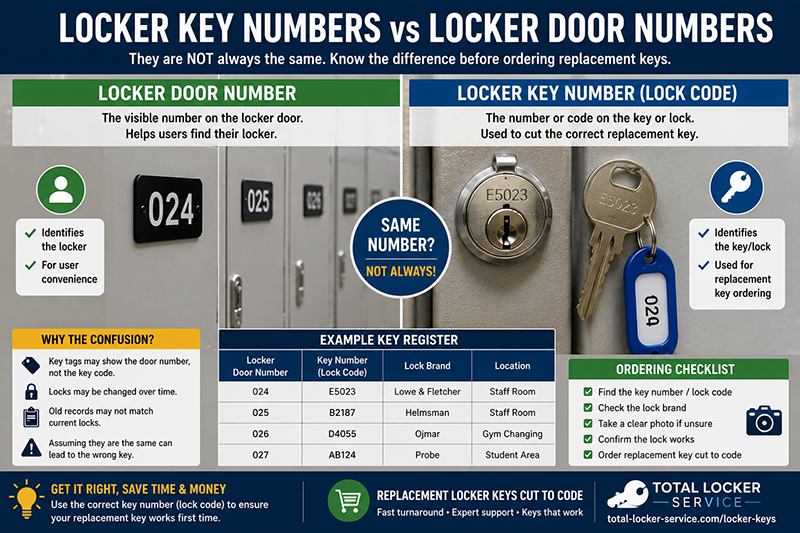
Locker key numbers and locker door numbers are often confused. They may look similar, but they are not always the same thing. The locker door number helps a user find the right compartment. The locker key number or lock code identifies the key needed to operate the lock.
This difference matters when ordering replacement locker keys. If the wrong number is used, the replacement key may not fit, may not turn, or may be cut for the wrong lock range.
This guide explains the difference between locker key numbers and locker door numbers, where to find the correct code, and how schools, gyms, leisure centres and workplaces can avoid ordering mistakes.
This article supports our main Locker Keys UK replacement and key management guide. For direct ordering, use Total Locker Service for replacement locker keys cut to code.

Quick Answer: Are Locker Key Numbers and Locker Door Numbers the Same?
Locker key numbers and locker door numbers are not always the same. The locker door number usually identifies the locker for the user. The locker key number, lock number or key code identifies the lock and is used to cut a replacement key.
Sometimes a site may choose to make the door number and key number match. However, this should never be assumed. A door labelled 024 may use key code E5023, AB124, 62731 or another manufacturer-specific code.
Before ordering replacement locker keys, always check the key, lock face, lock barrel, spare key record or site key register. If the lock still works and the correct code is known, a replacement key can often be cut to code without replacing the lock.
For a wider explanation of replacement keys, read replacement locker keys cut to code: what it means.
What Is a Locker Door Number?
A locker door number is the visible number used to identify a locker compartment. It is usually fixed to the outside of the door as a plate, disc, sticker, label or engraved marker.
The purpose of the door number is simple. It helps users find the right locker. In a school, it may help a pupil find their assigned locker. Inside a gym, it may help a member remember which locker they used. In a workplace, it may help staff and facilities teams identify an assigned storage space.
Door numbers are usually arranged in a logical sequence. A locker run may be numbered 001 to 100. A changing room may have lockers numbered by bay, row or compartment. These numbers help with navigation and daily use.
However, the door number does not always tell you which key will open the lock. It may only be a user-facing label. This is why it should not be used for replacement key ordering unless it has been confirmed as the key code.
What Is a Locker Key Number?
A locker key number is the code linked to the key and lock. It may also be called the lock code, key code or key number. This is the number normally needed when ordering a replacement locker key cut to code.
The key number may be stamped on the original key, shown on the lock face, marked on the lock barrel or recorded in the site key register. It may include numbers, letters, prefixes or leading zeros.
For example, a key code may look like 024, A1250, AB123, B2187, D4055 or another format linked to the lock range. The format depends on the lock brand, key profile and manufacturer system.
The key number is more important than the door number when ordering replacement keys. It tells the supplier which key blank, profile or cutting pattern may be needed.
For help finding this number, read where to find a locker key number or lock code.
Locker Door Number vs Locker Key Number
The two numbers serve different purposes. One helps people find the locker. The other helps identify the lock.
| Number type | What it identifies | Where it is found | Can it be used to order a replacement key? |
|---|---|---|---|
| Locker door number | The visible locker compartment | Door plate, number disc, label or engraved marker | Only if confirmed as the actual key code |
| Locker key number | The key or lock code | Key head, lock face, lock barrel, spare key or key register | Yes, in most cut-to-code replacement orders |
| Lock brand or range | The lock system or key profile | Key, lock, locker, paperwork or supplier record | Useful for accurate identification |
Some sites deliberately make the locker number and key number match. This can make day-to-day management easier. However, mixed installations, replacement locks and old records can still cause confusion later.
Why Locker Numbers and Key Numbers Get Confused
The numbers get confused because they are often both visible near the locker. A door number may be on the front of the locker. A key number may be on the key tag. A lock code may be stamped near the keyway. If staff are not used to the difference, it is easy to use the wrong number.
The problem becomes worse when a site has old lockers, mixed lock brands or poor key records. A replacement lock may have been fitted years ago, but the old key register may still show the original code. A key tag may show the door number, while the actual key blade has a different stamped code.
- The locker door number is easier to see than the key code.
- Key tags may show the door number, not the cut code.
- Older keys may have worn or unclear markings.
- Some lockers may have had locks replaced over time.
- Old spreadsheets may not match current locks.
- Different locker areas may use different lock brands.
These issues are common in schools, gyms, workplaces and leisure centres because lockers are used daily and may be repaired over many years.
Example: Door Number 024 Is Not Always Key Code 024
Imagine a locker door is labelled 024. A member of staff may assume that the replacement key should be ordered as key 024. That may be correct, but only if the lock is actually coded 024.
The lock may instead use key code E5023. The door number tells the user where to go. The key code tells the supplier which replacement key to cut.
In this example, ordering from 024 could produce the wrong key. Ordering from E5023 is more likely to produce the correct replacement, provided the brand and lock range are also correct.
This is why a site should record both values separately. The register should show locker 024 and key code E5023, rather than treating them as the same thing.
Where to Find the Correct Locker Key Code
The correct locker key code may be found in several places. Start with the original key if it is available. Many locker keys have a number stamped or engraved into the metal head of the key.
If the original key is missing, check the lock face. Some locks show the number around the keyway. Use good lighting and check from different angles because stamped markings can be shallow or worn.
If the door is open, check the lock barrel or inside of the door. Some locks show useful markings on the rear of the lock body, cam or barrel.
Next, check the site records. A key register, spare key list, old invoice, installation record or previous replacement key order may contain the correct code.
- Original locker key.
- Lock face or keyway area.
- Lock barrel or rear of the lock.
- Spare key tag or spare key cabinet.
- Site key register.
- Old invoices or installation records.
- Previous replacement key orders.
If the code is unclear, take clear photos of the key, lock face and full locker door. Do not guess unclear numbers.
For a full step-by-step guide, read where to find a locker key number or lock code.
Why the Lock Brand Also Matters
The key code is important, but the lock brand can also matter. Different locker locks use different key profiles, blanks and code ranges. Two locks may use similar-looking numbers but require different keys.
Commercial locker systems may use lock brands and ranges associated with Probe, Helmsman, Lowe & Fletcher, Ojmar, ASSA, Link, Garran, Pure and other locker lock systems. The locker cabinet brand and lock brand may not always be the same.
For example, a locker may have been supplied by one manufacturer but fitted with a lock from another. Replacement keys must match the lock, not just the locker cabinet.
When ordering replacement keys, provide the key code, lock brand and clear photographs where possible. This reduces the risk of ordering a key from the wrong range.
For more background, read are locker keys universal? why key codes and brands matter.
Why the Wrong Number Causes Replacement Key Problems
Using the wrong number can result in the wrong replacement key. The key may not enter the lock, or it may enter but fail to turn. In some cases, forcing a wrong key can damage the keyway or bend the key.
A wrong order also delays the repair. The locker may stay out of use while staff identify the correct code and place another order. This is frustrating in schools, gyms and workplaces where lockers are needed every day.
Wrong-number orders are usually caused by one of these issues:
- Using the door number instead of the key code.
- Using the number on a key tag instead of the stamped key code.
- Misreading a worn number.
- Missing a letter prefix or leading zero.
- Relying on an old record after a lock has been changed.
- Assuming all lockers on site use the same key range.
For more guidance, read common mistakes when ordering locker keys.
Should Key Tags Show the Door Number or Key Code?
In most user-facing situations, key tags should show the locker door number rather than the full key code. This helps users find the correct locker without exposing more information than necessary.
However, the site key register should record the actual key code separately. Staff should be able to match locker door number 024 to key code E5023 without showing that code openly on the user tag.
This gives a good balance between usability and control. Users can identify their locker easily, while facilities staff still have the information needed to order replacements.
For example:
| Visible key tag | Site key register | Purpose |
|---|---|---|
| 024 | Locker 024 — key code E5023 — staff changing room | User can identify the locker; staff can order the correct key |
| 126 | Locker 126 — key code B2187 — gym changing room | Clear user tag with accurate management record |
| Student Locker 15 | Locker 015 — key code AB124 — Year 9 corridor | School-friendly user label with separate key control |
For accessories and labels, read locker key tags, number discs and wrist straps explained.
How to Record Locker Door Numbers and Key Numbers Correctly
The safest approach is to record the door number and key code as two separate fields. Do not merge them into one column unless they are always identical and verified.
A good locker key register should include the locker number, key code, lock brand, locker location, issued user or department, issue date, return date and spare key location.
| Register field | Example | Why it matters |
|---|---|---|
| Locker door number | 024 | Identifies the visible locker compartment |
| Key code | E5023 | Used to order replacement keys |
| Lock brand | Lowe & Fletcher | Helps confirm the correct key range |
| Location | Staff changing room | Useful for large sites |
| Issued to | Staff member, department or user group | Supports accountability |
| Spare key location | Secure key cabinet | Helps resolve lost key issues quickly |
When a lock is changed, update the key code immediately. Old key records are one of the main causes of wrong replacement key orders.
For a practical setup, read how to build a locker key register.
What to Do If the Register and Lock Do Not Match
If the register shows one key code but the lock or key shows another, stop before ordering. This usually means the lock has been changed, the record is out of date, or the key has been labelled incorrectly.
Check the current lock first. A replacement key needs to match the lock fitted now, not the lock recorded several years ago. If there is a spare key, test and confirm it carefully.
Once the correct code is confirmed, update the register. Include a note if the lock was replaced or if the previous record was incorrect. This helps prevent the same mistake later.
If the lock cannot be identified and no code is available, the lock may need replacing. After replacement, record the new code immediately.
Sector Examples: Schools, Gyms and Workplaces
The same number distinction applies across all sites, but each sector has its own risks.
Schools
Schools often assign lockers to pupils for a term or academic year. The locker door number helps the pupil find the correct locker. The key code helps the school order replacements when keys are lost.
A pupil may report that locker 58 needs a new key. Staff should check whether locker 58 has key code 58 or a separate code. The school key register should make this clear.
For more detail, read school locker keys: replacement and key control guide.
Gyms and Leisure Centres
Gyms and leisure centres often use number tags or wrist straps. The number on the tag usually helps the user remember the locker, but it may not be the key cutting code.
If locker 126 has a lost key, staff should check the key register or lock code before ordering. This is especially important where wet-area locks have been replaced over time.
For more detail, read gym locker keys: replacement, wrist straps and member access and leisure centre locker keys: managing wet-area key loss.
Workplaces
Workplace lockers are often assigned to staff or departments. The door number may appear on staff records, while the key code may be held by facilities or maintenance teams.
When employees leave, the key should be returned and checked against the register. If the key is missing, the site should order from the key code, not just the locker number.
For more detail, read workplace locker keys: staff storage and replacement process.
Lost Key Example: What Staff Should Check
If a user says, “I have lost the key for locker 126”, staff should not automatically order key 126. They should check the site record first.
- Confirm the visible locker door number.
- Check the key register for the matching key code.
- Check whether the lock has been changed recently.
- Inspect the lock face if the record is unclear.
- Check any spare key for a stamped code.
- Order the replacement key using the confirmed key code.
- Update the register after the key arrives.
For the full lost key process, read lost locker key: what schools, gyms and workplaces should do.
Bulk Replacement Key Orders
Bulk orders need careful separation between locker numbers and key codes. A list that only contains door numbers may not be enough unless those numbers are confirmed as the actual key codes.
A bulk order list should include both fields. This helps the supplier understand which code should be used for cutting and which number belongs to the visible locker door.
| Locker door number | Key code | Lock brand | Quantity |
|---|---|---|---|
| 024 | E5023 | Lowe & Fletcher | 2 |
| 126 | B2187 | Helmsman | 2 |
| 157 | D4055 | Ojmar | 1 |
| 210 | AB124 | Probe | 3 |
For larger orders, read bulk replacement locker keys for schools and workplaces.
Replacement Key Ordering Checklist
Before ordering a replacement locker key, check the details below.
- Visible locker door number.
- Actual key number or lock code.
- Lock brand, if known.
- Locker brand, if known.
- Quantity required.
- Whether the lock is part of a master key system.
- Whether the lock still works correctly.
- Clear photos if the code is unclear.
- Confirmation that the record matches the current lock.
If the lock works and the correct key code is known, a replacement key can often be ordered without replacing the full lock. Use Total Locker Service for replacement locker keys cut to code.
How to Prevent Future Number Confusion
The best way to prevent number confusion is to build a clean record system. Keep locker door numbers and key codes in separate fields. Do not rely on loose notes or old labels.
- Record the visible locker door number.
- Record the actual key code separately.
- Record the lock brand where possible.
- Update the register when any lock is replaced.
- Keep spare keys in a secure key cabinet.
- Use clear number tags for users.
- Keep master keys separate from everyday user keys.
- Audit key records regularly.
For audit support, read the locker key audit checklist for facilities managers.
Related Locker Key Guides
This article is part of the locker keys canister. Use the guides below to support key identification, replacement ordering, lost key procedures and long-term key control.
- Locker Keys UK: Replacement, Cut-to-Code Ordering and Key Management Guide
- Replacement Locker Keys Cut to Code: What It Means
- Where to Find a Locker Key Number or Lock Code
- Are Locker Keys Universal? Why Key Codes and Brands Matter
- Lost Locker Key? What Schools, Gyms and Workplaces Should Do
- Common Mistakes When Ordering Locker Keys
- How to Build a Locker Key Register
- Bulk Replacement Locker Keys for Schools and Workplaces
- Locker Master Keys Explained
- Key Cabinets for Managing Locker Keys
- Locker Key Audit Checklist for Facilities Managers
Ordering Replacement Locker Keys
Before ordering replacement locker keys, confirm whether the number you have is the door number or the actual key code. This simple check can prevent wrong keys, delays and unnecessary lock changes.
For direct ordering, visit Total Locker Service: Locker Keys and Replacement Locker Keys.
Locker Key Numbers vs Locker Door Numbers FAQs
Is the locker door number the same as the key number?
Not always. The locker door number identifies the visible locker compartment. The key number or lock code identifies the lock and is used to cut a replacement key.
Can I order a replacement locker key from the door number?
Only if the door number is confirmed as the actual key code. Many door numbers are user-facing labels and are not suitable for replacement key ordering.
Where is the locker key number found?
The locker key number may be stamped on the key, shown on the lock face, marked on the lock barrel, recorded on a spare key tag or listed in the site key register.
Why do replacement locker key orders go wrong?
Orders often go wrong when the door number is used instead of the key code, when worn numbers are misread, or when old records no longer match the current lock.
Should key tags show the key code?
User-facing key tags usually show the locker door number. The actual key code should be recorded separately in the site key register for replacement ordering.
What should a locker key register include?
A locker key register should include the locker door number, key code, lock brand, location, issued user or department, issue date, return date and spare key location.