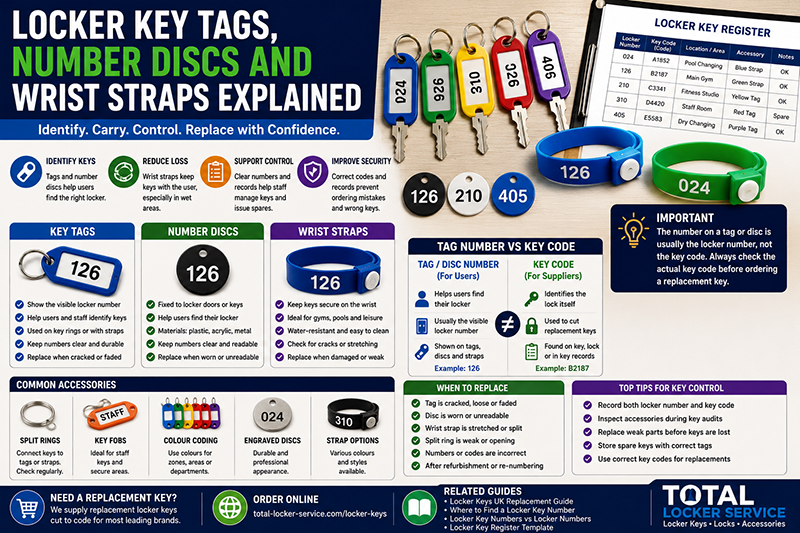
Locker key tags, number discs and wrist straps help users identify, carry and return locker keys. They are small accessories, but they have a large effect on locker key control. A clear number tag can help a pupil, member or staff user find the right locker. A strong wrist strap can reduce key loss in gyms and wet changing rooms. A properly recorded key tag can also help facilities teams match keys back to lockers during audits.
However, these accessories can also cause confusion. The number shown on a tag, wrist strap or locker door is not always the actual key code used to cut a replacement key. The visible number helps users find the locker. The key code identifies the lock.
This guide explains locker key tags, number discs, wrist straps, key rings, colour coding, replacement accessories and the difference between user-facing locker numbers and actual key codes.
This article supports our main Locker Keys UK replacement and key management guide. For direct ordering, use Total Locker Service for replacement locker keys cut to code.

Quick Answer: What Are Locker Key Tags, Number Discs and Wrist Straps For?
Locker key tags, number discs and wrist straps help users identify and carry locker keys. A tag or disc usually shows the visible locker number. A wrist strap helps users keep the key with them, especially in gyms, swimming pools and wet changing rooms.
The number on a tag or wrist strap should not automatically be treated as the replacement key code. It may only be the locker door number. The actual key code may be stamped on the key, shown on the lock face, recorded in the key register or listed on previous replacement key orders.
For replacement ordering, the key code matters most. For user identification, the visible locker number matters most. A good locker key system records both.
For this distinction, read locker key numbers vs locker door numbers.
What Are Locker Key Tags?
Locker key tags are small labels, fobs or holders attached to locker keys. They make the key easier to identify, issue, return and store. Most tags show a visible locker number, such as 024, 126 or 310.
Tags are useful in schools, gyms, workplaces, universities, healthcare sites and leisure centres. They help users find the correct locker and help staff return found keys to the correct area.
A good locker key tag should be clear, durable and easy to read. It should not crack easily or detach from the key during normal use. Weak tags can create key loss, even when the key itself is still usable.
- They help users identify the correct locker.
- They help staff return lost keys.
- They support key boards and spare key cabinets.
- They can show locker zones, departments or colour groups.
- They make audits faster.
- They reduce confusion between similar-looking keys.
The tag should normally show the user-facing locker number, not unnecessary personal details. The actual key code should be kept in the locker key register.
Locker Number Discs
Locker number discs are usually fixed to locker doors or attached to keys. They give each locker a visible identity. Within schools, they help pupils find assigned lockers. In gyms and leisure centres, they help members return to the locker they used. In workplaces, they help staff and facilities teams manage assigned storage.
Number discs may be engraved, printed, laminated, plastic, metal or acrylic. The best choice depends on the site. A school corridor needs durable numbers that can withstand daily use. A wet changing room needs materials that resist moisture and cleaning. A workplace may need clear numbering that matches the staff locker register.
The visible number disc should match the locker door number in the key register. It does not always need to match the lock code. This is why the register should have separate fields for locker number and key code.
| Numbering item | Where it appears | Purpose | Replacement key use |
|---|---|---|---|
| Locker number disc | Locker door | Helps users find the locker | Only useful if confirmed as the key code |
| Key tag number | Attached to key | Helps users and staff identify the key | May not be the key code |
| Key code | Key, lock face, barrel or records | Identifies the lock | Used to cut replacement keys |
For ordering accuracy, read common mistakes when ordering locker keys.
Locker Key Wrist Straps
Locker key wrist straps help users keep keys with them while moving around a site. They are especially useful in gyms, leisure centres, swimming pools, spas and changing rooms where users may not have pockets or bags with them.
A wrist strap usually holds the locker key, number tag and sometimes a token or coin-lock key assembly. The strap should be comfortable, strong, water-resistant and easy to clean.
In wet areas, wrist straps are not just a convenience. They reduce key loss. Without a wrist strap, users may leave keys on benches, in showers, in lockers, in poolside areas or inside bags.
- They keep the locker key with the user.
- They reduce keys being left on changing room benches.
- They help swimmers and gym users carry keys without pockets.
- They make keys easier to return after use.
- They support high-turnover locker areas.
- They can be colour coded by zone, pool area or changing room.
Wrist straps should be inspected regularly. A cracked or stretched strap can cause the same problem as a lost key.
For leisure-specific guidance, read leisure centre locker keys: managing wet-area key loss.
Tag Number vs Key Code
The number on a tag, number disc or wrist strap is often not the same as the key code. This is one of the most important points in locker key management.
The tag number is normally used by the person using the locker. It helps them remember the visible locker door number. The key code is used by the supplier or key cutter to make a replacement key.
For example, the tag may show locker 126, but the key code may be B2187. If the replacement key is ordered as “126” without checking the actual code, the key may not work.
| Visible item | Example | What it usually means | What to check before ordering |
|---|---|---|---|
| Door number | 126 | The visible locker number | Check whether this is also the key code |
| Key tag | 126 | Usually the locker number | Check the metal key or register |
| Wrist strap tag | 126 | Usually the locker number | Check the actual lock code |
| Stamped key code | B2187 | The key or lock code | Use this for replacement ordering |
A proper locker key register should record both values. For register setup, read how to build a locker key register.
Where to Find the Actual Key Code
The actual key code may be found in several places. The most reliable source is often the original key, but the code may also appear on the lock face, lock barrel, spare key record or previous order paperwork.
- Check both sides of the metal key.
- Check the lock face around the keyway.
- Check the lock barrel if the door is open.
- Check the spare key cabinet.
- Check the locker key register.
- Check previous replacement key orders.
- Take photos if the code is unclear.
Write the code exactly as shown. Include letters, prefixes and leading zeros. AB012 may not be the same as AB12.
For a full guide, read where to find a locker key number or lock code.
Materials and Durability
Locker key accessories should match the environment. A tag that works well in an office may not last in a wet changing room. A light-duty split ring may not survive school corridor use. A wrist strap used in a swimming pool must resist moisture and regular handling.
Durability matters because accessories are often the weak point in the key system. The key may still be fine, but the tag, ring or strap may fail first.
| Accessory | Common material | Best use | Risk if poor quality |
|---|---|---|---|
| Plastic key tag | Plastic or acrylic | Schools, offices and general lockers | Can crack or detach |
| Engraved number disc | Plastic, acrylic or metal | Locker doors and key boards | Can fade or become unreadable |
| Wrist strap | Flexible plastic, silicone or similar material | Gyms, pools and leisure centres | Can stretch, split or break |
| Split ring | Metal | Connecting key to tag or strap | Can open or weaken |
| Key fob | Plastic, engraved laminate or similar | Staff and managed key sets | Can be mislabelled or detached |
Accessories should be checked during key audits. A weak tag is easier to replace than a lost key.
Colour Coding and Locker Zones
Colour coding can make locker key control easier. It can show locker zones, changing room areas, year groups, departments, floors or user types. This is useful on larger sites where many keys look similar.
For example, a leisure centre may use blue tags for pool changing, green tags for gym changing and yellow tags for staff lockers. A school may use colours by year group or building. A workplace may use colours by department.
- Use colour to support location or user group.
- Keep the numbering system simple.
- Record the colour in the key register if useful.
- Avoid using colour as the only identification method.
- Do not let colour coding replace the actual key code.
- Check faded colours during audits.
Colour coding should support the key register, not replace it. A colour and number tag helps users. A key code helps with replacement ordering.
Key Rings, Split Rings and Fixings
The small metal ring between the key and the tag is easy to overlook. However, weak rings are a common cause of lost keys. If the ring opens, the key can detach from the tag, strap or fob.
Rings should be strong enough for the site. A gym or school may need stronger rings than a low-use office locker. Wet areas should be checked more often because moisture and cleaning routines can affect fittings over time.
- Check rings for gaps or weakness.
- Replace distorted rings.
- Use suitable rings for wrist straps and number discs.
- Check that the key cannot slip off the fitting.
- Inspect rings during routine audits.
- Replace failed rings before keys are lost.
A strong key tag is only useful if the fixing is also strong.
Locker Key Tags for Schools
Schools need clear and durable locker key tags. Pupils may carry keys in bags, pockets, coats and PE kits. Tags may be dropped, pulled, swapped or returned to the school office at the end of term.
The tag should normally show the visible locker number. The key code should be recorded in the school locker key register. This helps the school order a replacement key when a pupil loses a key, while keeping the user-facing system simple.
- Use clear numbers that match locker doors.
- Use durable tags that resist cracking.
- Record key codes separately.
- Check tags during end-of-term returns.
- Replace damaged tags before the next issue period.
- Avoid relying on handwritten labels that rub off.
For school key control, read school locker keys: replacement and key control guide.
Locker Wrist Straps for Gyms and Leisure Centres
Gyms and leisure centres often rely on wrist straps because users move between lockers, showers, pool areas, studios, changing spaces and fitness equipment. The key needs to stay with the user.
A good wrist strap should be easy to wear, easy to clean and strong enough for repeated use. It should also keep the key, ring and number tag secure.
Wet-area wrist straps should be inspected regularly. If a strap stretches, cracks or splits, the key may become lost during normal use. Staff should also check number tags because faded tags can create confusion when keys are returned.
- Use wrist straps suitable for wet changing rooms.
- Check straps for cracks and stretching.
- Check split rings and fittings.
- Keep the visible locker number readable.
- Record the actual key code separately.
- Replace worn straps before keys are lost.
For gym guidance, read gym locker keys: replacement, wrist straps and member access.
Locker Key Tags for Workplaces and Staff Lockers
Workplace locker key tags should support assigned staff storage. They may be used for staff lockers, PPE storage, changing rooms, warehouse lockers, factory lockers, office lockers and facilities areas.
Tags should identify the locker without exposing unnecessary personal information. A locker number or internal reference is usually enough. Personal names on loose keys may create avoidable privacy and security concerns.
- Use locker numbers rather than staff names on loose tags.
- Record the assigned user in the key register.
- Record department or shift group where useful.
- Check key tags during leaver processes.
- Replace damaged tags before reassignment.
- Keep spare key tags clear and consistent.
For workplace guidance, read locker keys: staff storage and replacement process.
Healthcare and University Locker Key Accessories
Healthcare sites and universities often manage larger or more complex locker systems. Key tags and number discs need to support departments, buildings, users and key schedules.
Universities may need colour coding by building or department. Healthcare sites may need secure staff storage records for changing rooms and shift-based users. In both settings, the accessory should support the register rather than replace it.
- Use building or department references where useful.
- Keep visible numbers consistent with the register.
- Record actual key codes separately.
- Use secure spare key storage.
- Audit tags, discs and straps during key checks.
- Update records when locks or tags are changed.
For related guidance, read university locker keys: managing large key schedules and healthcare locker keys: staff storage and secure control.
When Should Tags, Number Discs and Wrist Straps Be Replaced?
Locker key accessories should be replaced before they fail. A cracked tag, unreadable disc or stretched wrist strap can lead to lost keys, wrong returns and poor key records.
- Replace tags that are cracked, faded or loose.
- Replace number discs that are unreadable.
- Replace wrist straps that are stretched, split or brittle.
- Replace weak split rings.
- Replace handwritten labels that rub off.
- Replace accessories after refurbishment if numbering changes.
- Update the key register when tag numbers change.
Replacing an accessory is usually simpler than replacing a lost key. It is also cheaper than resolving repeated key confusion caused by unreadable labels.
How to Add Accessories to a Locker Key Register
A locker key register should include enough information to connect the visible number, key code and accessory type. This makes audits and replacement orders easier.
| Register field | Example | Why it matters |
|---|---|---|
| Locker number | 126 | Matches the visible locker door or tag |
| Key code | B2187 | Used to order replacement keys |
| Accessory type | Wrist strap | Shows how the key is issued |
| Tag colour | Blue | Useful for zones or departments |
| Location | Pool changing | Useful for large sites |
| Condition | Replace strap | Supports maintenance and audits |
For register setup, read how to build a locker key register.
Common Mistakes with Locker Key Tags and Wrist Straps
Most accessory mistakes come from treating visible tag numbers as key codes, using weak fittings or failing to update the key register after changes.
- Ordering replacement keys from tag numbers without checking the key code.
- Using worn wrist straps in wet areas.
- Leaving faded number discs in use.
- Using weak split rings that allow keys to detach.
- Putting personal names on loose key tags.
- Changing tags without updating the register.
- Colour coding keys without recording what the colours mean.
- Assuming all tags on site follow the same numbering system.
For replacement ordering problems, read common mistakes when ordering locker keys.
What to Do When a Key Loses Its Tag
If a locker key loses its tag, identify the key before reissuing it. Do not attach a random number tag without checking the actual lock or register.
- Check the code stamped on the key.
- Check the locker key register.
- Check whether the key works in the expected locker.
- Check the visible locker number.
- Attach the correct tag or number disc.
- Record the accessory replacement in the register.
- Check whether other tags in the same area are also worn.
If the key code is unclear, take photos and check the lock face, spare key records or previous orders before reissuing it.
Accessory Decision Table
| Issue | Likely action | Reason |
|---|---|---|
| Tag is cracked but key works | Replace the tag | The accessory is the fault |
| Wrist strap is stretched | Replace the strap | The key may be lost if the strap fails |
| Number disc is faded | Replace or re-engrave the disc | Users and staff need readable numbering |
| Key code is unknown | Check key, lock and register | The tag number may not be the key code |
| Split ring is weak | Replace the ring | The key may detach from the tag |
| Key is also worn or bent | Order replacement key and accessory | The key and accessory may both need replacing |
| Lock is stiff | Inspect lock before ordering key | A new tag will not fix a lock fault |
Locker Key Accessory Checklist
- Use clear key tags or number discs.
- Keep visible locker numbers easy to read.
- Record the actual key code separately.
- Use wrist straps in gyms, pools and wet changing rooms.
- Check split rings and fixings.
- Replace cracked, faded or loose tags.
- Replace stretched or broken wrist straps.
- Avoid using personal names on loose key tags.
- Use colour coding only when it is recorded clearly.
- Update the key register when accessories are changed.
- Check accessories during key audits.
- Use confirmed key codes for replacement key orders.
Related Locker Key Guides
This article is part of the locker keys canister. Use these guides to support key tags, number discs, wrist straps, replacement ordering and long-term locker key control.
- Locker Keys UK: Replacement, Cut-to-Code Ordering and Key Management Guide
- Replacement Locker Keys Cut to Code: What It Means
- Where to Find a Locker Key Number or Lock Code
- Locker Key Numbers vs Locker Door Numbers
- How to Build a Locker Key Register
- Common Mistakes When Ordering Locker Keys
- Lost Locker Key? What Schools, Gyms and Workplaces Should Do
- Broken Locker Key: What to Do Before Replacing the Lock
- Worn Locker Keys and Stiff Locks: Repair or Replace?
- School Locker Keys: Replacement and Key Control Guide
- Gym Locker Keys: Replacement, Wrist Straps and Member Access
- Leisure Centre Locker Keys: Managing Wet-Area Key Loss
- Locker Keys: Staff Storage and Replacement Process
- Locker Key Audit Checklist for Facilities Managers
Ordering Replacement Locker Keys and Accessories
Locker key tags, number discs and wrist straps help users manage keys, but they are not a substitute for the actual key code. Before ordering replacement locker keys, check the code on the key, lock face, lock barrel, spare key record or locker key register.
If the key is missing but the lock still works and the correct code is known, a replacement key can often be cut to code. If the accessory has failed, replace the tag, ring, disc or wrist strap at the same time so the new key is easier to manage.
For direct ordering, visit Total Locker Service: Locker Keys and Replacement Locker Keys.
Locker Key Tags, Number Discs and Wrist Straps FAQs
What are locker key tags used for?
Locker key tags are used to identify locker keys, usually by showing the visible locker number. They help users find lockers and help staff return keys to the correct place.
Is the number on a locker key tag the same as the key code?
Not always. The tag number often shows the visible locker number. The key code identifies the lock and is used to cut a replacement key.
Why are wrist straps used for locker keys?
Wrist straps help users keep locker keys with them, especially in gyms, swimming pools, leisure centres and wet changing rooms where users may not have pockets.
When should locker key tags be replaced?
Locker key tags should be replaced when they are cracked, faded, loose, unreadable or no longer match the locker key register.
When should locker key wrist straps be replaced?
Locker key wrist straps should be replaced when they are stretched, split, brittle, cracked or no longer hold the key securely.
Should personal names be used on locker key tags?
In most managed locker systems, it is better to use locker numbers or internal references rather than personal names on loose key tags.
Can a replacement locker key be ordered from a tag number?
Only if the tag number is confirmed as the actual key code. In many cases, the tag number is only the visible locker number and should not be used alone for ordering.