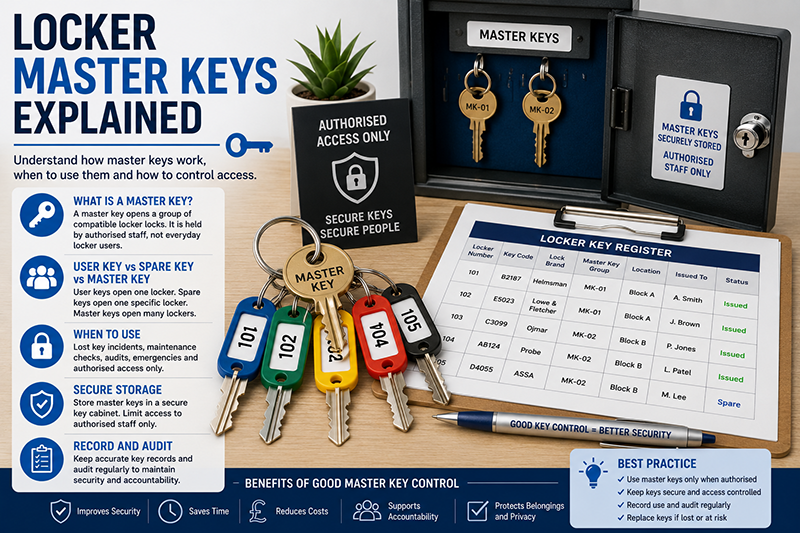
Locker master keys are useful for managed locker systems, but they need careful control. A master key can help authorised staff open lockers during lost key incidents, maintenance checks, audits and emergencies. However, because one master key may open many lockers, it creates a higher security risk than an ordinary user key.
This guide explains what locker master keys are, how they differ from spare keys and user keys, when they should be used, how they should be stored and how schools, gyms, workplaces, universities and healthcare sites can control them safely.
This article supports our main Locker Keys UK replacement and key management guide. For direct ordering support, use Total Locker Service for replacement locker keys cut to code.

Quick Answer: What Is a Locker Master Key?
A locker master key is a management key designed to open more than one locker lock within a specific master-keyed system. It is normally held by authorised staff, not everyday locker users. It can help staff open lockers during lost key incidents, maintenance checks, inspections and emergencies.
A master key is not universal. It will only work with locks that have been set up to operate under that master key system. A master key for one locker range, building or site will not automatically open all lockers.
Because a master key may open many lockers, it should be stored securely, issued only to authorised staff and recorded when used. A lost master key is a more serious issue than a lost user key because it may affect several lockers rather than one.
For a wider explanation of why locker keys are not universal, read are locker keys universal? why key codes and brands matter.
What Is a Locker Master Key?
A locker master key is a key that can open a group of compatible locker locks. It is normally supplied as part of a planned locker lock system. Each user key opens an individual locker, while the master key can open a wider group for management access.
Master keys are common in schools, gyms, leisure centres, workplaces, universities, healthcare sites and other managed facilities. They allow staff to help users when keys are lost, lockers are abandoned, locks need checking or access is required for an authorised reason.
A master key system should not be treated casually. It is part of the site’s access control. If too many people can use the master key, or if the key is stored insecurely, the site may lose control over who can access lockers.
The master key should be recorded in the locker key register or key control schedule. The record should show where the master key is stored, who can access it and which locker group it controls.
User Key vs Spare Key vs Master Key
Locker key control becomes easier when staff understand the difference between user keys, spare keys and master keys. These keys may look similar, but they perform different roles.
| Key type | What it opens | Who should hold it? | Main risk |
|---|---|---|---|
| User key | One assigned locker or one keyed-alike group | The locker user | Lost key affects one locker |
| Spare key | Usually one specific locker | Authorised staff or facilities team | Poor storage makes access harder to control |
| Master key | A group of compatible locks | Authorised management or facilities staff only | Lost key may affect many lockers |
A user key is for everyday access. A spare key is usually a backup for one locker. A master key is a higher-control key for authorised access across a group of locks.
These differences matter when a key is lost. A lost user key may only require a replacement key. A lost master key may require a wider risk review.
Why Master Keys Are Useful
Locker master keys are useful because they reduce the need for forced access. Without a master key, staff may be tempted to drill locks, force doors or replace locks unnecessarily when a user loses a key.
A controlled master key allows authorised staff to open a locker without damaging the door, lock or frame. This can save time, reduce repair costs and keep lockers in service.
- They help staff open lockers when user keys are lost.
- They reduce forced-entry damage.
- They support maintenance checks and locker audits.
- They help abandoned lockers return to use.
- They support emergency access where authorised.
- They reduce disruption in busy locker areas.
The benefit is strongest when the master key is part of a clear written process. A master key should make locker management safer and easier, not looser or less controlled.
Are Locker Master Keys Universal?
No. Locker master keys are not universal. A master key only works with locks that are part of the same compatible master-keyed system.
A school master key may open several lockers in one corridor, but it will not automatically open lockers in another school. A gym master key may open one changing room range, but it may not open older lockers in another area if those locks use a different system.
Large sites often contain mixed lock ranges. A university, hospital or leisure centre may have several locker installations fitted at different times. One master key may not cover all of them.
This is why the locker key register should record the master key group, lock brand and locker location. If staff assume one master key opens everything, they may waste time or create unnecessary access risks.
For more detail, read are locker keys universal? why key codes and brands matter.
Master-Keyed Systems and Lock Brands
Master-keyed systems depend on the lock range and how the locks were supplied or configured. Different lock brands and key profiles may not be compatible with each other.
Commercial locker systems may use lock brands and ranges associated with Probe, Helmsman, Lowe & Fletcher, Ojmar, ASSA, Link, Garran, Pure and other locker lock systems. The visible locker cabinet brand and the lock brand may not always be the same.
That distinction matters because a replacement user key, spare key or master key must match the lock system. If locks have been replaced over time without updating the register, the master key arrangement may become inconsistent.
- Record the lock brand where known.
- Record the master key group if the site has one.
- Keep old and new lock ranges separate in the register.
- Update records when locks are replaced.
- Check compatibility before replacing one lock in a master-keyed group.
For key number and lock code identification, read where to find a locker key number or lock code.
When Should a Locker Master Key Be Used?
A locker master key should only be used for authorised reasons. It should not be treated as a convenient shortcut for casual access.
Common valid reasons include lost key incidents, authorised locker opening, maintenance checks, emergency access, abandoned locker checks and end-of-term or end-of-membership inspections.
- A user has lost the locker key and needs access.
- A locker is abandoned or not cleared after the allocation period.
- A lock needs maintenance or inspection.
- A locker audit is taking place.
- There is an authorised welfare, safety or operational reason to open the locker.
- A locker needs to be reassigned after a user leaves.
Where personal belongings are involved, the opening should be handled carefully. Some sites may require two staff members, user verification or a written record. The correct process depends on the site and the risk involved.
When Should a Master Key Not Be Used?
A master key should not be used without a valid reason. It should not be used by unauthorised staff, casual users, students, members or visitors. It should also not be used to bypass proper key issue or return records.
- Do not leave the master key at reception for general access.
- Do not lend the master key to users.
- Do not use it without recording access when belongings are involved.
- Do not use it as a substitute for replacing missing user keys.
- Do not store it with ordinary user keys in an unsecured place.
- Do not assume it works with every locker on site.
Master key misuse can weaken trust in the locker system. Users expect lockers to protect their belongings. Access should be controlled and proportionate.
Using Master Keys After a Lost Locker Key
A lost locker key is one of the most common reasons to use a master key. The process should be controlled and consistent.
First, confirm the locker number and the user’s right to access the locker. In a gym, staff may ask for a description of the contents. Inside a workplace, a supervisor or facilities manager may confirm the assigned locker. In a school, authorised staff should check the pupil locker record.
Second, check whether a spare key is available. A spare key for the specific locker may be preferable to using a master key. If no spare key is available, an authorised master key may be used.
Third, identify the key code so a replacement user key can be ordered. The master key should restore access, but it should not replace the need for a normal user key.
- Confirm who is requesting access.
- Confirm the visible locker number and location.
- Check the site key register.
- Use a spare key if available.
- Use the master key only if authorised.
- Record the access where required.
- Identify the key code or lock code.
- Order a replacement user key if the lock still works.
- Update the key register after the issue is resolved.
For the full lost key process, read lost locker key: what schools, gyms and workplaces should do.
Master Key Security and Storage
Master keys should be stored securely. A loose master key in a drawer, workshop, reception desk or staff room creates an avoidable access risk.
The best storage method depends on the site. Many organisations use a secure key cabinet, controlled office, locked key safe or restricted facilities area. Access should be limited to authorised staff.
- Store master keys separately from everyday user keys.
- Keep master keys in a secure key cabinet or controlled location.
- Limit access to named or role-based authorised staff.
- Do not leave master keys unattended at reception.
- Do not attach unnecessary locker-location information to the key.
- Review master key access after staff role changes.
- Audit master keys regularly.
For key storage options, read key cabinets for managing locker keys.
Master Key Records and Audits
A master key record should show which master keys exist, where they are stored, who can access them and which locker groups they control.
For larger sites, one master key may not cover every locker. The register should show the master key group or lock range. This helps staff avoid confusion when several locker systems exist on one site.
| Register field | Example | Why it matters |
|---|---|---|
| Master key reference | MK-01 | Identifies the management key |
| Locker area | Sports changing room | Shows where the key applies |
| Lock brand or range | Helmsman | Helps confirm compatibility |
| Storage location | Secure key cabinet | Shows where the key is held |
| Authorised users | Facilities manager / duty manager | Controls access |
| Audit status | Checked monthly | Confirms the key is still present |
| Notes | Does not open older lockers | Prevents wrong assumptions |
Master key audits should be part of the wider locker key audit. Check that the key is present, stored correctly and still matches the lock group recorded.
For audit support, read the locker key audit checklist for facilities managers.
What If a Locker Master Key Is Lost?
A lost locker master key should be treated as a serious key control issue. The response depends on what the key opens, where it was lost, whether it can be linked to the site and what the lockers are used for.
First, confirm which master key is missing and which locker group it controls. Second, check whether the key may have been misplaced in a secure area. Third, assess whether the key could be used by an unauthorised person.
If the risk is low, the site may record the incident and order a replacement master key where possible. If the risk is higher, the site may need to replace locks or review the master-keyed group.
- Identify the missing master key reference.
- Check the storage location and sign-out record.
- Confirm which lockers the key can open.
- Assess whether the key can be linked to the site or locker area.
- Restrict access until the risk is reviewed.
- Replace affected locks if required.
- Update the key register and audit process.
A missing master key should not be ignored. The risk is wider than a missing user key because the key may open several lockers.
Locker Master Key Control by Sector
Different sites use master keys in different ways. The core principle stays the same: access should be authorised, controlled and recorded where needed.
| Sector | Common master key use | Main control point | Supporting guide |
|---|---|---|---|
| Schools | Lost pupil keys and end-of-term locker checks | Keep access with authorised office or site staff | School locker keys |
| Gyms | Member lost keys and changing room access | Verify the member before opening lockers | Gym locker keys |
| Leisure centres | Wet-area lost key incidents and pool changing rooms | Control master keys during busy public use | Leisure centre locker keys |
| Workplaces | Staff lockers, leavers and PPE access | Include keys in staff issue and return records | Staff locker keys |
| Universities | Large locker banks and multi-building schedules | Record master key groups by building or department | University locker keys |
| Healthcare | Staff changing rooms and secure staff storage | Restrict master key access to authorised staff | Healthcare locker keys |
Master Keys in Schools
Schools use locker master keys to help with lost pupil keys, locker checks and end-of-year returns. The master key should be controlled by authorised staff such as the site team, school office or facilities manager.
Pupils should not handle master keys. If a pupil loses a key, staff should check the locker record, use authorised access where needed and order a replacement key if the lock code is known.
For more school-specific guidance, read school locker keys: replacement and key control guide.
Master Keys in Gyms and Leisure Centres
Gyms and leisure centres often need master key access when a member loses a key and belongings are locked inside. Staff should verify the user before opening the locker. This protects members and reduces unauthorised access risk.
In wet changing rooms, master keys should not be left loose at reception or poolside. They should be stored securely and returned immediately after use.
For gym and leisure guidance, read gym locker keys: replacement, wrist straps and member access and leisure centre locker keys: managing wet-area key loss.
Master Keys in Workplaces and Healthcare Sites
Workplaces and healthcare sites may use master keys for staff lockers, changing rooms, PPE storage and leaver checks. Because lockers may contain personal belongings or work-related items, access should be controlled.
Supervisors, facilities teams or authorised managers may need access when keys are lost, staff leave or lockers need reassignment. The master key should not be available to all staff.
For workplace and healthcare guidance, read locker keys: staff storage and replacement process and healthcare locker keys: staff storage and secure control.
Replacement Keys and Master-Keyed Systems
Replacement user keys can often be cut to code even when a locker belongs to a master-keyed system. However, the replacement key must match the correct lock and key code. The master key arrangement should also be considered before locks are changed.
If the user key is lost but the lock still works and the key code is known, ordering a replacement key is usually simpler than replacing the lock. This keeps the existing master key system intact.
If the lock is replaced with an incompatible lock, the existing master key may no longer work for that locker. This can create future access problems for staff.
- Check the key code before ordering.
- Check whether the lock is part of a master-keyed group.
- Record the master key group in the register.
- Do not replace one lock without considering compatibility.
- Update the register after any lock change.
- Test user key and master key function where appropriate.
Total Locker Service supplies replacement locker keys cut to code for many common locker systems. For the replacement process, read replacement locker keys cut to code: what it means.
Master Key Control Checklist
- Identify every locker master key on site.
- Record which locker group each master key controls.
- Store master keys securely.
- Restrict access to authorised staff.
- Do not store master keys loose with ordinary user keys.
- Record use where personal belongings are involved.
- Audit master keys regularly.
- Review access after staff role changes.
- Investigate missing master keys immediately.
- Check master key compatibility before replacing locks.
- Update the key register after any lock change.
Locker Master Key Control Table
| Situation | Best action | Useful guide |
|---|---|---|
| User loses a locker key | Verify access, use spare or master key if authorised, then order replacement key | Lost locker key guide |
| Master key opens several lockers | Restrict access and store it securely | Key cabinets guide |
| Master key is missing | Assess risk, identify affected locks and review security | Key audit checklist |
| Lock needs replacing | Check master key compatibility before replacing it | Replacement keys cut to code |
| Site has mixed lock systems | Record master key groups by lock brand, location and range | Are locker keys universal? |
| Door number and key code differ | Record both fields separately | Key number vs door number |
Related Locker Key Guides
This article is part of the locker keys canister. Use these guides to support master key control, replacement ordering, lost key procedures and long-term locker key management.
- Locker Keys UK: Replacement, Cut-to-Code Ordering and Key Management Guide
- Replacement Locker Keys Cut to Code: What It Means
- Lost Locker Key? What Schools, Gyms and Workplaces Should Do
- Where to Find a Locker Key Number or Lock Code
- Locker Key Numbers vs Locker Door Numbers
- Are Locker Keys Universal? Why Key Codes and Brands Matter
- School Locker Keys: Replacement and Key Control Guide
- Gym Locker Keys: Replacement, Wrist Straps and Member Access
- Locker Keys: Staff Storage and Replacement Process
- Leisure Centre Locker Keys: Managing Wet-Area Key Loss
- University Locker Keys: Managing Large Key Schedules
- Healthcare Locker Keys: Staff Storage and Secure Control
- How to Build a Locker Key Register
- Key Cabinets for Managing Locker Keys
- Locker Key Audit Checklist for Facilities Managers
- Common Mistakes When Ordering Locker Keys
Ordering Replacement Locker Keys
A locker master key can help restore access, but it does not replace the need for a correct user key. If a user key is lost and the lock still works, a replacement key can often be cut to code from the key number or lock code.
Before ordering, confirm the key code, lock brand, locker number, quantity required and whether the lock is part of a master-keyed group. If the code is unclear, take clear photographs of the lock face, keyway, key and any markings.
For direct ordering, visit Total Locker Service: Locker Keys and Replacement Locker Keys.
Locker Master Keys FAQs
What is a locker master key?
A locker master key is a management key designed to open more than one compatible locker lock within a specific master-keyed system.
Are locker master keys universal?
No. Locker master keys are not universal. They only work with locks that have been set up for that specific master key system.
Who should hold a locker master key?
A locker master key should be held only by authorised staff, such as facilities teams, site managers, duty managers or other approved personnel.
How should locker master keys be stored?
Locker master keys should be stored securely in a key cabinet, controlled office or restricted key safe. They should not be left loose in drawers, reception areas or staff rooms.
What should happen if a locker master key is lost?
If a locker master key is lost, the site should identify which lockers it opens, assess the access risk, check sign-out records and replace affected locks if required.
Can replacement locker keys still be ordered for master-keyed locks?
Yes. Replacement user keys can often be ordered for master-keyed locks when the correct key number or lock code is known and the lock still works.
Will replacing one locker lock affect the master key?
It can. If a replacement lock is not compatible with the existing master-keyed system, the site master key may no longer open that locker.