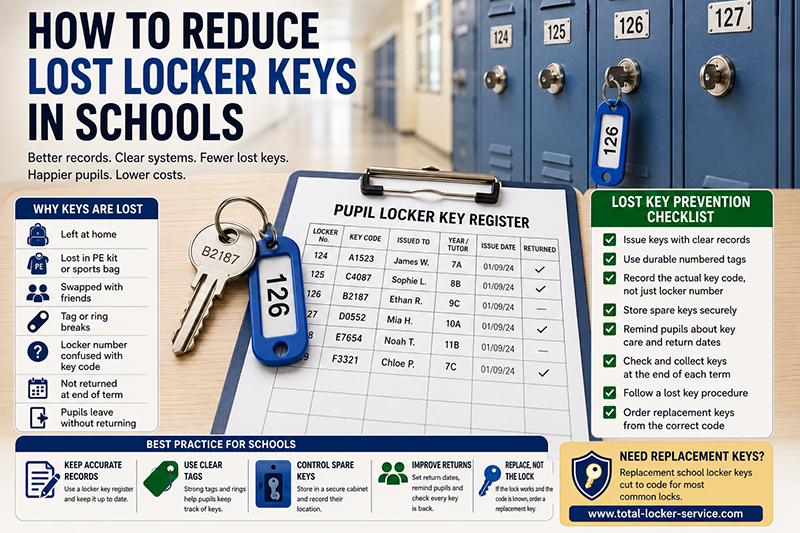
Lost locker keys are a common school problem. Pupils forget keys at home, lose them in bags, leave them in PE kits, swap them with friends or fail to return them at the end of term. A few missing keys may seem minor, but repeated key loss can create admin work, delays, locked lockers, damaged locks and unnecessary replacement costs.
The best way to reduce lost locker keys in schools is to manage the key system before keys go missing. Schools need clear issue records, visible locker numbers, recorded key codes, spare key control, end-of-term checks and a simple process for ordering replacement locker keys when needed.
This guide explains how schools can reduce lost locker keys, improve pupil key returns, build better key records and avoid replacing locks unnecessarily. It supports our main Locker Keys UK replacement and key management guide and our school locker keys replacement and key control guide.
For direct ordering, use Total Locker Service for replacement locker keys cut to code.

Quick Answer: How Can Schools Reduce Lost Locker Keys?
Schools can reduce lost locker keys by issuing each key against a clear pupil or year-group record, using durable numbered key tags, keeping the actual key code in a separate register, checking returns at the end of each term and storing spare keys securely.
The school should not rely only on the visible locker door number. The door number helps the pupil find the locker. The key code identifies the lock and is used to order a replacement key. These numbers may not be the same.
When a pupil loses a locker key, staff should check the key register, spare key cabinet and lock code before replacing the full lock. If the lock still works and the correct key code is known, a replacement key can often be cut to code.
For the replacement process, read replacement locker keys cut to code: what it means.
Why Schools Lose Locker Keys
School locker keys are handled by pupils every day. They are carried in blazer pockets, bags, pencil cases, PE kits, coat pockets and lunch bags. They may be removed from key tags, swapped between friends or left at home.
Key loss often increases when lockers are issued without a clear return process. If pupils are not reminded to return keys, or if the school does not check missing keys before pupils leave, the problem can grow quietly over time.
- Pupils forget keys at home.
- Keys are lost inside school bags or PE bags.
- Keys detach from weak tags or split rings.
- Locker numbers are confused with key codes.
- Keys are not returned at the end of term.
- Leavers fail to hand keys back.
- Spare keys are not stored clearly.
- Old key records no longer match replaced locks.
Most of these problems can be reduced with better records, stronger tags and a consistent return routine.
Use a School Locker Key Register
A school locker key register is the strongest tool for reducing lost keys. It should show which locker key has been issued, who has it, where the locker is located and which key code should be used if a replacement is needed.
The register can be a spreadsheet, school office record or facilities document. The key point is accuracy. It must be updated when keys are issued, returned, lost, replaced or when locks are changed.
| Register field | Example | Why it matters |
|---|---|---|
| Locker number | 126 | Identifies the visible locker door. |
| Key code | B2187 | Used to order a replacement key. |
| Lock brand | Helmsman | Helps match the correct key range. |
| Location | Year 9 corridor | Useful when several areas have similar numbers. |
| Issued to | Pupil, tutor group or year group | Shows who is responsible for the key. |
| Issue date | 04/09/26 | Shows when the key was issued. |
| Return status | Returned / missing / pending | Supports end-of-term checks. |
| Spare key location | Office key cabinet | Helps staff restore access quickly. |
| Notes | Tag cracked / lock stiff | Supports repairs and audits. |
For a full register structure, read how to build a locker key register.
Do Not Confuse the Locker Number with the Key Code
One of the most common school key mistakes is assuming that the locker number and key code are the same. Sometimes they match. Often they do not.
The locker number is the visible number on the door. It helps the pupil find the locker. The key code is the number or code linked to the lock. It is used when ordering replacement locker keys cut to code.
For example, locker 126 may use key code B2187. If the school orders a replacement key from 126 without checking the lock code, the replacement key may not work.
| Visible locker number | Actual key code | What to use for replacement ordering |
|---|---|---|
| 024 | E5023 | E5023 |
| 126 | B2187 | B2187 |
| 210 | AB124 | AB124 |
| 310 | 310 | 310, only if confirmed as the key code |
For the full explanation, read locker key numbers vs locker door numbers.
Improve the School Locker Key Issue Process
Lost key prevention starts when the key is issued. Pupils should know which locker they have, how to keep the key safe, what happens if it is lost and when it must be returned.
The school office, form tutor, facilities team or pastoral team should record the key issue at the point of handover. A key should not be issued informally without updating the register.
- Check the locker is empty and working before issuing it.
- Record the visible locker number.
- Record the actual key code.
- Record the pupil, year group or tutor group.
- Attach a clear numbered tag.
- Explain the key return date.
- Explain the lost key process.
- Store spare keys securely.
- Update the register immediately.
This process reduces later confusion. It also makes replacement ordering easier if the key is lost.
Use Clear Key Tags and Numbering
Clear key tags help pupils keep track of locker keys. They also help staff return found keys to the correct locker area.
The tag should usually show the visible locker number, not the actual key code. The key code should be held in the school key register. This reduces ordering errors and keeps the pupil-facing system simple.
- Use durable key tags that do not crack easily.
- Use clear numbers that match the locker door.
- Replace faded or broken tags before reissuing keys.
- Use strong split rings.
- Avoid handwritten labels that rub off.
- Check tags during end-of-term key returns.
- Record the actual key code separately.
A weak tag can cause a lost key even when the pupil has not mishandled it. Small accessories matter.
For more detail, read locker key tags, number discs and wrist straps explained.
Use Tutor Groups or Year Groups to Improve Returns
Schools often manage key returns more successfully when lockers are linked to tutor groups, year groups or building zones. This gives staff a clear ownership route when keys are missing.
For example, all Year 8 corridor lockers may be checked during the same week. Tutor groups can be given a return list before the end of term. Missing keys can be followed up before pupils leave for holidays.
- Group lockers by year group, corridor or building.
- Give tutors a return list before collection dates.
- Use the register to identify missing keys quickly.
- Check returned keys against the actual key code.
- Update missing-key status before pupils leave.
- Prepare replacement orders before the next issue period.
This turns key returns into a planned routine instead of a last-minute search.
Control Spare School Locker Keys
Spare keys help staff resolve lost key incidents without forcing lockers. However, spare keys must be stored securely and recorded properly.
A spare key should not be loose in a drawer, mixed with unrelated keys or labelled only with a handwritten tag. It should be stored in a controlled key cabinet, school office, site office or facilities area.
- Store spare keys securely.
- Record the spare key location in the register.
- Check spare keys during audits.
- Do not allow pupils to access spare keys directly.
- Use spare keys only through an authorised process.
- Replace missing spare keys before they are needed urgently.
- Keep master keys separate from normal spare keys.
For secure storage options, read key cabinets for managing locker keys. For management access, read locker master keys explained.
Improve Pupil Locker Key Returns
Many school locker keys are not lost during normal use. They are lost during return periods. Pupils take keys home, leave them in bags, forget return dates or hand them to the wrong place.
The return process should be visible and repeated. Pupils should know when keys are due back, where to return them and what happens if the key is missing.
- Set a clear return date before the end of term or year.
- Send reminders through tutor groups.
- Use a simple return point, such as the school office or tutor room.
- Check keys against the register as they are returned.
- Mark keys as returned immediately.
- Separate damaged keys from missing keys.
- Follow up missing keys before pupils leave.
- Prepare replacement key orders before reallocation.
Good returns reduce bulk replacement costs. They also make the next locker issue period smoother.
Lost School Locker Key Procedure
When a pupil loses a locker key, staff should follow a consistent process. This protects the pupil’s belongings and prevents unnecessary damage to the locker.
First, confirm the locker number and location. Then check the register for the key code and spare key status. If the pupil needs access, use an authorised spare key or master key if available. Do not force the door as the first response.
- Ask the pupil to check bags, coat pockets and PE kit.
- Confirm the locker number and location.
- Check the school locker key register.
- Check whether a spare key exists.
- Use authorised staff access if the locker must be opened.
- Identify the actual key code.
- Order a replacement key if the lock works.
- Replace the lock only if it is damaged, insecure or impossible to identify.
- Update the register after the issue is resolved.
For the wider lost key process, read lost locker key: what schools, gyms and workplaces should do.
Replacement School Locker Keys
Replacement school locker keys can often be cut to code. This means the replacement key is made from the key number or lock code rather than copied from the original key.
This is useful when the original key has been lost, not returned, bent, snapped or taken home. If the lock still works and the correct key code is known, the school may not need to replace the full lock.
Before ordering, confirm the key code, lock brand, visible locker number, location and quantity required. Include any letters, prefixes or leading zeros. AB012 may not be the same as AB12.
Total Locker Service supplies replacement locker keys cut to code for many common locker systems.
Bulk Replacement School Locker Keys
Bulk replacement is useful when several keys are missing after a term, academic year or school locker audit. Instead of ordering one key at a time, the school can prepare a clean list of missing keys and order replacements together.
A bulk order should include the actual key code, visible locker number, lock brand, school location and quantity required. The school should separate confirmed codes from uncertain codes.
| Locker number | Key code | Lock brand | Location | Quantity | Status |
|---|---|---|---|---|---|
| 024 | E5023 | Lowe & Fletcher | Year 7 corridor | 2 | Confirmed |
| 126 | B2187 | Helmsman | Year 8 corridor | 1 | Confirmed |
| 210 | AB124 | Probe | Sports block | 3 | Confirmed |
| 310 | D4055 | Ojmar | Sixth form area | 1 | Check photo |
For the full process, read bulk replacement locker keys for schools and workplaces.
When Should a School Replace the Locker Lock Instead?
A lost key does not automatically mean the lock needs replacing. Replacement keys are often enough when the lock still works and the code is known. However, there are times when the lock should be replaced.
- The lock is stiff or difficult to turn.
- The key has snapped inside the lock.
- The lock barrel is loose.
- The cam does not secure the door.
- The lock is damaged or vandalised.
- The key code cannot be found.
- The missing key creates a security concern.
- The lock no longer matches the school register.
- The school is standardising an old mixed-lock system.
For repair decisions, read broken locker key: what to do before replacing the lock and worn locker keys and stiff locks: repair or replace?.
Should Schools Charge for Lost Locker Keys?
Some schools charge for lost locker keys. Others use deposits or include key replacement as part of the locker allocation process. The best approach depends on the school’s policy, age group, admin process and how often keys are lost.
If a charge is used, it should be clear before the key is issued. Pupils and parents should know whether the charge covers a replacement key, a damaged tag or a full lock replacement.
- Make the lost key policy clear at issue.
- Separate replacement key cost from full lock replacement cost.
- Recognise when a tag or split ring has failed.
- Record charges consistently if used.
- Do not replace locks automatically where a replacement key is enough.
A fair policy should support responsibility without creating unnecessary lock changes.
School Locker Key Tags and Accessories
School locker key loss often starts with small accessory failures. A weak split ring, cracked tag or faded number can cause confusion and key loss.
During key returns, check the condition of each tag and ring. Replace damaged accessories before the key is reissued to another pupil.
- Check key tags for cracks.
- Check number labels for fading.
- Check split rings for weakness.
- Replace damaged tags before reissue.
- Keep tag numbers consistent with locker numbers.
- Keep key codes separate in the register.
For a full guide, read locker key tags, number discs and wrist straps explained.
School Locker Key Control Table
| Problem | Likely cause | Best prevention |
|---|---|---|
| Pupil loses key during term | Loose key, weak tag or poor routine | Use clear tags and reinforce safe storage |
| Keys not returned at year end | No return reminder or follow-up | Use tutor-group return lists |
| Wrong replacement key ordered | Door number used instead of key code | Record key code separately |
| Spare key cannot be found | Poor spare key storage | Use a secure key cabinet and register |
| Key breaks in lock | Worn key or stiff lock | Audit key and lock condition |
| Many keys missing at once | Weak end-of-term process | Prepare bulk replacement list from confirmed codes |
School Locker Key Audit Checklist
A school locker key audit should be carried out at least before reissuing lockers. Many schools also audit at the end of each term or academic year.
- Check every visible locker number.
- Check every actual key code where possible.
- Check returned keys against the register.
- Check missing keys and mark them clearly.
- Check spare key storage.
- Check master key control.
- Check key tags, number discs and split rings.
- Check locks that feel stiff or damaged.
- Prepare replacement key orders from confirmed codes.
- Update the register after replacements arrive.
- Do not reissue lockers with unresolved key or lock issues.
For a wider audit process, read the locker key audit checklist for facilities managers.
How to Reduce Lost Locker Keys in Schools: Action Plan
- Create or update the school locker key register.
- Separate locker numbers from actual key codes.
- Use durable numbered key tags.
- Store spare keys securely.
- Use tutor groups or year groups for returns.
- Set clear return dates before term ends.
- Check tags, split rings and lock condition during returns.
- Record missing keys immediately.
- Order replacement keys from confirmed key codes.
- Replace locks only when damaged, insecure or impossible to identify.
- Audit the system before the next locker issue period.
Related Locker Key Guides
This article is part of the locker keys canister. Use these guides to support school locker key control, replacement key ordering, lost key prevention and long-term key management.
- Locker Keys UK: Replacement, Cut-to-Code Ordering and Key Management Guide
- School Locker Keys: Replacement and Key Control Guide
- Replacement Locker Keys Cut to Code: What It Means
- Lost Locker Key? What Schools, Gyms and Workplaces Should Do
- How to Build a Locker Key Register
- Where to Find a Locker Key Number or Lock Code
- Locker Key Numbers vs Locker Door Numbers
- Bulk Replacement Locker Keys for Schools and Workplaces
- Common Mistakes When Ordering Locker Keys
- Locker Key Tags, Number Discs and Wrist Straps Explained
- Locker Master Keys Explained
- Key Cabinets for Managing Locker Keys
- Locker Key Audit Checklist for Facilities Managers
- Broken Locker Key: What to Do Before Replacing the Lock
- Worn Locker Keys and Stiff Locks: Repair or Replace?
Ordering Replacement School Locker Keys
School locker keys are easier to replace when the key code is recorded before the key is lost. If the lock still works and the correct code is known, a replacement key can often be cut to code without changing the full lock.
Before ordering, confirm the key code, lock brand, visible locker number, location and quantity required. If the code is unclear, take clear photographs of the lock face, keyway, key and any markings.
For direct ordering, visit Total Locker Service: Locker Keys and Replacement Locker Keys.
How to Reduce Lost Locker Keys in Schools FAQs
How can schools reduce lost locker keys?
Schools can reduce lost locker keys by using a clear key register, durable numbered tags, secure spare key storage, termly return checks and replacement key orders based on confirmed key codes.
Should schools record locker key codes?
Yes. Schools should record the actual key code separately from the visible locker number because the key code is used to order replacement locker keys.
Is the locker number the same as the key code?
Not always. The locker number identifies the visible door. The key code identifies the lock and is used to cut a replacement key.
What should a school do when a pupil loses a locker key?
The school should check the locker key register, confirm the locker number and key code, check spare key storage, restore access through authorised staff and order a replacement key if the lock still works.
Can school locker keys be replaced without changing the lock?
Yes. Many school locker keys can be replaced without changing the lock when the correct key number or lock code is known and the lock still works.
When should a school replace the locker lock instead of the key?
A school should replace the lock if it is damaged, stiff, insecure, impossible to identify or if a missing key creates a security concern.
How often should schools audit locker keys?
Schools should audit locker keys before reissuing lockers, usually at the end of term or the end of the academic year. Busy schools may also audit mid-year.