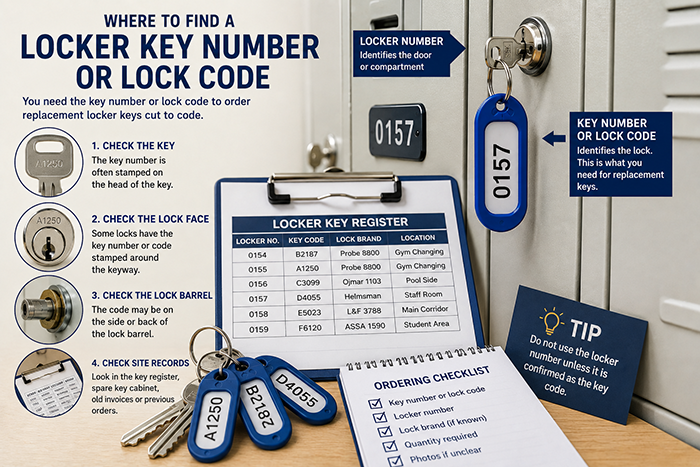
A locker key number or lock code is the detail needed to order many replacement locker keys. It tells the supplier which key profile and cutting pattern should match the lock. Without the correct code, a replacement key may not work, even if the visible locker door number looks right.
This guide explains where to find a locker key number, how to tell the difference between a locker number and a key code, what to check before ordering, and what to do when the code is missing or hard to read.
This article supports our main Locker Keys UK replacement and key management guide. For direct ordering, use Total Locker Service for replacement locker keys cut to code.

Quick Answer: Where Do You Find a Locker Key Number?
The locker key number is usually found on the original key, the lock face, the lock barrel or the site key register. It may be a number, a letter and number combination, or a manufacturer-specific code. This code is used to order a replacement locker key cut to code.
Do not assume the locker door number is the key number. The locker number helps users find the compartment. The key number identifies the lock. Sometimes they match, but often they are different.
If the key number is clear, a replacement key can often be ordered without removing the lock. If the number is missing or hard to read, take clear photos of the key, lock face and locker door before requesting help.
What Is a Locker Key Number?
A locker key number is the code used to identify the cut pattern for a specific locker key. It may be stamped on the key head, engraved into the key, marked on the lock face or recorded in a key schedule.
The number does not simply describe the locker position. It usually relates to the lock or key series. This is why a replacement key supplier needs the code, not just the locker door number.
Some locker key numbers are short. Others include letters, prefixes or longer number sequences. For example, a key code may look like 024, AB123, 62731, C3099 or another format linked to the lock range.
The format depends on the lock and key system. Commercial lockers may use locks from brands such as Probe, Helmsman, Lowe & Fletcher, Ojmar, ASSA, Link, Garran, Pure and other common locker lock ranges. The visible locker brand and the lock brand are not always the same.
For a wider explanation of key replacement, read replacement locker keys cut to code: what it means.
Locker Number vs Key Code
The locker number and key code are often confused. This is one of the most common causes of incorrect replacement key orders.
The locker number is usually displayed on the door. It helps a user find the right compartment. In a school corridor, changing room or staff area, the door number is there for quick identification.
The key code is linked to the lock. It tells the supplier which replacement key should operate the lock. This code may appear on the key, lock face, barrel or key record.
| Detail | What it identifies | Where it is usually found | Used for replacement key ordering? |
|---|---|---|---|
| Locker number | The user-facing locker door or compartment | Door plate, number disc or locker label | Only if it is also the key code |
| Key number | The key cutting code or lock code | Key head, lock face, lock barrel or key register | Yes |
| Lock brand | The lock or key range | Key, lock face, paperwork or supplier record | Often helpful |
For example, a locker door may show 24, while the key code may be AB124. In that case, ordering key 24 may not work. The supplier needs AB124.
For more detail, read locker key numbers vs locker door numbers.
1. Check the Original Locker Key
The original key is usually the best place to start. Many locker keys have a number stamped or engraved into the metal head of the key. Some also have a brand name or logo.
Look carefully at both sides of the key. The code may be small, worn or partly hidden by a key ring, tag or plastic cover. Clean the key gently if dirt or grime makes the number hard to read.
Write down the code exactly as shown. Include letters, numbers, prefixes, suffixes and leading zeros. A code such as AB012 is not the same as AB12.
- Check both sides of the key.
- Look for stamped numbers or letters.
- Do not ignore leading zeros.
- Include any prefix or suffix.
- Check whether the key also shows a brand name.
If the key is worn, take a clear close-up photograph. This is useful if the number could be read in more than one way.
Common Key Marking Problems
Older locker keys can be difficult to read. Numbers may be worn smooth, scratched or partly hidden. Some characters can look similar, especially when the stamp is shallow.
- A 6 may look like an 8.
- A 1 may look like a 7.
- The letter O may look like zero.
- The letter B may look like an 8.
- A worn prefix may be missed completely.
If there is any doubt, do not guess. Compare the key with the lock face, spare key record or site key register. Guessing can lead to a wrong replacement key.
2. Check the Locker Lock Face
If the original key is missing, check the face of the locker lock. Some locks have a number stamped around the keyway or printed on the lock face. This may be the key number or lock code needed for replacement ordering.
Use good lighting and look from more than one angle. Reflections, scratches and worn metal can make the code hard to see. A phone torch may help, but avoid glare when taking photos.
Take a close-up photograph of the lock face. Also take a wider photo showing the full locker door. The close-up helps with the code. The wider image helps identify the locker type, door style and possible manufacturer.
If the lock face has no visible number, do not assume the locker door number is enough. Continue checking other sources before ordering.
How to Photograph the Lock Code
A clear photograph can prevent mistakes when the code is hard to read. Take the image straight on if possible. Then take a second image from a slight angle to catch stamped markings.
- Use natural light or a steady torch.
- Keep the camera focused on the lock face.
- Take one close-up and one wider locker photo.
- Include any brand markings.
- Avoid heavy glare from shiny lock surfaces.
If sending photos to a supplier, include the written code you think it shows. This gives the supplier a useful comparison.
3. Check the Lock Barrel or Inside of the Door
Some locker locks do not show the full code on the front. The number may be visible on the lock barrel, rear fixing, cam or inside of the locker door. This is more likely when the door is open.
If the locker is open, inspect the inside of the door carefully. Look at the rear of the lock, the cam arm and any retaining nut or lock body marking. Do not remove the lock unless you are confident and authorised to do so.
In schools, gyms and workplaces, this check is usually handled by a site manager, caretaker, maintenance person or facilities team. They may be able to compare the lock with other lockers in the same area.
If the locker is locked shut and the key is missing, check whether an authorised master key or spare key is available. Avoid forcing the door unless there is an urgent reason.
For a lost key process, read lost locker key: what schools, gyms and workplaces should do.
4. Check the Site Key Register
A key register is often the most reliable source when it has been kept up to date. It should show the locker number, key code, lock brand, user or department, issue date and spare key location.
Schools may hold this record in the site office, bursar’s office or caretaker’s records. Gyms may hold it at reception or with the facilities manager. Workplaces may keep it with HR, maintenance or building management.
However, old records should be checked carefully. A locker may have had its lock changed since the record was created. If the register says one code but the lock face shows another, investigate before ordering.
A good register saves time because staff do not have to inspect every lock when a key goes missing. It also makes bulk replacement orders easier.
For a practical structure, read how to build a locker key register.
5. Check Spare Keys and Master Key Records
Spare keys can help confirm the correct code. A site may have a spare key cabinet, key board or controlled set of management keys. Check whether the spare key has a stamped number or labelled tag.
Do not rely only on handwritten labels if the key itself shows a different code. Labels may have been swapped, faded or written incorrectly. The key stamp, lock face and register should be compared where possible.
Master key records may also help identify the lock range. A master key may not give the individual user key code, but it can help confirm the lock system or manufacturer range.
Master keys should be kept secure. A missing user key may affect one locker. A missing master key may affect many lockers. Keep master key access limited and recorded.
For more guidance, read locker master keys explained and key cabinets for managing locker keys.
6. Check Old Orders, Invoices and Installation Records
If the key and lock markings are unclear, old paperwork may help. Previous invoices, locker installation records, maintenance notes and supplier emails may include the lock brand, key range or replacement key codes.
This is useful for older locker installations where some markings have worn away. It is also helpful when a site has several locker blocks installed at different times.
Search for terms such as locker keys, replacement keys, key numbers, lock codes, master keys, locker locks and the locker brand name. If you find an old key order, compare it with the current lock before ordering again.
Records are helpful, but they are not perfect. A lock may have been changed during a repair, meaning the old code no longer matches the current locker.
7. Identify the Lock or Locker Brand
The key number is the most important detail, but the lock or locker brand can also help. Some code ranges may look similar across different systems. The brand helps narrow the correct key profile.
Check the key head, lock face, locker door, locker frame, old paperwork and previous orders. The visible locker brand may not always be the lock brand, but both details are useful.
For example, a locker cabinet may be from one manufacturer but fitted with a lock from another supplier. The replacement key must match the lock, not just the cabinet.
If you are unsure, send clear photos when requesting help. Include the lock face, full locker door and any brand markings.
What If the Locker Key Number Is Missing?
If the locker key number is missing, start by checking every possible source: the original key, lock face, barrel, spare keys, key register and old paperwork. Many missing-code problems are solved by checking more than one place.
If no code can be found, take photographs. A specialist supplier may still be able to identify the key range from the lock type, keyway, locker model or brand details.
If the lock cannot be identified, the lock may need to be replaced. This is more likely with old, damaged or obsolete systems. In that case, update the site register as soon as the new lock is fitted.
When replacing a lock, check whether it forms part of a master-keyed system. Replacing one lock with an incompatible lock may cause future access problems for management staff.
For ordering error prevention, read common mistakes when ordering locker keys.
What If the Code Is Worn or Hard to Read?
A worn key code should be treated carefully. Do not assume the nearest-looking number is correct. One wrong character can produce the wrong key.
Use good lighting and compare several sources. If the original key is worn, check the lock face. If the lock face is worn, check the spare key. If both are unclear, check the register or previous invoices.
Take close-up photos from more than one angle. Sometimes a shallow stamp becomes clearer when light falls across it from the side.
- Do not guess unclear digits.
- Compare the code against spare keys.
- Check whether a prefix or leading zero is missing.
- Photograph the key and lock face.
- Ask for help before ordering if the code is uncertain.
Can You Order a Replacement Key from the Locker Door Number?
Sometimes, but only if the locker door number is also the key code. This should not be assumed.
In many installations, the door number is a user-facing label and has no direct relationship to the key cutting code. The door may say 023, but the key code may be D4055. Ordering from 023 would not produce the correct key unless 023 is recorded as the actual key code.
Before using a locker number to order, check your register or a spare key. If the register confirms that locker 023 uses key code 023, then it may be safe. If there is no confirmation, inspect the lock or key first.
Sector Examples
Different sites find key numbers in different ways. The core checks are the same, but the records may be held by different people.
| Site type | Where to check first | Useful supporting guide |
|---|---|---|
| School | Original key, pupil locker record, caretaker records | School locker keys |
| Gym | Key tag, reception spare keys, changing room lock face | Gym locker keys |
| Leisure centre | Wrist strap, spare key cabinet, lock face | Leisure centre locker keys |
| Workplace | Staff locker register, facilities records, lock face | Workplace locker keys |
| University | Department key schedule, building records, lock face | University locker keys |
| Healthcare | Facilities records, authorised key storage, lock face | Healthcare locker keys |
Replacement Locker Key Ordering Checklist
Before ordering a replacement locker key, collect the details below. This reduces the chance of wrong keys and delays.
- Key number or lock code.
- Locker door number.
- Lock brand, if known.
- Locker brand, if known.
- Quantity required.
- Clear photos if the code is uncertain.
- Details of any master key system.
- Confirmation that the lock still works.
- Delivery contact and site details.
If the lock works and the code is known, a replacement key can often be ordered without changing the full lock. Use Total Locker Service for replacement locker keys cut to code.
How to Prevent Future Key Number Problems
The best way to prevent future ordering problems is to record the key code before the key is lost. A simple key register can save time later.
Every locker should have a recorded locker number, key code, lock brand and location. If the lock is changed, update the register immediately. Old records are one of the main causes of wrong replacement orders.
Spare keys should be stored securely and labelled clearly. Avoid attaching personal names to keys. A locker number or internal reference is usually enough.
Carry out regular audits. Schools may audit keys at the end of term. Gyms and leisure centres may check keys during maintenance periods. Workplaces may review key records when staff leave or lockers are reassigned.
For audit support, read the locker key audit checklist for facilities managers.
Bulk Replacement Orders
If several keys are missing, prepare a bulk list rather than placing separate orders. This is useful for schools before a new term, gyms after a refurbishment, workplaces after staff changes and universities after annual audits.
A bulk list should include each key code, locker number, quantity, brand and any uncertainty. Separate confirmed codes from unclear codes. This helps the supplier process the order more accurately.
After the keys arrive, test them and update the register. The aim is not just to replace missing keys, but to improve the whole key management process.
For larger orders, read bulk replacement locker keys for schools and workplaces.
Related Locker Key Guides
This article is part of the locker keys canister. Use the related guides below to support replacement ordering, key management and sector-specific locker key control.
- Locker Keys UK: Replacement, Cut-to-Code Ordering and Key Management Guide
- Replacement Locker Keys Cut to Code: What It Means
- Locker Key Numbers vs Locker Door Numbers
- Lost Locker Key? What Schools, Gyms and Workplaces Should Do
- Are Locker Keys Universal? Why Key Codes and Brands Matter
- Common Mistakes When Ordering Locker Keys
- How to Build a Locker Key Register
- Bulk Replacement Locker Keys for Schools and Workplaces
- Locker Master Keys Explained
- Key Cabinets for Managing Locker Keys
- Locker Key Audit Checklist for Facilities Managers
Ordering Replacement Locker Keys
Once the key number or lock code is confirmed, replacement key ordering is much easier. Check the code carefully, include any letters or leading zeros, and confirm the lock or locker brand where possible.
For direct ordering, visit Total Locker Service: Locker Keys and Replacement Locker Keys.
Locker Key Number and Lock Code FAQs
Where is the locker key number?
The locker key number may be stamped on the original key, shown on the lock face, marked on the lock barrel or recorded in a site key register.
Is the locker number the same as the key number?
Not always. The locker number usually identifies the door or compartment. The key number identifies the lock code used to cut a replacement key.
Can I order a locker key from the door number?
Only if the door number is also confirmed as the key code. Many locker door numbers are user-facing labels and are not the same as the key cutting code.
What should I do if the lock code is worn away?
Check the original key, spare keys, site register and old ordering records. Take clear photos of the lock face and keyway before asking a supplier for help.
What information is needed to order a replacement locker key?
You normally need the key number or lock code, the locker number, lock brand where known, quantity required and clear photographs if the code is uncertain.
What if no key code can be found?
If no key code can be found, a specialist may still identify the lock from photographs. If the lock cannot be identified, it may need to be replaced.