A lost locker key can cause a small but urgent problem. A pupil may need books or PE kit. A gym member may have clothing, a phone or car keys locked inside. A member of staff may need PPE, uniform or personal belongings before starting work.
The right response depends on the site, the lock type, whether the locker is open or locked, and whether the key number or lock code is known. In many cases, a replacement locker key can be ordered without changing the full lock.
This guide explains what schools, gyms, leisure centres and workplaces should do when a locker key is lost. It supports our main Locker Keys UK replacement and key management guide. For direct ordering, use Total Locker Service for replacement locker keys cut to code.

Quick Answer: What Should You Do If a Locker Key Is Lost?
When a locker key is lost, first check whether the locker is locked or open. If it is open, keep it open until a replacement key has been arranged. If it is locked, check for an authorised spare key or master key before forcing the door.
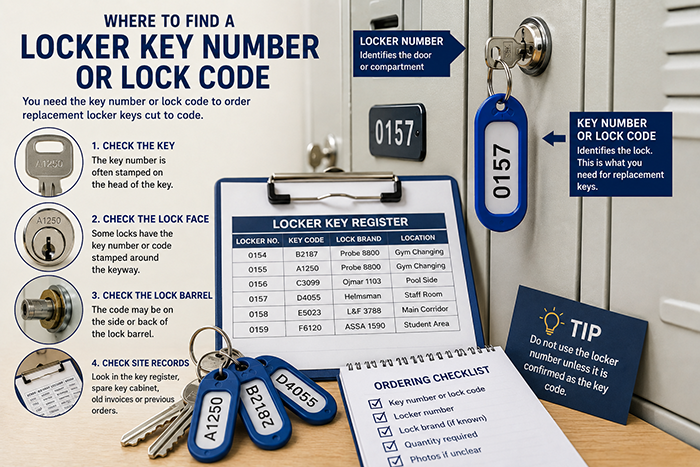
Next, find the key number or lock code. This may be stamped on the lock face, shown on a spare key, recorded in a key register or listed in old site records. If the lock still works and the code is known, a replacement key can often be cut to code.
Only replace the full locker lock if the lock is damaged, insecure, impossible to identify or if the missing key creates a security risk.
For the key identification stage, read where to find a locker key number or lock code.
First Steps When a Locker Key Is Lost
A lost locker key should be handled calmly and consistently. The main aim is to restore access without damaging the locker, weakening security or creating confusion in the key records.
Do not force the locker door as the first response. Forced entry can bend the door, damage the frame, break the cam or turn a simple replacement key issue into a full locker repair.
- Confirm who reported the missing key.
- Check whether the locker is locked or open.
- Ask the user to check bags, pockets, reception, changing areas and usual storage points.
- Check whether a spare key or master key is available.
- Find the key number or lock code.
- Order a replacement key if the code is known and the lock works.
- Replace the lock only when replacement key ordering is not suitable.
- Update the key register once the issue is resolved.
This process works for schools, gyms, leisure centres, workplaces, universities and managed commercial buildings. The details may vary, but the logic is the same: check, identify, replace only what needs replacing, and record the result.
Check Whether the Locker Is Locked or Open
The first practical question is simple: is the locker locked shut, or is it open?
If the locker is open, do not close it again. Keep the door open and mark the locker as temporarily out of use. This prevents the locker from becoming locked without a working key. The key number can then be identified from the lock, key register or spare key records before a replacement is ordered.
If the locker is locked, check whether the user needs urgent access. In a school, the locker may contain books, medicine, sports kit or personal items. In a gym, it may contain clothing, valuables or car keys. In a workplace, it may contain PPE or uniform needed for a shift.
Where access is needed, use an authorised spare key or master key if available. This should be done by approved staff and recorded where necessary. Avoid forcing the door unless there is a genuine need and no safer access method is available.
Check Whether the Key Is Really Lost
Many lost locker keys are found shortly after they are reported missing. Before ordering a replacement or opening the locker, ask the user to check common places.
- Coat pockets and trouser pockets.
- PE bags, gym bags and school bags.
- Reception desks or lost property areas.
- Changing room benches and floors.
- Classrooms, offices or staff rooms.
- Vehicle cup holders, bags and lockers used previously.
- Key hooks, lanyards, wrist straps or number tags.
This short check is worthwhile. It may prevent unnecessary ordering, avoid temporary lock changes and reduce admin time.
Use an Authorised Spare Key or Master Key
Many managed locker systems have spare keys or master keys. These can help staff open a locker without damaging it. However, they must be used carefully.
A spare key normally opens one locker. A master key may open many lockers in the same system. This makes master key control important. A lost master key is a bigger security issue than a lost user key.
Only authorised staff should use master keys. The key should be stored securely, returned after use and recorded where appropriate. Schools, gyms and workplaces should not leave master keys in open drawers, unlocked reception areas or shared cupboards.
For more detail, read locker master keys explained and key cabinets for managing locker keys.
Find the Key Number or Lock Code
The key number or lock code is the detail needed to order many replacement locker keys. It tells the supplier which key profile and cutting pattern should match the lock.
The code may be found on the original key, the lock face, the lock barrel, a spare key tag, a site key register, old invoices or previous replacement key orders.
- Check the original key if it has been found but is damaged.
- Check the face of the lock for stamped numbers.
- Check the lock barrel if the door is open.
- Check the spare key cabinet or key board.
- Check site records and key issue sheets.
- Check old invoices, installation records and previous orders.
Do not assume the locker door number is the same as the key code. The door number helps users identify the locker. The key code identifies the lock. Sometimes they match, but often they are different.
For a full guide, read where to find a locker key number or lock code and locker key numbers vs locker door numbers.
Take Photos If the Code Is Unclear
If the key number or lock code is worn, unclear or partly hidden, take clear photos before ordering. A close-up photo of the lock face can help confirm the code. A wider photo of the full locker door may help identify the locker type or brand.
Photograph the key if available. Take both sides. Include any brand name, number, letter prefix or stamped mark. If possible, photograph the lock straight on and from a slight angle to catch shallow markings.
Unclear characters should not be guessed. A 6 may look like an 8. A 1 may look like a 7. The letter O may look like zero. A missed prefix or leading zero can result in the wrong replacement key.
For error prevention, read common mistakes when ordering locker keys.
Order a Replacement Locker Key
If the lock still works and the key code is known, a replacement locker key can often be ordered without changing the full lock. This is usually the fastest and most cost-effective option.
Replacement keys cut to code are made from the key number or lock code rather than copied from the original key. This is useful when the original key is missing, broken or taken away by mistake.
Before ordering, collect the key code, locker number, lock brand, locker brand if known, quantity required and any photos if the code is unclear. Also check whether the lock is part of a master-keyed system.
Total Locker Service supplies replacement locker keys cut to code for many common locker systems. For process detail, read replacement locker keys cut to code: what it means.
Replacement Key Ordering Checklist
Use this checklist before ordering a replacement key.
- Key number or lock code.
- Locker door number.
- Lock brand, if known.
- Locker brand, if known.
- Quantity required.
- Clear photo of the key, if available.
- Clear photo of the lock face.
- Details of any master key system.
- Confirmation that the lock still works.
- Delivery contact and site details.
After the replacement key arrives, test it carefully and update the site record. A resolved lost key issue should always end with the key register being corrected.
When to Replace the Locker Lock Instead
A replacement key is not always the best answer. A new key will not repair a damaged or insecure lock.
Replace the locker lock if the lock barrel is loose, the keyway is damaged, the cam is bent, the lock does not turn smoothly or the lock code cannot be identified. Lock replacement may also be sensible when the missing key creates a security risk.
- The lock is damaged or stiff.
- The keyway is worn or blocked.
- The cam is bent or loose.
- The key code cannot be found.
- The key may have been stolen with identifying information.
- The lock is obsolete or difficult to support.
- The site is already upgrading the locker system.
For maintenance guidance, read broken locker key: what to do before replacing the lock and worn locker keys and stiff locks: repair or replace?.
Do Not Force the Locker Unless Necessary
Forcing a locker door should be a last resort. It can damage the door, frame, hinge, lock cam and surrounding lockers. It may also make the site look poorly managed, especially in public changing rooms or school corridors.
If urgent access is needed and no key is available, authorised staff should follow the site procedure. Where personal belongings are inside, access should be witnessed or recorded to protect both the user and the organisation.
After forced access, assess whether the lock, door or frame needs repair. Then update the key record so the same problem does not continue.
Lost Locker Key Procedure for Schools
Schools often deal with lost locker keys because pupils move between classrooms, changing rooms, sports areas and buses. Keys may be left at home, lost in bags, swapped between pupils or not returned at the end of term.
The school should have a simple process for lost keys. The pupil should report the missing key to the correct office or staff member. Staff should check the locker record, confirm the locker number and identify the key code.
If the locker contains urgent items, an authorised spare key or master key may be used. Access should be handled by staff, not by pupils. The incident should be recorded, especially if the locker contains personal items.
Schools should avoid repeatedly replacing full locks when a replacement key can be ordered by code. A good key register can save the site team significant time across the academic year.
School lost key checklist
- Ask the pupil to check bags, pockets, classrooms and PE areas.
- Confirm the locker number.
- Check the key code in the school register.
- Use an authorised spare key or master key if access is needed.
- Order a replacement key if the code is known.
- Record the issue and update the register.
- Collect keys at the end of term or school year.
For more school-specific guidance, read school locker keys: replacement and key control guide and how to reduce lost locker keys in schools.
Lost Locker Key Procedure for Gyms and Leisure Centres
Gyms and leisure centres need a fast lost key process because lockers are often used for short periods. A member may need access to clothing, a wallet, a phone or car keys before leaving the site.
Reception or duty management staff should verify the user’s claim before opening a locker. This protects users and reduces the risk of unauthorised access. The site should record who requested access, which locker was opened and which staff member authorised it.
Wet-area lockers may use wrist straps, number discs or plastic key tags. These accessories can break, fade or detach. When a lost key is reported, check whether the key has separated from the wrist strap or number tag.
After the locker has been opened, identify the key code and order a replacement key if required. Keep the locker out of use until the replacement key or lock repair has been completed.
Gym and leisure lost key checklist
- Ask the user to check changing areas, lockers and reception.
- Verify the user before opening the locker.
- Use authorised staff and a spare key or master key.
- Record the locker opening if personal belongings are involved.
- Check the key tag, wrist strap and lock code.
- Order a replacement key or replace damaged accessories.
- Review repeated lost key patterns.
For more guidance, read gym locker keys: replacement, wrist straps and member access, leisure centre locker keys: managing wet-area key loss and how to reduce lost locker keys in gyms.
Lost Locker Key Procedure for Workplaces
In workplaces, a lost locker key can affect staff attendance, shift starts and access to uniform, PPE or tools. This is especially important in factories, warehouses, healthcare sites and staff changing areas.
The first step is to confirm which employee or department uses the locker. Then check the staff locker register for the locker number and key code. If the locker contains work-critical items, an authorised supervisor or facilities team member may need to open it using a spare key or master key.
When an employee leaves, the key should be returned before the locker is reassigned. If the key is missing, the site should decide whether to order a replacement key or change the lock, depending on risk.
Workplaces should not let unrecorded key changes build up. If locks are replaced without updating the register, future lost key problems become harder to solve.
Workplace lost key checklist
- Confirm the locker user or department.
- Check the locker register for the key code.
- Use authorised spare key or master key access if needed.
- Record access where personal items are involved.
- Order a replacement key if the lock works and the code is known.
- Replace the lock if security has been compromised.
- Update the staff locker record after the issue is resolved.
For workplace-specific guidance, read workplace locker keys: staff storage and replacement process.
Should You Charge for a Lost Locker Key?
Some sites charge for lost locker keys. Others absorb the cost as part of normal locker management. The best approach depends on the setting, user group and site policy.
Schools may use a small deposit or replacement charge to encourage returns. Gyms may charge members for lost keys, wrist straps or number tags. Workplaces may handle lost keys through staff procedures, especially where uniform or PPE storage is involved.
Any charge should be clear before keys are issued. The policy should explain what happens if a key is lost, whether a deposit applies, and whether the user pays for a replacement key or full lock change.
The charge should also reflect the actual issue. If the lock still works and a replacement key can be ordered by code, a full lock replacement charge may not be appropriate unless there is a security reason.
Security Issues After a Lost Locker Key
Not every lost locker key creates the same level of risk. A key lost somewhere on site with no identifying details may be low risk. A key stolen with a labelled tag, locker number or personal details may be more serious.
Consider where the key was lost, whether it can be linked to a specific locker, what is stored inside the locker and whether unauthorised access is likely.
- Low risk: unlabelled key lost away from the locker area.
- Medium risk: key lost with a locker number tag.
- Higher risk: key stolen with identifying details or access information.
- Higher risk: locker used for sensitive, valuable or work-critical items.
For higher-risk situations, replacing the lock may be safer than ordering a replacement key. Record the decision and update the key register.
How to Prevent Repeat Lost Locker Key Problems
The best lost key procedure is prevention. A few simple controls can reduce repeated issues and make replacement ordering easier when a key does go missing.
- Use a clear locker key register.
- Record the key code separately from the door number.
- Use durable number tags, fobs or wrist straps.
- Keep spare keys in a secure key cabinet.
- Limit master key access to authorised staff.
- Audit keys regularly.
- Replace worn keys before they snap.
- Update records whenever locks are changed.
- Collect keys at the end of term, membership, tenancy or employment.
For practical tools, read how to build a locker key register, locker key audit checklist for facilities managers and locker key tags, number discs and wrist straps explained.
When Keyless Locks May Be Better
If lost locker keys are a constant problem, the site may need to review the locking method. Combination locks, coin locks, RFID locks and electronic locks can reduce reliance on physical keys.
However, keyless systems have their own issues. Combination codes can be forgotten. RFID wristbands and cards can still be lost. Electronic locks may need batteries, programming and staff training.
Traditional keys still work well for many schools, workplaces and managed locker areas. The question is not whether keys are old-fashioned. The question is whether the site has a practical process for issuing, replacing and auditing them.
For comparison, read locker keys or combination locks: which is better? and locker keys or RFID locks: which is better for leisure sites?.
Lost Locker Key Action Table
| Situation | Best action | Useful guide |
|---|---|---|
| Locker is open but key is missing | Keep the locker open, identify the code and order a replacement key | Replacement keys cut to code |
| Locker is locked and user needs access | Use authorised spare key or master key access if available | Master keys explained |
| Key code is unclear | Check the lock face, key register and spare keys; take photos | Find a key number |
| Lock is damaged or stiff | Replace the lock rather than only the key | Worn keys and stiff locks |
| Many keys are missing | Prepare a bulk replacement order and update the register | Bulk replacement keys |
| Lost keys happen repeatedly | Review tags, deposits, issue records, audits and locking method | Key audit checklist |
Related Locker Key Guides
This article is part of the locker keys canister. Use these guides to move from lost key response to replacement ordering, key identification and long-term key control.
- Locker Keys UK: Replacement, Cut-to-Code Ordering and Key Management Guide
- Replacement Locker Keys Cut to Code: What It Means
- Where to Find a Locker Key Number or Lock Code
- Are Locker Keys Universal? Why Key Codes and Brands Matter
- Locker Key Numbers vs Locker Door Numbers
- School Locker Keys: Replacement and Key Control Guide
- Gym Locker Keys: Replacement, Wrist Straps and Member Access
- Workplace Locker Keys: Staff Storage and Replacement Process
- How to Build a Locker Key Register
- Common Mistakes When Ordering Locker Keys
- Locker Key Audit Checklist for Facilities Managers
Ordering Replacement Locker Keys
A lost locker key does not always mean the lock needs to be replaced. If the lock still works and the correct key code is known, a replacement key can often be cut to code.
Before ordering, confirm the key number, lock code, lock brand and quantity required. If the code is unclear, take photographs of the lock face, keyway and any markings.
For direct ordering, visit Total Locker Service: Locker Keys and Replacement Locker Keys.
Lost Locker Key FAQs
What should I do first if a locker key is lost?
First check whether the locker is open or locked. If it is open, keep it open. If it is locked, check for an authorised spare key or master key before forcing the door.
Can a lost locker key be replaced without changing the lock?
Yes. Many lost locker keys can be replaced without changing the lock when the correct key number or lock code is known and the lock still works.
Where do I find the key number for a lost locker key?
The key number may be on the original key, lock face, lock barrel, spare key tag, site key register or previous order records.
Should I force open a locker if the key is lost?
Forcing a locker should be a last resort. It can damage the locker door, lock and frame. Use an authorised spare key or master key first where possible.
When should the lock be replaced after a key is lost?
Replace the lock if it is damaged, insecure, impossible to identify or if the missing key creates a security risk because it can be linked to the locker.
How can schools reduce lost locker keys?
Schools can reduce lost locker keys by using clear key tags, keeping an accurate key register, holding spare keys securely and collecting keys at the end of term or school year.
How can gyms reduce lost locker keys?
Gyms can reduce lost locker keys by using durable wrist straps, clear number tags, secure spare key control, member procedures and regular key audits.