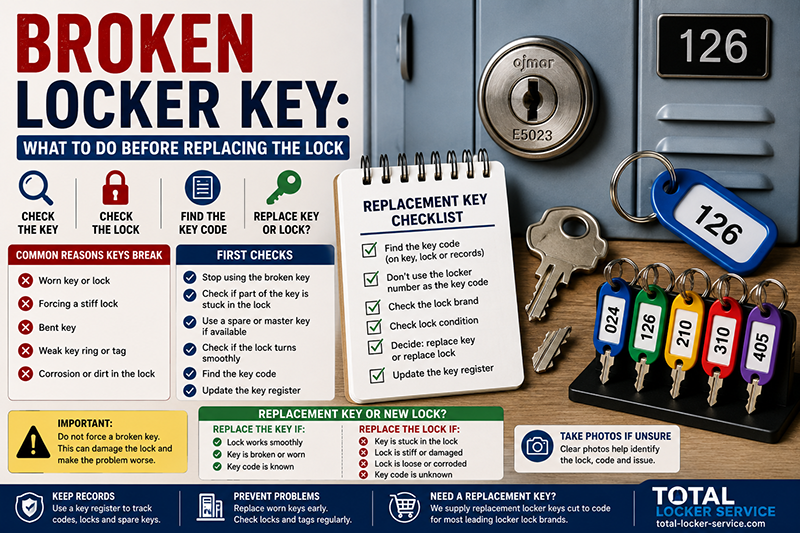
A broken locker key does not always mean the locker lock needs to be replaced. In many cases, the key has bent, snapped, worn down or broken away from the tag, while the lock itself may still be usable. The right action depends on where the key has broken, whether part of the key is stuck in the lock, whether the lock still turns and whether the correct key code can be identified.
This guide explains what to do before replacing a locker lock. It covers snapped keys, bent keys, broken key tags, stuck key fragments, replacement keys cut to code and the point where a full lock replacement becomes the better option.
This article supports our main Locker Keys UK replacement and key management guide. For direct ordering, use Total Locker Service for replacement locker keys cut to code.

Quick Answer: What Should You Do with a Broken Locker Key?
First, stop using the key. Do not force it further into the lock. Check whether the key is bent, snapped, worn, broken at the tag, or stuck inside the lock. Then check whether the lock still turns smoothly with a spare key or authorised master key.
If the lock still works and the correct key number or lock code is known, a replacement locker key can often be cut to code without replacing the full lock. If part of the key is stuck inside the barrel, or the lock is stiff, loose, corroded or damaged, the lock may need repair or replacement.
The main rule is simple: replace the key when the key is the problem. Replace the lock when the lock is the problem.
For replacement key ordering, read replacement locker keys cut to code: what it means.
First Checks Before Replacing the Lock
A broken key can make a locker seem worse than it is. Before replacing the lock, check the fault carefully. A damaged key, broken tag or missing key ring may be a small issue. A jammed barrel, snapped key fragment or stiff mechanism may be more serious.
- Stop using the broken key.
- Check whether any part of the key is stuck inside the lock.
- Check whether the locker is open or locked shut.
- Check whether a spare key or authorised master key exists.
- Check whether the lock turns smoothly with a working key.
- Find the key number or lock code.
- Decide whether the key, lock or accessory needs replacing.
- Update the locker key register after the issue is resolved.
Do not force a damaged key. This can push a broken fragment deeper into the barrel or damage the keyway. A small key problem can become a full lock replacement if the lock is forced.
For the general lost-key process, read lost locker key: what schools, gyms and workplaces should do.
Where Did the Locker Key Break?
The next step is to identify the type of break. Not every broken locker key needs the same response.
| Problem | Likely cause | Best next step |
|---|---|---|
| Key snapped inside the lock | Worn key, stiff lock or forced turning | Do not force it. Arrange safe extraction or lock replacement if needed. |
| Key bent but still whole | Heavy use, pressure, poor handling or stiff lock | Stop using it and order a replacement from the key code. |
| Key head broken | Wear around the ring hole or repeated pulling | Order a replacement key and replace tag or ring. |
| Key separated from tag or wrist strap | Broken split ring, tag or strap | Replace the accessory and check the key code. |
| Key turns poorly | Worn key or stiff lock | Check both key and lock before ordering. |
| Key does not enter the lock | Wrong key, bent key or blocked keyway | Do not force it. Check code, lock brand and lock condition. |
This first diagnosis helps avoid unnecessary lock replacement. It also prevents ordering a new key when the lock itself is failing.
Key Snapped Inside the Locker Lock
If part of the key has snapped inside the lock, stop immediately. Do not push another key into the lock. Do not keep turning the broken fragment. This can push the fragment further inside and make the lock harder to repair.
If the broken part is visible and loose, authorised maintenance staff may be able to remove it carefully using suitable tools. However, if the fragment is deep, tight or the lock is still under tension, the safer route is to involve a competent maintenance person, locksmith or locker supplier.
Once the fragment has been removed, test the lock with a known working spare key or authorised master key. If the lock turns smoothly, the lock may still be usable. If the lock remains stiff, loose or unreliable, replacing the lock may be better.
- Do not force another key into the lock.
- Do not keep turning the broken fragment.
- Do not drill or force the locker as the first step.
- Check whether the locker is open or locked shut.
- Use authorised staff for access and repair decisions.
- Test the lock after the fragment is removed.
- Order a replacement key only if the lock still works.
If the locker contains personal belongings, follow your site access procedure before opening it. For master key access, read locker master keys explained.
Bent or Worn Locker Key
A bent locker key should not be straightened and reused repeatedly. Even if it works once or twice, it may weaken and snap later. Bent keys are also more likely to damage the lock barrel.
A worn key may feel loose, turn poorly or need wiggling before it operates the lock. That is a warning sign. The key may be wearing down, or the lock may be becoming stiff.
If the key is bent or worn but the lock still turns smoothly with a spare key, order a replacement key from the correct key code. If all keys feel stiff in the same lock, the lock may be the problem.
- Stop using bent keys before they snap.
- Check whether a spare key works smoothly.
- Check whether the key code is still readable.
- Order a replacement key from the confirmed code.
- Inspect the lock if several keys feel stiff.
- Update the key register once the replacement is issued.
For wider diagnosis, read worn locker keys and stiff locks: repair or replace?.
Broken Key Tag, Wrist Strap or Split Ring
Sometimes the key itself is not broken. The problem may be the number tag, wrist strap, fob or split ring. This is common in gyms, leisure centres, swimming pools and schools where keys are handled frequently.
If the tag breaks away from the key, the key may become hard to identify. If the wrist strap fails, the key may be lost even when the user has tried to keep it safe. If the split ring opens, the key can detach from its number tag.
In this case, replacing the accessory may be enough. However, check the key code before the key becomes separated from the record. The visible tag number may not be the actual replacement key code.
- Replace cracked number tags.
- Replace weak split rings.
- Replace stretched or broken wrist straps.
- Record the actual key code separately.
- Do not rely only on the tag number for replacement ordering.
- Check wet-area accessories regularly.
For accessories, read locker key tags, number discs and wrist straps explained. For leisure environments, read leisure centre locker keys: managing wet-area key loss.
Find the Key Code Before Ordering a Replacement
Before ordering a replacement locker key, find the actual key number or lock code. Do not rely only on the visible locker door number unless it has been confirmed as the key code.
The key code may be stamped on the key, shown on the lock face, marked on the lock barrel, recorded on a spare key tag or listed in the locker key register.
- Check both sides of the broken key.
- Check the lock face for a stamped number.
- Check the lock barrel if the locker door is open.
- Check spare keys and key cabinet records.
- Check the locker key register.
- Check previous replacement key orders.
- Photograph unclear codes before ordering.
Write the code exactly as shown. Include letters, prefixes and leading zeros. A code such as AB012 may not be the same as AB12.
For step-by-step support, read where to find a locker key number or lock code.
Locker Number vs Key Code
A broken key often exposes a record problem. Staff may know the locker number but not the key code. These are not always the same.
The locker number is the visible number on the door. It helps the user find the locker. The key code identifies the lock and is used to cut the replacement key.
| Visible locker number | Actual key code | What matters for replacement? |
|---|---|---|
| 024 | E5023 | Use E5023 for the replacement key. |
| 126 | B2187 | Use B2187 for the replacement key. |
| 210 | AB124 | Use AB124 for the replacement key. |
| 310 | 310 | Use 310 only if confirmed as the key code. |
For the full explanation, read locker key numbers vs locker door numbers.
When a Replacement Locker Key Is Enough
A replacement key is usually enough when the lock is still working and the key is the part that has failed. This is common when the key has bent, snapped outside the lock, worn down, or broken at the head.
If the correct key code is known, a replacement locker key can often be cut to code without using the original key. This is useful when the original key is broken, missing or too worn to copy reliably.
A replacement key may be the right option when:
- The lock still turns smoothly with a spare key.
- The key has snapped outside the lock.
- The key is bent but the lock is otherwise fine.
- The key head has broken.
- The key code is still readable.
- The lock code is available in the register.
- The lock is not loose, stiff, damaged or corroded.
Total Locker Service supplies replacement locker keys cut to code for many common locker systems.
When the Locker Lock Should Be Replaced
A replacement key is not always enough. If the lock is damaged, insecure or unreliable, replacing the lock may be the better choice.
Lock replacement should be considered when the key has snapped inside the barrel and cannot be removed safely, when the lock is stiff with more than one key, or when the lock no longer secures the door properly.
- Part of the key is stuck deep inside the lock.
- The lock barrel is loose.
- The keyway is worn, blocked or damaged.
- The cam does not secure the locker door.
- The lock is stiff with more than one key.
- The lock shows corrosion or heavy wear.
- The key code cannot be found.
- The missing or broken key creates a security risk.
- The lock no longer matches the site key register.
Where lockers are part of a master-keyed system, check compatibility before replacing one lock. A random replacement lock may not work with the existing master key.
For master key considerations, read locker master keys explained.
Do Not Force the Locker Door
Forcing the locker door should be a last resort. It can bend the door, damage the frame, break the cam or turn a small key issue into a full locker repair.
If the locker is locked shut and access is needed, use the site’s authorised process. This may involve a spare key, master key, facilities team, locksmith or locker supplier. Where personal belongings are inside, the opening should be handled carefully and recorded where appropriate.
- Use authorised staff for access decisions.
- Verify the user before opening lockers in public settings.
- Record access where personal belongings are involved.
- Avoid drilling, forcing or prising as the first response.
- Inspect the lock and door after access is restored.
For wider access procedure, read lost locker key: what schools, gyms and workplaces should do.
Advice for Schools, Gyms and Workplaces
Broken locker keys happen in many settings. The basic decision is the same everywhere: check the key, check the lock, find the code, then decide whether to replace the key or the lock.
| Site type | Common broken key issue | Best action | Useful guide |
|---|---|---|---|
| Schools | Pupils bend keys or break key tags | Check the register and order a replacement key if the lock works | School locker keys |
| Gyms | Keys separate from wrist straps or become worn | Check straps, tags and key codes together | Gym locker keys |
| Leisure centres | Wet-area keys corrode, tags fade or straps fail | Inspect accessories and lock condition regularly | Leisure centre locker keys |
| Workplaces | Staff keys bend, snap or are not returned | Use staff key records and leaver checks | Staff locker keys |
| Universities | Large key schedules hide old or wrong records | Check building, key code and lock brand before ordering | University locker keys |
| Healthcare | Shift-based staff storage needs fast access | Use secure spare key and replacement key records | Healthcare locker keys |
Using the Locker Key Register
A good locker key register makes broken key problems easier to solve. It should show the visible locker number, actual key code, lock brand, location, issued user, spare key status and any notes about damaged locks.
When a key breaks, the register helps staff check whether a replacement key can be ordered. It also helps identify whether the lock has been replaced before or whether the current lock no longer matches the record.
- Check the locker number.
- Check the actual key code.
- Check lock brand and location.
- Check whether a spare key exists.
- Check whether the lock is part of a master-keyed group.
- Record the broken key issue.
- Update the register after the key or lock is replaced.
For register setup, read how to build a locker key register.
Common Mistakes with Broken Locker Keys
Broken key problems often become worse when staff react too quickly. The most common mistakes are forcing the key, guessing the code or replacing the lock without checking whether a replacement key would solve the issue.
- Forcing a bent key until it snaps.
- Pushing another key into a lock with a fragment inside.
- Ordering from the locker door number instead of the key code.
- Ignoring a stiff lock that caused the key to break.
- Replacing the lock without checking master key compatibility.
- Failing to record the new key or lock in the register.
- Leaving broken tags, weak rings or damaged straps in use.
For ordering errors, read common mistakes when ordering locker keys.
How to Prevent Broken Locker Keys
Most broken locker key problems can be reduced with simple checks. Replace worn keys before they fail. Repair stiff locks before users force them. Replace weak wrist straps, split rings and number tags before keys are lost.
- Replace bent keys early.
- Replace worn keys before they snap.
- Check locks that need force to turn.
- Do not issue keys that already show cracks or heavy wear.
- Use durable key tags and split rings.
- Inspect wrist straps in gyms and leisure centres.
- Keep spare keys securely stored.
- Audit key condition regularly.
- Update the register after every replacement.
For audit support, read the locker key audit checklist for facilities managers.
Broken Locker Key Decision Table
| Situation | Likely action | Why |
|---|---|---|
| Key is bent but lock works with spare key | Order replacement key | The key is the likely fault. |
| Key snapped outside the lock | Order replacement key from code | The lock may still be usable. |
| Key fragment is stuck in the lock | Arrange safe extraction or replace lock | The barrel may be blocked or damaged. |
| Several keys feel stiff in the same lock | Repair or replace lock | The lock is likely the fault. |
| Key tag or strap is broken | Replace accessory and check code | The key may still be usable. |
| Key code cannot be identified | Check records, photos or replace lock | A key cannot be cut accurately without the correct code. |
| Lock is master-keyed | Check compatibility before lock replacement | The site master key may need to keep working. |
Broken Locker Key Checklist
- Stop using the broken or bent key.
- Check whether part of the key is stuck inside the lock.
- Check whether the locker is open or locked shut.
- Use authorised access procedures where needed.
- Check whether a spare key or master key works.
- Find the actual key code.
- Check the lock brand where known.
- Check whether the lock turns smoothly.
- Order a replacement key if the lock works.
- Replace the lock if the lock is damaged or unreliable.
- Update the key register after the issue is resolved.
Related Locker Key Guides
This article is part of the locker keys canister. Use these guides to support broken key decisions, replacement ordering, lock diagnosis and long-term key control.
- Locker Keys UK: Replacement, Cut-to-Code Ordering and Key Management Guide
- Replacement Locker Keys Cut to Code: What It Means
- Where to Find a Locker Key Number or Lock Code
- Locker Key Numbers vs Locker Door Numbers
- Lost Locker Key? What Schools, Gyms and Workplaces Should Do
- Common Mistakes When Ordering Locker Keys
- Worn Locker Keys and Stiff Locks: Repair or Replace?
- Locker Master Keys Explained
- How to Build a Locker Key Register
- Bulk Replacement Locker Keys for Schools and Workplaces
- Locker Key Tags, Number Discs and Wrist Straps Explained
- Locker Key Audit Checklist for Facilities Managers
Ordering Replacement Locker Keys After a Break
A broken locker key can often be replaced without changing the full lock. The key requirement is the correct key number or lock code. Check the key, lock face, barrel, spare key record or locker key register before ordering.
If the lock still works and the correct code is known, a replacement key can often be cut to code. If the lock is stiff, damaged, insecure or blocked by a broken fragment, replacing the lock may be better.
For direct ordering, visit Total Locker Service: Locker Keys and Replacement Locker Keys.
Broken Locker Key FAQs
Does a broken locker key mean the lock must be replaced?
Not always. If the lock still works and the correct key code is known, a replacement locker key can often be cut to code without replacing the full lock.
What should I do if a key snaps inside a locker lock?
Stop using the lock and do not force another key into it. Arrange safe extraction by authorised maintenance staff, a locksmith or the locker supplier, then test whether the lock still works.
Can a replacement locker key be made from a broken key?
Often, yes, but the best route is to use the correct key number or lock code. The code may be on the key, lock face, lock barrel, spare key record or locker key register.
Should a bent locker key still be used?
No. A bent locker key is more likely to snap or damage the lock. Stop using it and order a replacement key if the lock still works.
When should a locker lock be replaced instead of the key?
Replace the lock if it is stiff, loose, damaged, corroded, blocked by a broken fragment, insecure or impossible to identify from the key code.
Is the locker number enough to replace a broken key?
Only if the locker number is confirmed as the actual key code. Many locker door numbers are not the same as the lock code used to cut replacement keys.
How can broken locker keys be prevented?
Broken locker keys can be reduced by replacing bent or worn keys early, repairing stiff locks, using durable tags and auditing locker keys regularly.