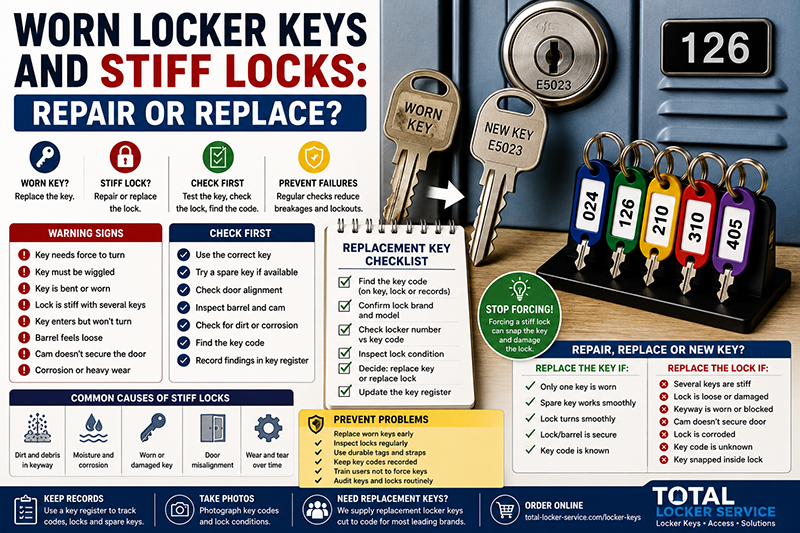
Worn locker keys and stiff locks are early warning signs. A key that needs force, wiggling or repeated turning should not be ignored. It may be worn, bent or close to snapping. The lock may also be dirty, corroded, misaligned or damaged.
The right action depends on the fault. Some problems can be solved with a replacement locker key cut to code. Other problems need lock maintenance or full lock replacement. The important point is to check the key and the lock before forcing anything.
This guide explains how to assess worn locker keys and stiff locker locks, when to order a replacement key, when to replace the lock and how to reduce future key failures.
This article supports our main Locker Keys UK replacement and key management guide. For direct ordering, use Total Locker Service for replacement locker keys cut to code.

Quick Answer: Should You Repair or Replace Worn Locker Keys and Stiff Locks?
Replace the key when the key is worn, bent or damaged but the lock still turns smoothly with a spare key. Replace or repair the lock when several keys are stiff in the same lock, the barrel is loose, the cam does not secure the door, the keyway is damaged or the lock is corroded.
Do not force a stiff locker key. Forcing the key can bend it, snap it inside the barrel or damage the lock. A small maintenance issue can quickly become a broken key or full lock replacement.
If the lock still works and the correct key number or lock code is known, a replacement locker key can often be cut to code without replacing the lock. If the lock is damaged or unreliable, replacing the lock may be the safer long-term option.
For broken-key decisions, read broken locker key: what to do before replacing the lock.
Warning Signs of Worn Locker Keys and Stiff Locks
A locker key system usually gives warning signs before it fails. These signs should be recorded during routine checks, key audits or user reports.
- The key needs force to turn.
- The key must be wiggled before the lock opens.
- The key bends slightly during use.
- The lock turns one day but not the next.
- The key enters the lock but does not turn.
- The key works in one direction but not the other.
- The barrel feels loose.
- The locker door does not close cleanly.
- The cam does not catch properly.
- The lock face, keyway or key shows corrosion or heavy wear.
These signs should not be ignored. A stiff lock can cause a key to snap. A worn key can damage the barrel. A misaligned door can put extra pressure on the lock and make a working key feel faulty.
Is the Key or the Lock Causing the Problem?
The first task is to work out whether the key is worn or the lock is failing. This simple check prevents unnecessary lock replacement and avoids ordering new keys for a damaged lock.
| Test | Likely meaning | Best action |
|---|---|---|
| One key is stiff, but a spare key works smoothly | The user key is worn or bent | Order a replacement key from the confirmed key code |
| Several keys are stiff in the same lock | The lock may be worn, dirty, corroded or misaligned | Inspect, repair or replace the lock |
| The key enters but will not turn | Wrong key, worn key, blocked keyway or lock fault | Check key code, lock brand and lock condition |
| The barrel moves or feels loose | The lock is physically worn or damaged | Replace the lock |
| The cam does not secure the door | The lock or cam may be damaged or misaligned | Repair or replace the lock |
| The door rubs or sits out of line | The locker door may be misaligned | Adjust the door before blaming the key |
Testing should be gentle. Do not force keys during diagnosis. If a key is already bent or cracked, stop using it before it breaks inside the lock.
When the Locker Key Is Worn
A worn locker key may still work, but it is less reliable. It may need extra movement before the lock opens. It may also begin to bend because the user is applying more force than normal.
Worn keys are common in schools, gyms, workplaces and leisure centres because keys are handled every day. They may be pulled by tags, twisted under load, dropped, carried loose in bags or exposed to water and cleaning chemicals.
A worn key should be replaced before it snaps. This is especially important where the key is used by pupils, members, shift workers or several staff members.
- Check whether the key is bent.
- Check whether the head of the key is cracked or stretched around the ring hole.
- Check whether the code is still readable.
- Check whether a spare key works better.
- Order a replacement key if the lock is otherwise working.
- Update the locker key register after replacement.
For code identification, read where to find a locker key number or lock code.
Worn Key or Wrong Key?
A key that does not work may not be worn. It may be the wrong key. This often happens when locker numbers, key tags and key codes become confused.
Check the actual key number or lock code before assuming the key is worn. The visible locker number may not match the replacement key code. A key tag may show the door number rather than the lock code.
For example, locker 126 may use key code B2187. If a key tagged 126 is mixed with another key, staff may think the lock is faulty when the wrong key is being used.
For this distinction, read locker key numbers vs locker door numbers.
When the Locker Lock Is Stiff
A stiff locker lock can be caused by wear, dirt, corrosion, a damaged barrel, a bent cam, door misalignment or poor previous use. It can also happen when a key has been forced repeatedly.
If several keys feel stiff in the same lock, the lock is probably the problem. A new key may not solve it. In fact, a new key may also become damaged if the lock still needs force.
Before replacing the lock, check whether the issue is caused by the locker door. If the door is out of alignment or the cam is rubbing, the lock may feel stiff even though the barrel is still working.
- Check whether the door closes cleanly.
- Check whether the cam catches correctly.
- Check whether the barrel is loose.
- Check whether the keyway is blocked.
- Check whether the lock face shows corrosion.
- Check whether a spare key works smoothly.
- Do not force the lock during testing.
If the lock remains stiff after basic checks, replacement is often better than waiting for a key to snap.
Do Not Force a Stiff Locker Lock
Forcing a stiff lock is one of the fastest ways to break a locker key. The key is usually weaker than the lock barrel. When extra force is applied, the key may twist, bend or snap inside the lock.
If the key does not turn normally, stop. Check whether the key is correct, whether the door is under pressure and whether a spare key works. If the lock is part of a managed locker system, use the authorised maintenance or master key process instead of forcing the key.
- Do not twist harder.
- Do not use pliers on the key.
- Do not push another key into a damaged lock.
- Do not drill or force the locker as the first step.
- Do check the key code and lock condition.
- Do record the issue before it becomes a broken key incident.
For broken-key recovery, read broken locker key: what to do before replacing the lock.
Wet-Area Locker Lock Problems
Wet-area lockers need closer inspection. Swimming pools, leisure centres, spas, gyms and changing rooms expose keys and locks to moisture, steam, cleaning products and heavy use.
Moisture can make number tags fade, wrist straps crack, split rings weaken and lock markings become harder to read. Poorly suited locks may become stiff or corroded over time.
Wet-area key issues should be checked as a system. Do not only check the key. Check the wrist strap, tag, ring, lock face, keyway, barrel and locker door.
- Check wrist straps for cracking or stretching.
- Check number tags for fading.
- Check split rings for weakness.
- Check keys for corrosion, bending or wear.
- Check locks for stiffness or corrosion.
- Check that key codes remain readable.
- Replace weak accessories before keys are lost.
For wet-area guidance, read leisure centre locker keys: managing wet-area key loss and gym locker keys: replacement, wrist straps and member access.
When a Replacement Locker Key Is Enough
A replacement locker key is usually enough when the lock still works correctly and the key itself is worn, bent, damaged or missing. The replacement key should be ordered from the correct key number or lock code.
This is often the best option when one key has worn down but a spare key still operates the lock smoothly. It is also suitable when the key has been lost but the lock is not damaged.
- Only one key is worn or bent.
- A spare key works smoothly.
- The lock barrel feels secure.
- The cam secures the door properly.
- The key code is known.
- The lock brand is known or identifiable.
- The lock is not corroded, loose or stiff.
Total Locker Service supplies replacement locker keys cut to code for many common locker systems. For ordering guidance, read replacement locker keys cut to code: what it means.
Find the Key Code Before Ordering
Before ordering a replacement key, find the actual key code. Do not rely only on the locker door number unless it has been confirmed as the lock code.
- Check the original key.
- Check the lock face.
- Check the lock barrel if the door is open.
- Check the spare key.
- Check the locker key register.
- Check previous replacement key orders.
- Take photos if the code is unclear.
Write the code exactly as shown. Include letters, prefixes and leading zeros. A code such as AB012 may not be the same as AB12.
For ordering error prevention, read common mistakes when ordering locker keys.
When to Replace the Locker Lock
The lock should be replaced when the lock is the problem. A new key will not fix a damaged barrel, loose cam, blocked keyway or badly worn lock.
Replacing the lock may also be the better option when the key code cannot be identified, when the missing key creates a security concern or when old locks are inconsistent with the rest of the site.
- Several keys are stiff in the same lock.
- The lock barrel is loose.
- The keyway is worn, damaged or blocked.
- The cam does not secure the door.
- The lock is corroded.
- The key has snapped inside and cannot be removed safely.
- The key code cannot be found.
- The lock no longer matches the register.
- The lock is part of an old or mixed system that needs standardising.
Where a lock is replaced, update the key register immediately. Old records are one of the main causes of future wrong key orders.
Master-Keyed Lock Considerations
Some locker systems are master-keyed. This means an authorised staff key can open a group of compatible locks. If one lock is replaced with an incompatible lock, the existing master key may no longer work for that locker.
Before replacing a lock, check whether it belongs to a master-keyed group. If the user key is worn but the lock still works, ordering a replacement key may keep the master-keyed system intact. If the lock must be replaced, compatibility should be checked before fitting the new lock.
- Check whether the lock is master-keyed.
- Record the master key group in the register.
- Use replacement keys when the lock still works.
- Check compatibility before replacing one lock in a group.
- Test user key and master key operation after replacement where appropriate.
For access-control guidance, read locker master keys explained.
Advice for Schools, Gyms, Workplaces and Facilities
Worn keys and stiff locks happen in all managed locker environments. The right process changes slightly by sector, but the core decision stays the same: check whether the key, the lock or the locker door is causing the issue.
| Site type | Common issue | Best action | Useful guide |
|---|---|---|---|
| Schools | Pupils force keys or bend them in corridor lockers | Replace worn keys early and audit locks at term end | School locker keys |
| Gyms | Keys wear from daily shared use and wrist straps fail | Inspect keys, tags, straps and locks together | Gym locker keys |
| Leisure centres | Wet-area locks become stiff or corroded | Check moisture exposure, accessories and lock condition | Leisure centre locker keys |
| Workplaces | Staff keys wear, bend or are not returned | Use staff key records and replace worn keys before failure | Staff locker keys |
| Universities | Old records hide mixed locks and worn key ranges | Use building-level key schedules and audit lock condition | University locker keys |
| Healthcare | Shift-based staff lockers need reliable access | Keep spare keys controlled and replace unreliable locks | Healthcare locker keys |
Using a Locker Key Register for Repairs
A locker key register should record more than key issue details. It should also include notes about worn keys, stiff locks, damaged locks and replaced locks.
When staff report a stiff lock, add a note to the register. If the same locker is reported again, the pattern shows that the lock may need attention. This is better than waiting for a key to snap.
- Record worn keys.
- Record stiff locks.
- Record broken key incidents.
- Record lock replacements.
- Record master key groups.
- Record spare key status.
- Record whether the key or lock was replaced.
For register setup, read how to build a locker key register.
How to Prevent Worn Locker Keys and Stiff Locks
Prevention is usually cheaper than emergency repair. Regular checks help sites spot worn keys, weak tags and stiff locks before they cause broken keys or locked-shut lockers.
- Replace bent or worn keys early.
- Check locks that need force to turn.
- Replace weak split rings, number tags and wrist straps.
- Keep key codes recorded before markings wear away.
- Audit spare keys regularly.
- Check wet-area locks more often.
- Record repeated stiffness in the key register.
- Train staff not to force stiff locks.
- Review old or mixed lock systems during refurbishments.
- Replace unreliable locks before they fail during use.
For a full audit process, read the locker key audit checklist for facilities managers.
Repair or Replace Decision Table
| Situation | Likely cause | Recommended action |
|---|---|---|
| One key is worn but spare key works | Worn user key | Order replacement key |
| Several keys are stiff in the same lock | Lock fault | Repair or replace lock |
| Key is bent | Wear, force or poor handling | Stop using it and order replacement key |
| Lock barrel is loose | Physical lock damage | Replace lock |
| Door is misaligned | Locker door or frame issue | Adjust door before replacing lock |
| Key code is unknown | Missing record or worn marking | Check key, lock face, barrel, photos and register |
| Lock is corroded | Moisture or age | Replace lock and review wet-area suitability |
| Master-keyed lock is failing | Wear or compatibility issue | Check master key group before replacement |
Worn Key and Stiff Lock Checklist
- Stop forcing the key.
- Check whether the correct key is being used.
- Check whether the key is bent or worn.
- Test with a spare key if available.
- Check whether the door is aligned.
- Check whether the lock barrel is loose.
- Check whether the cam secures the door properly.
- Find the actual key code before ordering.
- Check lock brand where known.
- Replace the key if the lock works smoothly.
- Replace the lock if the lock is damaged or unreliable.
- Update the key register after the work is complete.
Related Locker Key Guides
This article is part of the locker keys canister. Use these guides to support key replacement, lock diagnosis, broken-key decisions and long-term locker key control.
- Locker Keys UK: Replacement, Cut-to-Code Ordering and Key Management Guide
- Replacement Locker Keys Cut to Code: What It Means
- Broken Locker Key: What to Do Before Replacing the Lock
- Where to Find a Locker Key Number or Lock Code
- Locker Key Numbers vs Locker Door Numbers
- Common Mistakes When Ordering Locker Keys
- How to Build a Locker Key Register
- Locker Master Keys Explained
- Lost Locker Key? What Schools, Gyms and Workplaces Should Do
- Locker Key Audit Checklist for Facilities Managers
- Locker Key Tags, Number Discs and Wrist Straps Explained
Ordering Replacement Locker Keys for Worn Keys
When the key is worn but the lock still works, a replacement key can often be cut to code. The important detail is the correct key number or lock code. Check the key, lock face, barrel, spare key record or locker key register before ordering.
If the lock is stiff, damaged, loose or corroded, replacing the lock may be better than only ordering a key. Always check the lock condition before placing a replacement key order.
For direct ordering, visit Total Locker Service: Locker Keys and Replacement Locker Keys.
Worn Locker Keys and Stiff Locks FAQs
Should I keep using a worn locker key?
No. A worn locker key is more likely to bend, snap or damage the lock. It should be replaced before it fails.
Does a stiff locker lock mean the key is faulty?
Not always. If several keys are stiff in the same lock, the lock is likely to be the problem. If only one key is stiff, the key may be worn or bent.
Can a worn locker key be replaced without changing the lock?
Yes. If the lock still works and the correct key number or lock code is known, a replacement locker key can often be cut to code.
When should a stiff locker lock be replaced?
A stiff locker lock should be replaced if the barrel is loose, the keyway is damaged, the cam does not secure the door, the lock is corroded or several keys fail in the same lock.
Can forcing a stiff lock break the key?
Yes. Forcing a stiff lock can bend or snap the key inside the barrel, making the repair more difficult and potentially requiring lock replacement.
What should I check before ordering a replacement locker key?
Check the actual key code, lock brand, locker number, spare key record and lock condition before ordering a replacement locker key.
Are wet-area locker locks more likely to become stiff?
Wet-area locker locks can become stiff more quickly if they are exposed to moisture, humidity, cleaning products or corrosion, so they should be inspected regularly.