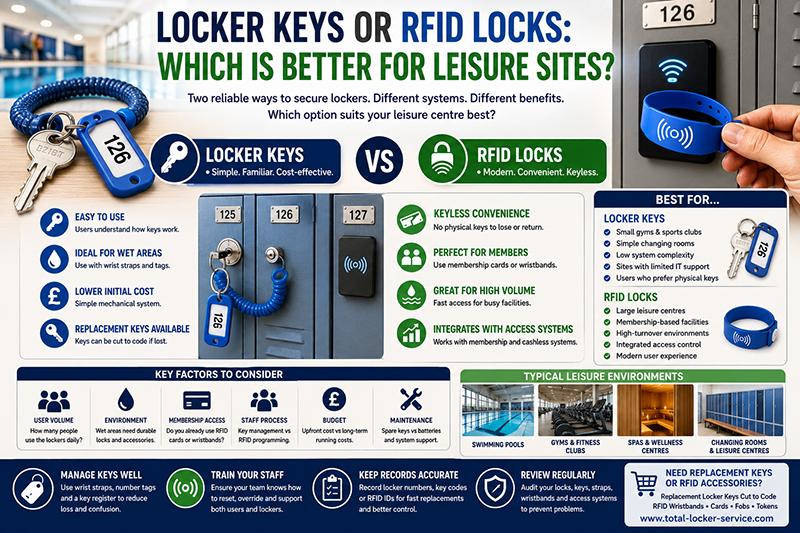
Locker keys and RFID locks can both work well in leisure sites. The better choice depends on the type of facility, user volume, wet-area conditions, staff process, access-control requirements and budget. A small gym may need a simple keyed system with wrist straps. A large leisure centre may benefit from RFID wristbands, membership cards or programmable access control.
This guide compares locker keys and RFID locks for gyms, swimming pools, leisure centres, spas, sports clubs and public changing rooms. It explains the benefits, drawbacks, management needs and replacement issues for each option.
This article supports our main Locker Keys UK replacement and key management guide. For direct replacement keys, use Total Locker Service for replacement locker keys cut to code. For RFID access accessories, see RFID locker access wristbands.

Quick Answer: Are Locker Keys or RFID Locks Better for Leisure Sites?
Locker keys are usually better for simple, low-cost leisure locker systems where users can carry a physical key on a wrist strap. RFID locks are usually better for larger leisure sites that already use membership cards, RFID wristbands or electronic access control.
Locker keys create lost-key and broken-key issues. RFID locks reduce physical key handling but introduce programming, card, wristband, battery and system-management issues. Neither option removes management completely.
If the leisure site mainly struggles with lost physical keys, broken wrist straps and high daily key handling, RFID may be worth considering. If the site needs a simple system that staff can manage without software or programming, locker keys may still be the better option.
For wet changing room key loss, read leisure centre locker keys: managing wet-area key loss.
The Main Difference Between Locker Keys and RFID Locks
The main difference is how the user opens the locker. With a keyed locker, the user carries a physical key. With an RFID locker, the user uses a card, fob, wristband or token that is read electronically by the lock.
Locker keys are mechanical. They need key control, spare keys, master keys and replacement keys. RFID locks are electronic. They need compatible credentials, programming, battery checks and staff who understand how to issue or reset access.
| Access type | User carries | Main issue | Management need |
|---|---|---|---|
| Locker keys | Physical key, usually on a wrist strap or tag | Lost, broken, bent or unreturned keys | Key register, spare keys, master keys and replacement keys |
| RFID locks | RFID wristband, card, fob or token | Lost credentials, programming errors, battery or reader faults | Credential management, programming, battery checks and override process |
For a wider comparison with mechanical combination locks, read locker keys or combination locks: which is better?.
Benefits of Locker Keys for Leisure Sites
Locker keys remain common in gyms and leisure centres because they are simple, familiar and easy to understand. A user locks the locker, keeps the key and returns to the same locker later.
For many leisure sites, a keyed system works well when keys are attached to strong wrist straps, number tags or coin-lock assemblies. Staff can manage lost keys through spare keys, master keys and replacement keys cut to code.
- Simple for users to understand.
- No programming required for everyday use.
- Works well with wrist straps in changing rooms.
- Can suit small gyms, sports clubs and independent leisure sites.
- Replacement keys can often be cut to code.
- Spare keys and master keys can support staff access.
- Lower technical complexity than electronic systems.
- Useful where users prefer visible physical access.
Locker keys work best when the site keeps a clear key register and checks wrist straps, tags and split rings regularly.
For accessory guidance, read locker key tags, number discs and wrist straps explained.
Drawbacks of Locker Keys in Gyms and Leisure Centres
The main drawback of locker keys is physical key loss. Leisure users may leave keys on benches, take them into showers, drop them poolside, forget them in bags or leave the site with them.
Wet changing rooms also create extra wear. Wrist straps can stretch or split. Number tags can fade. Split rings can weaken. Keys can bend or become worn. Locks can become stiff if the environment is damp or heavily used.
- Keys can be lost, broken or taken home.
- Wrist straps can fail in wet areas.
- Tags and number discs can fade or crack.
- Spare keys need secure storage.
- Master keys need controlled access.
- Replacement key ordering needs accurate key codes.
- High-volume sites may spend staff time managing lost keys.
- Mechanical locks still need inspection and maintenance.
These issues are manageable, but they need a process. For lost key support, read lost locker key: what schools, gyms and workplaces should do.
Benefits of RFID Locks for Leisure Sites
RFID locks can suit leisure sites that want to reduce physical key handling. Instead of carrying a metal key, the user presents an RFID wristband, card, fob or token to the lock.
This can work especially well where the site already uses membership cards or wristbands for access control. A single RFID credential may support entry, locker use or other site systems, depending on the setup.
- No physical locker key to cut or carry.
- Can reduce lost metal key problems.
- Useful for high-turnover changing rooms.
- Can work with RFID wristbands for wet areas.
- Can suit membership-based gyms and leisure centres.
- Can support shared-use lockers.
- Can reduce manual key issue at reception.
- Can give a more modern user experience.
RFID can be a strong option when the site has the staff process, budget and technical support needed to manage electronic access properly.
Drawbacks of RFID Locker Locks
RFID locks reduce physical key problems, but they do not remove management. They replace key management with electronic credential management.
RFID credentials can still be lost or damaged. Wristbands can break. Cards can fail. Locks may need batteries. Staff may need to programme wristbands, reset access, override locked lockers and deal with users who have lost or forgotten their credential.
- Higher setup cost than many keyed systems.
- Requires compatible RFID cards, wristbands or fobs.
- May need programming or site-specific setup.
- Electronic locks may need battery checks.
- Staff need training on resets and overrides.
- Lost RFID wristbands still need replacement.
- System faults can affect multiple lockers if not managed well.
- Some sites may not need the extra complexity.
RFID is not automatically better. It is better when the site can manage the electronic process more reliably than a physical key process.
Locker Keys vs RFID Locks Comparison Table
| Factor | Locker keys | RFID locks |
|---|---|---|
| Best for | Simple changing rooms, small gyms and sites wanting low technical complexity | Larger leisure sites, membership gyms and high-turnover locker areas |
| User carries | Physical key on tag or wrist strap | RFID wristband, card, fob or token |
| Main user issue | Lost, broken or unreturned key | Lost credential, failed card or access programming issue |
| Staff support | Spare keys, master keys and replacement keys | Programming, reset, override and battery checks |
| Wet-area suitability | Works well with durable wrist straps and suitable locks | Works well when RFID wristbands and locks suit the environment |
| Cost profile | Often lower upfront complexity | Usually higher setup and support complexity |
| Replacement issue | Keys can often be cut to code | Credentials may need replacing or reprogramming |
| Management access | Spare key or master key | Override credential, programming tool or management process |
| Failure point | Key loss or mechanical wear | Credential, battery, programming or electronics issue |
| Best fit | Sites wanting simple physical control | Sites wanting integrated electronic access |
The right option depends on which system your team can manage consistently.
Wet-Area Changing Rooms
Wet-area changing rooms need special thought. Swimming pools, spas, leisure centres and shower areas expose locks, keys, wrist straps and RFID credentials to moisture, cleaning products and heavy handling.
Keyed systems need strong wrist straps, readable number tags and regular checks. RFID systems need suitable wristbands, compatible lock readers and a process for lost or damaged RFID credentials.
| Wet-area issue | Keyed locker response | RFID locker response |
|---|---|---|
| User has no pockets | Use wrist straps | Use RFID wristbands |
| High key loss | Improve straps, tags and key return process | RFID may reduce metal key loss |
| Wrist strap failure | Replace straps and split rings | Replace RFID wristbands or bands |
| Unreadable numbers | Replace number tags or discs | Use clear locker numbering and access records |
| Moisture exposure | Check locks and keys more often | Check lock suitability and battery/process needs |
For wet-area key management, read leisure centre locker keys: managing wet-area key loss.
Membership Cards, RFID Wristbands and Visitor Access
RFID locks often make the most sense when the leisure site already uses RFID credentials. Members may already use cards, fobs or wristbands for entry, payment, classes or access zones.
In that situation, RFID lockers may feel natural to users. A member can use the same card or wristband to access a locker, depending on the system. However, the site must still manage lost cards, replacement wristbands and access permissions.
Visitor access also needs planning. Casual swimmers, day-pass users, school groups and event visitors may not already have a site credential. The leisure centre must decide whether to issue temporary RFID bands, cards or use a different locker zone.
- Check whether members already use RFID cards or wristbands.
- Decide how visitors receive temporary access.
- Plan what happens when an RFID wristband is lost.
- Train staff to reset or reissue credentials.
- Keep spare or temporary credentials under control.
- Use clear signage so users know how the lockers work.
For RFID wristband product support, see RFID locker access wristbands.
Staff Process and Support
The best locker system is the one staff can support reliably. A keyed system needs a key process. An RFID system needs an electronic access process.
For keyed lockers, staff need to know where spare keys are stored, who can use master keys, how to identify key codes and how to order replacement keys.
For RFID lockers, staff need to know how credentials are issued, how access is reset, how locked lockers are overridden, how batteries are checked and how visitor access works.
| Staff task | Keyed lockers | RFID lockers |
|---|---|---|
| User cannot open locker | Check key, spare key or master key | Check credential, programming and override process |
| User loses access item | Replace key or use spare/master access | Replace or reprogramme RFID credential |
| Locker remains locked | Use authorised master key or maintenance process | Use management credential, tool or override process |
| Audit process | Check keys, tags, straps and lock codes | Check credentials, batteries, access logs or lock status where available |
| Common admin record | Locker key register | Credential/access control record |
For master key control, read locker master keys explained.
Cost and Maintenance Considerations
Locker keys often have lower technical complexity. The site needs keys, tags, wrist straps, spare keys and replacement key records. The main ongoing costs are lost keys, replacement keys, broken accessories and lock maintenance.
RFID locks usually involve higher system complexity. The site may need compatible locks, credentials, programming tools, staff training and battery maintenance. The ongoing costs may include replacement wristbands, cards, lock support and electronic maintenance.
The cheapest system on day one is not always the cheapest over several years. Sites should compare the cost of lost keys against the cost of electronic setup and support.
- How often are physical keys lost?
- How often do wrist straps break?
- How much staff time is spent opening lockers?
- How many users are members rather than visitors?
- Does the site already use RFID credentials?
- Can staff programme and reset RFID access?
- How often will lock batteries need checking?
- How disruptive is a locked-shut locker?
For worn keys and stiff mechanical locks, read worn locker keys and stiff locks: repair or replace?.
Security and User Confidence
Both locker keys and RFID locks can support secure locker use when they are managed properly. The lock type alone does not create a secure system. Staff process, user behaviour, maintenance and records matter just as much.
Keyed lockers need controlled spare keys and master keys. RFID lockers need controlled management credentials and reset access. In both cases, staff should verify the user before opening lockers that contain personal belongings.
- Control staff access to spare keys or override credentials.
- Use clear procedures before opening a locker for a user.
- Record incidents where personal belongings are involved.
- Train staff on the correct access process.
- Audit keys, credentials and lock condition regularly.
- Do not leave management access tools uncontrolled.
For audit structure, read the locker key audit checklist for facilities managers.
Can Leisure Sites Use Both Locker Keys and RFID Locks?
Yes. Many leisure sites use different lock types in different areas. A gym may use RFID locks for member day lockers and keyed lockers for staff storage. A leisure centre may use keyed coin locks in a pool changing room and RFID locks in a premium fitness area.
A mixed system can work well if the site records each area clearly. The risk is confusion. Staff must know which lockers use physical keys, which use RFID credentials, how access is restored and who is responsible for support.
- Use keyed lockers where simple physical access is enough.
- Use RFID locks where member access is already electronic.
- Keep staff lockers separate from public-use lockers where needed.
- Record lock type by area.
- Train staff on both systems.
- Use signage to explain how users operate each locker type.
- Review problem areas before changing the whole site.
A mixed approach is often better than forcing one system onto every locker area.
When Should a Leisure Site Keep Locker Keys?
Locker keys may still be the best choice when the site wants a simple, familiar system with low electronic complexity.
- Keep locker keys for small gyms and sports clubs.
- Keep locker keys where users prefer simple physical access.
- Keep locker keys where staff can manage spare keys and master keys well.
- Keep locker keys where replacement key codes are recorded.
- Keep locker keys where the site does not use RFID membership credentials.
- Keep locker keys where the budget does not support electronic conversion.
- Keep locker keys where forgotten electronic access issues would cause more disruption than lost keys.
A keyed system can be strong when it has wrist straps, readable tags, spare keys and a proper key register.
When Should a Leisure Site Choose RFID Locks?
RFID locks may be the better option where the site has high user volume, frequent lost-key incidents and existing electronic membership access.
- Choose RFID where users already carry RFID cards or wristbands.
- Choose RFID where changing room key loss is a major ongoing issue.
- Choose RFID for high-turnover shared-use lockers.
- Choose RFID where staff can programme and reset access confidently.
- Choose RFID where the site wants a modern access experience.
- Choose RFID where electronic maintenance can be managed properly.
- Choose RFID where the budget supports setup, support and credentials.
RFID should be chosen because it solves a real operational problem, not only because it feels newer.
Decision Table: Locker Keys or RFID Locks?
| Leisure site priority | Better choice | Why |
|---|---|---|
| Simple low-complexity locker access | Locker keys | Easy for users and staff to understand |
| High-volume member changing rooms | RFID locks | Can reduce physical key issue and return |
| Small gym or sports club | Locker keys | Lower technical management requirement |
| Site already uses RFID membership cards | RFID locks | Can integrate better with existing access habits |
| Wet changing rooms with key loss | Depends on process | Keys need wrist straps; RFID needs suitable wristbands and lock support |
| Staff lockers | Locker keys | Assigned storage and leaver control are simpler |
| Premium or modern access areas | RFID locks | Can create a smoother user experience |
| Low budget replacement project | Locker keys | Usually lower setup complexity |
| Repeated broken wrist straps | RFID may help | But RFID wristbands still need management |
| Poor staff capacity for programming | Locker keys | Electronic systems need trained support |
Locker Keys or RFID Locks Checklist
- Check whether lockers are shared-use or assigned-use.
- Check how often physical keys are lost.
- Check how often wrist straps or tags fail.
- Check whether members already use RFID cards or wristbands.
- Check how visitors and casual users will access lockers.
- Check whether staff can manage RFID programming and resets.
- Check battery and maintenance requirements for electronic locks.
- Check whether staff lockers need a separate system.
- Check wet-area suitability before choosing a lock type.
- Check the full operating cost, not only the lock purchase price.
- Use a mixed system where different areas need different control.
Related Locker Key Guides
This article is part of the locker keys canister. Use these guides to support leisure locker access decisions, replacement key ordering, wet-area key control and long-term locker management.
- Locker Keys UK: Replacement, Cut-to-Code Ordering and Key Management Guide
- Leisure Centre Locker Keys: Managing Wet-Area Key Loss
- Gym Locker Keys: Replacement, Wrist Straps and Member Access
- Locker Key Tags, Number Discs and Wrist Straps Explained
- Locker Keys or Combination Locks: Which Is Better?
- Replacement Locker Keys Cut to Code: What It Means
- Lost Locker Key? What Schools, Gyms and Workplaces Should Do
- Locker Master Keys Explained
- How to Build a Locker Key Register
- Common Mistakes When Ordering Locker Keys
- Worn Locker Keys and Stiff Locks: Repair or Replace?
- Broken Locker Key: What to Do Before Replacing the Lock
Ordering Replacement Locker Keys and RFID Accessories
If your leisure site uses keyed lockers, replacement keys are easier to manage when the correct key codes are recorded. If the lock still works and the code is known, a replacement key can often be cut to code without changing the full lock.
If your site uses RFID locker access, keep spare or replacement credentials under control. Staff should know how to issue, programme or replace cards, fobs and wristbands.
For direct replacement key ordering, visit Total Locker Service: Locker Keys and Replacement Locker Keys. For RFID locker access wristbands, visit RFID Locker Access Wristbands.
Locker Keys or RFID Locks FAQs
Are locker keys or RFID locks better for leisure centres?
Locker keys are often better for simple low-complexity locker systems. RFID locks are often better for larger leisure centres that already use membership cards, RFID wristbands or electronic access control.
Do RFID locks stop lost locker key problems?
RFID locks reduce lost metal key problems, but users can still lose RFID cards, wristbands or fobs. The site still needs a replacement and reset process.
Are locker keys still suitable for gyms?
Yes. Locker keys still work well for many gyms when they are managed with wrist straps, clear tags, spare keys, master keys and a key register.
Are RFID wristbands useful in wet changing rooms?
RFID wristbands can be useful in wet changing rooms because users can wear them while moving around the facility, but the wristbands and locks must suit the site’s environment and access system.
Can leisure sites use both locker keys and RFID locks?
Yes. Many leisure sites use both. Staff lockers may use keys, while member day lockers or premium changing areas may use RFID locks.
Which option is cheaper: locker keys or RFID locks?
Locker keys usually have lower technical complexity, while RFID locks usually have higher setup and support requirements. The best value depends on user volume, lost key rates, staff time and maintenance needs.
Can replacement locker keys be ordered for leisure lockers?
Yes. Many leisure locker keys can be replaced when the correct key number or lock code is known and the lock still works.