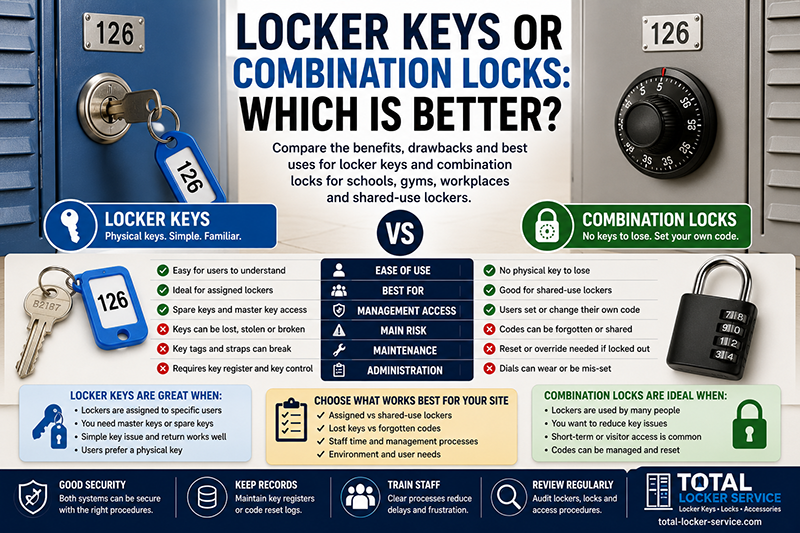
Locker keys and combination locks both give users controlled access to lockers. The better choice depends on how the lockers are used, who manages them, how often users change and what causes the most problems on site. A school with assigned pupil lockers may need a different system from a gym with shared daily-use lockers or a workplace with staff storage.
This guide compares locker keys and combination locks for schools, gyms, leisure centres, workplaces, universities and healthcare sites. It explains the benefits, drawbacks, management requirements and replacement issues for each option.
This article supports our main Locker Keys UK replacement and key management guide. For direct ordering, use Total Locker Service for replacement locker keys cut to code.

Quick Answer: Are Locker Keys or Combination Locks Better?
Locker keys are usually better for assigned lockers, staff storage, schools, controlled spare key systems and sites that need simple physical access. Combination locks are often better for shared-use lockers, short-term users and sites that want to reduce physical key loss.
Locker keys create lost-key problems. Combination locks create forgotten-code and reset problems. Neither option removes management completely. The best choice depends on whether your site would rather manage physical keys or manage access codes.
If a locker key is lost but the lock still works and the correct key code is known, a replacement locker key can often be cut to code. If a combination code is forgotten, staff need a safe reset or override process.
For replacement key ordering, read replacement locker keys cut to code: what it means.
The Main Difference Between Locker Keys and Combination Locks
The main difference is what the user carries or remembers. With a keyed locker, the user carries a physical key. With a combination lock, the user remembers or sets a code.
A physical key can be lost, bent, broken or taken home. A combination code can be forgotten, shared, guessed or left unchanged. Both systems need a management process.
Locker keys are easy to understand. The user inserts the key, turns it and opens the locker. Combination locks avoid physical key issue, but users must understand how to set, scramble, reopen and reset the lock.
| Access type | User action | Main issue | Management need |
|---|---|---|---|
| Locker key | Carry and use a physical key | Lost, broken or unreturned keys | Key register, spare keys and replacement keys |
| Combination lock | Remember or set a code | Forgotten, shared or mis-set codes | Reset process, staff override and user instructions |
For key record control, read how to build a locker key register.
Benefits of Locker Keys
Locker keys are familiar and simple. Most users understand them immediately. This makes them useful for schools, staff lockers, workplaces, healthcare sites and assigned-user storage.
They also give a clear physical access point. If a user has the key, the user can normally open the locker. If the key is lost, staff can check the key register, spare key record or master key system.
- Simple for users to understand.
- Good for assigned lockers.
- Useful where lockers are issued to named users.
- Easy to manage with key tags and number discs.
- Replacement keys can often be cut to code.
- Spare keys can be held securely by authorised staff.
- Master-keyed systems can support controlled access.
- Suitable for schools, workplaces and staff changing areas.
Locker keys work best when the site keeps an accurate key register. The register should record the visible locker number, actual key code, lock brand, issued user and spare key location.
For the difference between visible locker numbers and key codes, read locker key numbers vs locker door numbers.
Drawbacks of Locker Keys
The main drawback of locker keys is that they can be lost or damaged. A pupil may lose a key in a school bag. A gym member may take a key home. A staff member may leave without returning a key. A wet-area wrist strap may fail and the key may detach.
Key systems also need records. If the key code is not recorded, a simple replacement can become more difficult. If the locker door number is mistaken for the key code, the wrong replacement key may be ordered.
- Keys can be lost or taken home.
- Keys can bend, wear or snap.
- Key tags and wrist straps can break.
- Spare keys need secure storage.
- Master keys need controlled access.
- Incorrect records can cause wrong replacement orders.
- Old lock changes can make registers inaccurate.
These problems are manageable, but they should not be ignored. A good key register, spare key cabinet and replacement process reduce most key-based issues.
For ordering error prevention, read common mistakes when ordering locker keys.
Benefits of Combination Locks
Combination locks reduce the need to issue physical keys. This can be useful in shared locker areas, changing rooms, gyms, leisure centres, offices and visitor storage spaces.
They are especially useful where lockers are used by different people throughout the day. Instead of handing out keys, users set or use a code. This can reduce lost-key admin and reduce the need for wrist straps or key tags.
- No physical user key to lose.
- Useful for shared-use lockers.
- Good for short-term locker access.
- Can reduce reception key handling.
- Can suit gyms, offices and visitor lockers.
- Can reduce the need for replacement user keys.
- Useful where users change frequently.
Combination locks can be a strong choice when the main problem is lost physical keys. However, they still need a code reset process and clear user instructions.
Drawbacks of Combination Locks
Combination locks remove physical key loss, but they introduce code problems. Users may forget codes, set codes incorrectly, fail to scramble the dials, share codes with others or leave lockers locked at the end of use.
Staff then need a safe way to reset or open the lock. If the site has no reset process, a forgotten code can become as disruptive as a lost key.
- Users can forget codes.
- Codes can be shared with others.
- Users may set codes incorrectly.
- Dials can become worn or stiff.
- Staff need a reset or override process.
- Some users may struggle with small dials.
- Locks may be left set to unknown codes.
- Incorrect use can create access delays.
Combination locks are not maintenance-free. They need instructions, staff training and a process for abandoned or locked-shut lockers.
Locker Keys vs Combination Locks Comparison Table
| Factor | Locker keys | Combination locks |
|---|---|---|
| Best for | Assigned lockers, staff lockers and controlled storage | Shared-use lockers and short-term users |
| Main user risk | Lost, bent or broken key | Forgotten or shared code |
| Admin need | Key register, spare keys and replacement key process | Reset process, user instructions and override control |
| Replacement issue | Replacement keys may be cut to code if the code is known | Lock may need reset, override or replacement if code control fails |
| Ease of use | Very familiar | Simple for many users, but not all |
| Shared-use suitability | Possible, but keys need return control | Often strong, especially for daily use |
| Assigned-use suitability | Strong | Can work, but code records may be needed |
| Wet-area use | Works with wrist straps and suitable lock choice | Can work, but dials and mechanism must suit the environment |
| Management access | Spare keys or master keys | Override, reset tool or management code depending on lock type |
| Common failure point | Lost key or worn key | Forgotten code or mis-set lock |
There is no single best option for every site. The right lock depends on user behaviour, management capacity and the type of locker use.
Locker Keys or Combination Locks for Schools?
Schools often use assigned lockers. A pupil may have the same locker for a term or academic year. In that setting, locker keys can work well because the key is issued to a known pupil and recorded in a school key register.
However, schools also face lost key problems. Pupils may lose keys, leave them at home, damage key tags or forget to return them. Combination locks can reduce physical key loss, but they may create forgotten-code problems, especially for younger pupils.
| School situation | Better option | Reason |
|---|---|---|
| Assigned pupil lockers | Locker keys | Easy to issue, record and recover at term end |
| Older pupils with personal responsibility | Either option | Depends on lost keys vs forgotten codes |
| Younger pupils | Often locker keys | Simple physical access may be easier |
| High lost-key rate | Combination locks may help | Reduces physical key replacement |
| Strict end-of-year key return process | Locker keys | Keys can be collected and reassigned |
For school key control, read school locker keys: replacement and key control guide.
Locker Keys or Combination Locks for Gyms and Leisure Centres?
Gyms and leisure centres often use shared lockers. Members use lockers for short periods while they train, swim or attend classes. This makes combination locks attractive because users do not need to collect and return physical keys.
Locker keys can still work well, especially with wrist straps, coin locks or clear key return systems. They are familiar and simple, but staff must manage lost keys, broken straps and spare keys.
In wet areas, the decision should also consider moisture, cleaning routines and user behaviour. Keyed systems need durable wrist straps and readable number tags. Combination locks need suitable dials or mechanisms that can cope with the environment.
| Gym or leisure situation | Better option | Reason |
|---|---|---|
| High-turnover shared lockers | Combination locks | No physical key issue or return needed |
| Swimming pool changing rooms | Depends on system | Keys need wrist straps; combination locks need wet-area suitability |
| Coin-operated lockers | Locker keys | Key return is part of the system |
| Frequent forgotten codes | Locker keys may be easier | Physical access avoids reset delays |
| Frequent lost wrist straps | Combination locks may help | Reduces physical accessory loss |
For related guidance, read gym locker keys: replacement, wrist straps and member access and leisure centre locker keys: managing wet-area key loss.
Locker Keys or Combination Locks for Workplaces?
Workplaces often use lockers for staff storage, PPE, uniforms, bags, coats and personal belongings. If lockers are assigned to staff, locker keys are often the simpler option. The key can be issued, recorded and collected when the employee leaves or changes role.
Combination locks can suit shared workplace lockers, hot-desk offices, visitor lockers or short-term shift lockers. They reduce the need to issue physical keys, but staff still need a code reset process.
The best workplace option depends on whether lockers are assigned or shared. Assigned staff storage usually favours keys. Flexible shared storage often favours combination locks.
| Workplace use | Better option | Reason |
|---|---|---|
| Assigned staff lockers | Locker keys | Clear issue, return and leaver process |
| Shared day lockers | Combination locks | No daily key issue needed |
| PPE or uniform storage | Locker keys | Assigned accountability is useful |
| Visitor lockers | Combination locks | Short-term use without key handling |
| High staff turnover | Depends on process | Keys need leaver control; codes need reset control |
For workplace key control, read locker keys: staff storage and replacement process.
Locker Keys or Combination Locks for Universities and Healthcare Sites?
Universities and healthcare sites often manage larger locker estates. They may have staff lockers, student lockers, visitor lockers, changing room lockers, department lockers and shared-use lockers across several buildings.
In these settings, the choice may vary by area. A university sports centre may use combination locks or keyed wrist straps. A library may use short-term combination lockers. Staff changing rooms may use assigned keyed lockers. Healthcare staff lockers may need secure key control and leaver records.
Large sites should avoid choosing one system for every locker without checking how each area is used.
| Area | Often suitable option | Reason |
|---|---|---|
| University library | Combination locks | Short-term student use |
| University staff lockers | Locker keys | Assigned users and return records |
| Sports centre changing rooms | Either option | Depends on lost keys vs forgotten codes |
| Healthcare staff changing | Locker keys | Assigned storage and controlled spare keys |
| Visitor storage | Combination locks | Short-term access without key issue |
For large-site records, read university locker keys: managing large key schedules and healthcare locker keys: staff storage and secure control.
Shared-Use vs Assigned-Use Lockers
The most important decision is not simply key or combination. It is whether the locker is shared-use or assigned-use.
Assigned-use lockers are linked to a person, department, pupil, member or staff role. Shared-use lockers are used by different people at different times, often on the same day.
Assigned lockers usually work well with keys because the key can be issued to a known user. Shared lockers often work well with combination locks because there is no key to issue or collect each time.
| Locker use type | Typical setting | Often better option | Reason |
|---|---|---|---|
| Assigned pupil locker | School corridor | Locker key | Clear issue and return record |
| Assigned staff locker | Workplace changing room | Locker key | Good for leaver checks and accountability |
| Shared gym locker | Changing room | Combination lock | No physical key issue needed |
| Short-term visitor locker | Reception or office | Combination lock | Fast temporary access |
| Wet-area pool locker | Leisure centre | Either option | Depends on wrist strap loss and code reset process |
Lost Keys vs Forgotten Codes
Every locker system has a failure point. With keyed lockers, the common failure point is the lost or broken key. With combination locks, the common failure point is the forgotten or mis-set code.
The better system is the one your site can manage more reliably.
- Choose locker keys if staff can manage a key register, spare keys and replacement key orders.
- Choose combination locks if staff can manage code resets, user instructions and abandoned locked lockers.
- Avoid combination locks if users frequently forget codes and staff cannot reset them efficiently.
- Avoid keyed systems if physical keys are constantly lost and the site has no replacement process.
For lost key procedures, read lost locker key: what schools, gyms and workplaces should do.
Management Access and Override Control
Both systems need authorised management access. With keyed lockers, this may be a spare key or master key. With combination locks, this may be a management override, reset code, reset tool or site procedure, depending on the lock type.
Access should be controlled. Staff should not open lockers casually, especially where personal belongings are inside. The process should be clear, authorised and recorded where appropriate.
- Keyed lockers need spare key or master key control.
- Combination locks need reset or override control.
- Public-use lockers need user verification before staff access.
- Staff lockers need manager or facilities authorisation.
- Schools need clear pupil access procedures.
- Large sites need consistent records by location.
For master key control, read locker master keys explained.
Cost and Maintenance Considerations
The cheapest option is not always the best long-term option. A keyed system may have lower upfront complexity but needs replacement keys and spare key control. A combination system may reduce key replacement, but may require more user instruction, reset support and lock replacement when mechanisms fail.
Sites should look at the full operating cost, not only the lock price.
- How often are keys lost?
- How often are codes forgotten?
- How much staff time is spent on access issues?
- How many lockers are shared daily?
- How many lockers are assigned long term?
- How often are locks damaged?
- How easy is it to order replacement keys?
- How easy is it to reset combination locks?
For worn key and lock condition checks, read worn locker keys and stiff locks: repair or replace?.
When Should You Keep Locker Keys?
Locker keys are still the better choice for many sites. They work especially well when lockers are assigned to known users and the site can maintain key records.
- Keep locker keys for assigned staff lockers.
- Keep locker keys for long-term pupil lockers.
- Keep locker keys where users prefer simple physical access.
- Keep locker keys where spare keys and master keys are well controlled.
- Keep locker keys where replacement key codes are recorded.
- Keep locker keys where forgotten codes would cause more disruption than lost keys.
- Keep locker keys where accessibility or user confidence is important.
A keyed system can perform well when supported by tags, number discs, spare keys and a good key register.
For accessories, read locker key tags, number discs and wrist straps explained.
When Should You Use Combination Locks?
Combination locks can be the better choice where many users need short-term access and the site wants to reduce physical key handling.
- Use combination locks for shared-use day lockers.
- Use combination locks for visitor lockers.
- Use combination locks where physical keys are lost constantly.
- Use combination locks where users change frequently.
- Use combination locks where staff can reset codes quickly.
- Use combination locks where clear instructions can be displayed.
- Use combination locks where the lock type suits the environment.
Combination locks should not be installed without a reset process. Forgotten codes need a controlled response, just as lost keys need a controlled response.
Can You Mix Locker Keys and Combination Locks?
Yes. Many sites use a mixed approach. A workplace may use keyed staff lockers and combination visitor lockers. A university may use keyed staff lockers, combination library lockers and keyed or combination sports centre lockers. A leisure site may use coin-operated keyed lockers in one area and combination locks in another.
A mixed system can work well if the site records each locker area clearly. The risk is confusion. Staff need to know which lock type applies to each location, how access is restored and who is responsible for support.
- Record lock type by locker area.
- Keep key records for keyed lockers.
- Keep reset procedures for combination locks.
- Train staff on both systems.
- Use signage so users understand the lock type.
- Review repeated problems by area.
For large key schedules, read university locker keys: managing large key schedules.
Decision Table: Which Lock Should You Choose?
| Priority | Better choice | Why |
|---|---|---|
| Assigned staff storage | Locker keys | Simple issue, return and leaver control |
| Shared daily-use lockers | Combination locks | No physical key issue for each user |
| Young pupils | Often locker keys | Physical keys may be easier than code recall |
| High lost-key costs | Combination locks | Reduces replacement key demand |
| High forgotten-code issues | Locker keys | Reduces reset calls |
| Wet changing rooms | Depends on product | Keys need wrist straps; combination locks need suitable mechanisms |
| Controlled management access | Either option | Keys use master/spare access; combinations need reset/override control |
| Bulk replacement after lost keys | Locker keys | Replacement keys can often be cut to code |
| Visitor lockers | Combination locks | Short-term use without key handling |
Locker Keys or Combination Locks Checklist
- Decide whether lockers are assigned or shared-use.
- Check how often keys are lost.
- Check how often users forget codes.
- Check whether staff can manage key records.
- Check whether staff can reset combination locks.
- Check whether the locker area is wet or dry.
- Check whether users are pupils, staff, members, visitors or students.
- Check whether management access is needed.
- Check whether locks need to be master-keyed.
- Check the cost of replacement keys, lock resets and lock changes.
- Use a mixed system if different areas need different control.
Related Locker Key Guides
This article is part of the locker keys canister. Use these guides to support lock choice, replacement key ordering, lost key procedures and long-term locker access control.
- Locker Keys UK: Replacement, Cut-to-Code Ordering and Key Management Guide
- Replacement Locker Keys Cut to Code: What It Means
- Lost Locker Key? What Schools, Gyms and Workplaces Should Do
- How to Build a Locker Key Register
- Locker Key Numbers vs Locker Door Numbers
- Common Mistakes When Ordering Locker Keys
- Locker Master Keys Explained
- Locker Key Tags, Number Discs and Wrist Straps Explained
- Worn Locker Keys and Stiff Locks: Repair or Replace?
- Broken Locker Key: What to Do Before Replacing the Lock
- School Locker Keys: Replacement and Key Control Guide
- Gym Locker Keys: Replacement, Wrist Straps and Member Access
- Locker Keys: Staff Storage and Replacement Process
- Leisure Centre Locker Keys: Managing Wet-Area Key Loss
- University Locker Keys: Managing Large Key Schedules
- Healthcare Locker Keys: Staff Storage and Secure Control
Ordering Replacement Locker Keys
If your site uses keyed lockers, replacement keys are easier to manage when the key code is recorded before the key is lost. If the lock still works and the correct code is known, a replacement key can often be cut to code without changing the full lock.
Before ordering, confirm the key code, lock brand, locker number, location and quantity required. If the code is unclear, take clear photographs of the lock face, keyway, key and any markings.
For direct ordering, visit Total Locker Service: Locker Keys and Replacement Locker Keys.
Locker Keys or Combination Locks FAQs
Are locker keys or combination locks better?
Locker keys are usually better for assigned lockers and staff storage. Combination locks are often better for shared-use lockers and short-term users.
Are combination locks better than locker keys for gyms?
Combination locks can work well in gyms because they reduce physical key handling, but they still need a reset process for forgotten or mis-set codes.
Are locker keys better for schools?
Locker keys often work well for schools with assigned pupil lockers because keys can be issued, recorded and collected at the end of term or year.
Do combination locks remove locker management?
No. Combination locks reduce physical key management, but they still need user instructions, reset procedures and staff access control.
Can replacement locker keys be ordered if a key is lost?
Yes. Many replacement locker keys can be cut to code when the correct key number or lock code is known and the lock still works.
Which is better for assigned staff lockers?
Locker keys are often better for assigned staff lockers because the key can be issued to a known user and returned during leaver checks.
Can a site use both locker keys and combination locks?
Yes. Many sites use both. Assigned staff lockers may use keys, while shared visitor or day-use lockers may use combination locks.