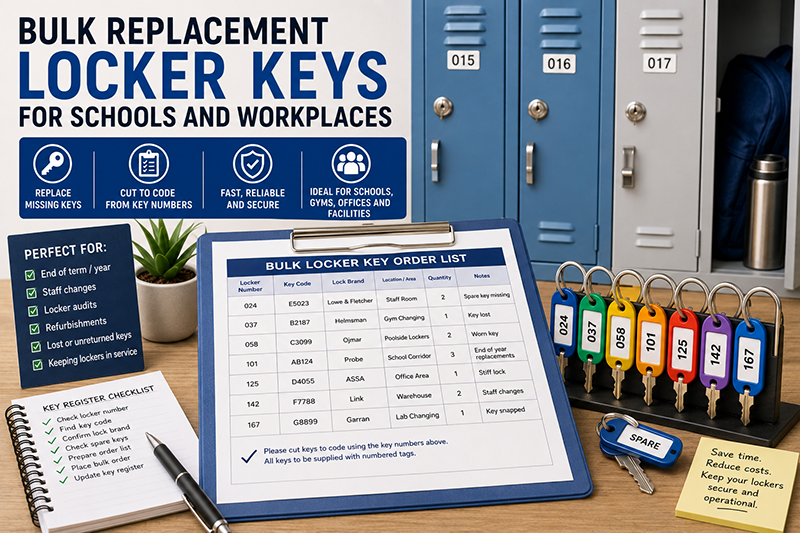
Bulk replacement locker keys are useful when a school, workplace, gym, leisure centre, university or healthcare site has several missing, damaged or unreturned locker keys. Instead of ordering one key at a time, the site can prepare a clear replacement list and order keys in one organised batch.
This helps reduce admin time, avoid repeated delivery delays, keep lockers in service and improve the site’s key records. It is especially useful before a new school year, after a locker audit, after staff changes, after a refurbishment or when many keys have been lost over time.
This guide explains how to prepare a bulk replacement locker key order, what information to collect, how to avoid common mistakes and when a replacement key is better than a full lock change.
This article supports our main Locker Keys UK replacement and key management guide. For direct ordering, use Total Locker Service for replacement locker keys cut to code.

Quick Answer: How Do You Order Bulk Replacement Locker Keys?
To order bulk replacement locker keys, prepare a list showing the key code, locker number, lock brand, location and quantity required for each key. The key code is the most important detail because it is normally used to cut the replacement key.
Do not rely on the visible locker door number unless it has been confirmed as the actual key code. The locker number helps users find the compartment. The key code identifies the lock and is used for replacement ordering.
If the lock still works and the correct key code is known, a replacement key can often be cut to code without changing the full locker lock. If the lock is damaged, insecure or impossible to identify, replacing the lock may be better.
For the replacement process, read replacement locker keys cut to code: what it means.
What Are Bulk Replacement Locker Keys?
Bulk replacement locker keys are multiple replacement keys ordered at the same time. They may be for one locker area, one school corridor, one staff changing room, one gym changing area, one university building or a whole site.
The keys are usually cut from recorded key numbers or lock codes. This means the original key does not always need to be available. If the correct code is known, a replacement key can often be made to operate the existing lock.
Bulk ordering is useful when many keys are missing, bent, worn, snapped, unreturned or poorly recorded. It can also help after a site audit has identified gaps in the key register.
A bulk replacement order should not be a guess list. It should be based on confirmed key codes, lock brands where known, locker locations and quantities.
When Should You Order Replacement Locker Keys in Bulk?
Bulk ordering is best when several keys are missing or damaged at the same time. It is also useful when a site wants to tidy up key control before a new operating period.
- Before the start of a new school year.
- After end-of-term school locker returns.
- After a gym or leisure centre changing room audit.
- After staff changes, leavers or department moves.
- After a workplace locker audit.
- After a university campus key schedule review.
- After a refurbishment or locker relocation.
- When several keys have been lost over time.
- When spare key cabinets are missing key sets.
- When worn keys need replacing before they snap.
Ordering in bulk can save time because staff only need to check the key records once and prepare one organised list.
Why Bulk Ordering Is Better Than One-Key-at-a-Time Ordering
One-key-at-a-time ordering can work for occasional lost keys. However, it becomes inefficient when many lockers are affected. Staff may repeat the same checks several times, and records may become inconsistent.
A bulk order encourages the site to check the whole locker key system. This often reveals old errors, missing spare keys, unclear codes, damaged locks and records that need updating.
| Ordering method | Best for | Main limitation |
|---|---|---|
| Single key order | One lost or damaged key | Can become inefficient if repeated often |
| Bulk replacement order | Several missing, damaged or unreturned keys | Needs a clear list of confirmed key codes |
| Lock replacement programme | Damaged, obsolete or insecure locks | More disruptive and usually more expensive than key replacement |
Bulk key ordering is usually most effective when it is linked to a locker key register. For the register structure, read how to build a locker key register.
What Information Is Needed for a Bulk Replacement Key Order?
The best bulk replacement locker key orders include clear and accurate information. This reduces the risk of wrong keys and delays.
- The actual key number or lock code.
- The visible locker door number.
- The lock brand, where known.
- The locker brand, where known.
- The locker location or area.
- The quantity required for each key code.
- Whether the key code is confirmed or uncertain.
- Photos of unclear codes, keyways or lock faces.
- Details of any master-keyed system.
- Notes about damaged locks or stiff locks.
The key code is the most important part. If the code is wrong, the replacement key may not work. A clear location and locker number also help the site match the replacement key to the correct locker when the order arrives.
For code identification, read where to find a locker key number or lock code.
Key Code vs Locker Door Number
The most common bulk ordering mistake is using the locker door number instead of the actual key code. These numbers may match, but often they do not.
The locker door number is the visible number on the locker. It helps the user find the compartment. The key code identifies the lock and is normally used to cut the replacement key.
For example, locker 126 may use key code B2187. If the order list only says “126”, the replacement key may be wrong unless 126 has been confirmed as the key code.
| Detail | What it means | Use in bulk order |
|---|---|---|
| Locker number | The visible door or compartment number | Useful for matching keys to lockers |
| Key code | The lock or key number used for cutting | Essential for replacement ordering |
| Lock brand | The lock system or key range | Helpful for accurate identification |
| Location | The building, room or locker area | Important for large sites |
For the full explanation, read locker key numbers vs locker door numbers.
Bulk Replacement Locker Key Order Template
A bulk order should be clear enough for the supplier and useful enough for the site team when the keys arrive. The template below can be adapted into a spreadsheet.
| Locker number | Key code | Lock brand | Location | Quantity | Status | Notes |
|---|---|---|---|---|---|---|
| 024 | E5023 | Lowe & Fletcher | Staff changing room | 2 | Confirmed | Code from key register |
| 126 | B2187 | Helmsman | Gym changing room | 1 | Confirmed | Spare key missing |
| 157 | D4055 | Ojmar | Poolside lockers | 2 | Check photo | Lock face worn |
| 210 | AB124 | Probe | School corridor | 3 | Confirmed | End-of-term missing keys |
Separate confirmed codes from uncertain codes. If a code is unclear, add a note and attach a clear photo of the lock face, key or barrel. Do not guess worn or partly hidden numbers.
How to Prepare a Bulk Order Step by Step
A bulk order should start with the locker key register. If the register is missing or out of date, inspect the lockers, keys and spare key records before ordering.
- List every missing, damaged or unreturned key.
- Confirm the visible locker number for each key.
- Confirm the actual key code or lock code.
- Record the lock brand where known.
- Check whether each lock still works.
- Check whether the lock is part of a master-keyed system.
- Add the quantity required for each code.
- Add photos for unclear codes or unknown lock brands.
- Separate confirmed entries from uncertain entries.
- Order replacement keys from the confirmed key codes.
- Test the replacement keys when they arrive.
- Update the key register immediately.
This process turns a bulk order into a key management improvement, not just a replacement purchase.
Bulk Replacement Locker Keys for Schools
Schools often need bulk replacement locker keys at the end of term, the end of the school year or before new pupils are assigned lockers. Keys may be lost, taken home, damaged or not returned by pupils who leave.
A school bulk order should start with the pupil locker register. The school should check which keys have not been returned, which lockers are being reassigned and which locks have become stiff or damaged.
Do not order from pupil-reported locker numbers alone. Check the actual key code from the register, lock face, spare key or previous order record.
School bulk order checklist
- Check end-of-term or end-of-year key returns.
- Mark missing pupil keys in the register.
- Confirm key codes before ordering.
- Check spare key cabinets.
- Identify damaged or stiff locks.
- Order replacement keys before the next allocation period.
- Update the school locker key register after delivery.
For school-specific guidance, read school locker keys: replacement and key control guide.
Bulk Replacement Locker Keys for Workplaces
Workplaces may need bulk replacement locker keys after staff changes, department moves, shift changes, factory reorganisations, warehouse audits or leaver checks. Staff keys may be taken home, lost or not returned when employees leave.
A workplace bulk order should separate assigned staff lockers from spare lockers and department lockers. It should also check whether lockers are used for uniforms, PPE, personal belongings or work-critical equipment.
If a key is missing because a staff member has left, the site should assess whether a replacement key is enough or whether the lock should be changed before reassignment.
Workplace bulk order checklist
- Check staff leaver records.
- Check assigned locker records.
- Confirm key codes before ordering.
- Identify lockers used for PPE, uniforms or equipment.
- Check whether security risk requires lock replacement.
- Prepare a clean list by department or location.
- Update the staff locker key register after delivery.
For workplace-specific guidance, read locker keys: staff storage and replacement process.
Bulk Replacement Keys for Gyms and Leisure Centres
Gyms and leisure centres may need bulk replacement keys after changing room audits, wet-area checks, wrist strap failures, missing spare keys or repeated member key loss.
In wet areas, key tags, wrist straps and split rings should be checked at the same time as the bulk key order. A replacement key may not solve the problem if the strap or tag is the part that keeps failing.
The bulk list should include locker number, key code, location, lock brand, quantity and notes about wrist straps or key tags.
- Check changing room key boards and spare sets.
- Inspect wrist straps, number tags and split rings.
- Check lock faces for readable key codes.
- Record wet-area locks that are stiff or corroded.
- Prepare a bulk key and accessory list together.
- Update the key register after replacement.
For related guides, read gym locker keys: replacement, wrist straps and member access and leisure centre locker keys: managing wet-area key loss.
Bulk Replacement Keys for Universities and Healthcare Sites
Universities and healthcare sites often have large or complex locker estates. Lockers may be spread across buildings, departments, changing rooms, laboratories, sports areas, staff rooms and accommodation areas.
A bulk replacement order should include the building and location for each key. This prevents confusion when several areas have lockers with the same visible number.
For universities, the order should connect with the campus key schedule. For healthcare sites, it should connect with staff changing room records, leaver checks and secure key control.
| Site type | Extra detail needed | Useful guide |
|---|---|---|
| University | Campus, building, department and locker area | University locker keys |
| Healthcare | Staff changing location, department and assigned user or team | Healthcare locker keys |
| Large workplace | Department, shift area and leaver status | Staff locker keys |
Large sites should avoid sending a flat list of locker numbers without location and key code information. The risk of duplicate door numbers is higher on larger estates.
How to Handle Unclear or Missing Key Codes
Some bulk orders include unclear key codes. A code may be worn, partly hidden, missing from the register or hard to read on the lock face. These entries should be handled separately.
Do not guess unclear codes. A single wrong digit can create a wrong replacement key. Instead, check the original key, lock face, lock barrel, spare key, old invoices and previous key orders.
- Mark unclear codes as “check” or “uncertain”.
- Take clear photos of the key and lock face.
- Check both sides of the key if available.
- Check the lock barrel if the locker door is open.
- Look for letters, prefixes and leading zeros.
- Separate uncertain codes from confirmed bulk order lines.
For code checks, read where to find a locker key number or lock code.
Lock Brands and Mixed Locker Systems
Bulk orders become more difficult when a site has mixed lock brands. This is common in schools, universities, workplaces and leisure centres where lockers have been installed or repaired over many years.
Commercial locker systems may include locks associated with Probe, Helmsman, Lowe & Fletcher, Ojmar, ASSA, Link, Garran, Pure and other locker lock ranges. The locker cabinet brand and lock brand may not always be the same.
If different areas use different lock ranges, record the lock brand against each key code. This helps avoid ordering keys from the wrong range.
For brand and key range issues, read are locker keys universal? why key codes and brands matter.
Master-Keyed Locker Systems and Bulk Orders
If the lockers are part of a master-keyed system, check compatibility before replacing locks. Replacement user keys can often be ordered without affecting the master key system, provided the lock still works and the correct key code is known.
However, replacing a lock with an incompatible lock may mean the existing master key no longer works for that locker. This can create future access problems for staff.
- Record whether each lock is part of a master-keyed group.
- Keep the master key group in the register.
- Use replacement keys where the lock still works.
- Check compatibility before replacing one lock in a group.
- Test user keys and master key access after lock replacement where appropriate.
For access-control detail, read locker master keys explained.
When Should You Replace Locks Instead of Ordering Bulk Keys?
Bulk replacement keys are not always the right answer. If a lock is damaged, worn, insecure or impossible to identify, replacing the lock may be more sensible.
A replacement key will not fix a faulty barrel, damaged cam, corroded lock or worn keyway. If the lock no longer works smoothly, a new key may still fail or may break in use.
- The lock is stiff or difficult to turn.
- The lock barrel is loose.
- The keyway is damaged, worn or blocked.
- The cam does not secure the door properly.
- The key code cannot be found.
- The missing key creates a security risk.
- The lock is obsolete or inconsistent with the rest of the site.
- The locker area is being refurbished or standardised.
For repair decisions, read worn locker keys and stiff locks: repair or replace? and broken locker key: what to do before replacing the lock.
Common Bulk Replacement Key Ordering Mistakes
Bulk orders can go wrong when the list is rushed or based on old records. The most common mistakes are easy to avoid with a structured register.
- Using locker door numbers instead of key codes.
- Missing letter prefixes or leading zeros.
- Mixing confirmed and uncertain codes in one list.
- Ignoring lock brands.
- Relying on old records after locks have been changed.
- Ordering keys for locks that are actually damaged.
- Failing to record the locker location on large sites.
- Not checking master-keyed lock compatibility.
- Failing to update the register after keys arrive.
For a full error guide, read common mistakes when ordering locker keys.
What to Do After Bulk Replacement Keys Arrive
The job is not finished when the keys arrive. The site should test, label, store and record the new keys before putting lockers back into normal use.
- Check the delivery against the bulk order list.
- Match each key to its locker number and key code.
- Test keys carefully in the correct locks.
- Do not force any key that does not turn smoothly.
- Attach the correct tag, disc or wrist strap.
- Store spare keys securely.
- Issue user keys where needed.
- Mark missing keys as replaced in the register.
- Record any keys that do not work.
- Review whether any locks need repair or replacement.
Testing is important. It confirms that the order is correct and that the locks still work properly.
How Bulk Replacement Orders Improve Key Control
A bulk order should improve the wider key system. It is an opportunity to correct records, rebuild spare key sets and remove old confusion from the locker estate.
After a bulk order, the site should have a better register, clearer spare key storage and fewer out-of-use lockers.
- Missing keys are replaced in one organised process.
- Old records are checked and corrected.
- Spare key cabinets can be rebuilt.
- Damaged locks can be identified separately.
- Future lost key incidents become easier to manage.
- Bulk ordering data can support the next audit.
For audit support, read the locker key audit checklist for facilities managers.
Bulk Replacement Locker Key Checklist
- List all missing, damaged or unreturned keys.
- Confirm every visible locker number.
- Confirm every actual key code.
- Record lock brands where known.
- Record locker locations clearly.
- Separate confirmed codes from uncertain codes.
- Add photos for unclear codes or unknown locks.
- Check whether locks are damaged or stiff.
- Check master-keyed systems before replacing locks.
- Order from confirmed key codes.
- Test the keys when they arrive.
- Update the locker key register immediately.
Bulk Replacement Locker Keys Control Table
| Situation | Best action | Useful guide |
|---|---|---|
| Many keys are missing after an audit | Prepare a bulk order from confirmed key codes | Locker key register |
| Codes are unclear | Check key, lock face, barrel and old records before ordering | Find a key number |
| Door numbers and key codes differ | Record both fields separately | Key number vs door number |
| Locks are stiff or damaged | Replace or repair the lock rather than only ordering keys | Worn keys and stiff locks |
| Site has master keys | Check compatibility before replacing locks | Master keys explained |
| Keys arrive from bulk order | Test, tag, store and update the register | Key audit checklist |
Related Locker Key Guides
This article is part of the locker keys canister. Use these guides to support bulk replacement ordering, key identification, lost key procedures and long-term key control.
- Locker Keys UK: Replacement, Cut-to-Code Ordering and Key Management Guide
- Replacement Locker Keys Cut to Code: What It Means
- How to Build a Locker Key Register
- Where to Find a Locker Key Number or Lock Code
- Locker Key Numbers vs Locker Door Numbers
- Lost Locker Key? What Schools, Gyms and Workplaces Should Do
- School Locker Keys: Replacement and Key Control Guide
- Locker Keys: Staff Storage and Replacement Process
- Gym Locker Keys: Replacement, Wrist Straps and Member Access
- Leisure Centre Locker Keys: Managing Wet-Area Key Loss
- University Locker Keys: Managing Large Key Schedules
- Healthcare Locker Keys: Staff Storage and Secure Control
- Locker Master Keys Explained
- Common Mistakes When Ordering Locker Keys
- Locker Key Audit Checklist for Facilities Managers
Ordering Bulk Replacement Locker Keys
Bulk replacement locker keys are easiest to order when the site has a clear list of confirmed key codes, locker numbers, lock brands and quantities. If the locks still work and the correct codes are known, replacement keys can often be cut to code without replacing the full locks.
Before ordering, check every key code carefully. Add photographs where the code is unclear, and separate damaged locks from working locks that only need replacement keys.
For direct ordering, visit Total Locker Service: Locker Keys and Replacement Locker Keys.
Bulk Replacement Locker Keys FAQs
What are bulk replacement locker keys?
Bulk replacement locker keys are multiple replacement keys ordered at the same time, usually for missing, damaged, worn or unreturned locker keys across a site.
What information is needed for a bulk replacement key order?
A bulk order should include the key code, locker number, lock brand, location, quantity required and notes or photos for any unclear codes.
Can locker keys be replaced in bulk without the original keys?
Yes. Many locker keys can be replaced without the original key when the correct key number or lock code is known and the lock still works.
Is the locker number enough for a bulk key order?
Only if the locker number is confirmed as the actual key code. Many locker door numbers are not the same as the key code used for replacement ordering.
Should schools order locker keys in bulk?
Schools should consider bulk ordering after end-of-term returns, before a new academic year or after an audit identifies several missing or damaged locker keys.
Should workplaces order staff locker keys in bulk?
Workplaces should consider bulk ordering after staff changes, leaver checks, department moves, locker audits or when several staff locker keys are missing or worn.
When should locks be replaced instead of ordering bulk keys?
Locks should be replaced instead of only ordering keys when they are damaged, stiff, insecure, impossible to identify or when a missing key creates a security risk.