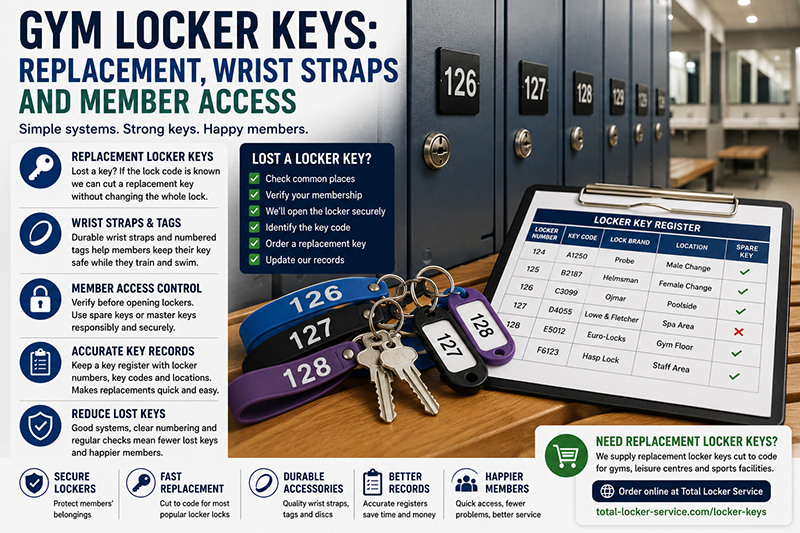
Gym locker keys need to be simple, durable and easy to manage. In gyms, leisure centres, swimming pools, spas and sports clubs, members use lockers for short periods while they train, swim or attend classes. A lost key, broken wrist strap or unclear locker number can quickly create queues at reception and frustration for users.
This guide explains how gyms and leisure centres can manage locker keys, replace lost keys, use wrist straps correctly, control member access and decide when a replacement key is better than a full lock change.
This article supports our main Locker Keys UK replacement and key management guide. For direct ordering, use Total Locker Service for replacement locker keys cut to code.

Quick Answer: How Should Gyms Manage Locker Keys?
Gyms should manage locker keys with clear numbering, durable wrist straps or key tags, secure spare key storage, controlled master key access and a simple lost key process. Each locker should have a visible door number, while the actual key number or lock code should be recorded separately for replacement ordering.
When a member loses a locker key, staff should verify the locker claim, check whether a spare key or master key is available, identify the key code and order a replacement key if the lock still works. The full lock should only be replaced if the lock is damaged, insecure or impossible to identify.
For a wider replacement process, read replacement locker keys cut to code: what it means.
Why Gym Locker Key Control Matters
Gym lockers are used differently from school or workplace lockers. Most members use them for short sessions. They may store clothing, bags, phones, wallets, water bottles, car keys and personal items while they train or use changing facilities.
This creates a fast turnover. A locker may be used several times in one day by different members. If a key goes missing, the issue needs to be resolved quickly so the locker can return to use.
Poor key control can create several problems. Members may be delayed at reception. Staff may spend time searching for spare keys. Lockers may be left out of service. Damaged wrist straps may separate from keys. In some cases, unauthorised access risks may increase if staff open lockers without a clear process.
- Members need quick access to belongings.
- Reception staff need a clear lost key process.
- Changing room lockers need to return to use quickly.
- Spare keys and master keys must be controlled.
- Wrist straps and tags must be durable enough for daily use.
- Replacement keys should be ordered from the correct key code.
A simple process helps gym staff deal with lost keys without damaging lockers or replacing locks unnecessarily.
Common Gym Locker Key Systems
Gyms and leisure centres use several types of locker locking systems. Some are simple keyed cam locks. Others use coin locks, padlock hasps, combination locks, RFID locks or electronic locks. This article focuses on physical gym locker keys, but the management principles still apply to many systems.
Keyed locker locks
Keyed locker locks are simple and familiar. The member uses a key to lock and unlock the door. The key may be attached to a wrist strap, number disc or plastic fob. If the key is lost, a replacement may be ordered by code if the lock code is known.
Coin-operated locker locks
Coin locks are common in leisure centres, swimming pools and public changing rooms. Many still use a physical key attached to a wrist strap. The coin encourages key return, but keys and straps can still be lost or damaged.
Padlock-compatible lockers
Some gyms use lockers with hasps so members can bring their own padlock. This reduces site key management, but it can create issues when members forget codes, lose padlock keys or leave padlocks on lockers after use.
RFID and electronic locker locks
RFID and electronic locks can work well in modern gyms, especially where members already use cards, fobs or wristbands. They can reduce physical key loss, but they introduce other management needs such as programming, batteries, user credentials and access control procedures.
For comparison, read locker keys or RFID locks: which is better for leisure sites? and locker keys or combination locks: which is better?.
Locker Key Wrist Straps
Wrist straps are one of the most important accessories for gym and leisure locker keys. They allow members to keep the key with them while training, swimming, showering or moving around the facility.
A good wrist strap should be comfortable, water-resistant, easy to clean and strong enough for repeated use. It should also hold the key securely. If the strap breaks, the key may be lost even when the member has tried to keep it safe.
Wrist straps are especially useful in wet changing rooms, swimming pools, spas and leisure centres. They reduce the chance of keys being left on benches, dropped into bags or taken into the wrong area.
- Use durable straps suitable for wet and dry changing rooms.
- Check split rings and fixings regularly.
- Replace cracked, stretched or broken wrist straps early.
- Use clear numbering that matches the locker door number.
- Keep the actual key code recorded separately in the key register.
- Clean and inspect straps during routine locker checks.
For a wider accessory guide, read locker key tags, number discs and wrist straps explained.
Numbered Tags, Discs and Fobs for Gym Locker Keys
Gym locker keys should be easy for members and staff to identify. Numbered tags, discs and fobs help link the key to the visible locker number. They also help reception staff return lost keys to the correct place.
The user-facing number on the tag should usually match the locker door number. This helps the member remember the locker. However, the actual key code should be recorded separately in the gym’s key register.
This distinction matters because the locker door number is not always the replacement key code. A tag may say 126, but the key code could be B2187 or another manufacturer code.
For this distinction, read locker key numbers vs locker door numbers.
Member Access and Lost Key Checks
When a gym member reports a lost locker key, staff need to restore access while protecting belongings. The locker may contain valuable personal items, so staff should not open lockers casually or without a process.
The first step is to ask the member to check common places. Keys are often found in gym bags, towel piles, changing room benches, lockers, reception areas, café seating, studio spaces or car cup holders.
If the locker is locked and the member needs access, staff should verify the claim before opening the locker. The exact process depends on the gym’s policy, but it may include checking membership details, asking for a description of the contents and recording the locker opening.
- Ask the member to check bags, pockets, benches and reception.
- Confirm the locker number if known.
- Check whether the locker is locked or open.
- Verify the member before opening the locker.
- Use an authorised spare key or master key if available.
- Record the incident if personal belongings are involved.
- Identify the key code and order a replacement key if needed.
- Update the gym key register.
For the full lost key process, read lost locker key: what schools, gyms and workplaces should do.
Replacement Gym Locker Keys
Replacement gym locker keys can often be cut to code. This means the new key is made from the key number or lock code rather than copied from the original key.
This is useful in gyms because the original key may be missing. A member may have lost it, taken it home, broken the wrist strap or returned only part of the key set.
If the lock still works and the code is known, a replacement key may be quicker and cheaper than changing the full lock. It also helps keep the existing locker system intact.
Before ordering, confirm the key code, lock brand, visible locker number and quantity required. If the code is unclear, take clear photos of the lock face, keyway, key and any brand markings.
Total Locker Service supplies replacement locker keys cut to code for many common locker systems.
When Should a Gym Replace the Lock Instead?
A replacement key is not always the right solution. If the lock is damaged, stiff, corroded or insecure, the full lock may need to be replaced.
Gym and leisure locks can suffer from heavy use, moisture, cleaning products and repeated impact. A new key will not solve a worn barrel or damaged cam.
- The lock does not turn smoothly.
- The keyway is worn, blocked or damaged.
- The lock barrel is loose.
- The cam does not secure the door properly.
- The lock has corrosion or water damage.
- The key code cannot be found.
- The missing key creates a security risk.
For repair guidance, read worn locker keys and stiff locks: repair or replace? and broken locker key: what to do before replacing the lock.
Key Number vs Locker Number in Gyms
Gym staff should not assume that the locker number is the same as the key code. This is a common cause of wrong replacement key orders.
The locker number is the visible number on the door or key tag. It helps the member find the locker. The key number or lock code is the code used to cut the replacement key.
For example, a locker may be labelled 126, while the key code may be B2187. Ordering key 126 may not work unless 126 is confirmed as the actual lock code.
A good gym key register should show both values separately.
| Visible locker number | Key code | Lock brand | Location |
|---|---|---|---|
| 124 | A1250 | Probe | Male changing |
| 125 | B2187 | Helmsman | Female changing |
| 126 | C3099 | Ojmar | Poolside |
| 127 | D4055 | Lowe & Fletcher | Staff changing |
For more detail, read locker key numbers vs locker door numbers.
Wet-Area Locker Key Issues
Wet changing rooms create extra challenges for locker keys. Keys, wrist straps and lock faces may be exposed to water, humidity, cleaning chemicals and repeated handling.
Over time, markings can become harder to read. Wrist straps can stretch or crack. Split rings can weaken. Lock barrels can become stiff. Key tags can fade or detach.
Gyms and leisure centres should inspect wet-area locker keys regularly. Small issues are easier to fix before a key breaks or a lock fails.
- Check wrist straps for cracking or stretching.
- Check split rings for weakness.
- Check number tags for fading.
- Check keys for bending or wear.
- Check lock faces for readable codes.
- Check that locks turn smoothly.
- Replace damaged accessories before keys are lost.
For wet-area planning, read leisure centre locker keys: managing wet-area key loss.
Spare Keys and Master Keys for Gyms
Spare keys and master keys help gym staff resolve access issues without damaging lockers. They should be stored securely and used only by authorised staff.
A spare key usually opens one locker. A master key may open a group of lockers in a managed system. This makes master key security important. If a master key is lost, the risk may affect many lockers.
Do not leave spare keys or master keys loose at reception. They should be kept in a secure key cabinet, controlled office or other restricted storage point. Staff should know how to access them during an incident, but access should still be limited.
- Store spare keys securely.
- Keep master keys separate from general key sets.
- Limit master key access to authorised staff.
- Record locker openings where personal belongings are involved.
- Return master keys immediately after use.
- Audit spare keys and master keys regularly.
For more detail, read locker master keys explained and key cabinets for managing locker keys.
Gym Locker Key Register
A gym locker key register helps staff manage keys, replacements and lock repairs. It should be simple enough for reception, duty managers and facilities staff to use.
The register should show the visible locker number, key code, lock brand, location, spare key status, wrist strap condition and any maintenance notes. This helps staff respond quickly when a member reports a lost key.
| Register field | Example | Why it matters |
|---|---|---|
| Locker number | 126 | Identifies the visible locker door |
| Key code | B2187 | Used for replacement key ordering |
| Lock brand | Helmsman | Helps match the correct key range |
| Location | Male changing room | Useful for multi-area sites |
| Spare key status | Available / missing | Helps staff restore access |
| Strap condition | Good / replace | Reduces repeat lost key issues |
For a full structure, read how to build a locker key register.
Charging Members for Lost Locker Keys
Many gyms charge members for lost locker keys, missing wrist straps or damaged key tags. This can encourage better key return, but the policy should be clear before use.
The charge should reflect the actual issue. A missing key may only need a replacement key cut to code. A damaged lock may require a full lock replacement. A missing wrist strap may only require a new strap or tag.
Make the policy visible in membership terms, changing room signage or reception procedures. Staff should understand what charge applies and when management approval is needed.
A clear policy helps avoid disputes and keeps the process fair for members.
How to Reduce Lost Gym Locker Keys
Gyms cannot stop every lost key, but they can reduce the number of incidents. The best approach combines clear accessories, good records and a simple lost key process.
- Use durable wrist straps or key tags.
- Replace worn straps before they break.
- Use clear locker numbers.
- Record the actual key code separately.
- Keep spare keys secure.
- Restrict master key access.
- Train reception staff on the lost key process.
- Audit keys during quieter maintenance periods.
- Replace stiff locks before keys snap.
- Review repeated lost key locations.
For more prevention guidance, read how to reduce lost locker keys in gyms.
When Gyms Should Consider Keyless Locker Systems
If lost keys are a constant issue, a gym may consider a keyless locker system. Combination locks, RFID locks and electronic locks can reduce the number of physical keys in circulation.
However, keyless systems do not remove management completely. Combination codes can be forgotten. RFID wristbands and cards can still be lost. Electronic locks may need batteries, programming and staff training.
Traditional keys remain practical for many gyms because they are simple and easy to understand. The right choice depends on member behaviour, staffing levels, budget, wet-area conditions and the number of lockers.
| Locking option | Best for | Management issue |
|---|---|---|
| Keyed locks | Simple daily locker use | Lost keys and strap wear |
| Coin locks | Shared changing rooms | Coin/token management and key return |
| Combination locks | Keyless user access | Forgotten codes |
| RFID locks | Modern leisure sites and membership systems | Cards, fobs, wristbands and programming |
| Electronic locks | Higher-control locker systems | Batteries, setup and maintenance |
Gym Locker Key Management Checklist
- Record every visible locker number.
- Record every key code separately.
- Record lock brands where known.
- Use durable wrist straps or tags.
- Inspect wet-area keys regularly.
- Keep spare keys in secure storage.
- Control master key access.
- Train staff on member verification before opening lockers.
- Record incidents involving personal belongings.
- Replace damaged straps, tags and split rings early.
- Replace worn locks before they fail.
- Order replacement keys from the confirmed key code.
For audit support, read the locker key audit checklist for facilities managers.
Gym Locker Key Control Table
| Situation | Best action | Useful guide |
|---|---|---|
| Member loses a key | Verify access, check spare key records and identify the key code | Lost locker key guide |
| Wrist strap breaks | Replace the strap and check the key tag number | Key tags and wrist straps |
| Key code is unclear | Check the key, lock face, lock barrel and register | Find a key number |
| Door number and key code differ | Record both numbers separately | Key number vs door number |
| Many keys are missing | Prepare a bulk replacement list | Bulk replacement keys |
| Keys are lost repeatedly | Review straps, signage, member process and lock type | Reduce lost gym keys |
Related Locker Key Guides
This article is part of the locker keys canister. Use these guides to support lost key response, replacement ordering, key identification and long-term key control.
- Locker Keys UK: Replacement, Cut-to-Code Ordering and Key Management Guide
- Replacement Locker Keys Cut to Code: What It Means
- Lost Locker Key? What Schools, Gyms and Workplaces Should Do
- Where to Find a Locker Key Number or Lock Code
- Locker Key Numbers vs Locker Door Numbers
- Are Locker Keys Universal? Why Key Codes and Brands Matter
- Leisure Centre Locker Keys: Managing Wet-Area Key Loss
- How to Reduce Lost Locker Keys in Gyms
- How to Build a Locker Key Register
- Bulk Replacement Locker Keys for Schools and Workplaces
- Common Mistakes When Ordering Locker Keys
- Locker Master Keys Explained
- Key Cabinets for Managing Locker Keys
- Locker Key Audit Checklist for Facilities Managers
Ordering Replacement Gym Locker Keys
Gym locker keys are easier to replace when the key code is recorded before the key is lost. If the lock still works and the correct code is known, a replacement key can often be cut to code without changing the full lock.
Before ordering, confirm the key code, lock brand, locker number and quantity required. If the code is unclear, take clear photographs of the lock face, keyway, key and any markings.
For direct ordering, visit Total Locker Service: Locker Keys and Replacement Locker Keys.
Gym Locker Keys FAQs
How should gyms manage locker keys?
Gyms should manage locker keys with clear numbering, durable wrist straps, secure spare key storage, controlled master key access and an accurate key register.
Can gym locker keys be replaced without changing the lock?
Yes. Many gym locker keys can be replaced without changing the lock when the correct key number or lock code is known and the lock still works.
Why are wrist straps used for gym locker keys?
Wrist straps help members keep locker keys with them while training, swimming or changing. They reduce the chance of keys being left on benches, in bags or in changing areas.
Is the gym locker number the same as the key code?
Not always. The locker number identifies the door for the member. The key code identifies the lock and is used to cut a replacement key.
What should gym staff do when a member loses a locker key?
Gym staff should ask the member to check common areas, verify access before opening the locker, use an authorised spare or master key if available, identify the key code and update the key register.
When should a gym replace the full locker lock?
A gym should replace the full locker lock if the barrel is damaged, the keyway is worn, the lock is corroded, the lock is insecure or the key code cannot be identified.
How can gyms reduce lost locker keys?
Gyms can reduce lost locker keys by using durable wrist straps, clear number tags, secure spare keys, regular key audits, member procedures and early replacement of worn straps or locks.