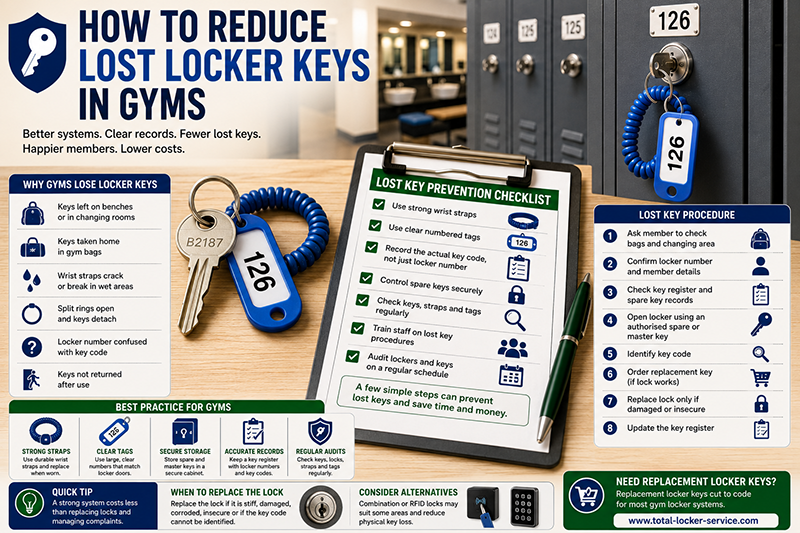
Lost locker keys are one of the most common locker management problems in gyms. Members may leave keys in changing rooms, take them home, drop them in bags, break wrist straps or forget which locker they used. A few missing keys can quickly become a regular admin problem for reception staff, duty managers and maintenance teams.
The best way to reduce lost locker keys in gyms is to manage the full key system, not just the key itself. That means using clear number tags, strong wrist straps, accurate key records, controlled spare keys, regular audits and a simple replacement process when keys are lost or damaged.
This guide explains how gyms can reduce lost locker keys, improve member access, manage wet changing room key loss and avoid unnecessary lock replacement. It supports our main Locker Keys UK replacement and key management guide and our Gym Locker Keys: Replacement, Wrist Straps and Member Access guide.
For direct ordering, use Total Locker Service for replacement locker keys cut to code.

Quick Answer: How Can Gyms Reduce Lost Locker Keys?
Gyms can reduce lost locker keys by using durable wrist straps, clear numbered tags, strong split rings, secure spare key storage and a locker key register that records the actual key code for each lock. Staff should also check keys, straps and tags during regular changing room audits.
The number on a wrist strap or key tag is usually the visible locker number. It is not always the key code used to order a replacement key. Gyms should record both the visible locker number and the actual key code separately.
When a gym member loses a locker key, staff should check the key register, spare key storage and lock code before replacing the full lock. If the lock still works and the correct code is known, a replacement locker key can often be cut to code.
For the replacement process, read replacement locker keys cut to code: what it means.
Why Gyms Lose Locker Keys
Gym locker keys are used in busy, high-turnover spaces. Members may arrive quickly, change clothing, move between gym floors, studios, showers and changing rooms, then leave without checking the key properly. This makes gym keys more vulnerable to loss than many workplace or school locker keys.
Lost keys are often caused by weak accessories rather than careless use. A split ring may open. A wrist strap may split. A number tag may fade. A key may detach from the strap during normal use.
- Members leave keys on changing room benches.
- Keys are taken home in gym bags.
- Keys are lost in coat pockets, lockers or showers.
- Wrist straps crack, stretch or split.
- Split rings open and keys detach.
- Number tags fade or become unreadable.
- Members forget which locker they used.
- Staff cannot find the correct spare key quickly.
- Door numbers are confused with actual key codes.
Reducing lost gym locker keys means controlling the key, the tag, the strap, the record and the staff process together.
Use Strong Locker Key Wrist Straps
Wrist straps are one of the most useful ways to reduce lost gym locker keys. They keep the key attached to the member while the member trains, showers or moves around the site.
A good wrist strap should be comfortable, durable and suitable for regular handling. In wet areas, it should also cope with moisture, cleaning routines and repeated use.
- Use wrist straps for changing room keys.
- Check straps for cracks, stretching and splitting.
- Replace worn straps before they fail.
- Use strong split rings between key, tag and strap.
- Check the key cannot detach from the strap.
- Use colours for zones where helpful.
- Record the actual key code separately from the strap number.
A failed wrist strap can create the same problem as a lost key. Regular strap checks are cheaper and easier than emergency key replacement.
For more detail, read locker key tags, number discs and wrist straps explained.
Use Clear Number Tags and Locker Number Discs
Clear number tags help members remember which locker they used. They also help staff return found keys to the correct area.
The number on the tag should usually match the visible locker door number. This keeps the member-facing system simple. However, the actual key code should be stored in the gym locker key register for replacement ordering.
- Use large, readable locker numbers.
- Replace faded or cracked tags.
- Keep tag numbers consistent with door numbers.
- Use durable number discs on locker doors.
- Avoid handwritten labels that rub off.
- Check tags during changing room audits.
- Record actual key codes separately.
Clear tags reduce confusion for members. Accurate key codes reduce errors for staff.
Do Not Confuse the Locker Number with the Key Code
The visible locker number and the actual key code are not always the same. This matters when ordering replacement gym locker keys.
The locker number helps the member identify the locker. The key code identifies the lock and is used to cut the replacement key. If staff order from the visible locker number without checking the key code, the replacement key may not work.
| Visible locker number | Actual key code | What to use for replacement ordering |
|---|---|---|
| 024 | E5023 | E5023 |
| 126 | B2187 | B2187 |
| 210 | AB124 | AB124 |
| 310 | 310 | 310, only if confirmed as the key code |
For the full explanation, read locker key numbers vs locker door numbers.
Improve the Member Key Process
Gyms can reduce lost keys by making the member process simple. Members should know how the locker system works, where to return keys and what to do if a key is lost.
Staff should also have a clear process for opening lockers when a member has lost a key. This protects members, reduces disputes and avoids forced entry.
- Display simple locker instructions in changing rooms.
- Ask members to keep keys on wrist straps during use.
- Use clear return points for shared or coin-operated systems.
- Train staff on lost key procedures.
- Verify the member before opening a locker.
- Record incidents where personal belongings are involved.
- Check whether lost keys are repeatedly linked to one area.
Good member instructions reduce key loss. Good staff procedures reduce stress when a key is already lost.
Use Clear Changing Room Signage
Changing room signage can prevent many locker key issues. It should be short, visible and practical. Members do not need a long policy notice. They need simple instructions at the point of use.
- Keep your locker key with you.
- Wear the wrist strap while using the facility.
- Remember your locker number.
- Report lost keys to reception or the duty manager.
- Do not force a locker lock.
- Return keys before leaving the site where required.
Clear signs are especially useful for casual users, trial members, visitors and people attending classes or events.
Control Spare Keys and Master Keys
Spare keys and master keys help gym staff restore access without damaging lockers. However, they need proper control.
A spare key usually opens one locker. A master key may open several compatible locks. Master keys should be controlled more tightly because they can affect many lockers.
- Store spare keys in a secure key cabinet or controlled office.
- Record spare key locations in the key register.
- Keep master keys separate from normal user keys.
- Limit master key access to authorised staff.
- Do not leave master keys loose at reception.
- Record use where personal belongings are involved.
- Audit spare keys and master keys regularly.
For secure storage, read key cabinets for managing locker keys. For management access, read locker master keys explained.
Wet Changing Room Key Loss
Wet changing rooms need extra attention. Moisture, showers, pool areas, steam rooms and cleaning routines can affect keys, tags, wrist straps and locks.
Gym locker keys in wet areas should be checked more often than keys used in dry staff rooms or office lockers. Wrist straps may stretch. Tags may fade. Rings may weaken. Locks may become stiff if they are exposed to moisture or heavy use.
- Inspect wrist straps for splits and stretching.
- Check number tags for fading.
- Check split rings for weakness.
- Check keys for wear, bending or corrosion.
- Check locks that feel stiff.
- Replace worn accessories before keys are lost.
- Record repeated wet-area problems in the key register.
For leisure and wet-area guidance, read leisure centre locker keys: managing wet-area key loss and worn locker keys and stiff locks: repair or replace?.
Lost Gym Locker Key Procedure
When a member loses a gym locker key, staff should follow a consistent process. This helps restore access while protecting personal belongings.
First, ask the member to confirm the locker number if known and describe the likely locker area. If the locker contains belongings, staff should verify that the person requesting access is entitled to open it. This may involve checking membership details, asking for a description of contents or following the site’s duty manager process.
- Ask the member to check bags, clothing and changing areas.
- Confirm the locker number or likely locker area.
- Verify the member before opening the locker.
- Check the key register and spare key record.
- Use an authorised spare key or master key if available.
- Identify the actual key code.
- Order a replacement key if the lock still works.
- Replace the lock only if it is damaged, insecure or impossible to identify.
- Update the gym locker key register after the issue is resolved.
For the wider lost key process, read lost locker key: what schools, gyms and workplaces should do.
Replacement Gym Locker Keys
Replacement gym locker keys can often be cut to code. This means the replacement key is made from the key number or lock code rather than copied from the original key.
This is useful when the original key has been lost, taken home, broken, bent or detached from its wrist strap. If the lock still works and the correct key code is known, the gym may not need to replace the full lock.
Before ordering, confirm the key code, lock brand, visible locker number, changing room location and quantity required. Include any letters, prefixes or leading zeros. AB012 may not be the same as AB12.
Total Locker Service supplies replacement locker keys cut to code for many common locker systems.
Bulk Replacement Gym Locker Keys
Bulk replacement is useful when several gym locker keys are missing after an audit, refurbishment, changing room review or period of repeated key loss.
A bulk order should include the actual key code, visible locker number, lock brand, location and quantity required. Add notes for worn locks, unclear codes or missing wrist straps.
| Locker number | Key code | Lock brand | Location | Quantity | Notes |
|---|---|---|---|---|---|
| 024 | E5023 | Lowe & Fletcher | Main changing room | 2 | Spare missing |
| 126 | B2187 | Helmsman | Gym changing | 1 | Wrist strap failed |
| 210 | AB124 | Probe | Studio changing | 3 | Confirmed |
| 310 | D4055 | Ojmar | Wet changing | 2 | Check lock photo |
For the full process, read bulk replacement locker keys for schools and workplaces.
When Should a Gym Replace the Locker Lock Instead?
A lost key does not always mean the lock needs replacing. A replacement key is often enough when the lock still works and the correct code is known. However, some situations need a lock replacement.
- The lock is stiff or difficult to turn.
- The key has snapped inside the lock.
- The lock barrel is loose.
- The keyway is worn, blocked or damaged.
- The lock is corroded from wet-area use.
- The cam does not secure the locker door.
- The key code cannot be found.
- The missing key creates a security concern.
- The lock no longer matches the key register.
For repair decisions, read broken locker key: what to do before replacing the lock and worn locker keys and stiff locks: repair or replace?.
Should Gyms Use Combination Locks or RFID Instead?
Some gyms reduce lost physical keys by moving to combination locks or RFID locker locks. This can work well, but it does not remove management completely. It changes the problem from lost keys to forgotten codes, reset processes, RFID wristbands, cards, batteries or programming.
Locker keys are usually better for simple, low-complexity systems. Combination locks can suit shared-use lockers where members set codes. RFID locks can suit larger gyms that already use membership cards or wristbands.
| System | Main advantage | Main issue |
|---|---|---|
| Locker keys | Simple and familiar | Keys can be lost or broken |
| Combination locks | No physical key to lose | Codes can be forgotten or mis-set |
| RFID locks | Modern access with cards or wristbands | Needs programming, credentials and support |
For comparisons, read locker keys or combination locks: which is better? and locker keys or RFID locks: which is better for leisure sites?.
Gym Locker Key Control Table
| Problem | Likely cause | Best prevention |
|---|---|---|
| Member loses key during visit | Loose key or poor wrist strap use | Use strong wrist straps and clear signage |
| Key taken home | Member forgets return or keeps key in bag | Use clear return points and staff checks |
| Key separates from strap | Weak split ring or worn strap | Inspect straps and rings regularly |
| Wrong replacement key ordered | Locker number used instead of key code | Record actual key code separately |
| Spare key cannot be found | Poor spare key storage | Use secure key cabinet and register |
| Several wet-area locks are stiff | Moisture, wear or unsuitable locks | Audit lock condition and replace failing locks |
Gym Locker Key Audit Checklist
Gyms should audit locker keys regularly, especially in changing rooms with high member traffic. Wet areas may need more frequent checks.
- Check every visible locker number.
- Check every actual key code where possible.
- Check wrist straps for cracks, splits and stretching.
- Check number tags for fading or damage.
- Check split rings for weakness.
- Check spare keys and master keys.
- Check locks that feel stiff or worn.
- Record missing keys immediately.
- Prepare replacement key orders from confirmed codes.
- Replace locks that are damaged, corroded or unreliable.
- Update the key register after replacements arrive.
For a full audit process, read the locker key audit checklist for facilities managers.
How to Reduce Lost Locker Keys in Gyms: Action Plan
- Create or update the gym locker key register.
- Record visible locker numbers and actual key codes separately.
- Use strong wrist straps for changing room keys.
- Use clear number tags that match locker doors.
- Inspect split rings, tags and straps regularly.
- Store spare keys securely.
- Control master key access.
- Use clear changing room signage.
- Train staff on lost key procedures.
- Order replacement keys from confirmed key codes.
- Replace damaged locks instead of only replacing keys.
- Review whether combination locks or RFID could help high-loss areas.
Related Locker Key Guides
This article is part of the locker keys canister. Use these guides to support gym locker key control, replacement key ordering, lost key prevention and long-term changing room access management.
- Locker Keys UK: Replacement, Cut-to-Code Ordering and Key Management Guide
- Gym Locker Keys: Replacement, Wrist Straps and Member Access
- Leisure Centre Locker Keys: Managing Wet-Area Key Loss
- Replacement Locker Keys Cut to Code: What It Means
- Lost Locker Key? What Schools, Gyms and Workplaces Should Do
- How to Build a Locker Key Register
- Where to Find a Locker Key Number or Lock Code
- Locker Key Numbers vs Locker Door Numbers
- Bulk Replacement Locker Keys for Schools and Workplaces
- Common Mistakes When Ordering Locker Keys
- Locker Key Tags, Number Discs and Wrist Straps Explained
- Locker Master Keys Explained
- Locker Keys or Combination Locks: Which Is Better?
- Locker Keys or RFID Locks: Which Is Better for Leisure Sites?
- Broken Locker Key: What to Do Before Replacing the Lock
- Worn Locker Keys and Stiff Locks: Repair or Replace?
Ordering Replacement Gym Locker Keys
Gym locker keys are easier to replace when the actual key code is recorded before the key is lost. If the lock still works and the correct code is known, a replacement key can often be cut to code without changing the full lock.
Before ordering, confirm the key code, lock brand, visible locker number, changing room location and quantity required. If the code is unclear, take clear photographs of the lock face, keyway, key and any markings.
For direct ordering, visit Total Locker Service: Locker Keys and Replacement Locker Keys.
How to Reduce Lost Locker Keys in Gyms FAQs
How can gyms reduce lost locker keys?
Gyms can reduce lost locker keys by using strong wrist straps, clear numbered tags, secure spare key storage, regular audits and a key register that records the actual key code for each lock.
Why do gym locker keys get lost?
Gym locker keys are often lost because members leave them in changing rooms, take them home in bags, break wrist straps or confuse locker numbers with key records.
Are wrist straps useful for gym locker keys?
Yes. Wrist straps help members keep locker keys with them during gym, pool and changing room use. They should be checked regularly for cracks, stretching and weak fittings.
Is the locker number the same as the key code?
Not always. The locker number identifies the visible locker door. The key code identifies the lock and is used to cut a replacement key.
Can gym locker keys be replaced without changing the lock?
Yes. Many gym locker keys can be replaced without changing the lock when the correct key number or lock code is known and the lock still works.
When should a gym replace the locker lock instead of the key?
A gym should replace the locker lock if it is stiff, damaged, corroded, insecure, impossible to identify or if a missing key creates a security concern.
Are RFID locks better than locker keys for gyms?
RFID locks can help larger gyms reduce physical key handling, but they still need wristbands, cards, programming, battery checks and staff support. Simple keyed systems may still suit smaller gyms well.