Blog

  • Locker Key Numbers vs Locker Door Numbers

    Locker Key Numbers vs Locker Door Numbers

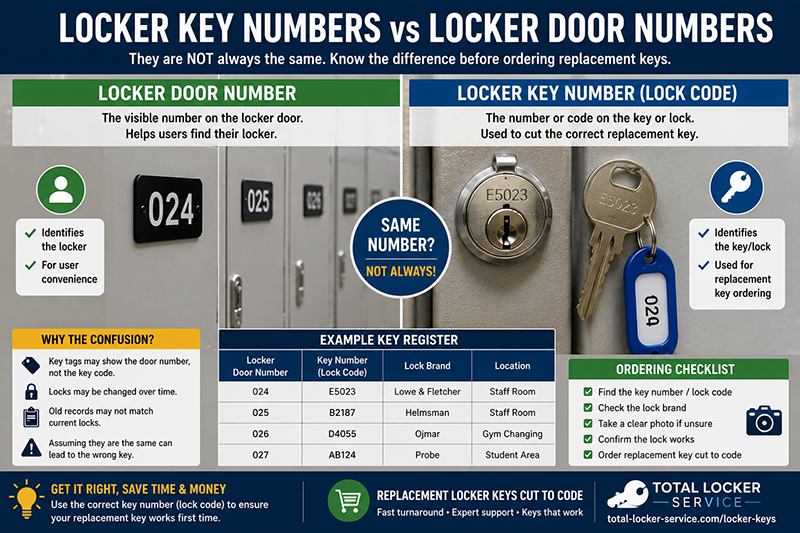
    Locker key numbers and locker door numbers are often confused. They may look similar, but they are not always the same thing. The locker door number helps a user find the right compartment. The locker key number or lock code identifies the key needed to operate the lock.

    This difference matters when ordering replacement locker keys. If the wrong number is used, the replacement key may not fit, may not turn, or may be cut for the wrong lock range.

    This guide explains the difference between locker key numbers and locker door numbers, where to find the correct code, and how schools, gyms, leisure centres and workplaces can avoid ordering mistakes.

    This article supports our main Locker Keys UK replacement and key management guide. For direct ordering, use Total Locker Service for replacement locker keys cut to code.

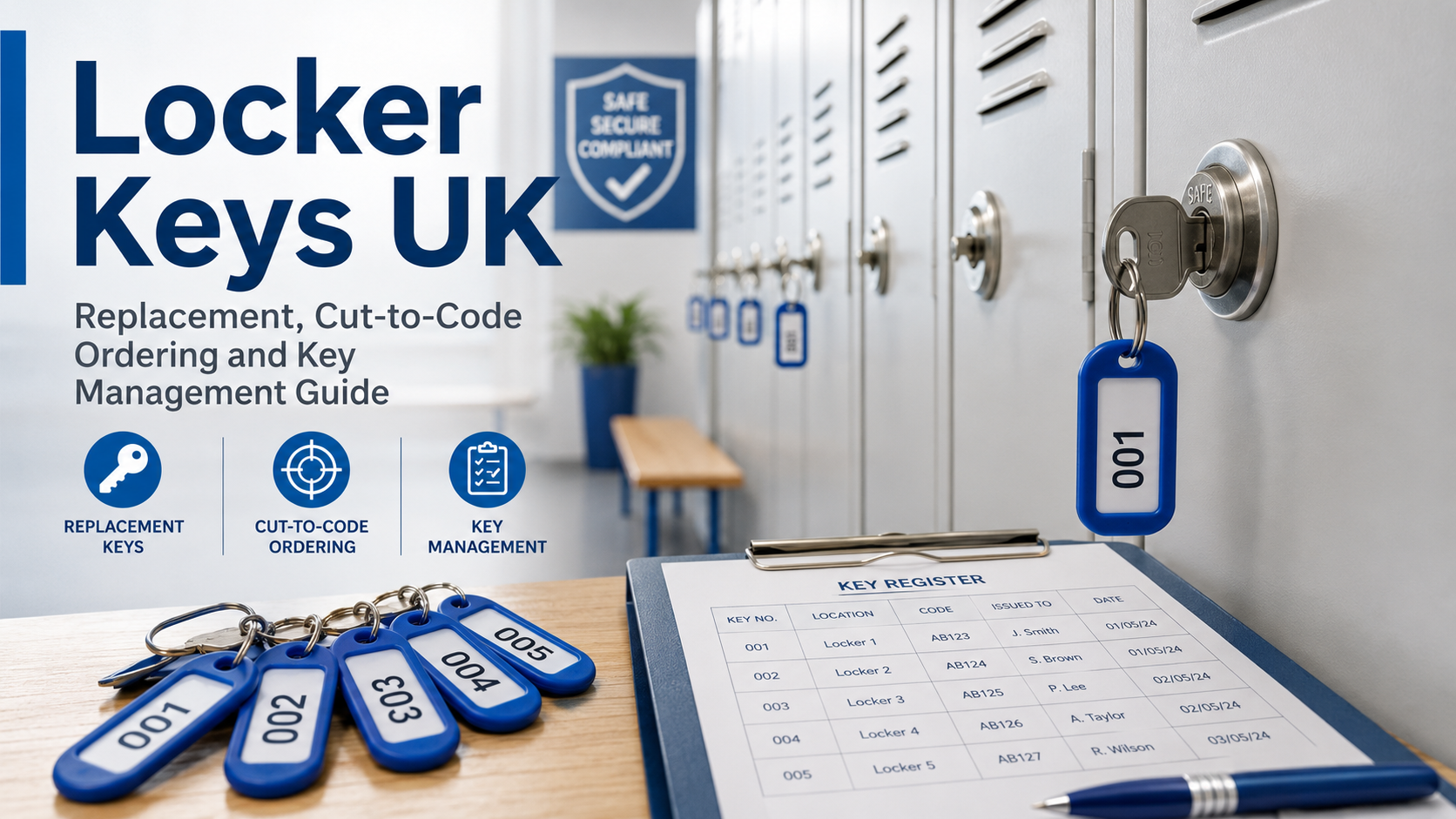
    Locker door number and locker key code comparison with numbered key tags and secure lockers

    Quick Answer: Are Locker Key Numbers and Locker Door Numbers the Same?

    Locker key numbers and locker door numbers are not always the same. The locker door number usually identifies the locker for the user. The locker key number, lock number or key code identifies the lock and is used to cut a replacement key.

    Sometimes a site may choose to make the door number and key number match. However, this should never be assumed. A door labelled 024 may use key code E5023, AB124, 62731 or another manufacturer-specific code.

    Before ordering replacement locker keys, always check the key, lock face, lock barrel, spare key record or site key register. If the lock still works and the correct code is known, a replacement key can often be cut to code without replacing the lock.

    For a wider explanation of replacement keys, read replacement locker keys cut to code: what it means.

    What Is a Locker Door Number?

    A locker door number is the visible number used to identify a locker compartment. It is usually fixed to the outside of the door as a plate, disc, sticker, label or engraved marker.

    The purpose of the door number is simple. It helps users find the right locker. In a school, it may help a pupil find their assigned locker. Inside a gym, it may help a member remember which locker they used. In a workplace, it may help staff and facilities teams identify an assigned storage space.

    Door numbers are usually arranged in a logical sequence. A locker run may be numbered 001 to 100. A changing room may have lockers numbered by bay, row or compartment. These numbers help with navigation and daily use.

    However, the door number does not always tell you which key will open the lock. It may only be a user-facing label. This is why it should not be used for replacement key ordering unless it has been confirmed as the key code.

    What Is a Locker Key Number?

    A locker key number is the code linked to the key and lock. It may also be called the lock code, key code or key number. This is the number normally needed when ordering a replacement locker key cut to code.

    The key number may be stamped on the original key, shown on the lock face, marked on the lock barrel or recorded in the site key register. It may include numbers, letters, prefixes or leading zeros.

    For example, a key code may look like 024, A1250, AB123, B2187, D4055 or another format linked to the lock range. The format depends on the lock brand, key profile and manufacturer system.

    The key number is more important than the door number when ordering replacement keys. It tells the supplier which key blank, profile or cutting pattern may be needed.

    For help finding this number, read where to find a locker key number or lock code.

    Locker Door Number vs Locker Key Number

    The two numbers serve different purposes. One helps people find the locker. The other helps identify the lock.

    Number typeWhat it identifiesWhere it is foundCan it be used to order a replacement key?
    Locker door numberThe visible locker compartmentDoor plate, number disc, label or engraved markerOnly if confirmed as the actual key code
    Locker key numberThe key or lock codeKey head, lock face, lock barrel, spare key or key registerYes, in most cut-to-code replacement orders
    Lock brand or rangeThe lock system or key profileKey, lock, locker, paperwork or supplier recordUseful for accurate identification

    Some sites deliberately make the locker number and key number match. This can make day-to-day management easier. However, mixed installations, replacement locks and old records can still cause confusion later.

    Why Locker Numbers and Key Numbers Get Confused

    The numbers get confused because they are often both visible near the locker. A door number may be on the front of the locker. A key number may be on the key tag. A lock code may be stamped near the keyway. If staff are not used to the difference, it is easy to use the wrong number.

    The problem becomes worse when a site has old lockers, mixed lock brands or poor key records. A replacement lock may have been fitted years ago, but the old key register may still show the original code. A key tag may show the door number, while the actual key blade has a different stamped code.

    • The locker door number is easier to see than the key code.
    • Key tags may show the door number, not the cut code.
    • Older keys may have worn or unclear markings.
    • Some lockers may have had locks replaced over time.
    • Old spreadsheets may not match current locks.
    • Different locker areas may use different lock brands.

    These issues are common in schools, gyms, workplaces and leisure centres because lockers are used daily and may be repaired over many years.

    Example: Door Number 024 Is Not Always Key Code 024

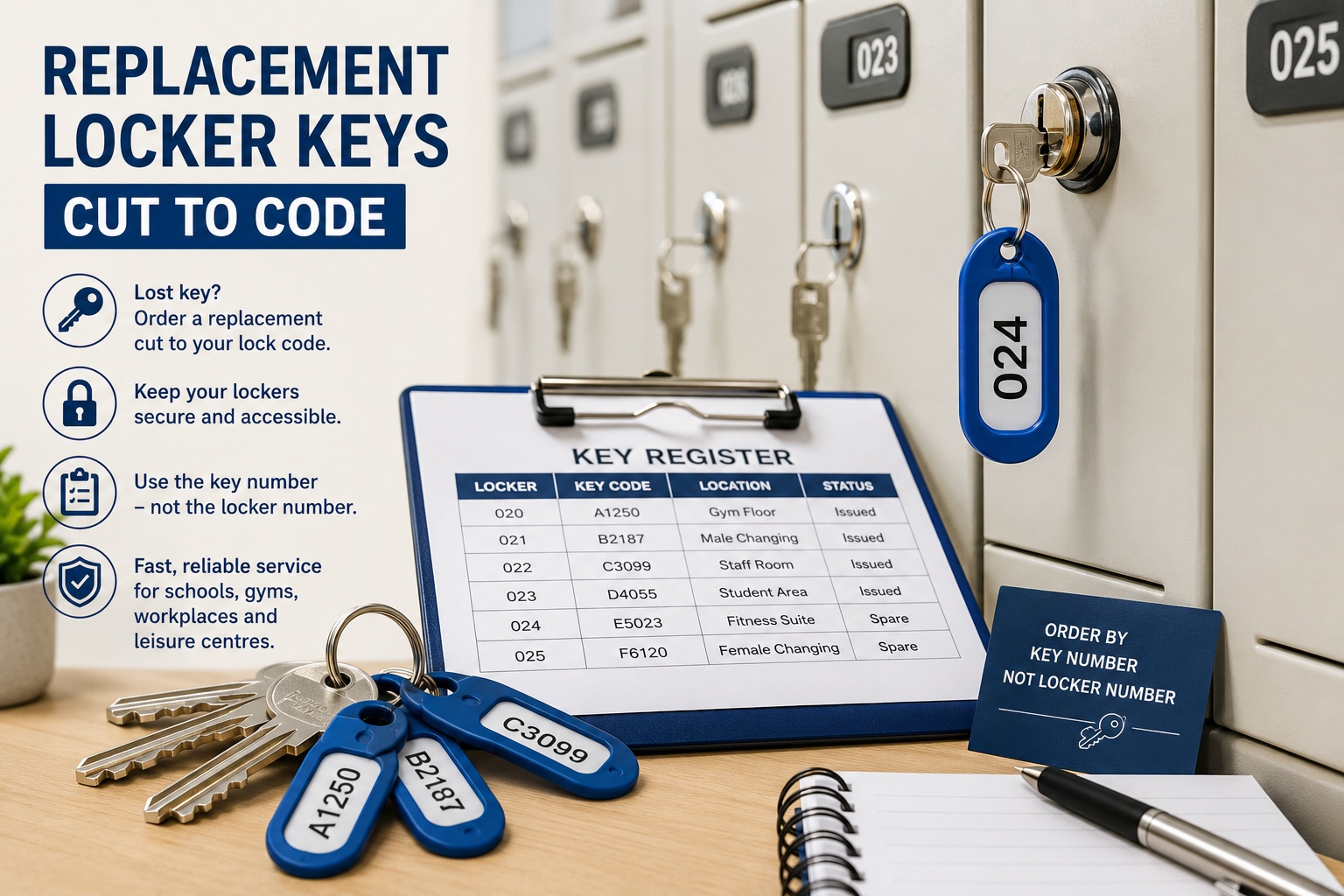
    Imagine a locker door is labelled 024. A member of staff may assume that the replacement key should be ordered as key 024. That may be correct, but only if the lock is actually coded 024.

    The lock may instead use key code E5023. The door number tells the user where to go. The key code tells the supplier which replacement key to cut.

    In this example, ordering from 024 could produce the wrong key. Ordering from E5023 is more likely to produce the correct replacement, provided the brand and lock range are also correct.

    This is why a site should record both values separately. The register should show locker 024 and key code E5023, rather than treating them as the same thing.

    Where to Find the Correct Locker Key Code

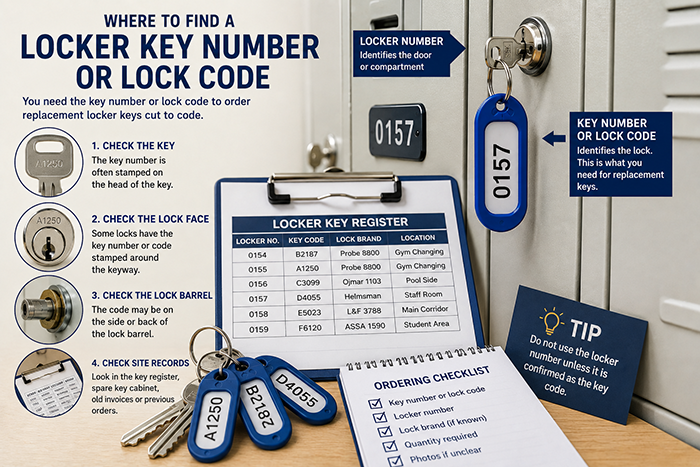
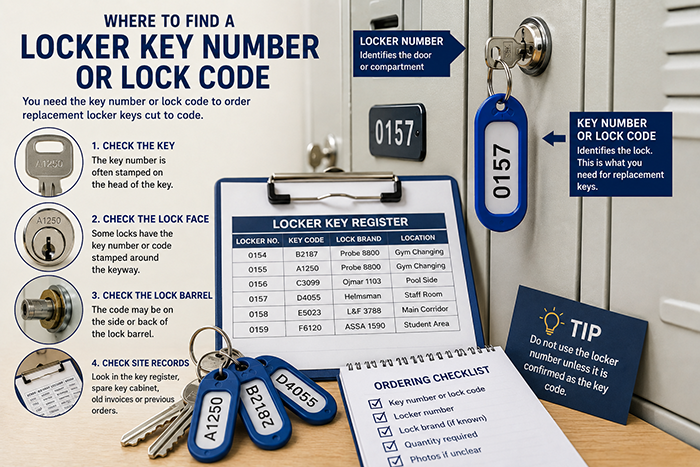
    The correct locker key code may be found in several places. Start with the original key if it is available. Many locker keys have a number stamped or engraved into the metal head of the key.

    If the original key is missing, check the lock face. Some locks show the number around the keyway. Use good lighting and check from different angles because stamped markings can be shallow or worn.

    If the door is open, check the lock barrel or inside of the door. Some locks show useful markings on the rear of the lock body, cam or barrel.

    Next, check the site records. A key register, spare key list, old invoice, installation record or previous replacement key order may contain the correct code.

    • Original locker key.
    • Lock face or keyway area.
    • Lock barrel or rear of the lock.
    • Spare key tag or spare key cabinet.
    • Site key register.
    • Old invoices or installation records.
    • Previous replacement key orders.

    If the code is unclear, take clear photos of the key, lock face and full locker door. Do not guess unclear numbers.

    For a full step-by-step guide, read where to find a locker key number or lock code.

    Why the Lock Brand Also Matters

    The key code is important, but the lock brand can also matter. Different locker locks use different key profiles, blanks and code ranges. Two locks may use similar-looking numbers but require different keys.

    Commercial locker systems may use lock brands and ranges associated with Probe, Helmsman, Lowe & Fletcher, Ojmar, ASSA, Link, Garran, Pure and other locker lock systems. The locker cabinet brand and lock brand may not always be the same.

    For example, a locker may have been supplied by one manufacturer but fitted with a lock from another. Replacement keys must match the lock, not just the locker cabinet.

    When ordering replacement keys, provide the key code, lock brand and clear photographs where possible. This reduces the risk of ordering a key from the wrong range.

    For more background, read are locker keys universal? why key codes and brands matter.

    Why the Wrong Number Causes Replacement Key Problems

    Using the wrong number can result in the wrong replacement key. The key may not enter the lock, or it may enter but fail to turn. In some cases, forcing a wrong key can damage the keyway or bend the key.

    A wrong order also delays the repair. The locker may stay out of use while staff identify the correct code and place another order. This is frustrating in schools, gyms and workplaces where lockers are needed every day.

    Wrong-number orders are usually caused by one of these issues:

    • Using the door number instead of the key code.
    • Using the number on a key tag instead of the stamped key code.
    • Misreading a worn number.
    • Missing a letter prefix or leading zero.
    • Relying on an old record after a lock has been changed.
    • Assuming all lockers on site use the same key range.

    For more guidance, read common mistakes when ordering locker keys.

    Should Key Tags Show the Door Number or Key Code?

    In most user-facing situations, key tags should show the locker door number rather than the full key code. This helps users find the correct locker without exposing more information than necessary.

    However, the site key register should record the actual key code separately. Staff should be able to match locker door number 024 to key code E5023 without showing that code openly on the user tag.

    This gives a good balance between usability and control. Users can identify their locker easily, while facilities staff still have the information needed to order replacements.

    For example:

    Visible key tagSite key registerPurpose
    024Locker 024 — key code E5023 — staff changing roomUser can identify the locker; staff can order the correct key
    126Locker 126 — key code B2187 — gym changing roomClear user tag with accurate management record
    Student Locker 15Locker 015 — key code AB124 — Year 9 corridorSchool-friendly user label with separate key control

    For accessories and labels, read locker key tags, number discs and wrist straps explained.

    How to Record Locker Door Numbers and Key Numbers Correctly

    The safest approach is to record the door number and key code as two separate fields. Do not merge them into one column unless they are always identical and verified.

    A good locker key register should include the locker number, key code, lock brand, locker location, issued user or department, issue date, return date and spare key location.

    Register fieldExampleWhy it matters
    Locker door number024Identifies the visible locker compartment
    Key codeE5023Used to order replacement keys
    Lock brandLowe & FletcherHelps confirm the correct key range
    LocationStaff changing roomUseful for large sites
    Issued toStaff member, department or user groupSupports accountability
    Spare key locationSecure key cabinetHelps resolve lost key issues quickly

    When a lock is changed, update the key code immediately. Old key records are one of the main causes of wrong replacement key orders.

    For a practical setup, read how to build a locker key register.

    What to Do If the Register and Lock Do Not Match

    If the register shows one key code but the lock or key shows another, stop before ordering. This usually means the lock has been changed, the record is out of date, or the key has been labelled incorrectly.

    Check the current lock first. A replacement key needs to match the lock fitted now, not the lock recorded several years ago. If there is a spare key, test and confirm it carefully.

    Once the correct code is confirmed, update the register. Include a note if the lock was replaced or if the previous record was incorrect. This helps prevent the same mistake later.

    If the lock cannot be identified and no code is available, the lock may need replacing. After replacement, record the new code immediately.

    Sector Examples: Schools, Gyms and Workplaces

    The same number distinction applies across all sites, but each sector has its own risks.

    Schools

    Schools often assign lockers to pupils for a term or academic year. The locker door number helps the pupil find the correct locker. The key code helps the school order replacements when keys are lost.

    A pupil may report that locker 58 needs a new key. Staff should check whether locker 58 has key code 58 or a separate code. The school key register should make this clear.

    For more detail, read school locker keys: replacement and key control guide.

    Gyms and Leisure Centres

    Gyms and leisure centres often use number tags or wrist straps. The number on the tag usually helps the user remember the locker, but it may not be the key cutting code.

    If locker 126 has a lost key, staff should check the key register or lock code before ordering. This is especially important where wet-area locks have been replaced over time.

    For more detail, read gym locker keys: replacement, wrist straps and member access and leisure centre locker keys: managing wet-area key loss.

    Workplaces

    Workplace lockers are often assigned to staff or departments. The door number may appear on staff records, while the key code may be held by facilities or maintenance teams.

    When employees leave, the key should be returned and checked against the register. If the key is missing, the site should order from the key code, not just the locker number.

    For more detail, read workplace locker keys: staff storage and replacement process.

    Lost Key Example: What Staff Should Check

    If a user says, “I have lost the key for locker 126”, staff should not automatically order key 126. They should check the site record first.

    1. Confirm the visible locker door number.
    2. Check the key register for the matching key code.
    3. Check whether the lock has been changed recently.
    4. Inspect the lock face if the record is unclear.
    5. Check any spare key for a stamped code.
    6. Order the replacement key using the confirmed key code.
    7. Update the register after the key arrives.

    For the full lost key process, read lost locker key: what schools, gyms and workplaces should do.

    Bulk Replacement Key Orders

    Bulk orders need careful separation between locker numbers and key codes. A list that only contains door numbers may not be enough unless those numbers are confirmed as the actual key codes.

    A bulk order list should include both fields. This helps the supplier understand which code should be used for cutting and which number belongs to the visible locker door.

    Locker door numberKey codeLock brandQuantity
    024E5023Lowe & Fletcher2
    126B2187Helmsman2
    157D4055Ojmar1
    210AB124Probe3

    For larger orders, read bulk replacement locker keys for schools and workplaces.

    Replacement Key Ordering Checklist

    Before ordering a replacement locker key, check the details below.

    • Visible locker door number.
    • Actual key number or lock code.
    • Lock brand, if known.
    • Locker brand, if known.
    • Quantity required.
    • Whether the lock is part of a master key system.
    • Whether the lock still works correctly.
    • Clear photos if the code is unclear.
    • Confirmation that the record matches the current lock.

    If the lock works and the correct key code is known, a replacement key can often be ordered without replacing the full lock. Use Total Locker Service for replacement locker keys cut to code.

    How to Prevent Future Number Confusion

    The best way to prevent number confusion is to build a clean record system. Keep locker door numbers and key codes in separate fields. Do not rely on loose notes or old labels.

    • Record the visible locker door number.
    • Record the actual key code separately.
    • Record the lock brand where possible.
    • Update the register when any lock is replaced.
    • Keep spare keys in a secure key cabinet.
    • Use clear number tags for users.
    • Keep master keys separate from everyday user keys.
    • Audit key records regularly.

    For audit support, read the locker key audit checklist for facilities managers.

    This article is part of the locker keys canister. Use the guides below to support key identification, replacement ordering, lost key procedures and long-term key control.

    Ordering Replacement Locker Keys

    Before ordering replacement locker keys, confirm whether the number you have is the door number or the actual key code. This simple check can prevent wrong keys, delays and unnecessary lock changes.

    For direct ordering, visit Total Locker Service: Locker Keys and Replacement Locker Keys.

    Locker Key Numbers vs Locker Door Numbers FAQs

    Is the locker door number the same as the key number?

    Not always. The locker door number identifies the visible locker compartment. The key number or lock code identifies the lock and is used to cut a replacement key.

    Can I order a replacement locker key from the door number?

    Only if the door number is confirmed as the actual key code. Many door numbers are user-facing labels and are not suitable for replacement key ordering.

    Where is the locker key number found?

    The locker key number may be stamped on the key, shown on the lock face, marked on the lock barrel, recorded on a spare key tag or listed in the site key register.

    Why do replacement locker key orders go wrong?

    Orders often go wrong when the door number is used instead of the key code, when worn numbers are misread, or when old records no longer match the current lock.

    Should key tags show the key code?

    User-facing key tags usually show the locker door number. The actual key code should be recorded separately in the site key register for replacement ordering.

    What should a locker key register include?

    A locker key register should include the locker door number, key code, lock brand, location, issued user or department, issue date, return date and spare key location.
  • Lost Locker Key? What Schools, Gyms and Workplaces Should Do

    Lost Locker Key? What Schools, Gyms and Workplaces Should Do

    A lost locker key can cause a small but urgent problem. A pupil may need books or PE kit. A gym member may have clothing, a phone or car keys locked inside. A member of staff may need PPE, uniform or personal belongings before starting work.

    The right response depends on the site, the lock type, whether the locker is open or locked, and whether the key number or lock code is known. In many cases, a replacement locker key can be ordered without changing the full lock.

    This guide explains what schools, gyms, leisure centres and workplaces should do when a locker key is lost. It supports our main Locker Keys UK replacement and key management guide. For direct ordering, use Total Locker Service for replacement locker keys cut to code.

    Lost locker key procedure with numbered key tags, secure lockers and a replacement key register

    Quick Answer: What Should You Do If a Locker Key Is Lost?

    When a locker key is lost, first check whether the locker is locked or open. If it is open, keep it open until a replacement key has been arranged. If it is locked, check for an authorised spare key or master key before forcing the door.

    Next, find the key number or lock code. This may be stamped on the lock face, shown on a spare key, recorded in a key register or listed in old site records. If the lock still works and the code is known, a replacement key can often be cut to code.

    Only replace the full locker lock if the lock is damaged, insecure, impossible to identify or if the missing key creates a security risk.

    For the key identification stage, read where to find a locker key number or lock code.

    First Steps When a Locker Key Is Lost

    A lost locker key should be handled calmly and consistently. The main aim is to restore access without damaging the locker, weakening security or creating confusion in the key records.

    Do not force the locker door as the first response. Forced entry can bend the door, damage the frame, break the cam or turn a simple replacement key issue into a full locker repair.

    1. Confirm who reported the missing key.
    2. Check whether the locker is locked or open.
    3. Ask the user to check bags, pockets, reception, changing areas and usual storage points.
    4. Check whether a spare key or master key is available.
    5. Find the key number or lock code.
    6. Order a replacement key if the code is known and the lock works.
    7. Replace the lock only when replacement key ordering is not suitable.
    8. Update the key register once the issue is resolved.

    This process works for schools, gyms, leisure centres, workplaces, universities and managed commercial buildings. The details may vary, but the logic is the same: check, identify, replace only what needs replacing, and record the result.

    Check Whether the Locker Is Locked or Open

    The first practical question is simple: is the locker locked shut, or is it open?

    If the locker is open, do not close it again. Keep the door open and mark the locker as temporarily out of use. This prevents the locker from becoming locked without a working key. The key number can then be identified from the lock, key register or spare key records before a replacement is ordered.

    If the locker is locked, check whether the user needs urgent access. In a school, the locker may contain books, medicine, sports kit or personal items. In a gym, it may contain clothing, valuables or car keys. In a workplace, it may contain PPE or uniform needed for a shift.

    Where access is needed, use an authorised spare key or master key if available. This should be done by approved staff and recorded where necessary. Avoid forcing the door unless there is a genuine need and no safer access method is available.

    Check Whether the Key Is Really Lost

    Many lost locker keys are found shortly after they are reported missing. Before ordering a replacement or opening the locker, ask the user to check common places.

    • Coat pockets and trouser pockets.
    • PE bags, gym bags and school bags.
    • Reception desks or lost property areas.
    • Changing room benches and floors.
    • Classrooms, offices or staff rooms.
    • Vehicle cup holders, bags and lockers used previously.
    • Key hooks, lanyards, wrist straps or number tags.

    This short check is worthwhile. It may prevent unnecessary ordering, avoid temporary lock changes and reduce admin time.

    Use an Authorised Spare Key or Master Key

    Many managed locker systems have spare keys or master keys. These can help staff open a locker without damaging it. However, they must be used carefully.

    A spare key normally opens one locker. A master key may open many lockers in the same system. This makes master key control important. A lost master key is a bigger security issue than a lost user key.

    Only authorised staff should use master keys. The key should be stored securely, returned after use and recorded where appropriate. Schools, gyms and workplaces should not leave master keys in open drawers, unlocked reception areas or shared cupboards.

    For more detail, read locker master keys explained and key cabinets for managing locker keys.

    Find the Key Number or Lock Code

    The key number or lock code is the detail needed to order many replacement locker keys. It tells the supplier which key profile and cutting pattern should match the lock.

    The code may be found on the original key, the lock face, the lock barrel, a spare key tag, a site key register, old invoices or previous replacement key orders.

    • Check the original key if it has been found but is damaged.
    • Check the face of the lock for stamped numbers.
    • Check the lock barrel if the door is open.
    • Check the spare key cabinet or key board.
    • Check site records and key issue sheets.
    • Check old invoices, installation records and previous orders.

    Do not assume the locker door number is the same as the key code. The door number helps users identify the locker. The key code identifies the lock. Sometimes they match, but often they are different.

    For a full guide, read where to find a locker key number or lock code and locker key numbers vs locker door numbers.

    Take Photos If the Code Is Unclear

    If the key number or lock code is worn, unclear or partly hidden, take clear photos before ordering. A close-up photo of the lock face can help confirm the code. A wider photo of the full locker door may help identify the locker type or brand.

    Photograph the key if available. Take both sides. Include any brand name, number, letter prefix or stamped mark. If possible, photograph the lock straight on and from a slight angle to catch shallow markings.

    Unclear characters should not be guessed. A 6 may look like an 8. A 1 may look like a 7. The letter O may look like zero. A missed prefix or leading zero can result in the wrong replacement key.

    For error prevention, read common mistakes when ordering locker keys.

    Order a Replacement Locker Key

    If the lock still works and the key code is known, a replacement locker key can often be ordered without changing the full lock. This is usually the fastest and most cost-effective option.

    Replacement keys cut to code are made from the key number or lock code rather than copied from the original key. This is useful when the original key is missing, broken or taken away by mistake.

    Before ordering, collect the key code, locker number, lock brand, locker brand if known, quantity required and any photos if the code is unclear. Also check whether the lock is part of a master-keyed system.

    Total Locker Service supplies replacement locker keys cut to code for many common locker systems. For process detail, read replacement locker keys cut to code: what it means.

    Replacement Key Ordering Checklist

    Use this checklist before ordering a replacement key.

    • Key number or lock code.
    • Locker door number.
    • Lock brand, if known.
    • Locker brand, if known.
    • Quantity required.
    • Clear photo of the key, if available.
    • Clear photo of the lock face.
    • Details of any master key system.
    • Confirmation that the lock still works.
    • Delivery contact and site details.

    After the replacement key arrives, test it carefully and update the site record. A resolved lost key issue should always end with the key register being corrected.

    When to Replace the Locker Lock Instead

    A replacement key is not always the best answer. A new key will not repair a damaged or insecure lock.

    Replace the locker lock if the lock barrel is loose, the keyway is damaged, the cam is bent, the lock does not turn smoothly or the lock code cannot be identified. Lock replacement may also be sensible when the missing key creates a security risk.

    • The lock is damaged or stiff.
    • The keyway is worn or blocked.
    • The cam is bent or loose.
    • The key code cannot be found.
    • The key may have been stolen with identifying information.
    • The lock is obsolete or difficult to support.
    • The site is already upgrading the locker system.

    For maintenance guidance, read broken locker key: what to do before replacing the lock and worn locker keys and stiff locks: repair or replace?.

    Do Not Force the Locker Unless Necessary

    Forcing a locker door should be a last resort. It can damage the door, frame, hinge, lock cam and surrounding lockers. It may also make the site look poorly managed, especially in public changing rooms or school corridors.

    If urgent access is needed and no key is available, authorised staff should follow the site procedure. Where personal belongings are inside, access should be witnessed or recorded to protect both the user and the organisation.

    After forced access, assess whether the lock, door or frame needs repair. Then update the key record so the same problem does not continue.

    Lost Locker Key Procedure for Schools

    Schools often deal with lost locker keys because pupils move between classrooms, changing rooms, sports areas and buses. Keys may be left at home, lost in bags, swapped between pupils or not returned at the end of term.

    The school should have a simple process for lost keys. The pupil should report the missing key to the correct office or staff member. Staff should check the locker record, confirm the locker number and identify the key code.

    If the locker contains urgent items, an authorised spare key or master key may be used. Access should be handled by staff, not by pupils. The incident should be recorded, especially if the locker contains personal items.

    Schools should avoid repeatedly replacing full locks when a replacement key can be ordered by code. A good key register can save the site team significant time across the academic year.

    School lost key checklist

    • Ask the pupil to check bags, pockets, classrooms and PE areas.
    • Confirm the locker number.
    • Check the key code in the school register.
    • Use an authorised spare key or master key if access is needed.
    • Order a replacement key if the code is known.
    • Record the issue and update the register.
    • Collect keys at the end of term or school year.

    For more school-specific guidance, read school locker keys: replacement and key control guide and how to reduce lost locker keys in schools.

    Lost Locker Key Procedure for Gyms and Leisure Centres

    Gyms and leisure centres need a fast lost key process because lockers are often used for short periods. A member may need access to clothing, a wallet, a phone or car keys before leaving the site.

    Reception or duty management staff should verify the user’s claim before opening a locker. This protects users and reduces the risk of unauthorised access. The site should record who requested access, which locker was opened and which staff member authorised it.

    Wet-area lockers may use wrist straps, number discs or plastic key tags. These accessories can break, fade or detach. When a lost key is reported, check whether the key has separated from the wrist strap or number tag.

    After the locker has been opened, identify the key code and order a replacement key if required. Keep the locker out of use until the replacement key or lock repair has been completed.

    Gym and leisure lost key checklist

    • Ask the user to check changing areas, lockers and reception.
    • Verify the user before opening the locker.
    • Use authorised staff and a spare key or master key.
    • Record the locker opening if personal belongings are involved.
    • Check the key tag, wrist strap and lock code.
    • Order a replacement key or replace damaged accessories.
    • Review repeated lost key patterns.

    For more guidance, read gym locker keys: replacement, wrist straps and member access, leisure centre locker keys: managing wet-area key loss and how to reduce lost locker keys in gyms.

    Lost Locker Key Procedure for Workplaces

    In workplaces, a lost locker key can affect staff attendance, shift starts and access to uniform, PPE or tools. This is especially important in factories, warehouses, healthcare sites and staff changing areas.

    The first step is to confirm which employee or department uses the locker. Then check the staff locker register for the locker number and key code. If the locker contains work-critical items, an authorised supervisor or facilities team member may need to open it using a spare key or master key.

    When an employee leaves, the key should be returned before the locker is reassigned. If the key is missing, the site should decide whether to order a replacement key or change the lock, depending on risk.

    Workplaces should not let unrecorded key changes build up. If locks are replaced without updating the register, future lost key problems become harder to solve.

    Workplace lost key checklist

    • Confirm the locker user or department.
    • Check the locker register for the key code.
    • Use authorised spare key or master key access if needed.
    • Record access where personal items are involved.
    • Order a replacement key if the lock works and the code is known.
    • Replace the lock if security has been compromised.
    • Update the staff locker record after the issue is resolved.

    For workplace-specific guidance, read workplace locker keys: staff storage and replacement process.

    Should You Charge for a Lost Locker Key?

    Some sites charge for lost locker keys. Others absorb the cost as part of normal locker management. The best approach depends on the setting, user group and site policy.

    Schools may use a small deposit or replacement charge to encourage returns. Gyms may charge members for lost keys, wrist straps or number tags. Workplaces may handle lost keys through staff procedures, especially where uniform or PPE storage is involved.

    Any charge should be clear before keys are issued. The policy should explain what happens if a key is lost, whether a deposit applies, and whether the user pays for a replacement key or full lock change.

    The charge should also reflect the actual issue. If the lock still works and a replacement key can be ordered by code, a full lock replacement charge may not be appropriate unless there is a security reason.

    Security Issues After a Lost Locker Key

    Not every lost locker key creates the same level of risk. A key lost somewhere on site with no identifying details may be low risk. A key stolen with a labelled tag, locker number or personal details may be more serious.

    Consider where the key was lost, whether it can be linked to a specific locker, what is stored inside the locker and whether unauthorised access is likely.

    • Low risk: unlabelled key lost away from the locker area.
    • Medium risk: key lost with a locker number tag.
    • Higher risk: key stolen with identifying details or access information.
    • Higher risk: locker used for sensitive, valuable or work-critical items.

    For higher-risk situations, replacing the lock may be safer than ordering a replacement key. Record the decision and update the key register.

    How to Prevent Repeat Lost Locker Key Problems

    The best lost key procedure is prevention. A few simple controls can reduce repeated issues and make replacement ordering easier when a key does go missing.

    • Use a clear locker key register.
    • Record the key code separately from the door number.
    • Use durable number tags, fobs or wrist straps.
    • Keep spare keys in a secure key cabinet.
    • Limit master key access to authorised staff.
    • Audit keys regularly.
    • Replace worn keys before they snap.
    • Update records whenever locks are changed.
    • Collect keys at the end of term, membership, tenancy or employment.

    For practical tools, read how to build a locker key register, locker key audit checklist for facilities managers and locker key tags, number discs and wrist straps explained.

    When Keyless Locks May Be Better

    If lost locker keys are a constant problem, the site may need to review the locking method. Combination locks, coin locks, RFID locks and electronic locks can reduce reliance on physical keys.

    However, keyless systems have their own issues. Combination codes can be forgotten. RFID wristbands and cards can still be lost. Electronic locks may need batteries, programming and staff training.

    Traditional keys still work well for many schools, workplaces and managed locker areas. The question is not whether keys are old-fashioned. The question is whether the site has a practical process for issuing, replacing and auditing them.

    For comparison, read locker keys or combination locks: which is better? and locker keys or RFID locks: which is better for leisure sites?.

    Lost Locker Key Action Table

    SituationBest actionUseful guide
    Locker is open but key is missingKeep the locker open, identify the code and order a replacement keyReplacement keys cut to code
    Locker is locked and user needs accessUse authorised spare key or master key access if availableMaster keys explained
    Key code is unclearCheck the lock face, key register and spare keys; take photosFind a key number
    Lock is damaged or stiffReplace the lock rather than only the keyWorn keys and stiff locks
    Many keys are missingPrepare a bulk replacement order and update the registerBulk replacement keys
    Lost keys happen repeatedlyReview tags, deposits, issue records, audits and locking methodKey audit checklist

    This article is part of the locker keys canister. Use these guides to move from lost key response to replacement ordering, key identification and long-term key control.

    Ordering Replacement Locker Keys

    A lost locker key does not always mean the lock needs to be replaced. If the lock still works and the correct key code is known, a replacement key can often be cut to code.

    Before ordering, confirm the key number, lock code, lock brand and quantity required. If the code is unclear, take photographs of the lock face, keyway and any markings.

    For direct ordering, visit Total Locker Service: Locker Keys and Replacement Locker Keys.

    Lost Locker Key FAQs

    What should I do first if a locker key is lost?

    First check whether the locker is open or locked. If it is open, keep it open. If it is locked, check for an authorised spare key or master key before forcing the door.

    Can a lost locker key be replaced without changing the lock?

    Yes. Many lost locker keys can be replaced without changing the lock when the correct key number or lock code is known and the lock still works.

    Where do I find the key number for a lost locker key?

    The key number may be on the original key, lock face, lock barrel, spare key tag, site key register or previous order records.

    Should I force open a locker if the key is lost?

    Forcing a locker should be a last resort. It can damage the locker door, lock and frame. Use an authorised spare key or master key first where possible.

    When should the lock be replaced after a key is lost?

    Replace the lock if it is damaged, insecure, impossible to identify or if the missing key creates a security risk because it can be linked to the locker.

    How can schools reduce lost locker keys?

    Schools can reduce lost locker keys by using clear key tags, keeping an accurate key register, holding spare keys securely and collecting keys at the end of term or school year.

    How can gyms reduce lost locker keys?

    Gyms can reduce lost locker keys by using durable wrist straps, clear number tags, secure spare key control, member procedures and regular key audits.

  • Are Locker Keys Universal? Why Key Codes and Brands Matter

    Are Locker Keys Universal? Why Key Codes and Brands Matter

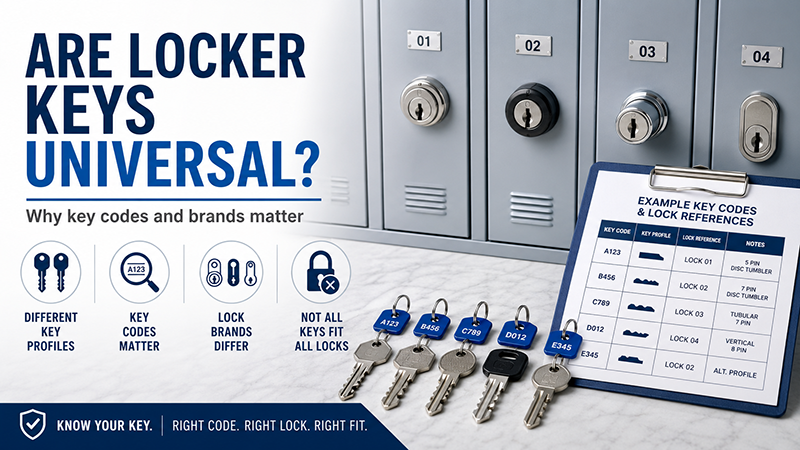
    Locker keys are not universal. A key that fits one locker will not automatically fit another locker, even when the locks look similar. The correct replacement depends on the key code, lock brand, key profile, lock series and sometimes the master key system used on site.

    This guide explains why locker keys are not usually interchangeable, why key codes and brands matter, and what information to check before ordering a replacement key.

    This article supports our main Locker Keys UK replacement and key management guide. For direct ordering, use Total Locker Service for replacement locker keys cut to code.

    Different locker keys, lock codes and brands showing why locker keys are not universal

    Quick Answer: Are Locker Keys Universal?

    No, locker keys are not universal. Most locker keys are cut for a specific lock, code range or manufacturer system. A key may look similar to another key, but small differences in the blade, grooves, length or cut pattern can stop it from fitting or turning.

    To order a replacement key, you normally need the key number, lock code or manufacturer reference. This code may be stamped on the key, shown on the lock face, marked on the lock barrel or recorded in a site key register.

    The visible locker number on the door is not always the same as the key code. This is one of the most common reasons replacement keys are ordered incorrectly.

    For direct help finding the correct number, read where to find a locker key number or lock code.

    Why Locker Keys Are Not Universal

    Locker keys are designed to match specific locks. The lock barrel contains internal parts that line up only when the correct key is inserted. If the key shape or cut pattern is wrong, the lock will not open.

    Two locker keys may look almost identical from a distance. However, they may use different blanks, different grooves, different cut depths or different code series. A small difference is enough to stop the key from working.

    This is why a replacement key should not be ordered by appearance alone. A key that looks right may still be wrong. The supplier needs the correct code and, where possible, the lock brand or key range.

    • Different locker locks use different key profiles.
    • Different brands use different code ranges.
    • The same locker room may contain mixed lock types.
    • Older lockers may have had some locks replaced over time.
    • Master-keyed systems may need compatible key ranges.

    For a broader explanation of replacement ordering, read replacement locker keys cut to code: what it means.

    What Does “Universal” Usually Mean?

    When people ask whether locker keys are universal, they may mean several different things. Each meaning has a different answer.

    QuestionAnswerWhy it matters
    Will one user key open all lockers?No, not normally.User keys are usually cut for one lock or one small keyed-alike group.
    Will any key from the same locker brand work?No.The key must match the correct code and lock series.
    Can a master key open many lockers?Sometimes.Only if the locks were set up for that master key system.
    Can a replacement key be made without the original?Often, yes.The supplier needs the correct key number or lock code.

    In most cases, the safe assumption is simple: the key is not universal, and the code must be checked before ordering.

    Why the Key Code Matters

    The key code identifies the cutting pattern needed for the replacement key. It may be a short number, a longer number, a letter and number combination, or a manufacturer-specific reference.

    Without the correct code, the replacement key may not fit the lock. Even one wrong digit can produce the wrong key. This is why worn markings should be checked carefully before ordering.

    The key code may be found on the original key, lock face, lock barrel, spare key tag or site key register. It should be written exactly as shown, including letters, prefixes and leading zeros.

    For example, AB012 may not be the same as AB12. A code beginning with a letter may belong to a different range from a number-only code. These details matter because they guide the key-cutting process.

    For step-by-step identification, use our guide to finding a locker key number or lock code.

    Why the Lock Brand Matters

    The lock brand can help identify the correct key range. Commercial lockers may use locks associated with brands such as Probe, Helmsman, Lowe & Fletcher, Ojmar, ASSA, Link, Garran, Pure and other locker lock systems.

    The visible locker brand and the lock brand are not always the same. A locker cabinet may have been made by one company but fitted with a lock from another supplier. This means the replacement key must match the lock, not just the locker cabinet.

    Brand information is especially useful when a code is unclear or when different lock ranges use similar-looking numbers. It can also help when a site has several locker types installed across different buildings or at different times.

    • Check the key head for a brand name or logo.
    • Check the lock face for markings.
    • Check the locker door or frame for manufacturer details.
    • Check old invoices and installation records.
    • Photograph the lock if the brand is uncertain.

    When ordering from Total Locker Service, provide the code, brand and any clear photos where possible. Use the replacement locker keys page for direct ordering support.

    Key Profile, Key Blank and Cut Pattern

    A locker key has more than one important feature. The visible number is only part of the story. The physical key shape also matters.

    The key profile describes the shape and grooves of the key blade. The key blank is the uncut key before the pattern is added. The cut pattern is the set of cuts that allows the lock barrel to turn.

    A replacement key must match all relevant parts. The correct code helps identify the cut pattern, but the correct lock range helps identify the right blank and profile. This is why keys are not interchangeable simply because they look similar.

    Trying to force the wrong key into a lock can cause damage. It may bend the key, jam the barrel or make the lock harder to use. If a key does not enter or turn smoothly, stop and check the code again.

    Locker Number vs Key Code

    The locker number is usually shown on the door. It helps users find the correct compartment. The key code identifies the lock and is used for replacement key cutting.

    Sometimes the locker number and key code match. However, this should never be assumed. Many lockers have a door number that is completely separate from the key code.

    For example, locker 024 may use key code E5023. In that case, ordering a replacement key for 024 may not work. The supplier needs E5023 because that is the lock code.

    This distinction is important for schools, gyms and workplaces because staff may only see the door number during a lost key incident. The actual key code may be on the key, lock face, barrel or key register.

    For a full explanation, read locker key numbers vs locker door numbers.

    Are Locker Master Keys Universal?

    No. Locker master keys are not universal either. A master key only works with locks that have been set up to operate under that master key system.

    A school, gym or workplace may have a master key that opens many lockers on one site. That does not mean the same master key will open lockers from another site, another brand or another lock range.

    Master keys are useful for managed locker environments. They allow authorised staff to open lockers during lost key incidents, maintenance checks or emergency access situations. However, they must be controlled carefully because one lost master key may affect many lockers.

    When ordering replacement user keys, check whether the lock is part of a master-keyed system. The replacement key should work correctly with the individual locker while preserving the wider management access arrangement.

    For more detail, read locker master keys explained.

    Can One Locker Key Open More Than One Locker?

    Sometimes, but only when the locks are keyed alike or designed as part of the same system. This is different from being universal.

    Keyed-alike lockers are set up so one user key opens more than one lock. This may be useful for staff storage, maintenance cupboards or controlled storage groups. However, it is planned during supply or lock setup. It does not mean any random locker key will work.

    Most user lockers are keyed differently. This means each locker has its own key. That arrangement is better for personal storage because users should not be able to open each other’s lockers.

    If several lockers unexpectedly open with the same key, check the lock system. It may be intentional, or it may indicate a security concern that needs review.

    Mixed Locker Installations

    Many sites have mixed locker installations. A school may have added new lockers over several years. A gym may have refurbished one changing room but not another. A workplace may have replaced damaged locks individually rather than changing the whole system.

    This means one room can contain different locks, key profiles and code ranges. A replacement key that works in one area may not work in another, even if the lockers look similar.

    Mixed installations make key records more important. The key register should show the locker number, key code, lock brand and location. If the lock is replaced, the register should be updated immediately.

    For record-keeping support, read how to build a locker key register.

    What Happens If You Order the Wrong Locker Key?

    If the wrong locker key is ordered, it may not enter the lock, or it may enter but fail to turn. In some cases, forcing the wrong key can damage the lock or bend the key.

    A wrong key order also delays the repair. The locker may remain out of use, and staff may need to check the code again before placing a second order.

    Wrong orders are usually caused by one of five issues: using the locker number instead of the key code, misreading a worn number, missing a letter or leading zero, choosing the wrong lock brand, or relying on an old record after the lock has been changed.

    • Do not guess unclear numbers.
    • Do not order from the door number unless it is confirmed as the key code.
    • Do not ignore the lock brand.
    • Do not miss prefixes or leading zeros.
    • Do not rely on old records without checking the current lock.

    For a detailed list, read common mistakes when ordering locker keys.

    What to Check Before Assuming a Key Is Universal

    Before trying a key in several lockers, check whether the system is intended to work that way. A master key or keyed-alike group may open several lockers. A normal user key should usually open one locker only.

    If a key opens more lockers than expected, record which lockers are affected and check the lock schedule. This may be normal for a managed system, or it may suggest that a lock has been fitted incorrectly.

    If a user key opens the wrong locker, stop using that locker until the issue is checked. Personal storage needs clear access control. Users should not be able to access lockers assigned to other people.

    Sector Examples

    The same key rules apply across different sectors, but the risks vary by site type.

    Site typeCommon issueBest actionSupporting guide
    SchoolsPupils may assume door numbers are key numbersUse a clear key register and termly checksSchool locker keys
    GymsChanging room keys may lose tags or wrist strapsUse durable identifiers and spare key recordsGym locker keys
    Leisure centresWet-area keys may become worn or hard to readReplace worn tags and audit key codesLeisure centre locker keys
    WorkplacesStaff lockers may be reassigned without record updatesRecord key issue and return datesWorkplace locker keys
    UniversitiesMultiple buildings may use different lock rangesKeep department-level key schedulesUniversity locker keys
    Healthcare sitesSpare key and master key control may be criticalRestrict access and audit keys regularlyHealthcare locker keys

    Replacement Key Ordering Checklist

    Before ordering a replacement key, collect as much accurate information as possible. This reduces the risk of receiving a key that does not work.

    • Key number or lock code.
    • Locker door number.
    • Lock brand, if known.
    • Locker brand, if known.
    • Quantity required.
    • Clear photo of the original key, if available.
    • Clear photo of the lock face.
    • Photo of the full locker door, if the brand is uncertain.
    • Details of any master key system.
    • Confirmation that the lock is still working.

    If the lock still works and the correct code is known, a replacement key can often be ordered without changing the lock. Use Total Locker Service for replacement locker keys cut to code.

    How to Reduce Future Key Confusion

    The best way to avoid future key confusion is to keep accurate records. Every locker should have a recorded locker number, key code, lock brand and location.

    Spare keys should be stored securely and labelled clearly. Labels should identify the locker number or internal reference, not personal user details. Master keys should be controlled separately and only issued to authorised staff.

    When a lock is changed, update the register immediately. Old records are a common cause of wrong replacement key orders. A key register is only useful when it reflects the locks currently fitted.

    For audit support, read the locker key audit checklist for facilities managers.

    Bulk Replacement Orders and Mixed Brands

    Bulk replacement orders need extra care because one site may contain several lock brands or code ranges. Do not assume all lockers use the same key system simply because they are in the same building.

    Create a clean list before ordering. Include the locker number, key code, lock brand, quantity and any uncertainty. Separate confirmed codes from unclear codes. Add photographs for any locks that are difficult to identify.

    After the replacement keys arrive, test them and update the register. This makes the next bulk order easier and reduces future errors.

    For more detail, read bulk replacement locker keys for schools and workplaces.

    This article is part of the locker keys canister. Use the guides below to move from key identification to replacement ordering, lost key procedures and long-term key management.

    Ordering Replacement Locker Keys

    Locker keys are not universal, so the safest ordering route is to identify the correct key number, lock code and brand before placing an order. This helps avoid wrong keys, delays and unnecessary lock replacements.

    For direct ordering, visit Total Locker Service: Locker Keys and Replacement Locker Keys.

    Are Locker Keys Universal? FAQs

    Are locker keys universal?

    No. Locker keys are not universal. Most keys are cut for a specific lock, key code, lock brand or key range.

    Can one locker key open more than one locker?

    Sometimes, but only when the lockers are keyed alike or part of a planned master key system. A normal user key usually opens one locker.

    Are locker master keys universal?

    No. A locker master key only works with locks set up for that specific master key system. It will not open all locker locks.

    Can I order a replacement locker key by brand only?

    Usually not. The brand helps, but the key number or lock code is normally needed to cut the correct replacement key.

    Is the locker number enough to order a key?

    Only if the locker number is confirmed as the key code. Many locker door numbers are user-facing labels and are not the same as the lock code.

    Why do locker key brands matter?

    Brands matter because different lock makers use different key profiles, blanks, code ranges and cutting patterns. The correct brand can help identify the correct replacement key range.

  • Where to Find a Locker Key Number or Lock Code

    Where to Find a Locker Key Number or Lock Code

    A locker key number or lock code is the detail needed to order many replacement locker keys. It tells the supplier which key profile and cutting pattern should match the lock. Without the correct code, a replacement key may not work, even if the visible locker door number looks right.

    This guide explains where to find a locker key number, how to tell the difference between a locker number and a key code, what to check before ordering, and what to do when the code is missing or hard to read.

    This article supports our main Locker Keys UK replacement and key management guide. For direct ordering, use Total Locker Service for replacement locker keys cut to code.

    Locker key number and lock code shown on numbered keys, locker doors and a key register

    Quick Answer: Where Do You Find a Locker Key Number?

    The locker key number is usually found on the original key, the lock face, the lock barrel or the site key register. It may be a number, a letter and number combination, or a manufacturer-specific code. This code is used to order a replacement locker key cut to code.

    Do not assume the locker door number is the key number. The locker number helps users find the compartment. The key number identifies the lock. Sometimes they match, but often they are different.

    If the key number is clear, a replacement key can often be ordered without removing the lock. If the number is missing or hard to read, take clear photos of the key, lock face and locker door before requesting help.

    What Is a Locker Key Number?

    A locker key number is the code used to identify the cut pattern for a specific locker key. It may be stamped on the key head, engraved into the key, marked on the lock face or recorded in a key schedule.

    The number does not simply describe the locker position. It usually relates to the lock or key series. This is why a replacement key supplier needs the code, not just the locker door number.

    Some locker key numbers are short. Others include letters, prefixes or longer number sequences. For example, a key code may look like 024, AB123, 62731, C3099 or another format linked to the lock range.

    The format depends on the lock and key system. Commercial lockers may use locks from brands such as Probe, Helmsman, Lowe & Fletcher, Ojmar, ASSA, Link, Garran, Pure and other common locker lock ranges. The visible locker brand and the lock brand are not always the same.

    For a wider explanation of key replacement, read replacement locker keys cut to code: what it means.

    Locker Number vs Key Code

    The locker number and key code are often confused. This is one of the most common causes of incorrect replacement key orders.

    The locker number is usually displayed on the door. It helps a user find the right compartment. In a school corridor, changing room or staff area, the door number is there for quick identification.

    The key code is linked to the lock. It tells the supplier which replacement key should operate the lock. This code may appear on the key, lock face, barrel or key record.

    DetailWhat it identifiesWhere it is usually foundUsed for replacement key ordering?
    Locker numberThe user-facing locker door or compartmentDoor plate, number disc or locker labelOnly if it is also the key code
    Key numberThe key cutting code or lock codeKey head, lock face, lock barrel or key registerYes
    Lock brandThe lock or key rangeKey, lock face, paperwork or supplier recordOften helpful

    For example, a locker door may show 24, while the key code may be AB124. In that case, ordering key 24 may not work. The supplier needs AB124.

    For more detail, read locker key numbers vs locker door numbers.

    1. Check the Original Locker Key

    The original key is usually the best place to start. Many locker keys have a number stamped or engraved into the metal head of the key. Some also have a brand name or logo.

    Look carefully at both sides of the key. The code may be small, worn or partly hidden by a key ring, tag or plastic cover. Clean the key gently if dirt or grime makes the number hard to read.

    Write down the code exactly as shown. Include letters, numbers, prefixes, suffixes and leading zeros. A code such as AB012 is not the same as AB12.

    • Check both sides of the key.
    • Look for stamped numbers or letters.
    • Do not ignore leading zeros.
    • Include any prefix or suffix.
    • Check whether the key also shows a brand name.

    If the key is worn, take a clear close-up photograph. This is useful if the number could be read in more than one way.

    Common Key Marking Problems

    Older locker keys can be difficult to read. Numbers may be worn smooth, scratched or partly hidden. Some characters can look similar, especially when the stamp is shallow.

    • A 6 may look like an 8.
    • A 1 may look like a 7.
    • The letter O may look like zero.
    • The letter B may look like an 8.
    • A worn prefix may be missed completely.

    If there is any doubt, do not guess. Compare the key with the lock face, spare key record or site key register. Guessing can lead to a wrong replacement key.

    2. Check the Locker Lock Face

    If the original key is missing, check the face of the locker lock. Some locks have a number stamped around the keyway or printed on the lock face. This may be the key number or lock code needed for replacement ordering.

    Use good lighting and look from more than one angle. Reflections, scratches and worn metal can make the code hard to see. A phone torch may help, but avoid glare when taking photos.

    Take a close-up photograph of the lock face. Also take a wider photo showing the full locker door. The close-up helps with the code. The wider image helps identify the locker type, door style and possible manufacturer.

    If the lock face has no visible number, do not assume the locker door number is enough. Continue checking other sources before ordering.

    How to Photograph the Lock Code

    A clear photograph can prevent mistakes when the code is hard to read. Take the image straight on if possible. Then take a second image from a slight angle to catch stamped markings.

    • Use natural light or a steady torch.
    • Keep the camera focused on the lock face.
    • Take one close-up and one wider locker photo.
    • Include any brand markings.
    • Avoid heavy glare from shiny lock surfaces.

    If sending photos to a supplier, include the written code you think it shows. This gives the supplier a useful comparison.

    3. Check the Lock Barrel or Inside of the Door

    Some locker locks do not show the full code on the front. The number may be visible on the lock barrel, rear fixing, cam or inside of the locker door. This is more likely when the door is open.

    If the locker is open, inspect the inside of the door carefully. Look at the rear of the lock, the cam arm and any retaining nut or lock body marking. Do not remove the lock unless you are confident and authorised to do so.

    In schools, gyms and workplaces, this check is usually handled by a site manager, caretaker, maintenance person or facilities team. They may be able to compare the lock with other lockers in the same area.

    If the locker is locked shut and the key is missing, check whether an authorised master key or spare key is available. Avoid forcing the door unless there is an urgent reason.

    For a lost key process, read lost locker key: what schools, gyms and workplaces should do.

    4. Check the Site Key Register

    A key register is often the most reliable source when it has been kept up to date. It should show the locker number, key code, lock brand, user or department, issue date and spare key location.
    Schools may hold this record in the site office, bursar’s office or caretaker’s records. Gyms may hold it at reception or with the facilities manager. Workplaces may keep it with HR, maintenance or building management.

    However, old records should be checked carefully. A locker may have had its lock changed since the record was created. If the register says one code but the lock face shows another, investigate before ordering.

    A good register saves time because staff do not have to inspect every lock when a key goes missing. It also makes bulk replacement orders easier.

    For a practical structure, read how to build a locker key register.

    5. Check Spare Keys and Master Key Records

    Spare keys can help confirm the correct code. A site may have a spare key cabinet, key board or controlled set of management keys. Check whether the spare key has a stamped number or labelled tag.

    Do not rely only on handwritten labels if the key itself shows a different code. Labels may have been swapped, faded or written incorrectly. The key stamp, lock face and register should be compared where possible.

    Master key records may also help identify the lock range. A master key may not give the individual user key code, but it can help confirm the lock system or manufacturer range.

    Master keys should be kept secure. A missing user key may affect one locker. A missing master key may affect many lockers. Keep master key access limited and recorded.

    For more guidance, read locker master keys explained and key cabinets for managing locker keys.

    6. Check Old Orders, Invoices and Installation Records

    If the key and lock markings are unclear, old paperwork may help. Previous invoices, locker installation records, maintenance notes and supplier emails may include the lock brand, key range or replacement key codes.

    This is useful for older locker installations where some markings have worn away. It is also helpful when a site has several locker blocks installed at different times.

    Search for terms such as locker keys, replacement keys, key numbers, lock codes, master keys, locker locks and the locker brand name. If you find an old key order, compare it with the current lock before ordering again.

    Records are helpful, but they are not perfect. A lock may have been changed during a repair, meaning the old code no longer matches the current locker.

    7. Identify the Lock or Locker Brand

    The key number is the most important detail, but the lock or locker brand can also help. Some code ranges may look similar across different systems. The brand helps narrow the correct key profile.

    Check the key head, lock face, locker door, locker frame, old paperwork and previous orders. The visible locker brand may not always be the lock brand, but both details are useful.

    For example, a locker cabinet may be from one manufacturer but fitted with a lock from another supplier. The replacement key must match the lock, not just the cabinet.

    If you are unsure, send clear photos when requesting help. Include the lock face, full locker door and any brand markings.

    What If the Locker Key Number Is Missing?

    If the locker key number is missing, start by checking every possible source: the original key, lock face, barrel, spare keys, key register and old paperwork. Many missing-code problems are solved by checking more than one place.

    If no code can be found, take photographs. A specialist supplier may still be able to identify the key range from the lock type, keyway, locker model or brand details.

    If the lock cannot be identified, the lock may need to be replaced. This is more likely with old, damaged or obsolete systems. In that case, update the site register as soon as the new lock is fitted.

    When replacing a lock, check whether it forms part of a master-keyed system. Replacing one lock with an incompatible lock may cause future access problems for management staff.

    For ordering error prevention, read common mistakes when ordering locker keys.

    What If the Code Is Worn or Hard to Read?

    A worn key code should be treated carefully. Do not assume the nearest-looking number is correct. One wrong character can produce the wrong key.

    Use good lighting and compare several sources. If the original key is worn, check the lock face. If the lock face is worn, check the spare key. If both are unclear, check the register or previous invoices.

    Take close-up photos from more than one angle. Sometimes a shallow stamp becomes clearer when light falls across it from the side.

    • Do not guess unclear digits.
    • Compare the code against spare keys.
    • Check whether a prefix or leading zero is missing.
    • Photograph the key and lock face.
    • Ask for help before ordering if the code is uncertain.

    Can You Order a Replacement Key from the Locker Door Number?

    Sometimes, but only if the locker door number is also the key code. This should not be assumed.

    In many installations, the door number is a user-facing label and has no direct relationship to the key cutting code. The door may say 023, but the key code may be D4055. Ordering from 023 would not produce the correct key unless 023 is recorded as the actual key code.

    Before using a locker number to order, check your register or a spare key. If the register confirms that locker 023 uses key code 023, then it may be safe. If there is no confirmation, inspect the lock or key first.

    Sector Examples

    Different sites find key numbers in different ways. The core checks are the same, but the records may be held by different people.

    Site typeWhere to check firstUseful supporting guide
    SchoolOriginal key, pupil locker record, caretaker recordsSchool locker keys
    GymKey tag, reception spare keys, changing room lock faceGym locker keys
    Leisure centreWrist strap, spare key cabinet, lock faceLeisure centre locker keys
    WorkplaceStaff locker register, facilities records, lock faceWorkplace locker keys
    UniversityDepartment key schedule, building records, lock faceUniversity locker keys
    HealthcareFacilities records, authorised key storage, lock faceHealthcare locker keys

    Replacement Locker Key Ordering Checklist

    Before ordering a replacement locker key, collect the details below. This reduces the chance of wrong keys and delays.

    • Key number or lock code.
    • Locker door number.
    • Lock brand, if known.
    • Locker brand, if known.
    • Quantity required.
    • Clear photos if the code is uncertain.
    • Details of any master key system.
    • Confirmation that the lock still works.
    • Delivery contact and site details.

    If the lock works and the code is known, a replacement key can often be ordered without changing the full lock. Use Total Locker Service for replacement locker keys cut to code.

    How to Prevent Future Key Number Problems

    The best way to prevent future ordering problems is to record the key code before the key is lost. A simple key register can save time later.

    Every locker should have a recorded locker number, key code, lock brand and location. If the lock is changed, update the register immediately. Old records are one of the main causes of wrong replacement orders.

    Spare keys should be stored securely and labelled clearly. Avoid attaching personal names to keys. A locker number or internal reference is usually enough.

    Carry out regular audits. Schools may audit keys at the end of term. Gyms and leisure centres may check keys during maintenance periods. Workplaces may review key records when staff leave or lockers are reassigned.

    For audit support, read the locker key audit checklist for facilities managers.

    Bulk Replacement Orders

    If several keys are missing, prepare a bulk list rather than placing separate orders. This is useful for schools before a new term, gyms after a refurbishment, workplaces after staff changes and universities after annual audits.

    A bulk list should include each key code, locker number, quantity, brand and any uncertainty. Separate confirmed codes from unclear codes. This helps the supplier process the order more accurately.

    After the keys arrive, test them and update the register. The aim is not just to replace missing keys, but to improve the whole key management process.

    For larger orders, read bulk replacement locker keys for schools and workplaces.

    This article is part of the locker keys canister. Use the related guides below to support replacement ordering, key management and sector-specific locker key control.

    Ordering Replacement Locker Keys

    Once the key number or lock code is confirmed, replacement key ordering is much easier. Check the code carefully, include any letters or leading zeros, and confirm the lock or locker brand where possible.

    For direct ordering, visit Total Locker Service: Locker Keys and Replacement Locker Keys.

    Locker Key Number and Lock Code FAQs

    Where is the locker key number?

    The locker key number may be stamped on the original key, shown on the lock face, marked on the lock barrel or recorded in a site key register.

    Is the locker number the same as the key number?

    Not always. The locker number usually identifies the door or compartment. The key number identifies the lock code used to cut a replacement key.

    Can I order a locker key from the door number?

    Only if the door number is also confirmed as the key code. Many locker door numbers are user-facing labels and are not the same as the key cutting code.

    What should I do if the lock code is worn away?

    Check the original key, spare keys, site register and old ordering records. Take clear photos of the lock face and keyway before asking a supplier for help.

    What information is needed to order a replacement locker key?

    You normally need the key number or lock code, the locker number, lock brand where known, quantity required and clear photographs if the code is uncertain.

    What if no key code can be found?

    If no key code can be found, a specialist may still identify the lock from photographs. If the lock cannot be identified, it may need to be replaced.

  • Replacement Locker Keys Cut to Code: What It Means

    Replacement Locker Keys Cut to Code: What It Means

    Replacement locker keys cut to code are useful when a locker key has been lost, damaged, snapped or taken away, but the lock itself still works. Instead of copying an existing key, the replacement key is made from the key number or lock code.

    This guide explains what cut-to-code replacement means, where to find the correct code, when it is the right solution and when the full locker lock should be replaced instead.

    This article supports our main Locker Keys UK replacement and key management guide. For direct ordering, use Total Locker Service for replacement locker keys cut to code.

    Locker keys with blue number tags, key register clipboard and secure lockers for UK replacement key management

    Quick Answer: What Are Replacement Locker Keys Cut to Code?

    Replacement locker keys cut to code are new keys made from a known key number, lock number or manufacturer code. The original key does not need to be available. The code tells the supplier which key blank and cutting pattern are required for the lock.

    This is different from copying a key. Key copying needs an original key. Cut-to-code replacement uses the lock or key code instead. This makes it useful when a locker key has been lost, stolen, broken or taken home by mistake.

    When the lock is still working and the correct code is known, cut-to-code replacement is often faster, cheaper and less disruptive than replacing the full locker lock.

    What Does Cut to Code Mean?

    Cut to code means that a key is produced from a recorded key pattern. Each suitable locker lock has a code linked to a specific key shape and cutting pattern. When the correct code is provided, a replacement key can be made to operate the existing lock.

    This process is common in managed locker environments. Schools, gyms, workplaces, leisure centres and universities often need replacement keys, but they may not have the original key available. A cut-to-code service allows the site to order a new key without removing the lock from the door.

    The key code may be a number, a letter-number combination or a manufacturer-specific reference. It must be recorded accurately. A single wrong digit may result in a key that does not work.

    For a wider overview of how locker keys work, read the main Locker Keys UK guide.

    Cut-to-Code Replacement vs Key Copying

    Cut-to-code replacement and key copying are not the same process. Both can produce a replacement key, but they use different starting information.

    MethodWhat is needed?Best used when
    Key copyingThe original working keyThe key is available and in good condition
    Cut-to-code replacementThe key number, lock number or codeThe original key is lost, broken or unavailable

    Key copying can be useful when the original key is present. However, it may copy wear from an old or damaged key. Cut-to-code replacement uses the intended key pattern, provided the correct code is known.

    For many locker sites, cut-to-code ordering is the better option because locker keys are often lost rather than simply duplicated.

    Why the Locker Key Code Matters

    The key code is the detail that connects the replacement key to the lock. Without the correct code, the supplier may not know which key profile and cut pattern are required.

    A locker door number is not always the same as a key code. This is one of the most common mistakes when ordering replacement locker keys. The locker number helps users find their compartment. The key code identifies the lock.

    For example, a locker door may show number 24, but the key code may be AB124, 62731 or another lock-series number. Ordering key 24 may not work unless 24 is also the key code.

    Before placing an order, check whether the number is printed on the door, stamped on the key or marked on the lock. These are different things.

    For more detail, read locker key numbers vs locker door numbers.

    Where to Find the Locker Key Code

    The locker key code may be found in several places. The easiest place is usually the original key, if it is still available. Many locker keys have a number stamped or engraved into the head of the key.

    The next place to check is the lock face. Some locker locks show a number around the barrel or on the front of the lock. Use good lighting, as older lock markings can be worn or partly hidden.

    The code may also be visible on the lock barrel, especially when the locker door is open. In some cases, the facilities team may need to inspect the lock from the inside of the door.

    Site records can also help. A school, gym or workplace may have a key register, locker allocation sheet, old invoice or maintenance record that lists the key code.

    Spare keys are another useful source. If a spare key is held in a secure key cabinet, check whether it has the code stamped on it or written on the tag.

    For a step-by-step guide, read where to find a locker key number or lock code.

    What Information Should You Collect Before Ordering?

    The best replacement key orders include clear and accurate information. This reduces the risk of ordering the wrong key and helps the supplier identify the correct key range.

    • The key number or lock code.
    • The locker number, if different from the key code.
    • The lock brand, where known.
    • The locker brand, where known.
    • The quantity of keys required.
    • Clear photos of the key, lock face or locker if the code is unclear.
    • Details of any master key system, if relevant.

    Do not rely on memory if the code is unclear. Check the lock, key, register and spare key records before ordering. A short check can prevent delays later.

    How to Order Replacement Locker Keys Cut to Code

    The ordering process is straightforward when the correct code is available. Start by confirming the key code from the key, lock face, lock barrel or key register. Write it down exactly as shown, including letters, prefixes and leading zeros.

    Next, check the lock or locker brand. This may be shown on the key, lock, locker door, old paperwork or invoice records. Common locker and lock names may include Probe, Helmsman, Lowe & Fletcher, Ojmar, ASSA, Link, Garran, Pure and other commercial locker systems.

    Then decide how many keys are needed. A site may want one replacement key, a pair of keys or a small spare set for management use. For larger sites, a bulk list may be more efficient.

    Finally, place the order with a specialist supplier. Total Locker Service provides replacement locker keys cut to code for many common locker systems.

    After the replacement key arrives, test it carefully. Then update the key register so the site record stays accurate.

    Why Cut-to-Code Ordering Helps Facilities Teams

    Cut-to-code ordering helps facilities teams keep lockers in service. It avoids unnecessary lock changes when the lock is still working. It also reduces disruption for users who need access to personal storage.

    For schools, this can reduce the amount of time caretakers spend dealing with lost pupil keys. For gyms and leisure centres, it helps reception teams and managers keep changing room lockers available. For workplaces, it helps staff lockers stay usable during shift changes and staff turnover.

    The system works best when key records are accurate. A simple spreadsheet or key register can save hours of checking, especially on larger sites with many lockers.

    For practical record keeping, read how to build a locker key register.

    When Cut-to-Code Replacement Is the Right Solution

    Cut-to-code replacement is usually the right solution when the lock is still working, the code is known and there is no security reason to change the lock.

    It is useful when a key has been lost, taken home, damaged or snapped away from the lock. It is also useful when a site wants spare keys for management records or bulk replacement keys before a new term, season or staff change.

    • The locker lock still turns correctly.
    • The key code or lock code is known.
    • The lock has not been damaged.
    • The missing key does not create a wider security risk.
    • The site wants to avoid unnecessary lock replacement.

    This approach is especially helpful for schools, gyms, universities, workplaces, leisure centres and commercial buildings with many lockers.

    For larger orders, read bulk replacement locker keys for schools and workplaces.

    When Should the Locker Lock Be Replaced Instead?

    A replacement key will not fix a faulty lock. If the lock is damaged, worn or insecure, replacing the full lock may be the better option.

    Replace the lock if the keyway is damaged, the barrel is loose, the cam is bent or the lock does not turn smoothly. A stiff lock may damage new keys and create more problems later.

    Lock replacement may also be sensible if the key has been stolen with identifying details, if the code cannot be found, or if the lock belongs to an obsolete system that is difficult to support.

    In some cases, lock replacement is part of a wider upgrade. For example, a site may replace old mixed locks with a consistent system during a locker refurbishment.

    For repair guidance, read broken locker key: what to do before replacing the lock and worn locker keys and stiff locks: repair or replace?.

    Cut-to-Code Replacement in Schools

    Schools often deal with regular lost locker keys. Pupils may misplace keys during the school day, leave them at home or fail to return them at the end of term. Replacing the full lock every time can become expensive and time-consuming.

    Cut-to-code replacement helps schools manage these problems. If the key code is recorded, a replacement key can be ordered without removing the lock. This keeps lockers available and reduces pressure on site staff.

    Schools should record the locker number, key code, pupil or year group, issue date and return status. They should also hold spare keys securely and carry out termly checks.

    For more detail, read school locker keys: replacement and key control guide.

    Cut-to-Code Replacement in Gyms and Leisure Centres

    Gyms and leisure centres often have high locker turnover. Members and visitors may use lockers for short periods while they train, swim or attend classes. Keys may be attached to wrist straps, fobs or number discs.

    When a key is lost, staff need a clear process. They may need to open the locker, confirm ownership of belongings and return the locker to service. If the key code is known, a replacement key can usually be ordered without changing the lock.

    Leisure sites should use durable key tags and keep spare keys secure. Wet areas may need water-resistant wrist straps and clear numbering that remains readable after repeated use.

    For more detail, read gym locker keys: replacement, wrist straps and member access and leisure centre locker keys: managing wet-area key loss.

    Cut-to-Code Replacement in Workplaces

    Workplace lockers are often assigned to staff. They may be used for clothing, PPE, bags, personal items or equipment. A lost key can delay an employee, especially when the locker contains items needed for work.

    Cut-to-code replacement helps workplaces avoid unnecessary downtime. If the key code is held in the staff locker record, the facilities team can order a replacement without replacing the full lock.

    Staff changes are also easier when the key register is accurate. When an employee leaves, the key should be returned, the locker checked and the record updated. If the key is missing, a replacement can be ordered by code.

    For workplace-specific guidance, read workplace locker keys: staff storage and replacement process.

    Common Mistakes When Ordering Replacement Locker Keys

    The most common mistake is ordering from the locker door number instead of the key code. Always check whether the number is user-facing or lock-specific.

    Another common mistake is misreading a worn number. Older keys and lock faces can be difficult to read. Take a photo if there is any doubt. Do not guess a number because one wrong character may produce the wrong key.

    Some sites also assume that all lockers in one area use the same key range. This may not be true. Locks may have been replaced at different times, or several locker brands may be installed in the same building.

    • Do not use the locker door number unless it is also the key code.
    • Do not miss letters, prefixes or leading zeros.
    • Do not ignore the lock brand.
    • Do not assume all lockers on site use the same key range.
    • Do not order from old records without checking whether the lock has been changed.

    For a fuller checklist, read common mistakes when ordering locker keys.

    How to Reduce Future Replacement Key Problems

    The best way to reduce replacement key problems is to keep accurate records. A clear key register makes future ordering much easier. It also helps staff respond quickly when a key is lost.

    • Record every locker number.
    • Record every key code.
    • Record the lock brand where known.
    • Store spare keys securely.
    • Control master key access.
    • Use clear key tags or number discs.
    • Replace worn keys before they snap.
    • Update records when locks are changed.
    • Audit locker keys regularly.

    For a wider control process, read the locker key audit checklist for facilities managers.

    Should You Move to Keyless Locker Locks?

    Cut-to-code replacement is useful, but some sites may still consider keyless locker locks if key loss is frequent. Combination locks, coin locks, RFID locks and electronic locks can reduce the need for physical keys.

    However, keyless systems have their own management needs. Combination codes can be forgotten. Electronic locks may need batteries. RFID systems need cards, fobs or wristbands. The best option depends on the site, users and budget.

    For many schools, workplaces and managed locker areas, keyed locks remain practical because they are simple and easy to maintain. The key is to manage the records properly.

    For comparison, read locker keys or combination locks: which is better? and locker keys or RFID locks: which is better for leisure sites?.

    This article is part of the locker keys canister. Use the related guides below to support identification, lost key procedures, key control and sector-specific locker key management.

    Ordering Replacement Locker Keys

    Replacement locker keys cut to code are a practical solution when the lock still works and the correct key code is known. They help reduce locker downtime and avoid unnecessary lock replacement.

    Before ordering, check the key number, lock number, brand and quantity required. If the code is unclear, take photographs of the lock face, keyway and any markings before placing the order.

    To order replacement keys, visit Total Locker Service: Locker Keys and Replacement Locker Keys.

    Replacement Locker Keys Cut to Code FAQs

    What does cut to code mean for locker keys?

    Cut to code means the replacement locker key is made from a key number, lock number or manufacturer code rather than copied from the original key.

    Can a locker key be replaced without the original key?

    Yes. Many locker keys can be replaced without the original key when the correct key code or lock number is known.

    Where do I find the code for a replacement locker key?

    The code may be stamped on the key, shown on the lock face, marked on the lock barrel or recorded in a site key register.

    Is the locker door number the same as the key code?

    Not always. The locker door number identifies the locker for users. The key code identifies the lock and is used to cut the replacement key.

    When should I replace the full locker lock instead of ordering a key?

    Replace the full lock if the lock is damaged, worn, insecure, impossible to identify or if a stolen key creates a security risk.

    Can schools and gyms order locker keys in bulk?

    Yes. Schools, gyms, workplaces and leisure centres can order replacement locker keys in bulk when they have a clear list of key codes and quantities.

  • Locker Keys UK: Replacement, Cut-to-Code Ordering and Key Management Guide

    Locker Keys UK: Replacement, Cut-to-Code Ordering and Key Management Guide

    Locker Keys UK: Replacement, Cut-to-Code Ordering and Key Management Guide

    The good news is that many locker key problems can be solved without replacing the whole lock. When the correct key number, lock number or code is available, a replacement locker key can often be cut to code. This means the new key is made from the lock code rather than copied from the original key.

    This guide explains how locker keys work, where to find the key number, how replacement keys are ordered and how schools, gyms, workplaces and facilities teams can reduce lost key problems. For direct ordering support, visit Total Locker Service for replacement locker keys cut to code.

    Quick answer: how do you replace locker keys?

    Most locker keys can be replaced when the correct key number, lock number or manufacturer code is known. The code may be stamped on the original key, shown on the lock face, recorded on a spare key schedule or listed in a site key register. Once the code is confirmed, a replacement key can usually be cut to match the existing lock.

    This is normally faster and cheaper than changing the full locker lock. It is especially useful for schools, gyms, leisure centres and workplaces that manage large numbers of lockers. If the lock still works and the code is known, replacing the key is usually the most practical solution.

    For a deeper explanation of the process, read our supporting guide to replacement locker keys cut to code, or order directly from Total Locker Service using the replacement locker keys page.

    What are locker keys?

    Locker keys are cut to operate specific locker locks. Each key has a blade profile and cut pattern that matches a lock barrel. Many commercial locker locks use numbered key series, which allows replacement keys to be produced from a code.

    A locker key is not always linked to the visible locker number on the door. The door number helps users find their compartment. The key number identifies the lock or key series. These two numbers can be the same, but they often are not. This is one of the most common causes of incorrect replacement key orders.

    For example, a locker door may show number 42, but the key code may be 62731, A124 or another manufacturer-specific number. Ordering key 42 may not work unless 42 is also the key code. Before ordering, always confirm whether the number belongs to the door, the key or the lock.

    If this is a common issue on your site, use our guide to locker key numbers vs locker door numbers. It explains how to separate user-facing locker numbers from the lock codes needed for replacement key cutting.

    Why locker keys are still widely used

    Keyed locker locks remain popular because they are simple. They do not need batteries, software, apps, Wi-Fi, cards or electronic programming. A user inserts the key, turns the lock and secures the door. For many sites, that simplicity is a major advantage.

    Schools often choose keyed lockers because pupils can understand the system quickly. Workplaces use them because staff lockers are usually assigned to individual users. Gyms and leisure centres use them because traditional key systems are familiar and easy for reception teams to manage.

    Keyed locks can also be cost-effective across large locker installations. A site with hundreds of lockers may not want to replace a complete lock every time a key is lost. If replacement locker keys can be ordered by code, the locker can usually return to service without a full repair.

    That does not mean keyed locks are always the best option. In some busy shared-use areas, combination locks, coin locks, RFID locks or electronic locker locks may be better. However, where a site wants a simple, low-maintenance and familiar access method, locker keys still work well.

    For comparison, read our guide to locker keys vs combination locks and our guide to locker keys vs RFID locks.

    Where to find a locker key code

    The locker key code is the most important detail when ordering a replacement key. It tells the supplier which cut pattern is required. Without the correct code, the wrong key may be produced, even if the locker number seems correct.

    The first place to check is the original key. Many locker keys have a code stamped or engraved into the head of the key. This may be a number, a letter and number combination, or a code linked to a specific lock manufacturer.

    The second place to check is the lock face. Some locker locks show the key number or lock number around the barrel. Use good lighting and inspect the lock carefully, as older numbers may be worn or partly hidden.

    The third place to check is the lock barrel or cam area. In some cases, the number may only be visible when the locker door is open. Site maintenance teams may need to inspect the lock from the inside of the door.

    The fourth place to check is the site key record. Schools, gyms and workplaces often hold a key schedule, locker allocation list or spreadsheet. This may show which key code belongs to each locker.

    The fifth place to check is the spare key set. A key cabinet, spare key board or facilities office may hold labelled spare keys. These can help confirm the correct code before a replacement order is placed.

    For a step-by-step identification guide, read where to find a locker key number or lock code.

    What to do when the code is unclear

    If the locker key code is unclear, do not guess. A worn number can easily be misread. A 6 can look like an 8. A 1 can look like a 7. The letter O can be mistaken for zero. Some key codes also include prefixes that must be included when ordering.

    Take clear photos before ordering. Photograph the key, the lock face, the full locker door and any brand markings. If possible, photograph both sides of the key. Good images can help identify the lock range and reduce the chance of ordering the wrong replacement key.

    If the key is missing and the lock face has no visible number, check old invoices, locker installation records and spare key schedules. A previous supplier record may show the original lock series or key range.

    Where identification is not possible, the lock may need to be replaced. This is more likely with old, damaged or obsolete locker locks. However, it is still worth checking the code carefully before deciding that a full lock replacement is needed.

    How cut-to-code replacement locker keys work

    Cut-to-code replacement means the new locker key is made from the lock code rather than copied from the original key. This is useful when the original key has been lost, snapped, worn or taken away by a user.

    With standard key duplication, the original key is placed into a cutting machine and copied. That process only works when the original key is available and in good condition. With cut-to-code key replacement, the supplier uses the code to identify the correct cut pattern.

    This is why recording key codes is so valuable. A well-managed site can order replacements without removing locks, drilling doors or waiting for a major repair. The locker remains part of the existing system and can return to use quickly.

    Cut-to-code replacement is particularly useful for large locker sites. A school with 500 pupil lockers, a gym with busy changing rooms or a workplace with several staff locker areas will save time if key codes are recorded properly.

    Total Locker Service supplies replacement locker keys cut to code for many common locker and lock brands. The ordering process is simplest when the key code and lock brand are known.

    Are locker keys universal?

    No. Locker keys are not universal. Two keys may look similar but still belong to different key profiles, lock ranges or manufacturers. A key from one locker brand may not enter another lock, even when the visible code seems similar.

    Commercial locker locks can vary by blade profile, keyway, length, cut depth and code series. Some locker manufacturers use locks made by separate lock suppliers. This means the locker brand and lock brand are not always the same.

    For example, a locker may have been made by one manufacturer but fitted with a lock from another. In that case, the replacement key must match the lock and code series, not just the locker cabinet.

    This matters when ordering replacement locker keys. Provide the key code, lock brand, locker brand and clear photos where possible. The more precise the information, the lower the risk of receiving a key that does not fit.

    For more detail, read are locker keys universal?.

    Common locker key and lock brands

    Locker installations across the UK may include locks and keys from several manufacturers and ranges. Common names include Probe, Helmsman, Lowe & Fletcher, Ojmar, ASSA, Link, Garran, Pure, Ronis and other commercial locker lock systems.

    Some names refer to locker manufacturers. Others refer to lock manufacturers. This can create confusion because the visible locker brand may not be the same as the lock brand. A site may describe the locker by the cabinet supplier, while the replacement key must match the lock barrel fitted to the door.

    When a key is missing, record everything visible. Check the key head, lock face, locker frame, locker door, old invoices and maintenance notes. If the lock is part of a larger master-keyed system, make sure that is recorded too.

    This is especially important for older installations. A site may have replaced some locks over time, leaving mixed lock ranges across the same changing room or corridor. A proper key audit can identify these differences before a bulk order is placed.

    What to do when a locker key is lost

    A lost locker key should be handled in a controlled way. Do not force the locker door unless there is an urgent safety or security reason. Forced entry can damage the door, bend the cam, mark the frame or turn a simple key issue into a larger repair.

    First, confirm whether the locker is locked or open. If the door is open, keep it open and stop further use until the replacement key has been arranged. This avoids locking the locker again with no key available.

    Second, check whether the user may still have the key. Many lost locker keys are later found in bags, coat pockets, changing areas, reception desks, vehicles or classrooms. A short search may avoid unnecessary action.

    Third, check whether a spare key or master key is available. A master key may allow authorised staff to open the locker without damage. Spare keys should be kept securely and recorded when used.

    Fourth, identify the key code. Check the lock face, key register, spare key schedule and any old records. If the code is clear, order a replacement key. If it is not clear, take photos and ask for identification support.

    For a full process, read lost locker key: what schools, gyms and workplaces should do.

    Replacement key or replacement lock?

    A replacement key is usually the best option when the lock is working, the code is known and there is no security concern. It is faster, cheaper and less disruptive than replacing the complete lock. It also keeps the locker within the existing key system.

    However, a replacement key is not always the correct solution. The lock should be replaced if the barrel is damaged, the cam is bent, the keyway is worn or the lock does not turn smoothly. A new key will not repair a faulty mechanism.

    The lock should also be replaced if security has been compromised. If a key has been stolen with identifying information, or if there is a realistic risk of unauthorised access, changing the lock may be safer than simply replacing the missing key.

    Replacement may also be sensible when the lock code cannot be identified, when the lock range is obsolete or when a refurbishment is already planned. In those cases, updating the lock system may improve future maintenance.

    For maintenance guidance, read worn locker keys and stiff locks: repair or replace? and broken locker key: what to do before replacing the lock.

    School locker keys

    Schools often have high locker key turnover. Pupils move between classrooms, changing rooms, sports areas and buses. Keys can be lost, swapped, taken home, damaged or left in bags. Without a clear system, a small number of missing keys can quickly become a regular site-management problem.

    A school locker key system should be simple and consistent. Each locker should have a clear door number. Each key should have a matching user-facing tag. The actual key code should be recorded separately in the site key register. Spare keys should be controlled by authorised staff.

    At the start of term, keys should be issued with a record of the pupil, locker number, issue date and any deposit or return requirement. At the end of term or academic year, keys should be collected before lockers are reassigned.

    Schools should avoid putting personal details on key tags. A locker number is usually enough. If a key is found, staff can match the locker number to the internal record without exposing pupil information.

    For more detailed school guidance, read school locker keys: replacement and key control guide and how to reduce lost locker keys in schools.

    Gym and leisure centre locker keys

    Gyms and leisure centres have different locker key pressures from schools and workplaces. Many lockers are used for short periods by members, visitors or casual users. Keys may be attached to wrist straps, number discs or fobs. In wet areas, key accessories need to cope with water, chlorine, repeated handling and daily cleaning routines.

    Lost keys can be disruptive in a busy leisure site. A locked locker may hold a visitor’s clothing, phone, wallet or car key. Staff need a quick and controlled process for opening the locker, confirming ownership and returning the locker to service.

    Durable key tags and wrist straps help reduce loss. Clear numbering helps staff identify the correct locker quickly. Spare keys and master keys should be kept securely, not left in open drawers or unattended reception areas.

    Where lost keys are a repeated issue, the site may consider deposits, stronger wrist straps, better signage, replacement key procedures or a move to coin, combination, RFID or electronic locks. However, keyed locks can still work well where the site has good records and a reliable replacement process.

    For leisure-sector detail, read gym locker keys: replacement, wrist straps and member access, leisure centre locker keys: managing wet-area key loss and how to reduce lost locker keys in gyms.

    Workplace locker keys

    Workplace lockers are often assigned to individual members of staff. They may be used for clothing, bags, PPE, uniforms, tools, documents or personal items. A lost key can cause delays at the start or end of a shift, especially if workwear or equipment is locked inside.

    Workplaces should treat locker keys as part of staff storage management. When a locker is issued, record the employee name, locker number, key code, issue date and return requirement. When an employee leaves, the key should be collected before the locker is reassigned.

    Industrial and warehouse environments may place extra strain on locker keys. Keys can become bent, contaminated, worn or damaged through daily use. If a key becomes stiff, staff should report it rather than forcing it. A snapped key can be harder to resolve than an early replacement.

    For sites with multiple departments, a shared key register helps prevent confusion. It should show which lockers are in use, which are spare, which locks have been changed and which key codes are confirmed.

    For workplace guidance, read workplace locker keys: staff storage and replacement process.

    University and healthcare locker keys

    Universities and colleges often manage lockers across several buildings. Students may use lockers in libraries, sports centres, workshops, laboratories, accommodation areas and departmental spaces. The challenge is scale. A simple key issue becomes harder when lockers are spread across a large campus.

    A central key record helps universities avoid repeated confusion. Each department should know which lockers it controls, which key codes are active and how replacements are ordered. End-of-term audits can identify missing keys before the next intake of students arrives.

    Healthcare sites need controlled staff storage. Locker keys may be used for changing rooms, uniform storage, personal effects and department areas. Spare keys and master keys should be held securely, with access limited to authorised staff.

    In healthcare and care settings, key records should be accurate because staff movement, shift patterns and department changes can quickly make old records unreliable. A key issued to one person may later be used by another unless the schedule is updated.

    For sector-specific support, read university locker keys: managing large key schedules and healthcare locker keys: staff storage and secure control.

    Locker master keys and spare keys

    A master key allows authorised staff to open a group of lockers. This is useful for emergencies, inspections, lost key situations and locker reassignment. Master keys are common in schools, gyms, leisure centres, workplaces and other managed facilities.

    However, master keys must be controlled carefully. A lost user key may affect one locker. A lost master key may affect many lockers. This makes master key security far more important.

    Master keys should be stored in a secure key cabinet or controlled office. Access should be limited to authorised staff. Use should be recorded, especially when a locker is opened because a user has lost a key.

    Spare keys also need control. They should be labelled clearly, stored securely and checked during audits. A spare key system is useful only if staff can find the correct key quickly and know when it has been removed.

    For more detail, read locker master keys explained and key cabinets for managing locker keys.

    How to build a locker key register

    A locker key register is one of the simplest ways to reduce future problems. It does not need to be complex. A spreadsheet is enough for many sites, provided it is kept up to date.

    The register should include the locker number, key code, lock brand, locker location, key holder, issue date, return date, spare key location and notes. If the lock is replaced, the register must be updated immediately. Old key codes should not remain attached to lockers that now have different locks.

    Large sites may also record the locker block, floor, department, room, master key group and supplier details. This helps when several locker ranges are installed across different areas.

    A good key register saves time. It allows staff to order replacement keys without searching through old paperwork or guessing from worn numbers. It also makes audits easier because missing keys, unused lockers and changed locks can be identified quickly.

    For a practical structure, read how to build a locker key register and locker key audit checklist for facilities managers.

    Bulk replacement locker keys

    Bulk replacement is useful when many keys are missing, worn or unrecorded. Schools may order replacement keys before a new academic year. Gyms may refresh key sets during a changing room update. Workplaces may review staff locker keys after a site move or department restructure.

    Before placing a bulk order, prepare a clean list. Include the key code, locker number, lock brand, quantity required and any uncertainty. Separate confirmed codes from unclear codes. Take photos of any locks where the code is difficult to read.

    Bulk ordering is also a good moment to improve the key system. When the replacement keys arrive, update the register, relabel any unclear fobs and remove obsolete records. The aim is not only to replace missing keys, but to make the next order easier.

    For larger sites, read bulk replacement locker keys for schools and workplaces, then order from Total Locker Service using the locker key replacement service.

    Locker key tags, number discs and wrist straps

    Locker keys are easier to manage when they are attached to the right accessories. Number discs help users and staff identify a key quickly. Key fobs provide a larger surface for numbering. Wrist straps are useful in leisure centres, gyms, swimming pools and wet changing areas.

    The accessory should match the environment. Wet areas need materials that can cope with water and repeated handling. Schools need durable tags that can survive daily pupil use. Workplaces may need simple numbered fobs that match a staff locker record.

    Avoid weak split rings, cracked tags and unclear numbering. A key that separates from its tag is harder to identify and easier to lose. A small accessory failure can create a larger access problem.

    For accessory guidance, read locker key tags, number discs and wrist straps explained.

    Common mistakes when ordering locker keys

    The most common mistake is ordering from the locker door number instead of the key code. The door number helps users find their locker. The key code tells the supplier how to cut the replacement key. Always check which number you are using.

    Another common mistake is misreading a worn code. Letters and numbers can be confused, especially on old keys or lock faces. If the marking is unclear, take a photo and check before ordering.

    Some sites also assume all lockers in one room use the same key series. This may not be true. Locks may have been replaced over time, or several locker ranges may have been installed in the same building.

    Master key compatibility is another issue. If your lockers form part of a master-keyed system, do not ignore that detail. Replacement keys need to work correctly with the existing lock arrangement.

    For a full checklist, read common mistakes when ordering locker keys.

    Locker key management checklist

    • Record every locker number.
    • Record every key code.
    • Record the lock brand where known.
    • Keep spare keys secure.
    • Control master key access.
    • Use clear number discs, fobs or wrist straps.
    • Replace damaged tags early.
    • Replace worn keys before they snap.
    • Train staff on the lost key process.
    • Audit keys regularly.
    • Update records when locks are changed.
    • Photograph unclear lock codes before ordering.
    • Order replacement keys before lockers are urgently needed.
    • Review whether high-loss areas need a different lock type.

    Best approach by sector

    SectorMain locker key issueRecommended approachSupporting guide
    SchoolsLost pupil keys and end-of-year returnsUse a key register, secure spare keys and termly auditsSchool locker keys
    GymsHigh user turnover and missing wrist strapsUse durable tags, clear numbering and fast replacement proceduresGym locker keys
    Leisure centresWet-area key loss and heavy daily useUse water-resistant accessories and controlled spare keysLeisure centre locker keys
    WorkplacesStaff changes and assigned lockersRecord issue dates, returns and key codesWorkplace locker keys
    UniversitiesLarge multi-site locker systemsUse department-level records and yearly auditsUniversity locker keys
    HealthcareControlled staff access and secure storageLimit spare key access and maintain accurate recordsHealthcare locker keys

    Supporting locker key guides

    This locker keys guide is the main hub for the canister. The supporting guides below cover specific search intents, sectors and maintenance issues. Together, they help users solve key problems while passing clear topical relevance to the main commercial replacement key service.

    When to order replacement locker keys

    Order replacement locker keys when the lock still works, the key code is known and there is no reason to replace the full lock. This is the most efficient route for many lost-key situations. It keeps the locker in use, avoids unnecessary parts and reduces maintenance time.

    You should also order spare keys before they are urgently needed. Waiting until a locker is locked shut can create pressure for staff and users. A small set of spare keys, stored securely and recorded properly, can prevent disruption.

    For larger sites, review your key records at regular intervals. Schools may do this before the start of term. Leisure centres may do it before peak season. Workplaces may do it after staff changes, site moves or refurbishment work.

    When ready to order, use the Total Locker Service page for replacement locker keys. Prepare the key code, lock brand, quantity and any supporting photos before ordering.

    Conclusion

    Locker keys remain one of the simplest and most practical ways to control locker access. They are familiar, cost-effective and easy to support when the correct records are kept. Most problems happen when key numbers are not recorded, door numbers are mistaken for key codes, spare keys are poorly controlled or worn keys are left until they fail.

    A better locker key system does not need to be complicated. Record the key code, keep spare keys secure, use clear tags, control master keys and audit the system regularly. These steps reduce lost key problems and help keep lockers available for users.

    For direct replacement support, visit Total Locker Service to order locker keys cut to code.

    Frequently asked questions about locker keys

    Can locker keys be replaced without the original key?

    Yes. Many locker keys can be replaced without the original key when the correct key number, lock number or manufacturer code is known. The replacement key is cut to code rather than copied from the original.

    Where is the locker key number?

    The key number may be stamped on the key, shown on the lock face, marked on the lock barrel or recorded in the site key register. It is not always the same as the locker door number.

    Are locker keys universal?

    No. Locker keys are not universal. They vary by lock brand, key profile, cut pattern and code series. A key that looks similar may still not fit the lock.

    Is the locker number the same as the key number?

    Not always. The locker number usually identifies the door or compartment. The key number identifies the lock code needed to cut the replacement key.

    What should I do if the locker key code is worn away?

    Check the lock face, lock barrel, spare key records and old site paperwork. Take clear photos of the lock and key if available. A specialist supplier may be able to identify the correct range.

    Is it cheaper to replace a locker key or the full lock?

    Replacing the key is usually cheaper and faster when the lock is working and the code is known. Replace the lock when it is damaged, insecure, obsolete or impossible to identify.

    How can schools reduce lost locker keys?

    Schools can reduce lost locker keys by recording key codes, using clear number tags, holding spare keys securely, collecting keys at the end of term and auditing lockers before reassignment.

    How can gyms reduce lost locker keys?

    Gyms can reduce lost locker keys by using durable wrist straps, clear number discs, controlled spare keys, simple member procedures and fast replacement ordering when keys are missing.

    “`

  • How Many Lockers Do I Need? UK Planning Formula and Examples

    How Many Lockers Do I Need? UK Planning Formula and Examples

    Knowing how many lockers you need is one of the first steps in planning a locker room, staff storage area, school corridor, gym changing room or commercial facility. Too few lockers create pressure, clutter and user complaints. Too many lockers can waste budget, wall space and floor area.

    The right number depends on users, shift patterns, shared use, visitor demand, compartment size, spare capacity and the room layout. A workplace with 100 staff may not need 100 lockers if only 60 staff are on site at one time. A school with 500 pupils may need a different calculation depending on year groups, corridor space and allocation rules. A gym may need to plan around peak use rather than total membership.

    This UK guide gives simple locker planning formulas and worked examples for workplaces, schools, gyms, offices, leisure centres, warehouses and shared buildings. It also explains when to use single-door lockers, two-door lockers and smaller multi-door lockers as part of the calculation.

    Quick answer: how many lockers do you need?

    For assigned lockers, start with one locker per regular user, then add 10% to 20% spare capacity for growth, temporary users, repairs and changes. For shared-use lockers, calculate peak users rather than total users, then add spare capacity. For staff sites with shift patterns, use the highest number of people on site at one time, not the total payroll number.

    A simple planning formula is:

    Required lockers = peak users needing storage + spare capacity allowance

    For example, if 80 staff need assigned storage and you want 15% spare capacity, calculate 80 × 1.15 = 92 lockers. If 120 gym members may use the changing rooms at peak time and only 70% are expected to need lockers, calculate 120 × 0.70 = 84 lockers, then add spare capacity.

    Site typeCalculation basisTypical spare capacity
    Workplace lockersStaff on site at peak or assigned users10% to 20%
    School lockersPupils allocated lockers by year group or area5% to 15%
    Gym lockersPeak changing room use, not total membership10% to 25%
    Office lockersAssigned staff, hybrid attendance or hot-desk users10% to 20%
    Visitor lockersExpected visitor peak plus valuables demand10% to 30%
    Shift worker lockersHighest shift overlap plus storage policy10% to 20%

    This guide should support the lockers UK guide, the locker size guide, the locker installation guide and the locker door options guide.

    Basic locker planning formula

    The simplest locker calculation starts with the number of users who need storage at the same time. Then add spare capacity. This prevents the system from being full on day one and gives room for growth, damaged compartments, temporary users and future changes.

    Step 1: Count peak users who need storage.

    Step 2: Multiply by your spare capacity factor.

    Step 3: Round up to the next practical locker bank or compartment count.

    Use this simple version for most projects:

    Required lockers = peak storage users × 1.10 to 1.20

    Use 1.10 for a 10% spare allowance. Use 1.15 for a 15% spare allowance. Use 1.20 for a 20% spare allowance. Higher spare capacity may be useful for gyms, visitors, public buildings and fast-growing sites.

    Peak users needing lockers10% spare15% spare20% spare
    2528 lockers29 lockers30 lockers
    5055 lockers58 lockers60 lockers
    7583 lockers87 lockers90 lockers
    100110 lockers115 lockers120 lockers
    150165 lockers173 lockers180 lockers
    200220 lockers230 lockers240 lockers

    After calculating the number, check the room. A calculation may say that 120 lockers are needed, but the room may only fit 90 practical compartments once aisles, benches, door swing and access routes are included. The number and layout must work together.

    What to count before calculating lockers

    Do not start with the wall space. Start with the users and stored items. A locker count is only useful if the lockers are the right size for what people need to store.

    • Total number of users.
    • Highest number of users on site at the same time.
    • Number of users who need assigned storage.
    • Number of users who only need short-term storage.
    • Shift patterns and overlap periods.
    • Visitors, contractors or temporary users.
    • Stored items such as coats, bags, PPE, uniforms, shoes and devices.
    • Whether lockers are for full personal storage or small valuables only.
    • Expected growth over the next 12 to 36 months.
    • Any compartments likely to be out of use during repairs.

    This prevents a common mistake: counting compartments without checking whether those compartments are usable. A site may install 100 small lockers, but if users need space for coats and bags, the real usable capacity is much lower.

    Spare capacity allowance

    Spare capacity is the extra locker space added above the current need. It allows for staff growth, new pupils, visitors, contractors, repairs, lost keys, broken locks, changing work patterns and future site changes.

    For most workplace and school projects, 10% to 20% spare capacity is a practical planning range. For visitor areas, gyms and public-use facilities, a higher allowance may be useful because demand can vary more strongly by time of day or season.

    Spare allowanceBest useComment
    5%Stable, low-growth sitesOnly use where user numbers are predictable
    10%Small workplaces and controlled-use areasGood minimum planning allowance
    15%Most workplaces, schools and staff areasBalanced option for growth and repairs
    20%Busy or growing sitesUseful where user numbers may rise
    25%+Gyms, visitors and variable-use sitesUseful where peak demand changes strongly

    Spare capacity should not be random. It should reflect how much uncertainty the site has. A stable office may not need the same spare allowance as a busy leisure centre or growing school.

    Assigned lockers vs shared lockers

    The calculation changes depending on whether lockers are assigned or shared. Assigned lockers are used by the same person. Shared lockers are used by different people at different times.

    Assigned lockers usually need one compartment per assigned user, plus spare capacity. Shared lockers need a peak-use calculation. For example, a gym may have thousands of members, but only a smaller number need lockers at the same time. An office may have 150 employees, but only 90 are present on a normal peak day because of hybrid working.

    Use modelHow to calculateBest for
    Assigned lockersOne locker per assigned user + spare capacityStaff, students, PPE, uniforms and regular users
    Shared lockersPeak users needing storage + spare capacityGyms, visitors, hot desks and short-term use
    Department lockersPeak department users + equipment storage allowanceFactories, warehouses, healthcare and teams
    Valuables lockersPeak small-item users + visitor allowancePhones, wallets, keys and small belongings

    Lock type also changes with use model. Assigned lockers often suit key locks or managed digital locks. Shared lockers often suit hasp, coin, combination or digital locks. For lock selection, use the locker lock options guide.

    How door options affect locker numbers

    The number of locker doors affects capacity. A single-door locker provides one large compartment. A two-door locker provides two medium compartments in the same column. Four-door and six-door lockers increase the number of users per column but reduce the size of each compartment.

    This means you cannot choose the number of lockers without choosing the compartment size. A six-door locker may give six compartments, but it cannot replace six full-height staff lockers if users need coats, uniforms, PPE and large bags.

    Door formatUsers per columnBest usePlanning warning
    Single-door locker1Coats, bags, PPE, uniforms and large itemsMore columns needed for the same user count
    Two-door locker2General staff, school and gym storageNo full-height hanging space
    Three-door locker3Medium-small personal storageMay be too small for larger bags
    Four-door locker4Small bags, shoes and valuablesNot ideal for full changing-room use
    Six-door locker6Phones, wallets, keys and small itemsVery limited compartment size

    For the door configuration decision, link this page to the locker door options guide. For height, width and depth, link to the locker size guide.

    Workplace locker example

    A workplace has 86 staff. On the busiest shift, 70 staff are on site at the same time. All staff on site need storage for coats, bags and work items. The site wants 15% spare capacity.

    Calculation: 70 peak users × 1.15 = 80.5

    Rounded answer: 81 lockers or compartments

    If staff need coats, PPE and larger bags, single-door lockers may be best. If storage is lighter, two-door lockers may be suitable. The site should not choose six-door lockers simply because the compartment count looks efficient.

    Recommended product route: workplace lockers.

    School locker example

    A school wants lockers for Year 7 and Year 8 pupils. There are 240 pupils across both year groups. The school wants one assigned locker per pupil and 10% spare capacity for new pupils, repairs and allocation changes.

    Calculation: 240 pupils × 1.10 = 264

    Rounded answer: 264 locker compartments

    If the lockers are for bags and books, two-door or three-door lockers may be practical depending on corridor space and compartment size. If pupils need larger storage for sports kit or coats, the school may need larger compartments in selected areas.

    Recommended product route: school lockers.

    Gym locker example

    A gym has 1,200 members, but total membership is not the correct calculation. The gym estimates 140 people may use the site during peak evening periods. Around 75% of peak users are expected to need changing room lockers. The gym wants 20% spare capacity because demand varies strongly.

    Step 1: 140 peak users × 0.75 = 105 locker users

    Step 2: 105 × 1.20 = 126

    Rounded answer: 126 locker compartments

    If members need bags, shoes, towels and clothing storage, two-door or single-door lockers may be suitable. Smaller four-door or six-door lockers can be added separately for phones and valuables.

    Recommended product route: leisure lockers.

    Office and hybrid workplace example

    An office has 160 employees, but only 95 are usually on site at peak because of hybrid working. The business wants shared lockers for hot-desk users and a 15% spare allowance.

    Calculation: 95 peak users × 1.15 = 109.25

    Rounded answer: 110 shared locker compartments

    If staff store laptops, bags and personal items, the office should check compartment size carefully. If devices need to charge during the day, charging lockers may be a better solution than standard lockers.

    Recommended product route: charging lockers where powered storage is required.

    Warehouse and shift worker example

    A warehouse has three shifts. The largest shift has 54 staff. During handover, up to 68 staff may be on site at one time. Staff need storage for coats, bags, PPE and safety footwear. The site wants 15% spare capacity.

    Calculation: 68 peak overlap users × 1.15 = 78.2

    Rounded answer: 79 lockers or compartments

    Because PPE and footwear are involved, the site should avoid small compartments. Single-door lockers or larger two-door lockers may be more practical than high-density multi-door lockers.

    Recommended product route: workplace lockers.

    Visitor and valuables locker example

    A visitor area expects up to 35 visitors during peak periods. Most visitors only need storage for phones, wallets, keys and small bags. The site wants 25% spare capacity because visitor demand can change.

    Calculation: 35 peak visitors × 1.25 = 43.75

    Rounded answer: 44 small locker compartments

    Four-door or six-door lockers may work well here because the stored items are small. The site should choose a lock type that visitors can use without heavy staff support, such as combination, coin, digital or a managed key system.

    Checking the number against room space

    After calculating the number of lockers, check whether the room can support the layout. Locker count should never be separated from physical space. A room may fit many lockers along the walls but still fail if users cannot open doors, sit on benches, move past each other or reach exits easily.

    Check wall length, locker depth, door swing, aisle width, benches, radiators, columns, sockets, fire exits and cleaning access. If the required number does not fit safely, consider a different compartment format, another room, staggered allocation or a shared-use model.

    • Check the delivery route before finalising the locker order.
    • Measure the room, not just the wall.
    • Allow for open locker doors.
    • Allow for users standing in front of lockers.
    • Plan benches with locker access.
    • Keep fire exits and main routes clear.
    • Leave cleaning and maintenance access.

    For delivery and positioning checks, use the locker installation guide. For full room layout planning, use the locker planning guide.

    Common locker quantity mistakes

    Most locker quantity mistakes come from counting the wrong thing. Total staff, total pupils or total members may not be the right number. The correct number is usually the peak number of people who need storage at the same time, adjusted for spare capacity and use model.

    • Using total membership for gyms instead of peak changing room demand.
    • Using total payroll for shift sites instead of peak shift overlap.
    • Forgetting spare capacity for growth and repairs.
    • Counting compartments without checking if they are large enough.
    • Choosing six-door lockers for users who need bags and coats stored.
    • Forgetting visitors, contractors or temporary users.
    • Not allowing for damaged or out-of-service lockers.
    • Ignoring room space, door swing and aisle clearance.
    • Using assigned-locker calculations for shared-use storage.
    • Ordering lockers before checking delivery and installation access.

    The strongest calculation starts with real use, then checks the room. User count, compartment size and layout must all agree.

    Locker quantity planning checklist

    Use this checklist before deciding how many lockers to order.

    QuestionAnswer
    How many total users are there?Insert number
    How many users are on site at peak time?Insert number
    How many peak users need locker storage?Insert number
    Are lockers assigned or shared?Assigned / Shared / Mixed
    What spare capacity is needed?10% / 15% / 20% / Other
    What do users need to store?Bags / coats / PPE / devices / valuables
    What compartment size is needed?Large / medium / small
    Which door option is suitable?Single / two / three / four / six door
    What lock type is needed?Key / hasp / coin / combination / digital
    Does the room fit the calculated number?Yes / No / Needs layout check
    Has delivery access been checked?Yes / No
    Has future growth been considered?Yes / No

    Internal links for this locker quantity guide

    This page should act as the calculation layer between the main lockers guide, locker planning guide, locker size guide and product pages. It should link upwards to the main lockers route and sideways to the relevant planning and sector articles.

    Reader needRecommended linkAnchor text
    Browse all lockersLockers.phpcommercial lockers
    Choose workplace storageworklockers.phpworkplace lockers
    Choose school storageschoollockers.phpschool lockers
    Choose gym and leisure storageLeisurelockers.phpleisure lockers
    Choose charging storageCharging.phpcharging lockers
    Choose lock typesLockerLockbytype.phplocker locks by type
    Order replacement keysLocker-keys.phpreplacement locker keys

    Use varied hub-facing anchors across the wider canister. Suitable examples include lockers UK guide, complete lockers guide, choosing lockers for UK sites and main locker buying guide.

    Final recommendation

    To calculate how many lockers you need, start with peak users who need storage, not just total users. Then add a spare capacity allowance. For assigned lockers, use one locker per assigned user plus spare capacity. For shared lockers, use peak demand plus spare capacity. For shift sites, use the highest overlap period.

    After calculating the number, check that the room can support the layout. Locker count, compartment size, door option, lock type and installation space must all work together. A smaller number of correctly sized lockers is usually better than a larger number of compartments that users cannot use properly.

    Total Locker Service supplies workplace lockers, school lockers, gym lockers, leisure lockers, charging lockers, locker locks, replacement keys and accessories for UK workplaces, schools, gyms, leisure centres and commercial buildings. Browse commercial lockers, view workplace lockers, or call 01284 749211 for help calculating how many lockers your site needs.

    How many lockers do I need? FAQs

    How do I calculate how many lockers I need?

    Start with the number of peak users who need storage at the same time, then add spare capacity. A simple formula is peak storage users × 1.10 to 1.20, depending on how much spare capacity is needed.

    Should I count total staff or peak staff?

    For shared or shift-based lockers, count peak staff on site at the same time. For assigned lockers, count every person who needs their own locker, then add spare capacity.

    How many spare lockers should I allow?

    Most sites should allow 10% to 20% spare capacity. Gyms, visitor areas and fast-growing sites may need a higher allowance because demand changes more strongly.

    Do gyms need lockers for every member?

    No. Gyms should calculate lockers from peak changing room demand, not total membership. Use the number of members likely to need lockers at the busiest time, then add spare capacity.

    Do schools need one locker per pupil?

    Some schools choose one assigned locker per pupil, while others allocate lockers by year group, area or need. The calculation should follow the school’s allocation policy, corridor space and storage requirement.

    How many lockers are needed for shift workers?

    For shift workers, calculate the highest number of staff on site during shift overlap. Then add spare capacity. If lockers are assigned to individuals across all shifts, the calculation may need one locker per assigned user.

    Should I choose more small lockers or fewer large lockers?

    Choose locker size based on what users need to store. More small lockers are useful for valuables, phones and keys. Fewer larger lockers are better for coats, bags, PPE, uniforms and changing room storage.

    What locker type gives the most users per space?

    Six-door lockers provide high user capacity in a small footprint, but each compartment is small. They are best for valuables and small items, not full personal storage.

    Can locker numbers be reduced by using shared lockers?

    Yes. Shared lockers can reduce the total number needed where users are not present at the same time. This works well for gyms, visitors and some hybrid offices, but it needs clear rules and the right lock type.

    Who can help calculate locker numbers for a UK site?

    Total Locker Service can help UK workplaces, schools, gyms, leisure centres and commercial sites calculate locker numbers, choose compartment sizes and plan locker layouts.

    “`

  • Locker Installation Guide UK: Delivery, Positioning and Room Planning

    Locker Installation Guide UK: Delivery, Positioning and Room Planning

    Locker installation is more than placing lockers against a wall. A good installation starts with delivery access, room measurements, user routes, door swing, floor condition, wall space, bench positions, aisle width and future maintenance. When these details are planned early, lockers are easier to deliver, easier to position and easier to use every day.

    This UK locker installation guide explains how to plan delivery, positioning and room layout for workplaces, schools, gyms, leisure centres, offices, warehouses, factories, healthcare sites and commercial buildings. It covers the practical checks that help avoid cramped locker rooms, blocked access routes, poor door clearance and awkward installation problems.

    The aim is simple. Choose lockers that fit the room, reach the room and work properly once installed. A locker bank may be the right product, but it can still cause problems if delivery access is poor, the room is too tight or the layout does not match how people move through the space.

    Quick answer: what should you check before installing lockers?

    Before installing lockers, check the delivery route, doorways, lifts, stairs, room size, wall length, floor condition, ceiling height, aisle width, door swing, bench positions, sockets, radiators, fire exits and cleaning access. Also confirm the locker size, depth, door configuration, material and lock type before delivery.

    The most common installation problems are caused by poor access planning or poor room layout. Lockers may fit against the wall but still block movement. They may reach the building but not fit through a narrow internal route. They may open correctly when empty but cause congestion during peak use.

    Planning areaWhat to checkWhy it matters
    Delivery accessVehicle access, unloading area, doorways, lifts and stairsEnsures lockers can reach the installation room
    Room dimensionsWall length, depth, ceiling height and fixed obstaclesConfirms the locker bank fits the room
    Door clearanceLocker door swing and user standing spacePrevents blocked aisles and awkward access
    Aisle widthSpace between locker rows, benches and opposite wallsSupports safe movement during busy periods
    Floor conditionLevel, stable and suitable floor surfaceHelps lockers sit correctly and operate safely
    Room useStaff, students, members, visitors or equipment usersMatches layout to real user behaviour
    Future maintenanceAccess to locks, keys, hinges, number plates and cleaning areasReduces long-term repair and access problems

    This installation guide should support the complete lockers guide and link sideways to the locker size, door option, material, lock and planning guides.

    Why locker installation planning matters

    Lockers are long-term storage assets. Once installed, they affect how people move through the room every day. A poor installation can create crowding, blocked routes, damaged doors, difficult cleaning and weak user experience. A good installation makes the locker area feel natural and easy to use.

    Planning also reduces delivery problems. Lockers may arrive fully assembled, nested, flat-packed or in sections depending on the product and order. If access routes are not checked, delivery can be delayed or made harder than necessary. Narrow corridors, tight staircases, small lifts and awkward doorways should be reviewed before the order is confirmed.

    Good installation planning protects the product and the room. It helps avoid scraping walls, forcing lockers through tight spaces, installing lockers too close to benches or blocking fire routes. It also supports later maintenance because locks, keys, doors and number plates remain accessible.

    Checks before ordering lockers

    The best time to prevent installation problems is before ordering. Check the site, the users and the room first. Then choose the locker size, material, door option and lock type.

    • Count current users and allow for future growth.
    • List what users need to store.
    • Measure the room accurately.
    • Check the full delivery route from vehicle to room.
    • Confirm whether lockers need to be assembled, positioned or fixed.
    • Check door swing, aisle width and bench positions.
    • Confirm whether the room is dry, damp, wet or humid.
    • Choose lock types before ordering.
    • Plan numbering, keys and spare parts.
    • Check whether cleaning access is needed around or below lockers.

    Do not choose lockers only from the product dimensions. External size matters, but so does how people stand in front of the lockers, open doors, use benches and move around other users.

    Delivery access planning

    Delivery access should be checked before the installation date. This includes the route from the delivery vehicle to the locker room. Measure doorways, corridors, staircases, lifts and tight turns. Also check whether there are steps, ramps, thresholds or restricted access times.

    Large locker banks may need more space to move safely. Even if the locker fits the final room, it must also fit through the building. Internal access is often the limiting factor in older schools, leisure centres, basements, offices and multi-storey buildings.

    Delivery route checklist

    • Vehicle unloading area.
    • Site access restrictions.
    • External steps, ramps or kerbs.
    • Main entrance width and height.
    • Internal doorway widths.
    • Corridor widths and tight corners.
    • Lift dimensions and weight limits.
    • Staircase width, turns and landings.
    • Floor protection requirements.
    • Access times and site contact details.

    If the access route is tight, confirm the delivery format before ordering. Some sites may need smaller units, sectional delivery or a different installation plan.

    Room measurements

    Accurate room measurements are essential. Measure wall length, room depth, ceiling height and fixed obstacles. Include skirting, radiators, pipes, sockets, windows, door frames, columns, fire equipment and any wall-mounted fittings.

    Take measurements at more than one point. Older buildings may have uneven walls, sloping floors or awkward corners. A locker bank that fits one end of the wall may not fit cleanly along the full run.

    MeasurementWhy it mattersCommon issue
    Wall lengthShows how many lockers fit in a runForgetting door frames, pipes or radiators
    Room depthControls locker projection and aisle widthChoosing lockers that are too deep for the space
    Ceiling heightConfirms full-height lockers and sloping tops fitIgnoring low ceilings or beams
    Door positionAffects routes and locker placementLocker doors opening into room doors
    Socket and radiator positionPrevents blocked servicesCovering sockets or heat sources
    Bench positionAffects changing room comfortBenches blocking lower locker compartments

    For detailed dimension decisions, link this article to the locker size guide. The installation page should focus on whether the chosen locker will fit and work in the room.

    Locker positioning

    Locker positioning should follow user movement. Place lockers where users naturally need storage, but avoid blocking routes, exits, doors, benches, wash areas or workstations. A good position makes the locker bank easy to reach without turning the room into a bottleneck.

    In staff rooms, lockers should be close enough to be useful but not so close that they block seating, kitchen areas or break spaces. Within schools, lockers should support corridor flow and avoid crowded pinch points. In gyms and leisure centres, lockers should support the movement from entry to changing, showering and exit.

    • Keep locker runs clear of fire exits and main walkways.
    • Do not block room doors, emergency equipment or service panels.
    • Position lockers near the correct user route.
    • Use corners carefully; they can restrict door opening.
    • Avoid placing lockers where open doors block circulation.
    • Leave space for cleaning and maintenance.
    • Separate staff, visitor and member storage where control matters.

    Floor and wall checks

    Lockers should be installed on a suitable, stable floor. Uneven floors can cause locker doors to misalign or locker banks to sit poorly. If lockers are placed on soft, damaged or sloping surfaces, extra planning may be needed.

    Wall condition also matters where lockers are fixed, restrained or placed close to walls. Check for weak plaster, uneven walls, pipes, cables and services. Do not drill or fix into walls without confirming what is behind them.

    In wet areas, floor drainage and cleaning access become more important. Avoid layouts that trap water or make it hard to clean around locker bases. For wet changing rooms, use materials and bases that suit the environment.

    Aisles and door clearance

    Locker doors need space to open. Users also need space to stand in front of the locker while handling bags, coats, shoes and personal belongings. A locker room can feel too tight if aisle width is planned only around closed lockers.

    Door clearance depends on locker width, door configuration and room layout. Single-door lockers often have larger doors. Multi-door lockers may have smaller doors but more users opening lockers at the same time. Both situations need planning.

    Layout factorInstallation impactPlanning action
    Locker depthControls how far lockers project into the roomCheck remaining aisle width after installation
    Door swingCan block routes when openAllow space for users and open doors
    Opposing locker rowsUsers may open doors on both sidesIncrease circulation space where possible
    BenchesCan reduce usable aisle widthPlan lockers and benches together
    Peak useMore users open lockers at oncePlan for busy times, not quiet periods

    For door configuration decisions, link this page to the locker door options guide. For space and aisle planning, link it to the locker planning guide.

    Benches and changing rooms

    Changing rooms need lockers and benches to work together. Users need space to sit, change shoes, open bags, open locker doors and move around other people. If benches are too close to lockers, they can block lower doors or make the aisle difficult to use.

    Plan benches before finalising locker positions. The best layout depends on the room shape, number of users, locker depth, door swing and wet or dry routes. In busy changing rooms, benches placed in the wrong location can cause congestion even when the locker bank is correctly sized.

    • Leave practical space between lockers and benches.
    • Do not block lower compartments with bench frames.
    • Keep main circulation routes clear.
    • Use benches to support changing, not obstruct locker access.
    • Plan for users carrying bags, towels, shoes and clothing.
    • Keep cleaning routes accessible.

    Wet areas and changing rooms

    Wet areas need extra installation planning. Swimming pools, gyms, spas and shower-adjacent changing rooms expose lockers to moisture, humidity, cleaning routines and wet user movement. The locker material, position and base arrangement should suit those conditions.

    Standard steel lockers are usually best for dry indoor areas. Plastic or wet-area lockers are usually better near pools, showers and humid spaces. Laminate lockers may be suitable in premium dry or semi-dry changing rooms if the full construction fits the environment.

    Start by mapping the wet and dry routes through the changing room. Identify the entrance, shoe-changing area, showers, benches, locker banks and exit route. Then check how wet users and dry users move through the space. Lockers should support that flow, not fight it.

    For wet facilities, link this page to the wet area locker guide, plastic locker guide and gym locker guide.

    Locker installation planning by sector

    Different sites need different installation priorities. A school corridor, office, warehouse and gym changing room should not be planned in the same way.

    Workplace locker installation

    Workplace lockers are often installed in staff rooms, changing areas, warehouses, factories and welfare spaces. Plan around shift changes, PPE storage, staff routes and available wall space. In industrial settings, deeper or larger lockers may be needed for workwear, boots and bags.

    Recommended route: workplace lockers.

    School locker installation

    School lockers often sit in corridors, classrooms, changing rooms or common areas. Installation should protect corridor flow and avoid pinch points. Door swing, student movement and supervision should be considered before deciding the final position.

    Recommended route: school lockers.

    Gym and leisure locker installation

    Gym and leisure lockers must support member routes through changing rooms, showers, benches and activity areas. Wet and dry zones should be planned carefully. Plastic lockers may be required in wet areas, while laminate or steel may suit dry zones depending on appearance and budget.

    Recommended route: leisure lockers.

    Office locker installation

    Office lockers often support hybrid working, personal storage, hot desks and visitor storage. Position lockers near staff routes but away from doorways, meeting room entrances and crowded circulation points. If devices need charging, plan sockets and cable management before ordering powered lockers.

    Recommended route: charging lockers for powered device storage.

    Maintenance access after installation

    Installation should allow future maintenance. Locks, keys, hinges, number plates, wrist straps, bases and tops may all need inspection or replacement over time. If lockers are packed into a room too tightly, simple repairs become harder.

    Leave enough access for cleaning, lock replacement, key management and condition checks. In wet areas, make sure bases and floor areas can be cleaned properly. In schools and gyms, keep numbering clear so staff can find faults quickly.

    • Keep locker numbers visible.
    • Record lock types and key codes.
    • Allow staff to access locks and hinges for repairs.
    • Plan cleaning routes around bases and corners.
    • Do not block service panels or sockets.
    • Keep spare keys and replacement parts controlled.

    For aftercare, link this article to the locker maintenance guide and locker estate management guide.

    Common locker installation mistakes

    Most locker installation problems are avoidable. They usually come from measuring only the wall and forgetting delivery access, door swing, benches and user movement.

    • Not checking the delivery route before ordering.
    • Forgetting lift, stair and doorway restrictions.
    • Choosing lockers that fit the wall but block the aisle.
    • Ignoring locker door swing.
    • Placing benches too close to locker doors.
    • Blocking sockets, radiators, fire equipment or access panels.
    • Using standard steel lockers in wet or humid changing rooms.
    • Installing lockers where cleaning access is poor.
    • Not planning key, lock and number plate management.
    • Choosing maximum locker count over practical use.

    The strongest installation plan starts with the whole route: delivery vehicle, building access, room access, locker position, user movement and maintenance access.

    Locker installation planning checklist

    Use this checklist before confirming a locker order or installation plan.

    CheckConfirmed?
    Delivery vehicle can access the siteYes / No
    Unloading area is availableYes / No
    Doorways, corridors, stairs and lifts are measuredYes / No
    Room wall length and depth are measuredYes / No
    Ceiling height and obstacles are checkedYes / No
    Locker depth and door swing are allowed forYes / No
    Aisle width is suitable for usersYes / No
    Benches are planned with locker accessYes / No
    Wet or dry environment has been confirmedYes / No
    Floor condition is suitableYes / No
    Sockets, radiators and services are not blockedYes / No
    Lock type and key management are plannedYes / No
    Cleaning and maintenance access is availableYes / No
    Future user growth has been consideredYes / No

    Final recommendation

    Locker installation should be planned before the lockers arrive. Check the delivery route, room measurements, floor condition, wall space, locker depth, door swing, aisle width, benches and user movement. The right locker system should fit the building, fit the room and fit the way people use the space.

    For workplaces and dry staff areas, steel lockers may be practical and cost-effective. Where there are premium visible spaces, laminate lockers may be suitable. For wet changing rooms, plastic or wet-area lockers may provide better long-term value. For device storage, powered charging lockers may be needed.

    Total Locker Service supplies lockers, workplace lockers, school lockers, leisure lockers, charging lockers, locker locks, replacement keys and accessories for UK workplaces, schools, gyms, leisure centres and commercial buildings. Browse commercial lockers, view workplace lockers, or call 01284 749211 for help planning locker delivery, positioning and installation.

    Locker installation FAQs

    What should I check before installing lockers?

    Check the delivery route, doorways, lifts, stairs, room size, wall length, ceiling height, locker depth, door swing, aisle width, benches, floor condition and any fixed obstacles before installing lockers.

    How do I know if lockers will fit in the room?

    Measure the wall length, room depth and available aisle space. Allow for locker projection, open doors, benches and users standing in front of the lockers. Do not rely on wall length alone.

    Do lockers need to be fixed to the wall?

    Some locker installations may need fixing, nesting or restraint depending on the locker type, layout, height, site use and safety requirement. Check the product and site conditions before installation.

    How much space should be left in front of lockers?

    Enough space should be left for locker doors to open and for users to stand, move and access belongings safely. Changing rooms and high-traffic areas usually need more practical circulation space than simple storage rooms.

    Can lockers be installed in changing rooms?

    Yes. Lockers can be installed in changing rooms, but benches, door swing, wet and dry routes, cleaning access and material suitability must be planned carefully.

    What lockers are best for wet changing rooms?

    Plastic or specialist wet-area lockers are usually best for wet changing rooms, swimming pools, shower-adjacent spaces and humid leisure environments because they resist moisture better than standard steel lockers.

    What can go wrong with locker installation?

    Common problems include poor delivery access, lockers too deep for the room, doors blocking aisles, benches placed too close, sockets or radiators being covered and wet-area lockers being specified incorrectly.

    Should lockers be installed before or after benches?

    Lockers and benches should be planned together before either is installed. The best sequence depends on the room, but bench positions should never be treated as an afterthought because they affect door access and circulation.

    Do charging lockers need extra installation planning?

    Yes. Charging lockers need planning for power, sockets, cable routes, ventilation, device size and safe user access. Standard locker placement checks still apply.

    Who supplies and advises on lockers in the UK?

    Total Locker Service supplies lockers, workplace lockers, school lockers, leisure lockers, charging lockers, locker locks, replacement keys and accessories for UK workplaces, schools, gyms, leisure centres and commercial buildings.

  • Gym Locker Guide UK: Member Storage, Locks and Changing Room Layout

    Gym Locker Guide UK: Member Storage, Locks and Changing Room Layout

    Gym lockers help members store bags, coats, shoes, towels, phones, wallets, keys and personal belongings while they train, shower or use the changing room. The right locker system improves member experience, keeps changing areas organised and helps staff manage shared storage more easily.

    Gym lockers should not be chosen by appearance alone. A good gym locker needs the right size, material, door option, lock type and layout. It must suit how members move through reception, changing rooms, showers, gym floors, studios, pools and exit routes. It also needs to be easy to clean, maintain and manage during busy periods.

    This UK guide explains how to choose gym lockers for member storage, shared use, changing rooms, wet areas and staff management. It covers locker sizes, lock options, materials, member flow, bench spacing, wet and dry zones, maintenance and common planning mistakes.

    Quick answer: what gym lockers do you need?

    Most gym changing rooms need lockers large enough for bags, shoes, clothing and towels. Single-door or two-door lockers are usually best for full member storage. Four-door and six-door lockers work well for valuables, phones, wallets and keys, but they are usually too small for full changing room storage.

    For dry gym areas, steel or laminate lockers may be suitable. For wet or shower-adjacent changing rooms, plastic or wet-area lockers are usually a better long-term choice. For shared member use, coin return locks, hasp locks, combination locks or digital locks are often more practical than assigned key locks.

    Gym locker needBest starting optionWhy
    Full changing room storageSingle-door or two-door lockersEnough room for bags, shoes, clothes and towels
    Small valuables storageFour-door or six-door lockersCompact storage for phones, wallets and keys
    Wet changing roomPlastic or wet-area lockersBetter moisture and corrosion resistance
    Dry premium gym areaLaminate lockersSmart finish for member-facing spaces
    Dry staff or back-of-house storageSteel lockersStrong, practical and cost-effective
    Shared member useCoin, hasp, combination or digital locksBetter suited to changing users

    This gym locker guide should sit under the wider lockers UK guide and link sideways to wet-area, plastic locker, lock option, size and door option guides. It should target gym and member-storage intent rather than broad “lockers” searches.

    What are gym lockers?

    Gym lockers are secure storage lockers used by gym members, visitors, staff and sometimes contractors. They are usually placed in changing rooms, reception areas, corridors, staff rooms, studios, spa areas or near activity zones. Their purpose is to keep personal belongings safe and changing areas organised while people use the facility.

    Gym lockers can be full-height, half-height or multi-compartment. They may be made from steel, laminate, plastic or specialist wet-area materials. They can be fitted with key locks, coin locks, hasp locks, combination locks or digital locks. The best choice depends on whether the lockers are for members, visitors, staff, wet areas or valuables only.

    A gym often needs more than one locker type. Large lockers may be used in changing rooms. Small lockers may be placed near reception for valuables. Staff lockers may be kept separate from member lockers. Wet changing areas may need plastic lockers, while dry staff areas may use steel lockers.

    Why gym lockers matter

    Gym lockers affect the member experience from the moment someone arrives. Members need somewhere safe to leave belongings before training. If lockers are too small, unreliable, badly placed or difficult to use, the changing room feels frustrating. If locks fail or keys are often lost, staff spend more time dealing with avoidable problems.

    Good locker planning also improves room flow. Busy gyms often have peak periods before work, after work and at weekends. During these times, changing rooms can become crowded. Lockers, benches, showers and circulation routes need to work together so members can move easily through the space.

    • Improves member confidence and convenience.
    • Keeps bags and belongings out of walkways.
    • Supports safe changing room movement.
    • Reduces lost property and abandoned items.
    • Helps staff manage shared storage.
    • Protects phones, wallets, keys and clothing during workouts.
    • Improves the appearance and organisation of changing areas.

    Member storage needs

    Before choosing gym lockers, list what members actually bring into the facility. A member may carry a gym bag, coat, trainers, towel, toiletries, phone, wallet, car keys, headphones and work clothing. Some members arrive before work and need to store office clothes. Others visit after work and need space for a laptop bag or backpack.

    Small lockers can be useful, but they should not replace full changing room lockers where members need larger storage. A phone locker or valuables locker is not the same as a locker for bags, shoes and towels.

    Member itemLocker requirementBest locker type
    Gym bagMedium to large compartmentSingle-door or two-door locker
    Coat and work clothesFull-height or larger storageSingle-door locker
    Shoes and trainersMedium compartment with practical depthTwo-door locker
    Towel and toiletriesStorage suitable for damp itemsPlastic or wet-area locker in wet zones
    Phone, wallet and keysSmall secure compartmentFour-door or six-door locker
    Laptop bagLarger compartment and secure lockSingle-door or deeper two-door locker

    The strongest locker layout often mixes full-size member lockers with smaller valuables lockers. This gives members the right storage for different needs without wasting larger compartments on small items.

    Gym locker sizes

    Gym locker size should follow the storage need. In changing rooms, members usually need enough space for clothing, shoes, towels and a bag. In reception areas, small-item storage may be enough. In staff rooms, employees may need separate lockers for uniforms and personal belongings.

    Depth is especially important. A shallow locker may look suitable from the front but may not fit a gym bag comfortably. A deeper locker can be easier to use, but it needs more aisle space. Always plan locker size with changing room layout.

    Locker size choiceBest gym useWatch point
    Full-height lockerCoats, bags, work clothing and larger member storageUses more wall space per user
    Two-door lockerGeneral changing room storageMay not suit long coats or bulky bags
    Four-door lockerShoes, small bags and compact personal itemsToo small for full changing use
    Six-door lockerPhones, wallets, keys and valuablesVery limited compartment size
    Deeper lockerGym bags, coats and larger itemsNeeds adequate aisle clearance

    For detailed dimension planning, link this page to the locker size guide. The gym page should explain the member-use case, while the size guide should handle height, width, depth and compartment detail.

    Gym locker door and compartment options

    Locker door configuration controls how much space each member receives. Single-door lockers provide the most room. Two-door lockers give a strong balance between member capacity and storage space. Four-door and six-door lockers are best for compact storage and valuables.

    For most gym changing rooms, single-door or two-door lockers are the safest starting point. Members need enough room for shoes, clothes, towels and bags. Smaller multi-door lockers can be placed near reception, studios or activity zones for phones and valuables.

    Door optionBest gym useNot ideal for
    Single-door lockerFull changing room storage, coats and larger bagsHigh-density small-item storage
    Two-door lockerGeneral member storage in changing roomsLong coats or very bulky bags
    Three-door lockerMedium-small personal storageFull changing-room use with large bags
    Four-door lockerShoes, small bags and valuablesCoats, towels and gym bags
    Six-door lockerPhones, wallets, keys and small itemsMember changing storage

    For a fuller comparison, link this article to the locker door options guide. Gym locker planning should use the door guide as a specification support page.

    Gym locker materials

    Gym lockers can be made from steel, laminate, plastic or specialist wet-area materials. The right material depends on moisture level, appearance, cleaning routine and budget.

    Steel lockers can work well in dry staff areas, offices and back-of-house spaces. Laminate lockers are useful where the gym wants a premium changing room finish. Plastic lockers are usually best for wet, humid or shower-adjacent areas because they resist moisture and do not have a steel body that can rust.

    MaterialBest gym useMain advantage
    Steel lockersDry staff rooms and dry gym storageStrong, practical and cost-effective
    Laminate lockersPremium dry changing rooms and member-facing interiorsSmart finish and strong visual appeal
    Plastic lockersWet changing rooms, showers, pools and humid areasMoisture and corrosion resistance

    For broader material comparison, use the locker materials guide. For wet leisure settings, link this page to the plastic locker guide and wet area locker guide.

    Gym locker lock options

    Gym locker locks should suit shared use. Most member lockers are used by different people throughout the day, so assigned key locks are not always the best option. The lock must be simple for members, manageable for staff and suitable for the environment.

    Coin return locks are familiar in gyms, pools and leisure centres. Hasp locks work where members bring their own padlocks. Combination locks reduce physical key handling. Digital locks can suit premium gyms and modern facilities where staff can manage batteries, codes or access credentials.

    Lock typeBest gym useManagement note
    Coin return lockShared member changing roomsEncourages key return but needs coin and key management
    Hasp lockMembers bring their own padlocksLow admin, but padlock quality varies
    Combination lockKeyless gym storageForgotten codes need reset support
    Digital lockPremium gyms and modern shared-use lockersNeeds battery, override or access management
    Key lockAssigned staff lockers or controlled storageLess ideal for high-turnover member use

    For a full lock comparison, see locker locks by type. For lost or replacement keys, see replacement locker keys. For pool and leisure key handling, see locker key wrist straps.

    Shared-use gym lockers

    Most gym member lockers are shared-use lockers. One member uses the locker for a workout or visit, then another member uses it later. This means the locker system must handle changing users, forgotten items, lost access and abandoned lockers.

    Shared-use lockers need clear rules. Members should know whether lockers are day-use only, whether items can be left overnight and what happens if a locker is abandoned. Staff should have a clear override process for lost keys, forgotten codes, jammed coin locks or padlocks left on lockers.

    • Use clear signage for locker use.
    • Decide whether lockers are day-use only.
    • Plan staff override access.
    • Check lockers regularly for abandoned items.
    • Choose locks that staff can support quickly.
    • Keep records of recurring lock faults.
    • Inspect shared lockers more often than assigned lockers.

    Shared-use locker planning should also consider peak demand. A gym may have enough lockers on average but not enough during peak evening use. Layout, locker count and compartment size should be planned around the busiest times.

    Gym changing room layout

    Gym changing room layout should support smooth movement from entry to locker, bench, shower, gym floor and exit. Lockers should not create bottlenecks or block routes. Members need room to open doors, remove coats, take shoes off, access bags and move around others.

    Plan lockers, benches and circulation together. A locker bank may fit along a wall, but still feel cramped if doors open into narrow aisles or benches block lower compartments. The best layout is based on real member behaviour, not just maximum locker count.

    • Place lockers where members naturally pass through the changing room.
    • Allow enough aisle space for open locker doors.
    • Keep benches close enough to be useful but not so close that they block doors.
    • Separate wet and dry movement where possible.
    • Do not block emergency routes, doors or main circulation paths.
    • Plan for busy periods, not only quiet times.
    • Allow cleaning access around locker bases and corners.

    For more detailed space planning, link this article to the locker planning guide and the locker size guide. Gym layout depends on both locker dimensions and room flow.

    Wet and dry zones in gym locker rooms

    Gym changing rooms often contain both wet and dry zones. Dry zones may include entrance areas, lockers, benches and changing spaces. Wet zones may include showers, pool access, spa areas and damp towel routes. The locker material and layout should reflect these zones.

    Start by mapping the wet and dry routes through the changing room. First, identify the entrance, shoe-changing area, showers, benches, locker banks and exit route. Then check how wet users and dry users move through the space. Lockers should support that flow, not fight it.

    Where lockers sit close to showers or pool access, plastic or wet-area lockers are usually safer than standard steel. In dry member-facing areas, laminate may be chosen for appearance. In staff-only dry zones, steel may offer better value.

    Staff lockers in gyms

    Gym staff lockers should usually be separate from member lockers. Staff may need assigned storage for uniforms, personal belongings, shoes, keys, radios, cleaning equipment or work items. Staff lockers often need a different lock and management process from member lockers.

    For staff areas, key locks or combination locks may be suitable. The locker size should match staff uniforms, coats and bags. If the staff area is dry, steel lockers may be practical. If staff lockers are in wet or humid areas, plastic lockers may be better.

    For more detail, link to the staff lockers guide and workplace lockers page.

    Gym locker maintenance and key management

    Gym lockers need regular maintenance because they are used frequently by many people. Shared lockers, wet areas and high-traffic changing rooms usually need more checks than quiet workplace lockers.

    Maintenance should include doors, hinges, locks, keys, wrist straps, number plates, vents, bases and compartment condition. Staff should also check for abandoned items, damaged locks, missing keys and damp or dirty compartments.

    • Check locks open and close smoothly.
    • Replace damaged wrist straps and worn keys.
    • Check coin locks for jams and return issues.
    • Reset or support forgotten combination locks.
    • Replace missing or unclear locker numbers.
    • Inspect doors and hinges for damage.
    • Clean compartments and remove abandoned items.
    • Record repeated faults and plan replacement parts.

    For aftercare, link this page to the locker maintenance guide and locker estate management guide. Gyms should treat lockers as a managed asset, especially where many members use them every day.

    Common gym locker mistakes

    Most gym locker problems come from choosing lockers for the room on paper rather than how members use the space. A layout may hold many compartments, but still feel cramped or frustrating if the compartments are too small or the lock system is hard to manage.

    • Using small valuables lockers for full changing room storage.
    • Choosing steel lockers in wet or shower-adjacent areas.
    • Installing lockers without enough aisle or bench space.
    • Forgetting that members bring bags, coats, towels and shoes.
    • Choosing locks without an override or support process.
    • Using too many different lock types in one facility.
    • Not checking lockers during peak-use periods.
    • Failing to replace damaged wrist straps or keys.
    • Not separating staff lockers from member lockers.
    • Ignoring cleaning access and ventilation.

    The best approach is to plan by user journey. Follow the member from arrival to storage, changing, training, showering and exit. The locker system should make that route easier.

    How to choose gym lockers

    Use this process before ordering lockers for a gym, fitness centre, leisure centre or changing room.

    1. Define the users. Separate members, visitors, staff and contractors.
    2. List the stored items. Include bags, coats, towels, shoes, phones, wallets and keys.
    3. Map the room. Check entrances, benches, showers, wet zones, dry zones and exits.
    4. Choose the material. Use plastic for wet areas, laminate for premium dry areas and steel for dry staff or back-of-house areas.
    5. Choose the door option. Use larger lockers for changing rooms and smaller lockers for valuables.
    6. Select the lock type. Match coin, hasp, combination, digital or key locks to member use.
    7. Plan peak capacity. Check busy periods, not only average daily use.
    8. Plan maintenance. Record keys, locks, wrist straps, number plates and repeated faults.

    If members need full changing room storage, start with single-door or two-door lockers. If members only need valuables storage, use smaller multi-door lockers. If the area is wet or humid, make material suitability the first decision.

    Internal links for this gym locker guide

    This page should sit below the wider leisure and lockers canister. It should link upwards to the main lockers route and sideways to the wet-area, plastic locker, size, door, lock and maintenance guides.

    Reader needRecommended linkAnchor text
    Browse gym and leisure lockersLeisurelockers.phpleisure lockers
    Browse all lockersLockers.phpcommercial lockers
    Choose staff storageworklockers.phpworkplace lockers
    Choose school storageschoollockers.phpschool lockers
    Choose powered storageCharging.phpcharging lockers
    Choose lock typesLockerLockbytype.phplocker locks by type
    Order replacement keysLocker-keys.phpreplacement locker keys
    Order wrist strapswrist-straps.phplocker key wrist straps

    Use varied hub-facing anchors across the wider canister. Suitable examples include complete lockers guide, lockers UK guide, choosing lockers for UK sites and main locker buying guide.

    Final recommendation

    Gym lockers should be planned around the member journey. Members need enough space for bags, shoes, clothing, towels and valuables. Staff need a lock system they can manage. Changing rooms need clear routes, suitable materials, good cleaning access and enough space for doors, benches and movement.

    For most gym changing rooms, single-door or two-door lockers are the best starting point. Four-door and six-door lockers are useful for valuables. Plastic lockers are usually best for wet and humid areas. Laminate lockers can improve premium dry changing rooms. Steel lockers can work well in dry staff or back-of-house areas.

    Total Locker Service supplies gym lockers, leisure lockers, plastic lockers, locker locks, replacement keys, wrist straps and accessories for UK gyms, swimming pools, leisure centres, sports clubs and commercial changing rooms. Browse leisure lockers, view commercial lockers, or call 01284 749211 for help choosing the right gym locker system.

    Gym locker FAQs

    What lockers are best for gyms?

    The best gym lockers depend on the area. Single-door or two-door lockers are usually best for changing rooms. Four-door and six-door lockers are useful for valuables. Plastic lockers are best for wet areas, while laminate lockers can suit premium dry changing rooms.

    What size should gym lockers be?

    Gym lockers should be large enough for bags, shoes, clothing and towels. Full-height or two-door lockers are usually more practical for changing rooms than small multi-door lockers. Smaller lockers are better for phones, wallets and keys.

    Are plastic lockers good for gyms?

    Plastic lockers are a good choice for wet or humid gym changing rooms, especially near showers, pools and spa areas. Dry gym areas may also use steel or laminate lockers depending on appearance, use and budget.

    What lock type is best for gym lockers?

    Coin return locks, hasp locks, combination locks and digital locks can all work for gym lockers. The best option depends on whether members bring padlocks, whether the lockers are shared and how staff manage lost access.

    Are key locks suitable for gym lockers?

    Key locks can be suitable for staff lockers or assigned lockers, but they are often less practical for high-turnover shared member lockers. Coin, hasp, combination or digital locks may be better for member use.

    Should gym lockers be shared-use?

    Most member gym lockers are shared-use because different people use them throughout the day. Shared-use lockers need clear rules, staff override access and regular checks for abandoned items.

    How should gym lockers be laid out?

    Gym lockers should be laid out with enough aisle space, door clearance and bench access. They should support the member route from entry to locker, bench, shower, gym floor and exit without causing congestion.

    Are steel lockers suitable for gyms?

    Steel lockers can be suitable for dry gym areas and staff rooms. They are usually less suitable for wet, humid or shower-adjacent areas where plastic or wet-area lockers may last longer.

    Do gyms need separate staff lockers?

    Yes, many gyms benefit from separate staff lockers. Staff may need assigned storage for uniforms, personal belongings, radios, keys or work items, and this is usually different from shared member storage.

    Who supplies gym lockers in the UK?

    Total Locker Service supplies gym lockers, leisure lockers, plastic lockers, locker locks, replacement keys, wrist straps and accessories for UK gyms, leisure centres, swimming pools, sports clubs and commercial changing rooms.

    “`

  • Staff Lockers UK: Workplace Storage, Sizes and Lock Options

    Staff Lockers UK: Workplace Storage, Sizes and Lock Options

    Staff lockers give employees a secure and organised place to store personal belongings, workwear, bags, coats, uniforms, PPE, tools and workplace equipment. They are used in offices, warehouses, factories, schools, healthcare sites, leisure centres, retail sites, hospitality buildings and shared commercial workplaces.

    The right staff locker system improves workplace storage, supports staff welfare and helps keep work areas clear. However, staff lockers should not be chosen by price or door count alone. The best option depends on what staff need to store, how often lockers are used, where they are installed, what lock type is required and whether the site needs assigned or shared use.

    This UK guide explains how to choose staff lockers by workplace type, locker size, compartment layout, material, lock option and maintenance need. It also shows how staff lockers fit into the wider locker planning structure for commercial and workplace sites.

    Quick answer: what staff lockers do you need?

    For most workplaces, staff lockers should be large enough for bags, coats, workwear and personal belongings. Single-door staff lockers are best when employees need full-height storage for coats, uniforms, PPE or bulky bags. Two-door staff lockers are a good balance when users need everyday personal storage but not full-height hanging space. Four-door and six-door lockers are best for small items, valuables, phones or visitor storage, not full staff changing storage.

    Steel staff lockers are usually the best value for dry indoor workplaces. Laminate lockers are useful where appearance matters. Plastic lockers are better for wet or humid changing rooms. Key locks are simple for assigned staff lockers, while hasp, combination or digital locks may suit shared or flexible workplace storage.

    Staff locker needBest starting optionWhy
    Coats, uniforms and PPESingle-door lockerFull-height storage gives the most usable space
    General staff belongingsTwo-door lockerGood balance of storage and user capacity
    Phones, wallets and keysFour-door or six-door lockerCompact storage for small valuables
    Wet changing areaPlastic or wet-area lockerBetter resistance to moisture and corrosion
    Dry workplace storageSteel lockerStrong, practical and cost-effective
    Premium staff areaLaminate lockerSmarter finish for visible interiors
    Device storageCharging lockerSecure storage with powered charging

    This staff locker guide should link upwards to the main locker buying guide and sideways to the size, lock, material and maintenance guides. It should act as the workplace-specific route within the wider lockers canister.

    What are staff lockers?

    Staff lockers are secure storage lockers used by employees, workers, contractors or site teams. They provide a defined place for personal belongings and work-related items during the working day. Depending on the site, they may be installed in staff rooms, changing rooms, welfare areas, offices, warehouses, workshops, corridors, break rooms or back-of-house storage areas.

    Staff lockers can be assigned to one person or used flexibly by different users. They can be fitted with key locks, hasp locks, combination locks, coin locks or digital locks. They can also be supplied in several door options, including single-door, two-door and multi-door formats.

    The phrase “staff lockers” can cover many workplace storage needs. In an office, a staff locker may hold a laptop bag and personal items. A warehouse, it may hold PPE, boots and workwear. In a gym or leisure centre, it may hold uniforms, towels and staff belongings. In a factory, it may be part of a wider changing and welfare system.

    Why staff lockers matter

    Staff lockers help keep workplaces organised. Without suitable storage, personal items often end up under desks, in corridors, on shelves, in changing rooms, in vehicles or around workstations. This can create clutter, reduce professionalism and make it harder for staff to separate personal belongings from work equipment.

    Lockers also support staff welfare. Employees need somewhere to store coats, bags, uniforms, phones, wallets, keys and other belongings during work. In workplaces with uniforms, PPE or shift work, the locker system becomes part of the daily routine.

    A good staff locker system can also improve site control. It gives managers a clearer way to manage storage, issue keys, plan replacement parts, allocate compartments and reduce lost belongings. It also supports better housekeeping because every user has a defined place for their items.

    • Improves workplace organisation.
    • Gives staff secure personal storage.
    • Supports changing rooms and welfare areas.
    • Helps manage uniforms, PPE and workwear.
    • Reduces clutter around desks and workstations.
    • Supports key control, lock control and maintenance planning.
    • Improves the professional appearance of staff areas.

    Workplace storage needs

    Before choosing staff lockers, list what staff need to store. This is the most important step. Consider a locker that is suitable for office staff may be too small for warehouse staff. A locker that works in a dry staff room may fail in a wet changing room. A locker that suits assigned users may not suit shared shift workers.

    Workplace storage needs can include personal belongings, clothing, uniforms, PPE, tools, footwear, laptops, tablets, phones, radios, scanners and documents. Each item affects the required locker size, depth, lock type and location.

    Stored itemLocker requirementPlanning note
    Coats and uniformsFull-height or larger compartmentsSingle-door lockers are often best
    Bags and personal itemsMedium compartmentsTwo-door lockers may be suitable
    PPE and workwearLarger and deeper storageCheck boots, helmets and hi-vis storage needs
    Phones and walletsSmall secure compartmentsFour-door or six-door lockers may work
    Laptops and devicesDevice-sized or powered storageConsider charging lockers where needed
    Tools or equipmentRobust storage with suitable depthConsider tool charging or specialist storage

    Once the stored items are clear, the locker decision becomes easier. Size, door option, material and lock type should all follow the real storage requirement.

    Staff locker sizes

    Staff locker size should be based on what employees need to store each day. The main dimensions are height, width and depth. A full-height locker gives the most storage. A wider locker gives more room for bags and equipment. A deeper locker gives more practical space for coats, PPE, boots and larger personal items.

    For many workplaces, full-height lockers around 1780mm to 1800mm high are a common starting point. Widths and depths vary by range, but common depths include around 300mm, 380mm and 450mm. A 300mm deep locker can work for compact storage. A 450mm deep locker is often better for bulky bags, coats, PPE and workwear.

    Locker depthBest staff useWatch point
    300mmCompact staff storage and smaller itemsMay be too shallow for bulky bags or PPE
    380mmGeneral staff storageGood balance for many workplaces
    450mmCoats, bags, PPE, boots and workwearNeeds more room depth and aisle clearance

    For detailed dimensions, link this page to the locker size guide. Staff locker buyers often need size advice before they are ready to choose a product.

    Staff locker door and compartment options

    Door configuration controls how much space each staff member gets. A single-door locker gives one user the full locker column. A two-door locker splits the same column between two users. Four-door and six-door lockers create compact compartments for small items.

    Staff changing rooms usually need larger compartments than visitor or valuables storage. Employees may need to store coats, shoes, uniforms, lunch bags and personal belongings for a full shift. Small compartments can cause overfilling, damaged doors and user frustration if they are used for the wrong purpose.

    Door optionBest staff useNot ideal for
    Single-door staff lockerCoats, uniforms, PPE, boots, bags and workwearHigh-density small-item storage
    Two-door staff lockerGeneral belongings, bags, shoes and folded clothingLong coats or bulky PPE
    Three-door lockerMedium-small personal storageLarge bags or hanging garments
    Four-door lockerSmall staff items, shoes, phones and valuablesFull staff changing storage
    Six-door lockerPhones, wallets, keys and compact valuablesBags, coats, uniforms and PPE

    For detailed compartment comparison, link this article to the locker door options guide. That page should handle the wider single-door, two-door and multi-door decision.

    Best materials for staff lockers

    Staff lockers can be made from different materials. Steel, laminate and plastic all have a role. The right material depends on the room conditions, appearance requirement and budget.

    Steel lockers are usually the best starting point for dry staff rooms, warehouses, factories and general workplace storage. Laminate lockers can be a stronger choice where appearance matters, such as offices or premium staff areas. Plastic lockers are better for wet or humid changing rooms where moisture resistance is important.

    MaterialBest staff useMain advantage
    Steel staff lockersDry workplaces, factories, warehouses and staff roomsStrong, practical and cost-effective
    Laminate staff lockersOffices, smart staff areas and premium interiorsBetter appearance and strong visual finish
    Plastic staff lockersWet changing rooms, pool areas and humid spacesMoisture and corrosion resistance

    For material comparison, link this page to the locker materials guide. For material-specific pages, link to steel lockers, plastic lockers and laminate lockers where relevant.

    Staff locker lock options

    The lock type should match how staff use the locker. Assigned staff lockers often work well with key locks because one person uses the same locker regularly. Shared staff lockers may work better with hasp locks, combination locks or digital locks, depending on how the site manages access.

    Key control is important. If the site uses key locks, keep a register of locker numbers, key codes, issued keys and spare keys. When the site uses combination locks, plan a reset process. If the site uses digital locks, plan battery checks and override access.

    Lock typeBest staff locker useManagement note
    Key lockAssigned staff lockersKeep spare keys and key codes recorded
    Hasp lockFlexible staff storage where users bring padlocksPadlock quality varies
    Combination lockKeyless staff storageForgotten codes need reset support
    Digital lockModern offices and shared staff areasNeeds battery or access management
    Coin return lockShared staff changing areas in some leisure settingsMore common in public changing rooms than assigned staff areas

    For lock comparison, see locker locks by type. For lost or spare keys, see replacement locker keys.

    Assigned staff lockers vs shared staff lockers

    Staff lockers can be assigned or shared. Assigned lockers are used by the same person each day. Shared lockers are used by different people at different times. This choice affects lock type, size, labelling, key control and maintenance.

    Assigned staff lockers are often better when employees need regular storage for workwear, PPE or personal items. Shared lockers can work in flexible offices, hot-desking environments, temporary staff areas or visitor-style staff storage. However, shared lockers need clear rules so items are not left inside permanently.

    Use modelBest forRecommended lock options
    Assigned staff lockerPermanent staff, uniforms, PPE and regular storageKey lock, combination lock or digital lock
    Shared staff lockerFlexible workspaces, hot desks and temporary useHasp lock, combination lock or digital lock
    Department locker bankTeams, shifts and shared equipmentKey lock or controlled digital lock
    Valuables lockerPhones, wallets, keys and small itemsCombination lock, digital lock or keyed lock

    Best staff lockers by workplace type

    Different workplaces need different staff lockers. The right choice depends on daily use, clothing, equipment, shift patterns and room layout.

    Office staff lockers

    Office staff lockers often support hybrid working, hot desking, personal storage and visitor storage. Two-door lockers can work well for everyday bags and personal items. Four-door or six-door lockers can suit phones, wallets and small valuables. Laminate lockers may be preferred where the locker area is visible and appearance matters.

    If staff need secure device charging, consider powered storage. Standard lockers may not be suitable where laptops, tablets or phones need to charge during the day.

    Recommended route: charging lockers for powered device storage.

    Warehouse and factory staff lockers

    Warehouses and factories often need larger staff lockers because employees may store workwear, PPE, boots, coats, gloves and bags. Single-door lockers are often the best starting point. Deeper lockers may also be needed for bulky items.

    Steel lockers are usually a strong option for dry industrial staff areas. The site should also plan key control, lock maintenance and replacement parts because shift-based use can create frequent wear.

    Recommended route: workplace lockers.

    Healthcare staff lockers

    Healthcare staff lockers may be used for uniforms, personal items, footwear, bags and shift storage. The locker area should support clean, organised staff use. Materials and cleaning routines should match the room conditions.

    Where lockers sit in dry staff areas, steel or laminate may be suitable. Where moisture or more demanding cleaning routines apply, material selection should be reviewed carefully.

    Retail and hospitality staff lockers

    Retail and hospitality sites often need compact staff storage in back-of-house areas. Staff may need to store coats, bags, phones, wallets and work clothing. Two-door lockers can be a good balance where space is limited, while single-door lockers are better for larger coats or uniforms.

    In small staff rooms, layout is important. Lockers should not block exits, break areas, kitchen access or circulation routes.

    Leisure centre and gym staff lockers

    Leisure and gym staff may need storage for uniforms, personal items, towels, shoes and work equipment. In dry staff rooms, steel lockers may be suitable. In wet or shower-adjacent areas, plastic or wet-area lockers may be better.

    Staff lockers should be separated from public member lockers where possible. Staff storage usually needs a more controlled and assigned-use system.

    Recommended route: leisure lockers.

    Staff locker layout and installation planning

    Staff locker layout affects how easy the storage area is to use. A locker bank can be the right product but still fail if it is installed in a narrow, awkward or congested space.

    Measure the room before choosing lockers. Check wall length, door swing, aisle width, bench positions, radiators, windows, sockets, fire exits and circulation routes. Staff need space to open doors, remove coats, change shoes, handle bags and move around colleagues.

    • Allow enough aisle space for doors to open.
    • Do not block exits or main routes.
    • Plan benches and lockers together in changing rooms.
    • Use deeper lockers only where the room can support the projection.
    • Place lockers near the right staff route without creating congestion.
    • Keep wet and dry zones separate where changing rooms are involved.
    • Allow cleaning and maintenance access around the locker bank.

    For wider layout planning, link this article to the locker planning guide. Lockers for staff should be planned as part of the room, not as a last-minute furniture item.

    Staff locker maintenance and key management

    Staff lockers need routine checks. Locks, keys, hinges, doors, number plates and compartments should be inspected regularly. This is especially important in large workplaces, shift-based sites and staff changing rooms where lockers are used every day.

    Keyed staff lockers should have a key register. Record locker numbers, key numbers, spare keys and issued keys. Replacement keys should be ordered before missing keys become a daily access problem. Where combination or digital locks are used, keep reset or override processes clear.

    • Check doors open and close correctly.
    • Check locks secure properly.
    • Replace lost, bent or worn keys.
    • Keep locker numbers clear and readable.
    • Inspect hinges and fixings.
    • Remove abandoned items through the site process.
    • Record repeated faults and plan repairs.

    For aftercare, link this page to the locker maintenance guide and locker estate management guide. These pages help sites manage repairs, keys, locks and replacement planning over time.

    Common staff locker mistakes

    Most staff locker problems come from underestimating storage need. A site may install enough compartments numerically, but the compartments may be too small or in the wrong place.

    • Choosing small lockers when staff need coats, bags or PPE storage.
    • Using six-door lockers for full staff changing storage.
    • Choosing shallow lockers for bulky workwear.
    • Installing lockers without checking door swing and aisle space.
    • Using key locks without a key register.
    • Forgetting spare capacity for new staff.
    • Using steel lockers in wet or humid changing areas.
    • Not separating staff lockers from visitor or public lockers where control matters.
    • Ignoring charging needs for laptops and devices.
    • Not planning maintenance, replacement keys or lock repairs.

    These problems can be avoided by planning staff lockers around users, stored items, room layout and long-term management.

    How to choose staff lockers

    Use this process before ordering staff lockers for a workplace, warehouse, office, factory, gym or commercial site.

    1. List the users. Count staff, shifts, departments and future growth.
    2. List stored items. Include bags, coats, uniforms, PPE, phones, laptops and shoes.
    3. Choose the compartment size. Use larger lockers for clothing and PPE, smaller lockers for valuables.
    4. Choose the material. Use steel for dry practical storage, laminate for appearance and plastic for wet areas.
    5. Choose the lock type. Match key, hasp, combination or digital locks to the management process.
    6. Plan the layout. Check aisle width, door swing, benches and user flow.
    7. Plan key and lock control. Keep registers for keys, codes and spare parts.
    8. Allow for maintenance. Build in routine checks and replacement planning.

    If staff need full storage, start with single-door or two-door lockers. If the need is small-item storage only, consider four-door or six-door lockers. When staff need device charging, use charging lockers instead of standard storage.

    Final recommendation

    Staff lockers should be chosen around real workplace use. Start with what staff need to store, then choose the right size, door option, material and lock type. Single-door lockers are best for full staff storage. Two-door lockers are a strong general option. Four-door and six-door lockers are useful for small valuables but not full changing-room storage.

    For most dry workplaces, steel staff lockers are practical and cost-effective. For smart offices and visible staff areas, laminate lockers may improve appearance. Wet changing rooms, plastic lockers or wet-area lockers are usually better. For laptops and phones, charging lockers may be the correct route.

    Total Locker Service supplies staff lockers, workplace lockers, locker locks, replacement keys, charging lockers and accessories for UK offices, warehouses, factories, schools, gyms, healthcare sites and commercial buildings. Browse workplace lockers, view commercial lockers, or call 01284 749211 for help choosing staff lockers for your site.

    Staff locker FAQs

    What are staff lockers?

    Staff lockers are secure storage lockers for employees, workers or contractors. They are used to store personal belongings, coats, bags, uniforms, PPE, phones, keys and workplace items during the working day.

    What size staff lockers do I need?

    The right size depends on what staff store. Single-door lockers are best for coats, uniforms, PPE and bulky bags. Two-door lockers work well for general personal storage. Four-door and six-door lockers are best for small valuables.

    Are steel lockers good for staff storage?

    Yes. Steel lockers are a practical and cost-effective choice for dry staff rooms, workplaces, factories, warehouses and offices. They are less suitable for wet or humid changing rooms.

    What lock type is best for staff lockers?

    Key locks are often best for assigned staff lockers. Hasp locks, combination locks and digital locks may suit shared or flexible staff storage. The best choice depends on how the site manages access.

    Should staff lockers be assigned or shared?

    Assigned lockers are better where staff need regular storage for workwear, uniforms or PPE. Shared lockers can work in flexible offices, hot-desking areas and temporary staff storage zones.

    Are four-door lockers suitable for staff?

    Four-door lockers are suitable for small staff items such as phones, wallets, keys and shoes. They are usually too small for full staff storage if employees need to store coats, bags, uniforms or PPE.

    Do staff lockers need key management?

    Yes. If staff lockers use key locks, the site should keep a key register with locker numbers, key codes, issued keys and spare keys. This helps reduce lockouts and replacement delays.

    Can staff lockers be used for laptops?

    Standard staff lockers can store laptops if the compartment is large enough, but charging lockers are better when devices need to charge securely during the day.

    Where should staff lockers be installed?

    Staff lockers should be installed where staff can access them easily without blocking corridors, exits, work areas or changing routes. In changing rooms, plan lockers with benches, door swing and aisle width.

    Who supplies staff lockers in the UK?

    Total Locker Service supplies staff lockers, workplace lockers, locker locks, replacement keys, charging lockers and accessories for UK workplaces, offices, warehouses, factories, schools, gyms and commercial buildings.

  • Plastic Lockers UK: Wet Area, Leisure and Pool Storage Guide

    Plastic Lockers UK: Wet Area, Leisure and Pool Storage Guide

    Plastic lockers are a strong choice for wet, humid and high-use environments where standard steel lockers may not be suitable. They are commonly used in swimming pools, leisure centres, gyms, spas, changing rooms, sports clubs and other areas where moisture resistance matters.

    The main advantage of plastic lockers is that they resist water and corrosion. This makes them useful in places with wet floors, damp towels, wet swimwear, shower traffic, pool air and regular cleaning routines. In these environments, choosing the wrong locker material can lead to rust, swelling, failed fittings and early replacement.

    This UK guide explains when plastic lockers are the best choice, how they compare with steel and laminate lockers, which environments suit them, and what to consider before ordering lockers for wet areas, gyms, pools and changing rooms.

    Quick answer: when are plastic lockers the best choice?

    Plastic lockers are usually the best choice for wet and humid environments such as swimming pools, spas, wet changing rooms, shower-adjacent areas and leisure centres. They resist moisture and do not have a steel body that can rust. They are also useful where lockers need frequent cleaning and long-term corrosion resistance.

    Plastic lockers are not always necessary in dry offices, dry staff rooms or school corridors. In those areas, steel lockers may offer better value, while laminate lockers may provide a smarter finish for premium interiors. The right material depends on the environment, user group and maintenance routine.

    Use caseAre plastic lockers suitable?Reason
    Swimming pool changing roomsYesExcellent moisture and corrosion resistance
    Wet gym changing roomsYesSuitable for damp towels, shower use and humidity
    Spas and wellness centresYesGood for humid environments and frequent cleaning
    Dry office storageSometimesSteel or laminate may be better depending on appearance and budget
    School corridorsSometimesSteel lockers may be more cost-effective in dry areas
    Premium dry changing roomsSometimesLaminate may offer a more refined finish
    Wet outdoor-adjacent areasYesUseful where moisture exposure is likely

    For the broad locker route, see the complete lockers guide. For wet and leisure environments, see leisure lockers.

    What are plastic lockers?

    Plastic lockers are storage lockers made from moisture-resistant plastic materials. They are designed to provide secure storage in environments where water, humidity or cleaning routines may damage unsuitable locker materials. They are often used in leisure centres, swimming pools, gyms, spas, changing rooms and wet areas.

    The term “plastic locker” can cover different product types and construction methods. Some lockers are designed for wet rooms and pool environments. Others may be used in damp staff areas, sports facilities or outdoor-adjacent storage zones. The important point is to check that the full locker system suits the environment, including the doors, body, locks, hinges and fixings.

    Plastic lockers are often compared with steel lockers and laminate lockers. Steel is usually better for dry practical storage. Laminate is often better for smart interiors. Plastic is usually better for moisture resistance.

    Why choose plastic lockers?

    Plastic lockers are chosen because they can cope with conditions that cause problems for many standard dry-area lockers. In wet changing rooms, water and humidity are normal. Users bring wet swimwear, damp towels, toiletries and shower water through the space. The locker material must be able to handle that routine.

    In the right environment, plastic lockers can reduce corrosion-related maintenance and replacement. They can also support better hygiene routines because they are suited to regular cleaning. This makes them particularly useful in wet leisure settings where the locker room is used heavily every day.

    • Excellent moisture resistance.
    • Strong choice for wet and humid environments.
    • No steel body to rust in damp conditions.
    • Suitable for swimming pools, spas and wet changing rooms.
    • Useful where lockers are cleaned regularly.
    • Good long-term option where corrosion is a concern.
    • Suitable for many leisure and sports facilities.

    Best environments for plastic lockers

    Plastic lockers perform best where moisture resistance matters. They should be considered early whenever the locker area includes showers, pool users, wet floors, steam, damp towels or regular washdown routines.

    Swimming pools

    Swimming pool changing rooms are one of the strongest use cases for plastic lockers. Users bring wet swimwear, towels, bags and toiletries into the space. Floors may stay damp for long periods. Humidity can be high. Standard steel lockers may corrode in these conditions, especially if the finish is damaged or maintenance is poor.

    Plastic lockers help reduce that risk. They are a practical choice for public pools, school pools, leisure centres, hotel pools, spa pools and sports facilities with regular wet use.

    Gyms and leisure centres

    Gyms may have both dry and wet zones. A dry gym floor or office area may not need plastic lockers. A shower-adjacent changing room may. A leisure centre may use plastic lockers in pool changing areas, laminate lockers in premium dry changing rooms and steel lockers in staff-only dry areas.

    The best approach is to map the environment by moisture level. Do not use one locker material across the whole site unless every area has similar conditions.

    Recommended route: leisure lockers.

    Spas and wellness centres

    Spas and wellness centres often have high humidity, towels, treatment areas, changing rooms and frequent cleaning. Plastic lockers can be useful where moisture exposure is common and long-term corrosion resistance is important.

    Appearance also matters in these settings. Where a premium finish is required, compare plastic with suitable laminate options. The material should match both the environment and the brand experience.

    Wet changing rooms

    Wet changing rooms need lockers that can handle real changing-room behaviour. Users may place damp bags inside compartments, hang towels over doors, leave wet shoes on the floor and open lockers with wet hands. The locker system should be chosen with this daily use in mind.

    Plastic lockers are often the safest starting point for wet changing rooms. They should still be planned with suitable locks, layout, ventilation, cleaning access and drainage.

    When plastic lockers may not be best

    Plastic lockers are excellent for wet areas, but they are not always the best choice for dry spaces. In a dry warehouse, factory or school corridor, steel lockers may provide better value. In a premium dry office or club changing room, laminate lockers may offer a more refined visual finish.

    Plastic lockers should be chosen for a reason. If the space is dry and the main priority is cost-effective storage, steel lockers may be the stronger route. If the space is visible to clients, members or students and design finish matters, laminate may be worth comparing.

    • Use steel lockers for many dry workplace and school installations.
    • Use laminate lockers where a premium finish is important.
    • Use charging lockers where devices need powered storage.
    • Use plastic lockers where moisture, humidity or corrosion risk matters.
    • Do not choose plastic only because it sounds more durable; match it to the room.

    For dry workplace storage, see workplace lockers. For education settings, see school lockers. Powered device storage, see charging lockers.

    Plastic vs steel vs laminate lockers

    For plastic, steel and laminate lockers each serve different roles. Plastic is strongest where moisture resistance matters. Steel is strongest where practical dry storage and value matter. Laminate is strongest where appearance and impact-resistant doors matter in smart interior spaces.

    MaterialBest forMain advantageMain limitation
    Plastic lockersPools, wet areas, spas and humid changing roomsExcellent moisture and corrosion resistanceMay not suit every dry interior or budget
    Steel lockersDry workplaces, schools, staff areas and warehousesStrong, practical and cost-effectiveNot ideal for wet or humid areas
    Laminate lockersOffices, schools, premium dry changing rooms and visible interiorsSmart finish and strong visual appealUsually higher cost than basic steel

    For the main comparison page, link this article to the locker materials guide. This plastic locker page should own the wet-area and plastic material intent, while the wider comparison page helps users decide between materials.

    Plastic lockers for wet areas

    Wet areas need more than a locker that looks suitable. They need a full storage system that resists moisture and supports cleaning. The locker body, door, lock, hinge, numbering, base and layout all affect long-term performance.

    Plastic lockers are often used in wet areas because they reduce corrosion risk. However, the lock and fittings still need attention. A plastic locker with an unsuitable lock may still create maintenance problems. In pools and wet changing rooms, choose locks and accessories that suit damp conditions and frequent use.

    • Use plastic lockers in wet and humid changing rooms.
    • Keep lockers away from unnecessary standing water where possible.
    • Allow cleaning access around locker bases.
    • Choose locks and fittings suitable for wet use.
    • Use clear numbering for easy management.
    • Check ventilation and room airflow.
    • Replace damaged wrist straps, keys and locks promptly.

    For detailed wet area planning, use the wet area locker guide as the main support article.

    Plastic locker sizes and compartments

    Plastic lockers can be supplied in different sizes and compartment formats depending on the range. The right option depends on what users need to store. A pool user may need space for clothing, shoes, bag and towel. A gym user may need room for a kit bag and coat. A visitor may only need small-item storage.

    Single-door and two-door lockers are often better for changing rooms because users need more space. Four-door and six-door lockers may be useful for valuables, phones, keys and small items. The more doors a locker has, the smaller each compartment becomes.

    Compartment formatBest forWet-area note
    Single-door plastic lockerClothing, bags, towels and larger itemsGood for full changing room storage
    Two-door plastic lockerGeneral gym or leisure storageGood balance of storage and capacity
    Three-door plastic lockerMedium-small personal storageUseful where users carry smaller bags
    Four-door plastic lockerShoes, small bags and valuablesBest for compact storage, not full changing use
    Six-door plastic lockerPhones, wallets, keys and small itemsUse for valuables, not clothes and towels

    For detailed size decisions, use the locker size guide. For door configuration decisions, use the locker door options guide.

    Lock options for plastic lockers

    Plastic lockers can use different lock types depending on the locker model and environment. In wet areas, lock choice matters because users may have wet hands and the room may be humid. The lock should be easy to operate, suitable for the conditions and manageable for staff.

    Coin return locks are common in swimming pools and leisure centres. Hasp locks can work where users bring their own padlock. Combination locks can reduce key handling. Digital locks may suit premium facilities if the model is suitable and the site can manage maintenance.

    Lock typeBest use with plastic lockersManagement note
    Coin return lockSwimming pools, leisure centres and shared changing roomsCheck coin return, key return and wrist straps regularly
    Hasp lockGyms and flexible-use lockersUsers bring padlocks; padlock quality varies
    Combination lockKeyless changing room or gym storageForgotten codes need reset support
    Key lockAssigned staff or controlled-use lockersSpare keys and codes should be recorded
    Digital lockPremium shared-use or member facilitiesCheck wet-area suitability, batteries and override process

    For lock comparison, see locker locks by type. For pool and leisure keys, see locker key wrist straps and replacement locker keys.

    Plastic locker cleaning and maintenance

    Plastic lockers are often chosen because they are practical in wet environments, but they still need maintenance. Regular cleaning, lock checks and inspection help protect the locker system and keep the changing area presentable.

    Cleaning should match the locker material and supplier guidance. Avoid harsh chemicals unless they are confirmed as suitable. Pay attention to doors, locks, hinges, bases, vents, numbering and any area where water or dirt may collect.

    • Clean lockers regularly with suitable products.
    • Check locks for smooth operation.
    • Replace worn wrist straps and damaged keys.
    • Check locker numbers remain clear.
    • Keep bases and surrounding floors clean.
    • Inspect for cracks, damaged fittings or loose parts.
    • Check ventilation and odour issues in changing rooms.

    For wider aftercare, link this article to the locker maintenance guide and the locker estate management guide. Wet-area lockers should be included in the site’s wider locker register and condition checks.

    Best plastic locker use by sector

    Plastic lockers are most useful in sectors where moisture, cleaning and shared use are common. The best specification depends on the user group and room layout.

    Plastic lockers for swimming pools

    Swimming pools are one of the best environments for plastic lockers. Pool users bring wet swimwear, towels and bags into the changing room. Plastic lockers help reduce corrosion risk and support regular cleaning.

    Pool lockers should be planned with suitable locks, wrist straps, clear numbering, bench spacing, drainage and cleaning access. Coin return locks are common, but the best lock depends on how the facility manages users.

    Plastic lockers for gyms

    Gyms may need plastic lockers in shower-adjacent changing rooms or humid areas. Dry gym zones may use steel or laminate lockers instead. The locker material should follow the moisture level of the area.

    For gym changing rooms, choose compartment size around bags, shoes, towels and clothing. Small lockers can work for valuables, but full changing-room storage usually needs larger compartments.

    Plastic lockers for schools

    Schools may use plastic lockers in pool areas, sports changing rooms or wet zones. For dry corridors, steel lockers may be more cost-effective. The site may therefore need a mixed locker system.

    When choosing lockers for school changing rooms, consider user age, lock type, supervision, cleaning routine and whether the lockers need to withstand wet kit and heavy daily use.

    Recommended route: school lockers.

    Plastic lockers for leisure centres

    Leisure centres often have the strongest need for plastic lockers because they combine public use, wet changing areas, pool access and daily cleaning. Plastic lockers can help extend service life in these demanding conditions.

    Leisure centres should also plan spare keys, wrist straps, lock replacement and regular condition audits. The locker estate should be managed as part of the wider facility maintenance plan.

    Common plastic locker mistakes

    Plastic lockers are often chosen for the right reason, but problems can still appear if the site ignores size, layout, lock type or cleaning access.

    • Choosing compartments that are too small for bags, towels and clothing.
    • Forgetting that locks and fittings must also suit wet areas.
    • Using small valuables lockers for full changing-room storage.
    • Not planning door swing, benches and wet user routes.
    • Installing lockers where cleaning access is poor.
    • Not replacing worn wrist straps or damaged keys.
    • Using one locker type across wet and dry zones without checking suitability.
    • Ignoring ventilation and odour control.
    • Choosing only by price instead of long-term environmental suitability.
    • Not keeping locker numbers, lock codes and spare parts recorded.

    The strongest approach is to choose plastic lockers where moisture resistance is needed, then plan the size, lock type and layout around daily use.

    How to choose plastic lockers

    Use this process before choosing plastic lockers for a wet area, gym, pool or leisure site.

    1. Check the moisture level. Decide whether the area is dry, damp, wet, humid or poolside.
    2. Map the user route. Check how people move between entry, showers, benches, lockers and exits.
    3. List the stored items. Include bags, towels, shoes, clothing, toiletries and valuables.
    4. Choose the compartment size. Use larger compartments for changing-room storage and smaller ones for valuables.
    5. Select the lock type. Match locks to shared use, assigned use or member use.
    6. Check cleaning access. Make sure the layout supports regular cleaning around locker bases.
    7. Plan ventilation. Avoid trapped moisture and odour problems.
    8. Record parts and keys. Keep lock types, key numbers and replacement parts in a register.

    If the environment is wet or humid, plastic lockers are often the best starting point. If the room is dry, compare plastic with steel and laminate before deciding.

    Final recommendation

    Plastic lockers are usually the best choice when moisture resistance is the main priority. They are especially useful for swimming pools, spas, wet changing rooms, shower-adjacent areas, gyms and leisure centres. Plastic lockers help reduce corrosion risk and support regular cleaning in demanding environments.

    They are not always the best choice for every dry area. Steel lockers may offer better value in workplaces and schools, while laminate lockers may offer a more premium finish in dry interiors. The right decision depends on the room, the users and the storage requirement.

    Total Locker Service supplies plastic lockers, leisure lockers, commercial lockers, locker locks, replacement keys, wrist straps and accessories for UK gyms, pools, schools, workplaces and leisure centres. Browse leisure lockers, view commercial lockers, or call 01284 749211 for help choosing the right plastic lockers for your site.

    Plastic locker FAQs

    What are plastic lockers best used for?

    Plastic lockers are best used in wet, humid or moisture-prone environments such as swimming pools, wet changing rooms, spas, gyms and leisure centres.

    Are plastic lockers waterproof?

    Plastic lockers are moisture-resistant and suitable for many wet-area environments, but suitability depends on the full locker system, including the body, doors, locks, hinges and fittings. Always check the specification for the intended use.

    Are plastic lockers better than steel lockers?

    Plastic lockers are usually better for wet and humid areas. Steel lockers are often better value for dry workplaces, schools and staff rooms. The best choice depends on the environment.

    Are plastic lockers good for swimming pools?

    Yes. Plastic lockers are often a strong choice for swimming pool changing rooms because they resist moisture and do not have a steel body that can rust.

    Are plastic lockers suitable for gyms?

    Plastic lockers are suitable for wet or shower-adjacent gym changing rooms. Dry gym areas may also use steel or laminate lockers, depending on appearance, budget and storage needs.

    Do plastic lockers rust?

    Plastic locker bodies do not rust like steel. However, locks, hinges and fittings should still be suitable for the environment and checked during maintenance.

    What lock types can plastic lockers use?

    Plastic lockers may use coin return locks, hasp locks, key locks, combination locks or digital locks depending on the model. Wet-area suitability should be checked for the lock and fittings.

    Are plastic lockers easy to clean?

    Plastic lockers are generally practical for wet-area cleaning routines, but cleaning methods should match the locker material and supplier guidance. Avoid unsuitable harsh chemicals.

    Can plastic lockers be used in schools?

    Yes. Plastic lockers can be useful for school pool areas, sports changing rooms and wet zones. For dry school corridors, steel lockers may be more cost-effective.

    Who supplies plastic lockers in the UK?

    Total Locker Service supplies lockers for gyms, pools, leisure centres, schools, workplaces and commercial buildings across the UK, with options for wet, dry and mixed-use environments.

  • Steel Lockers UK: When Metal Lockers Are the Best Choice

    Steel Lockers UK: When Metal Lockers Are the Best Choice

    Steel lockers are one of the most practical locker choices for UK workplaces, schools, warehouses, factories, offices, staff rooms and dry changing areas. They are strong, familiar, cost-effective and available in many sizes, depths, colours, door options and lock types.

    However, steel lockers are not the right answer for every environment. They are usually best in dry indoor areas where users need secure storage for bags, coats, uniforms, PPE, workwear, books, tools or personal belongings. In wet, humid or poolside areas, plastic or specialist wet-area lockers may be a better long-term choice.

    This UK guide explains when steel lockers are the best choice, when another material may be better and how to choose the right metal locker specification for your site.

    Quick answer: when are steel lockers the best choice?

    Steel lockers are usually the best choice for dry indoor sites that need strong, secure and cost-effective storage. They work well in workplaces, schools, offices, factories, warehouses, staff rooms, dry changing rooms and commercial buildings. They are a good option when users need practical storage for bags, clothing, PPE, books, uniforms or work equipment.

    Steel lockers are less suitable for wet, humid or corrosive areas such as swimming pool changing rooms, shower-adjacent spaces, spas and high-moisture leisure areas. In those environments, plastic or specialist wet-area lockers are usually a safer long-term route.

    Use caseAre steel lockers suitable?Reason
    Office staff storageYesDry environment and everyday personal storage
    School corridor lockersYesStrong, practical and cost-effective at scale
    Warehouse staff lockersYesGood for workwear, bags and PPE in dry areas
    Dry changing roomsYesSuitable where moisture is controlled
    Swimming pool changing roomsUsually noHumidity and wet use increase corrosion risk
    Premium reception-facing interiorsSometimesLaminate may offer a smarter finish
    Wet leisure areasUsually noPlastic or wet-area lockers are usually better

    For wider locker material comparison, use the locker materials guide. For the main product route, see the lockers UK guide.

    What are steel lockers?

    Steel lockers are metal storage lockers made for secure personal or equipment storage. They are commonly used in workplaces, schools, colleges, factories, warehouses, gyms, offices, staff rooms and commercial buildings. Depending on the range, they may be available in different heights, widths, depths, door numbers, colours and lock types.

    Most steel lockers are designed for dry indoor use. They can provide a strong and practical storage system for staff, students, visitors, contractors and site users. They are often chosen because they offer a good balance between durability, security, cost and availability.

    The phrase “metal lockers” is often used to describe steel lockers. In most practical buying situations, people searching for metal lockers are looking for durable steel storage lockers for commercial, workplace, school or staff use.

    Why choose steel lockers?

    Steel lockers remain popular because they solve a simple problem well. They provide secure, structured storage at a sensible cost. They are easy to specify, easy to understand and suitable for many everyday environments.

    For large locker installations, steel can also offer good value. A school, workplace or warehouse may need many compartments across several rooms. Steel lockers can provide that capacity without moving into a premium material cost unless the environment or design brief requires it.

    • Strong and practical for daily use.
    • Cost-effective for large installations.
    • Available in many sizes and door configurations.
    • Suitable for dry workplaces, schools and staff rooms.
    • Compatible with many common lock types.
    • Good for coats, bags, uniforms, PPE and personal belongings.
    • Easy to link into key, lock and parts management.

    Best environments for steel lockers

    Steel lockers perform best in dry, controlled indoor environments. They are especially useful where the main priority is secure, durable and affordable storage rather than wet-area resistance or premium interior design.

    Dry workplaces

    Steel lockers are a strong choice for offices, warehouses, factories, retail back rooms, staff areas and commercial buildings. They give staff a clear place to store personal belongings, bags, coats, uniforms and work items.

    In industrial workplaces, steel lockers can support staff welfare and PPE storage. However, the locker size should match what staff carry. Boots, hi-vis clothing, helmets, gloves and work bags may need deeper or wider compartments.

    Recommended route: workplace lockers.

    Schools and colleges

    Steel lockers are widely used in schools and colleges because they can provide robust student storage at scale. They are suitable for books, bags, personal items, school equipment and corridor storage where the environment is dry.

    Schools should choose door options carefully. Two-door and three-door lockers can help increase capacity, while single-door lockers give more space per pupil. Lock choice and key management should also be planned before installation.

    Recommended route: school lockers.

    Factories and warehouses

    Factories and warehouses often need practical staff lockers for shift workers, uniforms, PPE, boots, coats and bags. Steel lockers are usually well suited to these dry industrial settings because they are strong, familiar and easy to manage.

    Compartment size matters in these environments. Small multi-door lockers may not be suitable if staff need to store bulky workwear. Single-door lockers or larger two-door lockers may provide better daily usability.

    Dry changing rooms

    Steel lockers can be used in dry changing rooms where moisture is controlled. Staff changing rooms, office changing rooms and dry gym areas may all use steel lockers effectively.

    The key question is whether the room is genuinely dry. If users bring wet towels, swimwear or shower water into the area, steel may not be the best long-term option. In wet areas, choose a suitable wet-area material instead.

    When steel lockers may not be best

    Steel lockers are not a universal solution. They are usually less suitable where moisture, humidity, water exposure or corrosion risk is part of normal use. Choosing steel in the wrong environment can increase maintenance and shorten the useful life of the locker system.

    Before choosing steel, check the room conditions. A locker area near showers, pools, spas, wet kit storage or damp clothing may need plastic or specialist wet-area lockers. A smart front-of-house interior may be better suited to laminate lockers. A charging area may need powered charging lockers rather than standard steel storage.

    • Avoid standard steel lockers in wet pool changing rooms.
    • Avoid steel lockers in high-humidity spaces unless suitability is confirmed.
    • Consider laminate where appearance is a priority.
    • Consider plastic for wet and humid environments.
    • Consider charging lockers where devices need secure powered storage.
    • Do not use steel lockers to solve a sizing problem if compartments are too small.

    For wet environments, see leisure lockers. For powered storage, see charging lockers.

    Steel vs laminate vs plastic lockers

    Steel, laminate and plastic lockers each have a place. The right choice depends on the environment, appearance requirement, moisture level and budget. Steel is usually the best value route for dry practical storage. Laminate is often chosen for smarter interiors. Plastic is usually best for wet and humid areas.

    MaterialBest forMain advantageMain limitation
    Steel lockersDry workplaces, schools, staff areas and warehousesStrong, practical and cost-effectiveNot ideal for wet or humid areas
    Laminate lockersOffices, schools, premium changing rooms and visible interiorsSmart finish and strong visual appealUsually higher cost than basic steel
    Plastic lockersPools, spas, wet areas and humid changing roomsExcellent moisture resistanceMay not suit every dry interior or budget

    For a deeper comparison, link this page to the locker materials guide. This steel-specific page should own the metal locker intent, while the wider material comparison page should help users choose between material families.

    Steel locker sizes and compartments

    Steel lockers are available in many sizes and door configurations. The right size depends on what users need to store and how much space is available in the room. A full-height single-door steel locker gives maximum storage per user. Multi-door steel lockers increase user capacity but reduce compartment size.

    Common steel locker decisions include height, width, depth and door number. A shallow locker may save room space, but may not suit large bags or coats. A deeper locker may improve usability, but it needs more aisle clearance. Door configuration should follow the storage need, not only the number of users.

    Steel locker formatBest forWatch point
    Single-door steel lockerCoats, uniforms, PPE, workwear and bagsUses one full column per user
    Two-door steel lockerGeneral staff and school storageNo full-height hanging space
    Three-door steel lockerBooks, shoes and medium-small personal itemsMay be too small for large bags
    Four-door steel lockerSmall bags, shoes and valuablesNot suitable for coats or bulky workwear
    Six-door steel lockerPhones, wallets, keys and small itemsVery limited compartment size

    For detailed sizing decisions, use the locker size guide. For door configuration decisions, use the locker door options guide. This steel locker page should route users into the correct specification path rather than trying to answer every sizing issue in full.

    Lock options for steel lockers

    Steel lockers can usually support a wide range of lock options. This is one reason they are so widely used. The right lock depends on whether the locker is assigned, shared, supervised or public-facing.

    Key locks are common for assigned staff and student lockers. Hasp locks allow users to bring their own padlock. Coin return locks are useful for shared leisure lockers. Combination locks reduce key handling. Digital locks can suit modern offices and controlled-access facilities.

    Lock typeBest use with steel lockersManagement note
    Key lockAssigned staff, school and workplace lockersKeep spare keys and key codes recorded
    Hasp lockFlexible use where users bring padlocksPadlock quality varies
    Coin return lockShared gym or changing room lockersNeeds coin, token and key return management
    Combination lockKeyless school, office or gym storageForgotten codes need reset support
    Digital lockModern office or premium shared-use storageNeeds battery or access management depending on model

    For lock comparison, see locker locks by type. For lost keys or spare keys, see replacement locker keys.

    Steel locker maintenance and lifespan

    Steel lockers can provide long service when they are used in the right environment and maintained properly. Routine checks should include doors, hinges, locks, keys, number plates, tops, bases and signs of damage. In dry areas, steel lockers are usually straightforward to maintain.

    Maintenance becomes more important in high-use settings such as schools, gyms, factories and shift-work facilities. Doors can be dented, hinges can loosen, keys can be lost and locks can wear. Small repairs should be handled early before they become larger replacement issues.

    • Check doors open and close correctly.
    • Inspect hinges and fixings.
    • Check locks turn and secure properly.
    • Replace lost or worn keys promptly.
    • Replace missing number plates.
    • Clean lockers using suitable methods.
    • Watch for corrosion if lockers are exposed to damp conditions.

    For ongoing care, use the locker maintenance guide and locker estate management guide. These pages support steel lockers by helping users manage keys, locks, parts, repairs and replacement planning.

    Best steel locker use by sector

    Steel lockers can suit many sectors, but the best specification changes by site type. A school corridor, warehouse changing room, office store and dry gym area may all use steel, but not necessarily the same size, door option or lock type.

    Steel lockers for workplaces

    Workplaces often use steel lockers for staff belongings, uniforms, PPE, coats and work bags. Single-door lockers are best for bulky clothing and PPE. Two-door lockers can work where users need smaller daily storage.

    For workplace projects, consider staff numbers, shift patterns, room layout, welfare areas and spare capacity. Do not choose small compartments if staff need to store large work bags or safety equipment.

    Steel lockers for schools

    Schools use steel lockers because they are practical and available in high quantities. They can be installed in corridors, classrooms, changing rooms and common areas where dry conditions are maintained.

    Schools should focus on durability, key management, door configuration and corridor flow. Two-door or three-door lockers may work well for student storage. Smaller compartments may be useful for phones or valuables, but not for bags and books.

    Steel lockers for offices

    Office steel lockers can support personal storage, hot desking, hybrid working and visitor belongings. They are useful where the site wants practical storage without a premium laminate finish.

    If laptops, tablets or phones need to be charged, standard steel lockers may not be enough. In that case, consider charging lockers or dedicated device storage.

    Steel lockers for gyms and leisure centres

    Steel lockers can be used in dry gym and staff areas, but they are not usually the best choice for wet changing rooms, poolside areas or humid spaces. For leisure centres, it is common to use different locker materials in different zones.

    For example, a site may use steel lockers in a dry staff room, laminate lockers in a premium dry changing area and plastic lockers in a pool changing room. This mixed-material approach can provide better long-term value.

    Common steel locker mistakes

    Steel locker problems usually come from poor matching. The locker may be strong, but it still needs the right environment, size, lock type and layout.

    • Using standard steel lockers in wet or humid changing rooms.
    • Choosing compartments that are too small for coats, bags or PPE.
    • Ignoring door swing and aisle space.
    • Choosing key locks without a key register.
    • Using one locker type across a whole site with different needs.
    • Not checking whether lockers are for assigned or shared use.
    • Forgetting future growth in staff or student numbers.
    • Allowing damaged doors and locks to remain unrepaired.
    • Choosing the cheapest option without considering long-term suitability.
    • Using steel lockers where charging lockers are needed for devices.

    These mistakes are avoidable. Start with the site conditions, then the stored items, then the locker size, door option and lock type.

    How to choose steel lockers

    Use this process before choosing metal lockers for your site.

    1. Check the environment. Confirm the space is dry and suitable for steel lockers.
    2. List the users. Identify staff, students, visitors, members or contractors.
    3. List the stored items. Include bags, coats, uniforms, PPE, shoes, books and equipment.
    4. Choose the size. Select height, width and depth around real storage needs.
    5. Choose the door option. Use single-door lockers for larger items and multi-door lockers for smaller items.
    6. Select the lock type. Match key, hasp, coin, combination or digital locks to user behaviour.
    7. Plan the layout. Check door swing, aisle width, benches and access routes.
    8. Plan maintenance. Keep records for keys, locks, number plates and replacement parts.

    If the site is dry, practical and needs strong storage, steel lockers are often the best starting point. If the space is wet, humid or premium-design led, compare steel with plastic or laminate before deciding.

    Final recommendation

    Steel lockers are often the best choice when a site needs strong, secure and cost-effective storage in a dry indoor environment. They suit workplaces, schools, offices, factories, warehouses, staff rooms and dry changing areas. These are available in many sizes, door options and lock configurations, making them a flexible choice for many UK sites.

    They are not always the best choice for wet or humid areas. In swimming pools, spas and wet changing rooms, plastic or specialist wet-area lockers may offer better long-term value. In premium interiors, laminate lockers may provide a smarter finish.

    Total Locker Service supplies steel lockers, workplace lockers, school lockers, leisure lockers, locker locks, replacement keys and accessories for UK sites. Browse commercial lockers, view workplace lockers, or call 01284 749211 for help choosing the right metal lockers for your site.

    Steel locker FAQs

    Are steel lockers the same as metal lockers?

    In most buying situations, metal lockers usually means steel lockers. Steel is the common material used for practical commercial lockers in workplaces, schools, staff rooms and dry indoor areas.

    Where are steel lockers best used?

    Steel lockers are best used in dry indoor areas such as workplaces, schools, offices, warehouses, factories, staff rooms and dry changing rooms. They provide strong and cost-effective storage for everyday use.

    Are steel lockers suitable for swimming pools?

    Standard steel lockers are not usually the best choice for swimming pool changing rooms or wet areas because moisture and humidity can increase corrosion risk. Plastic or wet-area lockers are usually better for pool environments.

    Do steel lockers rust?

    Steel lockers can rust if they are used in wet, damp or corrosive environments, especially if the finish is damaged. They perform best in dry indoor areas with suitable maintenance.

    Are steel lockers good for schools?

    Yes. Steel lockers are a practical choice for many schools because they are strong, cost-effective and available in useful sizes and door options. Schools should also plan key control, lock type and corridor layout.

    Are steel lockers good for workplaces?

    Yes. Steel lockers are often a good choice for workplaces, staff rooms, factories and warehouses. They can store bags, coats, uniforms, PPE and personal belongings in dry areas.

    What lock types can steel lockers use?

    Steel lockers can often use key locks, hasp locks, coin return locks, combination locks or digital locks, depending on the locker model and site requirement.

    Are steel lockers cheaper than laminate lockers?

    Steel lockers are often more cost-effective than laminate lockers, especially for large dry-area installations. Laminate lockers may be chosen where appearance and premium finish are more important.

    What size steel locker should I choose?

    The right size depends on what users store. Single-door steel lockers suit coats, PPE and larger bags. Two-door lockers suit general staff or school storage. Four-door and six-door lockers are better for small items and valuables.

    Who supplies steel lockers in the UK?

    Total Locker Service supplies steel lockers, workplace lockers, school lockers, leisure lockers, locks, keys and accessories for UK workplaces, schools, gyms, warehouses and commercial facilities.

  • Locker Lock Options UK: Key, Coin, Combination and Digital Locks Compared

    Locker Lock Options UK: Key, Coin, Combination and Digital Locks Compared

    Locker lock choice affects security, user experience, daily management and long-term maintenance. A locker can be the right size, material and layout, but still cause problems if the lock type does not match how people use it. Lost keys, forgotten codes, jammed coin locks and poor override access can all create avoidable work for facilities teams.

    This UK guide compares the main locker lock options: key locks, coin return locks, hasp locks, mechanical combination locks and digital or electronic locks. It explains where each lock type works best, what to consider before ordering and how to match locks to workplaces, schools, gyms, leisure centres, offices, changing rooms and public-use lockers.

    The right locker lock is not always the most secure lock on paper. It is the lock that suits the users, the site routine, the level of supervision, the locker door type and the way the storage area is managed.

    Quick answer: which locker lock is best?

    The best locker lock depends on how the locker is used. Key locks are simple and reliable for assigned staff or student lockers. Coin return locks are useful for gyms, pools and leisure centres where lockers are shared for short periods. Hasp locks work when users bring their own padlock. Combination locks reduce key handling. Digital and electronic locks suit modern shared-use or controlled-access sites where the management process supports them.

    For permanent assigned use, key locks are often the simplest option. Public or member use, coin, combination or digital locks may reduce key management. For flexible workplace or visitor use, hasp or combination locks can work well. The lock should match the site’s daily routine, not just the locker body.

    Lock typeBest forMain advantageMain limitation
    Key lockAssigned staff, student and workplace lockersSimple, familiar and easy to replace keysKeys can be lost or mixed up
    Coin return lockGyms, pools, leisure centres and shared changing roomsEncourages temporary use and key returnCoin jams and lost keys need management
    Hasp lockSites where users bring padlocksLow admin and flexible useSecurity depends on padlock quality
    Combination lockSchools, offices, gyms and keyless shared useNo physical key for the user to loseForgotten codes need reset support
    Digital or electronic lockModern offices, premium gyms and controlled facilitiesImproved user experience and flexible access optionsNeeds power, batteries or system management depending on model

    For lock products and replacement options, see locker locks by type. For key replacement and key control, see replacement locker keys.

    Why locker lock choice matters

    Locker locks are used more often than most people expect. A staff locker may be opened every shift. A school locker may be used several times per day. A gym locker may be used by different people throughout the week. A visitor locker may need to be simple for someone who has never used the system before.

    That daily use makes lock choice important. A lock that suits an assigned staff locker may not suit a public changing room. A lock that reduces key handling may create code-reset work. A premium electronic lock may improve user experience, but only if staff can manage overrides, batteries or access settings.

    Lock choice also affects maintenance. More doors mean more locks to manage. Shared-use lockers need clear reset and override processes. Wet-area lockers need locks and fittings that suit damp conditions. Schools need key or code systems that staff can support quickly. The lock is part of the whole locker system.

    Key locks

    Key locks are one of the most common locker lock options. They are simple, familiar and suitable for assigned users. A key lock usually uses a cam mechanism that secures the locker door behind the frame. Each lock has a key, and replacement keys can often be cut to code if the key number or lock code is available.

    Key locks are often used for workplace lockers, school lockers, staff lockers, office lockers and general assigned storage. They work best when the same person uses the same locker regularly and the site has a clear spare key or master key process.

    Advantages of key locks

    • Simple and familiar for most users.
    • Good for assigned lockers.
    • Easy to understand with little instruction.
    • Replacement keys can often be ordered to code.
    • Suitable for workplaces, schools and staff areas.
    • Compatible with many standard locker types.

    Limitations of key locks

    The main weakness is key management. Keys can be lost, snapped, taken home, mixed between lockers or left inside compartments. If the site has many users and no key register, key locks can create recurring admin work.

    Key locks also need controlled spare keys. Master keys should not be left unsecured. Replacement keys should be ordered using the correct key number or lock code. If the key record is poor, a simple lost key can turn into a lock replacement.

    Best uses for key locks

    • Assigned staff lockers.
    • School lockers with key management.
    • Workplace lockers.
    • Office personal storage.
    • Dry changing rooms.
    • Sites with controlled spare key access.

    For replacement key support, use locker keys cut to code. For broader key routines, link this guide to your locker key management content.

    Coin return locks

    Coin return locks are commonly used in gyms, swimming pools, leisure centres and public changing rooms. The user inserts a coin or token, locks the locker and takes the key. When the key is returned and the locker is unlocked, the coin or token is released.

    Coin locks are useful where lockers are shared by different users throughout the day. They encourage temporary use and help reduce abandoned lockers. They also give users a simple process that is familiar in many leisure settings.

    Advantages of coin return locks

    • Good for shared-use changing rooms.
    • Encourages users to return keys.
    • Familiar in gyms, pools and leisure centres.
    • Can support coin or token systems depending on lock type.
    • Useful where lockers are used for short periods.
    • Reduces the need to assign lockers permanently.

    Limitations of coin return locks

    Coin locks need more mechanical management than simple key locks. Coins can jam, keys can be lost and the mechanism can wear under heavy use. Users may also arrive without the correct coin or token, which can create reception support work.

    In wet areas, the full lock and key system should be suitable for the environment. Wrist straps may also need replacing regularly in pools and leisure centres because they wear, stretch or become unhygienic over time.

    For wet and leisure environments, see leisure lockers and locker key wrist straps.

    Best uses for coin return locks

    • Swimming pool lockers.
    • Gym changing room lockers.
    • Leisure centre lockers.
    • Sports club changing rooms.
    • Short-term public or member storage.
    • Shared-use lockers where key return matters.

    Hasp locks

    Hasp locks allow users to secure the locker with their own padlock. The locker has a hasp fitting, and the user brings a padlock to lock the door. This can be a practical option in workplaces, gyms, schools, universities and visitor areas where the site wants to reduce key management.

    Hasp locks are simple and flexible. They remove the need for the site to issue a key for each locker. However, the security level depends on the padlock the user chooses. A weak padlock can reduce the overall security of the locker system.

    Advantages of hasp locks

    • Users provide their own padlocks.
    • Reduces key issue and replacement admin.
    • Simple and low-maintenance.
    • Useful for flexible or shared-use storage.
    • Works across many workplace, school and gym settings.
    • Easy for users to understand.

    Limitations of hasp locks

    The main limitation is inconsistent padlock quality. One user may bring a strong padlock. Another may bring a cheap or unsuitable one. If the padlock is lost, staff may need a process for removing it from the locker.

    Hasp locks may also be less suitable where the organisation wants full control over access. For assigned staff lockers, a keyed cam lock or managed electronic lock may give clearer administration.

    Best uses for hasp locks

    • Flexible staff storage.
    • Gym lockers where users bring padlocks.
    • University or college lockers.
    • Visitor lockers where padlock use is acceptable.
    • Shared storage areas with low key-management capacity.

    Combination locks

    Combination locks remove the need for a physical key. Users open the lock with a code. Mechanical combination locks are commonly used in schools, offices, gyms, leisure centres and workplaces where keyless access is useful.

    Combination locks can be used for assigned lockers or shared-use lockers, depending on the model and management process. They are useful where lost keys are a frequent problem. However, forgotten codes still need staff support and a reset process.

    Advantages of combination locks

    • No physical key for the user to lose.
    • Useful for schools, offices and gyms.
    • Can reduce replacement key admin.
    • Good for keyless assigned or shared use.
    • Can improve convenience for regular users.
    • Works well where staff can manage code resets.

    Limitations of combination locks

    The main weakness is forgotten codes. Users may forget their combination, change it incorrectly or leave the lock set to a code another person can guess. Staff need a clear override or reset process.

    Combination locks may also need more user instruction than key locks. In high-turnover public settings, clear signage can reduce support calls.

    Best uses for combination locks

    • Schools that want fewer lost key issues.
    • Offices and hybrid workplaces.
    • Gyms and sports facilities.
    • Visitor storage where keyless use is preferred.
    • Staff lockers where users can manage their own code.

    Digital and electronic locker locks

    Digital and electronic locker locks can provide modern keyless access. Depending on the lock type, users may use a keypad, RFID card, wristband, fob or other electronic credential. These locks are often used in premium gyms, modern offices, leisure centres, universities and controlled-access environments.

    Electronic locks can improve user experience, especially where users already carry access cards or wristbands. They can also support shared-use lockers where users set access for a session. However, they need a management process for batteries, overrides, programming and user support.

    Advantages of digital and electronic locks

    • Modern keyless user experience.
    • Good for premium offices, gyms and leisure centres.
    • Can reduce physical key handling.
    • May support RFID, keypad or credential-based access.
    • Useful where locker use changes frequently.
    • Can improve the appearance and feel of the locker system.

    Limitations of digital and electronic locks

    Digital locks need more management than simple mechanical locks. Batteries may need replacing. Staff may need training. Override access must be available. If the lock system is not maintained, a premium lock can become a user frustration.

    Electronic locks should also be matched to the environment. Wet areas, pools and gyms may need lock models that can cope with damp use, member turnover and frequent cleaning routines.

    Best uses for digital and electronic locks

    • Premium gyms and leisure facilities.
    • Modern offices and hybrid workplaces.
    • Universities and shared facilities.
    • Controlled-access staff areas.
    • High-quality visitor or member storage.
    • Sites with staff capacity to manage the lock system.

    Locker lock comparison table

    Use this comparison to choose the best locker lock option for your site. The right lock depends on user type, locker location, lock management and whether lockers are assigned or shared.

    Lock typeBest forUser experienceManagement levelTypical issue
    Key lockAssigned staff, school and workplace lockersVery simpleMediumLost or damaged keys
    Coin return lockGyms, pools and shared changing roomsFamiliar for public useMedium to highCoin jams or lost keys
    Hasp lockUsers bringing their own padlocksSimple if users know the systemLow to mediumLost padlocks or weak padlocks
    Combination lockKeyless staff, school and visitor storageConvenient when codes are rememberedMediumForgotten codes
    Digital or electronic lockModern shared-use or premium facilitiesHigh when managed wellMedium to highBattery, programming or override issues

    Best locker lock option by site type

    Different sites need different locker lock systems. A school corridor, gym changing room, staff area and visitor reception should not automatically use the same lock.

    Workplaces and staff lockers

    Workplace lockers often use assigned storage. Key locks are a strong default because they are simple and familiar. Hasp locks may work when staff bring padlocks. Combination locks can reduce key handling in offices or hybrid workplaces.

    Industrial workplaces should consider user behaviour, PPE storage and shift patterns. If lockers are assigned, key control can be straightforward. If lockers are shared by shift or department, combination or hasp options may reduce admin.

    Recommended route: workplace lockers.

    Schools and colleges

    Schools often use key locks or combination locks. Key locks are simple, but lost keys are common. Combination locks reduce key replacement but need a process for forgotten codes. The best choice depends on age group, supervision and how much admin the school office can support.

    Schools should also keep a clear locker register. This helps track locker numbers, key codes, issued keys and replacements.

    Recommended route: school lockers.

    Gyms and leisure centres

    Gyms and leisure centres often need shared-use locks. Coin return locks, combination locks, hasp locks and electronic locks can all work. Coin return locks are familiar in leisure environments. Digital locks can improve member experience in premium facilities. Hasp locks are simple where users bring padlocks.

    Wet changing rooms need extra care. Locks, wrist straps and fittings should suit damp use. Key return and abandoned locker processes should be clear.

    Recommended route: leisure lockers.

    Offices and hybrid workplaces

    Office lockers may be assigned, shared or used for hot desking. Combination locks and digital locks can work well where users change regularly. Key locks can still be suitable where compartments are assigned to staff. For short-term visitor storage, combination or digital locks may be more convenient.

    If lockers are used for laptops or phones, consider whether powered storage is also needed. For secure device storage, see charging lockers.

    Visitor and reception lockers

    Visitor lockers should be simple. Users may not know the site or the lock system. Combination locks, electronic locks or coin-style systems can work if the instructions are clear. Avoid systems that require too much staff explanation.

    For visitor areas, also think about compartment size. Four door or six door lockers may be enough if users only need to store phones, wallets, keys and small bags.

    Assigned use vs shared use

    Locker lock choice should start with one question: is the locker assigned or shared? Assigned-use lockers are used by the same person regularly. Shared-use lockers are used by different people at different times. The lock system should match that difference.

    Assigned lockers work well with key locks because the user keeps the key and the site keeps a spare or master process. Shared lockers often work better with coin, hasp, combination or digital locks because users change frequently.

    Use modelBest lock typesWhy
    Assigned staff lockerKey lock, combination lock or digital lockOne user has regular access
    Shared gym lockerCoin lock, hasp lock, combination lock or digital lockUsers change throughout the day
    School student lockerKey lock or combination lockAssigned access with school management support
    Visitor lockerCombination lock, digital lock or coin lockShort-term use with simple instructions
    Tool or equipment lockerKey lock or controlled electronic lockAccess control and accountability matter

    Locker locks for wet areas

    Wet areas need locks that suit damp and humid conditions. Swimming pools, spas, gyms and shower-adjacent changing rooms can be hard on lock mechanisms, keys, wrist straps and fittings. The locker material may be wet-area suitable, but the lock must also be appropriate.

    Coin return locks are common in swimming pools and leisure centres. Hasp locks and combination locks can also work in some gym environments. Digital locks may be suitable where the model and management process are appropriate for the conditions.

    Wet area sites should check locks more often than dry offices. Look for sticking keys, rust, poor return action, damaged wrist straps, weak fixings and user complaints. For wet changing rooms, see the wet area locker guide and the leisure lockers range.

    Maintenance and replacement planning

    Locker locks need maintenance because they are high-use parts. Even a strong locker system can become frustrating if locks are stiff, unreliable or poorly recorded. Facilities teams should record lock type, key codes, spare keys and known faults.

    For key locks, keep a key register. For coin locks, check the mechanism and key return. Combination locks, maintain a reset process. Digital locks, plan battery checks and override access. For hasp locks, inspect the hasp and remove abandoned padlocks through the site’s process.

    Lock typeMaintenance priorityPlanning note
    Key lockKey codes, spare keys and worn keysOrder replacement keys before access problems grow
    Coin lockCoin mechanism, key return and wrist strapsInspect frequently in leisure settings
    Hasp lockHasp alignment and abandoned padlocksSet rules for padlock removal
    Combination lockCode reset and user instructionsStaff need a clear support process
    Digital lockBatteries, programming and override accessRequires planned checks and trained staff

    For wider aftercare, link this page to the locker maintenance guide and the locker estate management guide. Lock choice should be part of long-term locker management, not a one-off purchase decision.

    Common locker lock mistakes

    Most locker lock problems come from choosing a lock that does not match the site routine. A lock can be good quality but still wrong for the environment or user group.

    • Using key locks in high-turnover shared areas without key control.
    • Choosing combination locks without a reset process.
    • Using coin locks without planning for coin jams or lost keys.
    • Allowing users to bring weak padlocks for hasp lockers.
    • Choosing digital locks without planning battery checks or overrides.
    • Installing dry-area lock systems in wet or humid changing rooms.
    • Using different lock types across one estate without a register.
    • Not recording key codes or spare keys.
    • Replacing complete lockers when only the locks or keys need replacing.
    • Forgetting that more locker doors means more locks to manage.

    The best lock system is the one the site can manage consistently. Choose the lock around the user, the room, the locker type and the support process.

    How to choose the right locker lock

    Use this process before choosing key, coin, hasp, combination or digital locker locks.

    1. Decide if lockers are assigned or shared. Assigned users and changing users need different lock systems.
    2. Identify the user group. Staff, students, members, visitors and contractors behave differently.
    3. Check the environment. Wet areas, schools, offices and factories create different demands.
    4. Review admin capacity. Decide who manages lost keys, forgotten codes, overrides and repairs.
    5. Match lock to door count. More compartments mean more locks to manage.
    6. Plan replacement support. Record key codes, lock types and spare parts.
    7. Consider user instructions. Shared-use locks need clear signage.
    8. Think long term. Choose a lock type the site can maintain for years.

    If the site wants the simplest assigned-use option, key locks are often suitable. If the site wants public shared-use lockers, coin or combination locks may be better. When the site wants modern access and can support the system, digital locks may be worth considering.

    Final recommendation

    Choose locker locks by use case. Key locks suit assigned storage. Coin return locks suit shared leisure lockers. Hasp locks work where users bring padlocks. Combination locks reduce key handling. Digital and electronic locks suit modern sites that can manage batteries, overrides and user support.

    The safest buying decision is to match the lock to the user group, room type and management process. A lock should not only secure the door. It should also be easy to manage, easy to maintain and suitable for the environment.

    Total Locker Service supplies locker locks, replacement locker keys, wrist straps, accessories and locker systems for workplaces, schools, gyms, leisure centres and commercial sites across the UK. Browse locker locks by type, order replacement locker keys, or call 01284 749211 for help choosing the right locker lock option.

    Locker lock options FAQs

    What is the best lock for lockers?

    The best locker lock depends on how the locker is used. Key locks suit assigned users, coin locks suit shared leisure lockers, combination locks reduce key handling and digital locks suit modern sites that can manage electronic access.

    Are key locks good for lockers?

    Yes. Key locks are simple and reliable for assigned lockers in workplaces, schools and staff areas. They work best when the site keeps a key register and controlled spare keys.

    What are coin return locker locks used for?

    Coin return locker locks are used for shared-use lockers in gyms, swimming pools, leisure centres and public changing rooms. They encourage temporary use and key return.

    Are combination locks better than key locks?

    Combination locks are better when lost keys are a major problem. Key locks are often better for simple assigned use. Combination locks still need a reset or override process for forgotten codes.

    What is a hasp locker lock?

    A hasp locker lock is a fitting that allows the user to secure the locker with their own padlock. It is a flexible option where the site does not want to issue keys for every locker.

    Are digital locker locks worth it?

    Digital locker locks can be worth it for modern offices, premium gyms and shared-use facilities. They offer a keyless experience but need battery checks, override access and staff management.

    Which locker lock is best for schools?

    Schools often use key locks or combination locks. Key locks are simple but keys can be lost. Combination locks reduce key replacement but need a clear process for forgotten codes.

    Which locker lock is best for gyms?

    Gyms often use coin return locks, hasp locks, combination locks or digital locks. The best choice depends on whether users bring padlocks, whether lockers are shared and how staff manage lost access.

    Can locker locks be replaced?

    Yes. Many locker locks can be replaced without replacing the full locker. Replacement keys, cams, coin locks, hasp locks and combination locks may all be available depending on the locker type.

    Who supplies locker locks in the UK?

    Total Locker Service supplies locker locks, replacement locker keys, wrist straps, engraved key fobs, accessories and locker systems for UK workplaces, schools, gyms, leisure centres and commercial facilities.

  • Locker Door Options UK: Single Door, Two Door and Multi-Door Lockers

    Locker Door Options UK: Single Door, Two Door and Multi-Door Lockers

    Locker door choice affects storage capacity, user experience, room layout and long-term value. A single-door locker gives one user a full-height space. A two-door locker gives two users practical storage in the same footprint. Four-door and six-door lockers increase user numbers but reduce the space inside each compartment.

    This UK guide compares single door, two door, three door, four door and six door lockers. It explains which locker door option suits workplaces, schools, gyms, leisure centres, changing rooms, offices and visitor areas. It also shows how door configuration connects to locker size, locker layout, lock choice and product selection.

    Door choice should not be based on capacity alone. The right locker must fit what users store each day. Coats, bags, PPE, shoes, laptops, tools, towels and valuables all need different compartment sizes. A locker bank may hold more users with smaller doors, but it may perform badly if the compartments are too small for real use.

    Quick answer: which locker door option do you need?

    Choose single door lockers when each user needs full-height storage for coats, uniforms, PPE, workwear, bags or equipment. Choose two door lockers when users need practical everyday storage and you want to double capacity within the same locker footprint. Choose four door or six door lockers when users only need compact storage for phones, wallets, keys, shoes, small bags or visitor belongings.

    As a simple rule, fewer doors mean more space per user. More doors mean more users per locker column. The best option depends on what people store, how long they use the locker, how busy the area is and how much room the site has available.

    Door optionBest forStorage levelBest environments
    Single door lockersCoats, uniforms, PPE, bags and larger itemsHighWorkplaces, factories, staff rooms and changing rooms
    Two door lockersGeneral personal storageMediumSchools, offices, workplaces and gyms
    Three door lockersMedium-small daily storageMedium-smallSchools, offices and visitor areas
    Four door lockersSmall bags, shoes, phones and valuablesSmallGyms, offices, schools and shared areas
    Six door lockersPhones, wallets, keys and small itemsVery smallVisitor storage, valuables storage and reception areas

    This guide sits below the commercial lockers route and should be used alongside the locker size and locker planning guides. Door configuration is one part of the buying decision, not the whole decision.

    Why locker door options matter

    Locker door configuration controls the size of each compartment. The external locker column may stay the same height and width, but the internal use changes completely when the column is split into more doors. A full-height single door locker can store a coat and bag. A six door locker in the same column may only suit small personal items.

    Door options also affect room flow. Larger doors need more swing space. Smaller compartments may increase the number of users opening lockers at the same time. In schools, gyms and shift-change areas, that can create congestion if the layout is too tight. Door choice should therefore be planned alongside aisle width, bench position and user numbers.

    The right door option also reduces damage. If compartments are too small, users force items into them. Doors become strained, locks misalign and hinges wear faster. If compartments are too large for the use, the site may waste wall space and reduce the number of available lockers.

    Single door lockers

    Single door lockers give each user the full height of the locker column. They are the best choice when users need to hang coats, store uniforms, keep PPE together or place larger bags inside the locker. They are often used in workplaces, staff rooms, factories, warehouses, changing rooms, emergency service facilities and industrial sites.

    A single door locker is the strongest general storage option when user comfort matters more than maximum compartment count. It gives room for bulky items and reduces the risk of overfilled compartments. It is also easier for users who need to store a mix of clothing, footwear and work equipment.

    Advantages of single door lockers

    • Provides the most storage per user.
    • Suitable for coats, uniforms, PPE and workwear.
    • Works well for larger bags and bulky items.
    • Good for changing rooms and staff storage.
    • Useful when users need assigned long-term storage.
    • Reduces the risk of forcing items into small compartments.

    Limitations of single door lockers

    The main limitation is capacity. A single door locker usually serves one user per column. If the site needs storage for many people in a small space, single door lockers may require more wall length than multi-door lockers.

    They also use larger doors, so door swing must be planned carefully. In narrow rooms, a row of open single doors can reduce aisle space and block movement. This is why single door lockers should be planned with room layout, not chosen in isolation.

    Best uses for single door lockers

    • Staff changing rooms.
    • Warehouse and factory lockers.
    • PPE and uniform storage.
    • Gym and leisure changing rooms.
    • Workplace coat and bag storage.
    • Sports kit and bulky personal storage.

    For staff and workwear use, see workplace lockers. For changing rooms and leisure settings, see leisure lockers.

    Two door lockers

    Two door lockers split a full-height column into two compartments. They are one of the most useful locker formats because they balance storage capacity with space efficiency. Each user gets a practical compartment, while the site doubles the number of users per column compared with single door lockers.

    Two door lockers are commonly used in schools, workplaces, offices, staff rooms, gyms and dry changing areas. They are suitable for bags, shoes, folded clothing, books and everyday personal items. They are less suitable for long coats, large uniforms or bulky PPE unless the compartment size is still sufficient.

    Advantages of two door lockers

    • Good balance between storage and user capacity.
    • Useful for staff, students and general personal storage.
    • More efficient than single door lockers where space is limited.
    • Suitable for bags, shoes and folded clothing.
    • Works well in schools, offices and workplaces.
    • Often easier to justify where user numbers are high.

    Limitations of two door lockers

    Two door lockers do not provide full-height hanging space. Users can usually store a bag, shoes and folded clothing, but they may struggle with long coats, bulky PPE or large sports equipment. If users regularly carry large items, single door lockers may be better.

    The top and bottom compartments may also feel different in use. Some users may prefer upper compartments. Others may find lower compartments less convenient. For schools and high-turnover areas, allocation and accessibility should be considered.

    Best uses for two door lockers

    • School corridors.
    • Office personal storage.
    • General workplace lockers.
    • Dry staff rooms.
    • Gym changing rooms where medium storage is enough.
    • Shared buildings with moderate storage needs.

    For education settings, see school lockers. For general commercial routes, use the main locker buying guide.

    Three door lockers

    Three door lockers divide a full-height column into three medium-small compartments. They offer more user capacity than two door lockers while still giving more space than four or six door lockers. They can work well where users need storage for smaller bags, books, shoes and personal items.

    Three door lockers are often suitable for schools, colleges, offices, visitor areas and staff rooms where users do not need hanging space. They can be a good middle option when two door lockers take too much space and four door lockers feel too small.

    Advantages of three door lockers

    • Increases user capacity compared with one or two door lockers.
    • Provides more usable space than four or six door lockers.
    • Good for books, shoes, compact bags and personal items.
    • Useful where storage need is moderate.
    • Can suit schools, colleges, offices and visitor storage.

    Limitations of three door lockers

    Three door lockers are not usually suitable for coats, long garments or bulky workwear. The top and bottom compartments may also be less comfortable for some users, depending on height and accessibility needs.

    They should be chosen only when the site has checked what users actually store. If users bring large backpacks, winter coats or gym bags, three door lockers may feel too limited.

    Four door lockers

    Four door lockers provide compact storage for four users in one full-height column. They are useful when the site needs secure storage for smaller items rather than full personal storage. Typical uses include phones, wallets, keys, shoes, small bags and visitor belongings.

    Four door lockers can work well in offices, schools, gyms, leisure centres, reception areas and shared facilities. They are useful where users only need temporary storage during a visit, lesson, shift or activity.

    Advantages of four door lockers

    • High user capacity in a compact footprint.
    • Good for small bags, shoes and valuables.
    • Useful for visitor and shared-use storage.
    • Works well where users do not need coats or large bags stored.
    • Can support offices, schools, gyms and reception areas.

    Limitations of four door lockers

    Four door lockers are too small for many full personal storage needs. They are not normally suitable for coats, uniforms, large bags, PPE or workwear. If used incorrectly, users may overfill them, strain the doors and damage locks.

    They should be treated as compact storage lockers. They are excellent for the right use, but poor for users who need changing-room or staff-room storage.

    Six door lockers

    Six door lockers create very high-density storage. They are best for small items such as phones, wallets, keys, small devices, visitor belongings and valuables. They can be useful in reception areas, offices, schools, gyms, leisure centres and public buildings where many users need short-term secure storage.

    A six door locker should not be confused with general personal storage. The compartments are small. They can be extremely useful for valuables, but they do not replace staff lockers, changing room lockers or school bag storage lockers.

    Advantages of six door lockers

    • Very high user capacity.
    • Excellent for small-item storage.
    • Useful for phones, wallets, keys and valuables.
    • Good for visitor areas and reception zones.
    • Can support short-term shared use.
    • Efficient where floor and wall space are limited.

    Limitations of six door lockers

    Six door lockers offer limited internal storage. They are not suitable for coats, bags, footwear, PPE, sports kit or uniforms. If users need to store anything more than small personal items, choose a larger compartment option.

    Six door lockers also create more locks per locker column. This can increase key, code or lock management. In public-use areas, choose the lock type carefully so staff can manage lost access, forgotten codes or abandoned compartments.

    Multi-door lockers

    Multi-door lockers include any locker column split into several compartments. This usually includes two door, three door, four door and six door lockers. The term is useful when comparing high-capacity storage options against full-height single door lockers.

    Multi-door lockers work best when users need secure compartments but not full personal storage. They can support schools, offices, gyms, leisure centres, staff areas, visitor zones and shared commercial buildings. They are especially useful where the site has many users and limited wall space.

    The important question is not “how many compartments can we fit?” The better question is “what does each user need to store?” Once that is clear, the door option becomes easier to choose.

    Locker door comparison table

    Use this table to compare locker door options before choosing a product route. Exact internal dimensions vary by locker range, so always check the specification before ordering.

    Door optionCapacity per columnBest storage useMain advantageMain limitation
    Single door1 userCoats, bags, uniforms, PPE and equipmentMaximum space per userLower user capacity
    Two door2 usersBags, shoes, folded clothing and daily itemsStrong balance of size and capacityNo full-height hanging space
    Three door3 usersBooks, smaller bags, shoes and personal itemsUseful middle optionCan be too small for larger bags
    Four door4 usersSmall bags, shoes, phones, wallets and valuablesCompact shared storageNot suitable for coats or PPE
    Six door6 usersPhones, keys, wallets and small itemsVery high-density storageVery limited compartment space

    Best locker door option by use

    Locker door choice should match the environment and user need. A workplace changing room, school corridor, gym, office and visitor area may all need different door configurations.

    Workplace lockers

    Workplaces often need single door or two door lockers. Single door lockers are best when staff store coats, uniforms, PPE, workwear, boots or larger bags. Two door lockers work well when users need personal storage but not full-height hanging space.

    Factories, warehouses and industrial sites should be careful with small compartments. Staff may need room for safety boots, hi-vis clothing, helmets and work bags. In these settings, single door lockers often provide better practical value.

    Recommended route: workplace lockers.

    School lockers

    Schools often use two door or three door lockers to balance storage capacity with corridor space. These formats can give students enough room for books, bags and personal items while keeping the locker bank efficient.

    Single door lockers provide more storage per student, but they need more wall space. Four door or six door lockers may work for valuables or phone storage, but they are usually too small for normal student storage.

    Recommended route: school lockers.

    Gym and leisure lockers

    Gym and leisure lockers should match the changing routine. Users may need space for bags, shoes, towels, coats and clothing. Single door or two door lockers are often best for changing rooms. Four door or six door lockers can work well for valuables near reception or activity areas.

    Wet changing rooms also need the right material. Door option is only one decision. Plastic or wet-area lockers may be more suitable near pools, showers and humid spaces.

    Recommended route: leisure lockers.

    Office lockers

    Office lockers often support hybrid working, personal storage and shared desks. Two door lockers are a strong option for everyday storage. Four door lockers may suit smaller personal items. Six door lockers can be useful for phones, wallets, keys or visitor belongings.

    If users need to store laptops or charge devices, check whether standard compartments are enough. Powered storage may be more suitable. For device storage, see charging lockers.

    Visitor lockers

    Visitor lockers usually need small, short-term storage. Four door and six door lockers can work well for phones, keys, wallets and small bags. The lock type should be simple to use and easy for staff to manage.

    For reception areas, avoid giving visitors larger compartments than they need. Small multi-door lockers often provide better space efficiency and cleaner access control.

    Layout and access planning

    Door configuration affects room layout. Single door lockers give more storage, but they also have larger doors. Multi-door lockers give more compartments, but they can create more users accessing the same area at once. The best layout depends on peak use, not just quiet use.

    Before choosing door options, check aisle width, door swing, bench position, user route, wall length and any fixed obstacles. In changing rooms, users need space to open lockers, sit down, change shoes, handle bags and move around others.

    • Allow enough space for locker doors to open.
    • Do not place locker doors where they block exits or main routes.
    • Plan benches and lockers together.
    • Consider peak times such as school breaks, shift changes and gym rush hours.
    • Use larger compartments where users have coats, bags or PPE.
    • Use smaller compartments only where the stored items are genuinely small.

    For room planning, link this page to the locker planning guide. For dimension decisions, use the locker size guide as the main supporting article.

    Lock choice by door option

    Locker door configuration also affects lock management. A single door locker uses one lock for one user. A six door locker uses six locks in the same column. More doors can mean more keys, codes, coins or access points to manage.

    For assigned-use lockers, keyed cam locks may be suitable. For shared-use lockers, hasp locks, coin return locks, combination locks or electronic locks may be more practical. The right option depends on the site, user turnover and staff support process.

    Door optionCommon lock choicesManagement note
    Single doorKeyed cam lock, hasp lock, combination lockGood for assigned staff or long-term users
    Two doorKeyed cam lock, hasp lock, coin lock, combination lockUseful for staff, school and gym storage
    Three doorKeyed cam lock, hasp lock, combination lockCheck user access to upper and lower compartments
    Four doorCoin lock, hasp lock, combination lock, electronic lockUseful for shared or short-term use
    Six doorCombination lock, electronic lock, keyed cam lockHigher number of locks to manage

    For lock selection, see locker locks by type. For lost or replacement keys, see replacement locker keys.

    Common locker door option mistakes

    Most locker door mistakes come from focusing on the number of compartments instead of the size of each compartment. A site may increase capacity on paper while reducing real usability.

    • Choosing six door lockers when users need space for bags or coats.
    • Using four door lockers for staff changing rooms with workwear.
    • Choosing single door lockers where only valuables storage is needed.
    • Ignoring door swing in narrow rooms.
    • Installing too many small compartments in high-traffic areas.
    • Forgetting that top and bottom compartments can be less accessible.
    • Using the same door option across a whole site with different storage needs.
    • Choosing door configuration before checking lock type.
    • Forgetting future user growth.
    • Ignoring wet-area material requirements in pool and shower areas.

    The strongest approach is to map the user, item and room first. Then choose the door configuration that fits those facts.

    How to choose the right locker door option

    Use this simple process before choosing single door, two door or multi-door lockers.

    1. List the users. Identify whether lockers are for staff, students, visitors, members or contractors.
    2. List the stored items. Include coats, bags, shoes, PPE, laptops, phones, towels, tools and valuables.
    3. Decide the storage level. Choose large, medium or small compartments based on real use.
    4. Check the room. Measure wall length, aisle width, door swing and bench positions.
    5. Choose the lock type. Match the lock to assigned use or shared use.
    6. Consider peak use. Plan for busy times, not just quiet periods.
    7. Allow for growth. Leave spare capacity where possible.
    8. Link the door choice to material. Wet areas, dry offices and industrial rooms may need different materials.

    For most staff and changing-room storage, start with single door or two door lockers. For school corridors and office storage, two door or three door lockers may work well. For valuables and visitor storage, four door or six door lockers are often more efficient.

    Final recommendation

    Locker door choice should follow the storage need. Use single door lockers when users need the most space. Use two door lockers when users need a practical balance between storage and capacity. Use three door lockers for moderate storage where space is tighter. Use four door and six door lockers for smaller items, valuables and short-term storage.

    Do not choose the door option from user numbers alone. Check what each person needs to store, how often lockers are used and how much room is available around the locker bank. The right door configuration makes the locker system easier to use, easier to manage and less likely to suffer from damage.

    Total Locker Service supplies single door lockers, two door lockers and multi-door lockers for workplaces, schools, gyms, leisure centres, healthcare sites and commercial buildings across the UK. Browse commercial lockers, view workplace lockers, or call 01284 749211 for help choosing the right locker door option for your site.

    Locker door option FAQs

    What is the best locker door option?

    The best locker door option depends on what users need to store. Single door lockers are best for coats, uniforms, PPE and larger bags. Two door lockers are best for general storage. Four door and six door lockers are best for small items and valuables.

    Are single door lockers better than two door lockers?

    Single door lockers are better when each user needs full-height storage. Two door lockers are better when the site needs more user capacity and each user only needs medium storage for bags, shoes and folded clothing.

    What are two door lockers used for?

    Two door lockers are used for general staff, student and personal storage. They are suitable for bags, shoes, folded clothing, books and everyday items where full-height hanging space is not required.

    Are four door lockers suitable for staff?

    Four door lockers can work for staff valuables or small personal items, but they are usually too small for full staff changing storage. Staff who need to store coats, uniforms, PPE or bags normally need larger compartments.

    What are six door lockers best for?

    Six door lockers are best for small-item storage such as phones, wallets, keys, small devices and visitor belongings. They are not suitable for coats, large bags, PPE or changing-room storage.

    Which locker door option is best for schools?

    Schools often use two door or three door lockers because they balance student storage with corridor space. Four door or six door lockers may be useful for phones or valuables, but they are usually too small for normal student bags.

    Which locker door option is best for gyms?

    Gyms often need single door or two door lockers for changing rooms because users bring bags, shoes, clothing and towels. Four door or six door lockers can be used for valuables or small-item storage near reception.

    Do multi-door lockers save space?

    Yes. Multi-door lockers can increase the number of users in the same locker footprint. However, each compartment becomes smaller, so they should only be used when the storage need is compact enough.

    Can different locker door options be used on the same site?

    Yes. Many sites benefit from mixed door options. A workplace may use single door lockers for changing rooms, two door lockers for staff storage and six door lockers for valuables. The door option should match each area’s use.

    Who supplies single door, two door and multi-door lockers in the UK?

    Total Locker Service supplies single door lockers, two door lockers and multi-door lockers for UK workplaces, schools, gyms, leisure centres, healthcare sites and commercial buildings.

  • Locker Estate Management UK: Audits, Registers and Replacement Planning

    Locker Estate Management UK: Audits, Registers and Replacement Planning

    Locker estate management is the organised control of lockers across a workplace, school, leisure centre, healthcare site, warehouse, university or commercial building. It covers the full locker system, not just individual locker faults. A good locker estate plan records what lockers you have, where they are, who uses them, what condition they are in and when they may need repair or replacement.

    Many sites only think about lockers when something goes wrong. A key is lost. A lock fails. A door drops. A compartment number goes missing. A changing room becomes overcrowded. Over time, these small issues become a bigger management problem. An estate-level approach prevents that drift.

    This UK guide explains how to manage a locker estate using audits, registers, condition checks, spare parts records and replacement planning. It is designed for facilities managers, school business managers, estates teams, leisure centre operators, site managers and organisations that manage lockers across several rooms, departments or buildings.

    Quick answer: how do you manage a locker estate?

    Manage a locker estate by creating a register of every locker bank, recording the location, locker numbers, material, lock type, key codes, condition, faults and replacement priority. Carry out regular audits, track repairs, keep spare keys and parts controlled, and plan replacements before lockers become unsafe, unusable or unsuitable for the site.

    The best locker estate systems are simple. They do not need complex software to begin with. A clear spreadsheet or asset register can work well if it is kept up to date. The important point is consistency. Each locker bank should be identifiable, inspectable and linked to a maintenance or replacement decision.

    Management areaWhat to recordWhy it matters
    Locker locationBuilding, floor, room, department or changing areaHelps teams find and manage each locker bank
    Locker quantityNumber of doors, compartments and banksShows total storage capacity
    Locker typeMaterial, size, door format and useHelps with repair and replacement planning
    Lock typeCam lock, hasp, coin lock, combination or electronic lockSupports key control and lock replacement
    ConditionGood, fair, poor or replaceCreates a clear maintenance priority
    FaultsLost keys, damaged locks, bent doors, rust or missing numbersPrevents repeated complaints and unmanaged decline
    Replacement priorityNow, within 12 months, within 2–3 years or monitorSupports budgeting and phased upgrades

    What is locker estate management?

    Locker estate management means managing all lockers across a site as one controlled asset group. Instead of treating every broken key, faulty lock or damaged door as a separate issue, the site records the full locker estate and manages it over time.

    A locker estate may be small or large. A single office may have one bank of staff lockers. A school may have corridor lockers, changing room lockers, staff lockers and sixth form lockers. A leisure centre may have pool lockers, dry changing lockers, staff lockers and valuables lockers. A warehouse may have shift lockers, PPE lockers, charging lockers and tool storage.

    The larger the site, the more important the register becomes. Without one, locker management becomes reactive. Nobody knows how many lockers are in service, which locks are fitted, which keys are missing or which banks are due for replacement.

    Why locker estate management matters

    Lockers are often treated as fixed furniture, but they behave more like operational assets. They are used daily, damaged gradually and repaired repeatedly. They affect staff welfare, student storage, member experience, site security, changing room flow and workplace organisation.

    When a locker estate is unmanaged, problems build quietly. Lockers remain in service with missing keys. Staff stop using broken compartments. Spare locks are ordered without knowing the correct type. Different departments buy different lock systems. Some banks are overused while others are underused. Replacement decisions become urgent instead of planned.

    A managed locker estate gives the site control. It shows what exists, what works, what needs repair and what should be replaced. That makes budgeting easier and reduces emergency decisions.

    • Reduces lost-key and lockout problems.
    • Improves repair planning and spare parts control.
    • Helps identify lockers that are no longer suitable.
    • Supports phased replacement instead of sudden large spend.
    • Improves user experience in staff, student and visitor areas.
    • Helps facilities teams manage several locker banks consistently.
    • Protects the value of the existing locker installation.

    Locker audits

    A locker audit is a structured check of the locker estate. It records what lockers are present, how they are used and what condition they are in. The audit can be carried out room by room, department by department or building by building.

    The audit should be practical. It should not only count lockers. It should identify whether the lockers still meet the site’s needs. A locker bank may have 100 compartments on paper, but if 15 locks are broken, 10 keys are missing and 8 doors are damaged, the usable capacity is much lower.

    What to include in a locker audit

    • Locker location.
    • Number of locker banks.
    • Number of doors or compartments.
    • Locker material, such as steel, laminate or plastic.
    • Locker size and door configuration.
    • Lock type fitted to each bank.
    • Locker numbering system.
    • Key or lock code availability.
    • Condition of doors, hinges, locks and frames.
    • Evidence of rust, swelling, dents or misuse.
    • Faults needing repair.
    • Parts needed.
    • Replacement priority.

    Photographs can make audits more useful. A photo of the full locker bank, close-up lock type, damaged door, missing number plate or rusted area helps identify the correct parts later. It also gives a useful before-and-after record when repairs are completed.

    How often should a locker audit be done?

    For most sites, a full locker audit once per year is a sensible starting point. High-use environments may need more frequent reviews. Schools, gyms, leisure centres, factories and wet changing rooms often need regular condition checks because lockers are exposed to heavy daily use.

    A full audit can sit alongside routine maintenance checks. Maintenance deals with immediate faults. The audit looks at the wider estate and asks whether the locker system still suits the site.

    Site typeSuggested audit frequencyReason
    Office or low-use workplaceAnnuallyLower wear but still needs key and condition control
    School or collegeTermly checks with annual full auditHigh student use and frequent key issues
    Gym or leisure centreQuarterly checks with annual full auditHeavy shared use and lock wear
    Swimming pool or wet areaQuarterly checks with annual full auditMoisture, corrosion and cleaning issues
    Factory or warehouseSix-monthly checks with annual full auditShift use, PPE storage and high operational demand
    Multi-site estateAnnual audit per site with central registerSupports replacement planning across locations

    Locker registers

    A locker register is the main record for the locker estate. It turns the audit into a live management document. The register should show what lockers exist, where they are, what lock type they use and what condition they are in.

    A register can be built in a spreadsheet, asset management system or facilities management platform. For many sites, a spreadsheet is enough at the start. The key is to use consistent columns and keep the information updated after repairs, key orders and replacements.

    Core locker register fields

    • Asset ID or locker bank reference.
    • Building and room location.
    • Department or user group.
    • Locker type and material.
    • Number of compartments.
    • Locker numbers included in the bank.
    • Lock type.
    • Key codes or lock codes.
    • Condition grade.
    • Known faults.
    • Parts required.
    • Repair date.
    • Replacement priority.
    • Notes and photographs.

    Once the register exists, it becomes much easier to answer practical questions. How many staff lockers are available? Which locker banks use coin locks? Which rooms have plastic wet-area lockers? How many keys are missing? Which locker bank should be replaced first? Without a register, these answers often depend on guesswork.

    Key and lock records

    Keys and locks are one of the highest-value parts of locker estate management. A locker bank may be physically sound, but if keys are missing or locks are inconsistent, the system becomes difficult to manage.

    Every keyed locker system should have a key record. This should show the locker number, key number, lock code, number of keys issued, number of spare keys and whether a master key exists. The record should also show where spare and master keys are stored.

    For replacement keys, use replacement locker keys cut to code. For lock types and upgrades, see locker locks by type.

    What to record for locker keys

    • Locker number.
    • Key number or lock code.
    • Number of keys issued.
    • Number of spare keys available.
    • Master key availability.
    • Date replacement keys were ordered.
    • User, department or class allocation where relevant.
    • Notes for lost, returned or damaged keys.

    Key records reduce downtime. If a key is lost, the site can order the correct replacement instead of replacing the full lock. If several keys are missing in one area, the site can address the problem as part of a wider review.

    When lock standardisation helps

    Older sites often have mixed lock types. Some lockers may use cam locks. Others may use hasp locks, coin locks, combination locks or older discontinued locks. Mixed systems are not always wrong, but they can make maintenance harder.

    Lock standardisation can help when a site has repeated lock faults, poor key control or too many lock types to manage easily. For example, a school may standardise student lockers around a manageable key system. A leisure centre may choose a consistent coin or combination lock. A workplace may decide that assigned staff lockers should use the same cam lock and key control process.

    Condition grading

    Condition grading turns inspection notes into a clear decision. Without a grade, every locker fault can feel equally urgent. With a grade, facilities teams can separate minor repairs from serious replacement needs.

    Use a simple grading system. It does not need to be complicated. The purpose is to support decisions, not create paperwork for its own sake.

    GradeConditionAction
    AGood conditionKeep in service and monitor during routine checks
    BUsable with minor faultsRepair small issues such as missing numbers or loose fittings
    CUsable but deterioratingPlan repairs and consider replacement within budget cycle
    DPoor conditionPrioritise replacement or major repair
    EUnsafe, unusable or unsuitableRemove from use and replace as soon as practical

    Condition grades should consider more than appearance. A locker may look worn but still work well. Another locker may look acceptable but have failing locks, sharp edges or doors that do not secure. Grade the locker by function, safety, suitability and repair need.

    Repair planning

    Repair planning helps avoid unnecessary replacement. Many locker faults can be fixed with parts. Replacement keys, locks, cams, number plates, wrist straps, hinges and key fobs can restore a locker system without replacing the full locker bank.

    The register should show which repairs are needed and which parts should be ordered. This helps avoid repeated emergency orders and makes it easier to batch repairs by room or department.

    Fault typeLikely repair routeRelated page
    Lost or damaged keyOrder replacement key to codereplacement locker keys
    Failed cam lockReplace lock or camlocker locks by type
    Missing locker numberFit replacement number platelocker number plates
    Damaged wrist strapReplace wrist straplocker key wrist straps
    Unclear key identificationReplace or relabel fobsengraved key fobs and locker accessories
    Multiple locker faultsAudit bank and consider planned refurbishment or replacementcommercial lockers

    Repair planning should also identify repeated fault patterns. If one bank has many failed locks, the issue may not be random. The lock type may be wrong for the user group, the doors may be misaligned, or the lockers may be overfilled. Repeated faults are a signal to review the system.

    Replacement planning

    Locker replacement planning prevents sudden large costs. Instead of waiting until a whole changing room or corridor fails, the site can rank locker banks by condition and replace them in phases.

    Replacement planning is especially useful for schools, leisure centres, universities, factories and multi-building estates. These sites may have lockers installed over many years. Some banks may still be in good condition, while others are no longer suitable.

    When lockers should be replaced

    • The locker body is badly damaged or structurally weak.
    • Doors no longer close or secure correctly.
    • Several locks in the same bank are failing.
    • Steel lockers are corroding in wet or humid areas.
    • Locker sizes no longer match user needs.
    • The material is unsuitable for the environment.
    • Replacement parts are difficult or uneconomical to source.
    • The layout causes congestion or poor user flow.
    • The locker bank looks poor in a public or member-facing area.

    Replacement should not be based only on age. A well-maintained locker in a dry staff room may last much longer than a poorly specified locker in a wet changing room. Suitability and condition are more important than age alone.

    Phased locker replacement

    Phased replacement is often better than replacing everything at once. It spreads cost and reduces disruption. It also lets the site improve the locker specification room by room.

    For example, a leisure centre may replace wet pool lockers first, then dry changing lockers, then staff lockers. A school may start with the most damaged corridor bank, then move to sports changing rooms, then staff areas. A workplace may replace shift lockers in phases by department.

    Budgeting and lifecycle planning

    A locker estate register supports better budgeting. It shows what needs immediate repair, what can wait and what should be planned into future budgets. This helps avoid reactive spending and emergency replacement.

    Budget planning should include both small parts and larger replacements. Replacement keys and locks may be low-cost but frequent. Full locker replacement may be less frequent but higher value. A good register allows both to be forecast.

    Budget categoryExamplesPlanning approach
    Routine partsKeys, number plates, wrist straps, fobsKeep small annual budget and reorder stock
    Lock repairsCam locks, coin locks, combination locks, camsTrack repeated faults and replace in batches
    Door and hinge repairsHinges, door parts, alignment repairsPlan around inspection results
    Locker refurbishmentLocks, numbering, minor repairs and cleaningUse where locker bodies remain sound
    Locker replacementNew locker banks or full-room replacementPhase by priority, room and condition grade

    Lifecycle planning also helps identify when the current locker type is no longer right. A bank of steel lockers in a wet changing room may need repeated repairs, but the real answer may be plastic or wet-area lockers. A school corridor may have enough lockers numerically, but the compartments may be too small for current student use. A workplace may need charging lockers instead of standard storage for devices.

    Locker estate management by sector

    Different sectors need different locker estate priorities. The register should reflect how the lockers are used, not just where they are installed.

    Schools and colleges

    Schools often have large locker estates spread across corridors, changing rooms, sixth form areas and staff rooms. Key control, locker numbering and condition checks are especially important because student lockers are used heavily.

    A school locker register should record student locker numbers, key codes, spare keys, damaged doors, lock faults and end-of-year checks. Termly checks can help prevent large numbers of faults building up unnoticed.

    Recommended route: school lockers.

    Workplaces, warehouses and factories

    Workplace locker estates are often linked to staff welfare, PPE, uniforms, tools and shift patterns. The register should record which departments use each locker bank and whether the lockers still suit the items being stored.

    Factories and warehouses may need larger lockers for workwear, boots, PPE and bags. If lockers are repeatedly overfilled or doors are damaged, the locker size or layout may be wrong for the site.

    Recommended route: workplace lockers.

    Gyms and leisure centres

    Leisure sites often manage shared-use lockers. This means lock reliability, wrist straps, key return, abandoned items and wet-area suitability are key issues. A locker estate register should separate dry changing rooms, wet changing rooms, pool areas, staff lockers and valuables lockers.

    Wet areas should be reviewed carefully. If standard steel lockers are corroding, repeated repairs may not be the best use of budget. Replacement with suitable wet-area lockers may give better long-term value.

    Recommended route: leisure lockers.

    Offices and hybrid workplaces

    Office locker estates often change as working patterns change. Hot desking, hybrid working and shared devices can all affect locker demand. The register should show which lockers are assigned, which are shared and whether charging storage is needed.

    If staff are using lockers for laptops and devices, standard lockers may not be enough. The site may need charging lockers or a dedicated powered storage area.

    Recommended route: charging lockers.

    Common locker estate management mistakes

    Most locker estate problems come from lack of records. The lockers may be visible every day, but the information about them is not controlled. That makes repair and replacement harder than it needs to be.

    • Not keeping a register of locker locations and numbers.
    • Ordering replacement keys without recording key codes.
    • Allowing different lock types to spread across the site without a plan.
    • Replacing complete lockers when small parts would solve the issue.
    • Repairing unsuitable lockers repeatedly instead of replacing them.
    • Ignoring wet-area corrosion until the whole bank deteriorates.
    • Not recording which lockers are out of use.
    • Failing to link locker faults to user behaviour or room layout.
    • Not budgeting for replacement until the situation becomes urgent.
    • Using the same locker specification in rooms with different conditions.

    The strongest estate management approach is simple: record, inspect, repair, review and replace in planned stages.

    Locker register template

    Use the table below as a simple locker register template. It can be copied into a spreadsheet and expanded for larger sites.

    FieldExample entry
    Asset IDLOCK-BLOCK-A-001
    LocationBlock A, ground floor, staff changing room
    User groupWarehouse staff
    Locker typeSteel two-door lockers
    MaterialSteel
    Number of compartments40
    Locker numbers001–040
    Lock typeCam lock with key
    Key codes recorded?Yes
    Spare keys available?Partial
    Condition gradeB
    Known faults3 missing keys, 2 stiff locks, 1 damaged number plate
    Parts requiredReplacement keys, 2 cam locks, number plate
    Repair priorityMedium
    Replacement priorityMonitor, review in 12 months
    Last inspectedInsert inspection date
    Next reviewInsert review date

    For larger estates, add columns for photos, supplier details, purchase date, warranty notes, budget year and replacement cost estimate. The more useful the register becomes, the easier it is to manage lockers as an estate rather than a series of isolated problems.

    Internal links for this locker estate management guide

    This article should sit after the locker maintenance guide in the canister. It is broader than a repair post and should connect into the main lockers hub, maintenance, keys, locks, parts and sector pages.

    Reader needRecommended linkAnchor text
    Browse all locker productsLockers.phpcommercial lockers
    Order replacement keysLocker-keys.phpreplacement locker keys
    Replace or upgrade locksLockerLockbytype.phplocker locks by type
    Replace number platesLockNumberPlate.phplocker number plates
    Order wrist strapswrist-straps.phplocker key wrist straps
    Order engraved accessoriesEngravedProducts.phpengraved key fobs and locker accessories
    Choose workplace storageworklockers.phpworkplace lockers
    Choose school storageschoollockers.phpschool lockers
    Choose leisure storageLeisurelockers.phpleisure lockers
    Choose powered device storageCharging.phpcharging lockers

    Final recommendation

    Locker estate management helps organisations move from reactive repairs to planned control. Instead of discovering locker problems only when users complain, the site keeps a clear register, inspects lockers regularly and plans repairs or replacements in advance.

    The best starting point is a simple audit. Record each locker bank, its location, lock type, key codes, condition and faults. Then use that information to order replacement keys, replace faulty locks, repair small parts and plan larger upgrades by priority.

    Total Locker Service supplies lockers, replacement locker keys, locker locks, number plates, wrist straps, accessories and locker systems for workplaces, schools, gyms, leisure centres and commercial sites across the UK. Browse commercial lockers, order replacement locker keys, or call 01284 749211 for help managing your locker estate.

    Locker estate management FAQs

    What is locker estate management?

    Locker estate management is the organised control of all lockers across a site or group of sites. It includes audits, registers, key records, lock records, condition checks, repairs and replacement planning.

    What should a locker audit include?

    A locker audit should include location, locker quantity, material, size, door format, lock type, key codes, numbering, condition, faults, required parts and replacement priority.

    How often should lockers be audited?

    Most sites should complete a full locker audit at least once per year. High-use environments such as schools, gyms, leisure centres, factories and wet changing rooms may need more frequent checks.

    What is a locker register?

    A locker register is a record of the locker estate. It usually includes asset ID, location, number of compartments, lock type, key codes, condition grade, faults, repairs and replacement priority.

    Why are locker key records important?

    Locker key records make it easier to order replacement keys, manage spare keys and avoid unnecessary lock replacement. They are especially important for schools, workplaces and leisure centres with many keyed lockers.

    Should faulty lockers be repaired or replaced?

    Minor faults such as lost keys, missing number plates and failed locks can often be repaired. Lockers should be replaced when the body is damaged, the material is unsuitable, corrosion is widespread or repeated repairs are no longer good value.

    How do you plan locker replacement?

    Plan locker replacement by grading each locker bank, ranking the worst areas first and replacing lockers in phases. This spreads cost and allows each room to receive the right locker type for its users and environment.

    Can locker replacement be phased?

    Yes. Phased replacement is often the best approach for schools, leisure centres, workplaces and multi-building sites. It allows the most urgent locker banks to be replaced first while lower-priority areas are monitored.

    What locker records help with budgeting?

    Useful budgeting records include condition grade, faults, parts required, repair history, replacement priority and estimated replacement cost. These records help separate routine maintenance from larger capital replacement needs.

    Who supplies locker keys, locks, parts and replacement lockers in the UK?

    Total Locker Service supplies replacement locker keys, locker locks, number plates, wrist straps, engraved key fobs, accessories and locker systems for UK workplaces, schools, gyms, leisure centres and commercial facilities.

    “`

  • Locker Maintenance Guide UK: Keys, Locks, Doors and Parts

    Locker Maintenance Guide UK: Keys, Locks, Doors and Parts

    Locker maintenance keeps lockers safe, usable and cost-effective. A good maintenance routine helps prevent stuck locks, lost keys, damaged doors, loose hinges, missing number plates and avoidable replacements. It also improves user experience because staff, students, members and visitors can access their lockers without delays.

    This UK locker maintenance guide explains how to look after locker keys, locks, doors, hinges, number plates, compartments and replacement parts. It is designed for workplaces, schools, gyms, leisure centres, factories, offices, healthcare sites and commercial buildings that need reliable locker storage every day.

    The aim is simple. Repair small locker problems before they become larger ones. A missing key, loose cam, bent door or broken hasp can often be fixed quickly if it is found early. Left too long, the same issue can lead to lockouts, user complaints, damaged lockers and unnecessary replacement costs.

    Quick answer: how do you maintain lockers?

    Maintain lockers by checking keys, locks, doors, hinges, number plates and fixings regularly. Replace lost or damaged keys quickly. Check that locks turn smoothly, doors close correctly and hinges are secure. Tighten loose parts, replace damaged locks and keep a record of repairs. In wet areas, also check for corrosion, swelling, trapped moisture and damaged fittings.

    Most locker faults start small. A stiff lock, loose key, misaligned door or missing number plate may seem minor, but it can quickly create user problems. Regular checks help facilities teams fix issues before lockers become unusable.

    Maintenance areaWhat to checkRecommended action
    KeysLost, bent, worn or unlabelled keysOrder replacement keys and keep a controlled spare set
    LocksStiff movement, loose barrels, failed cams or damaged haspsAdjust, lubricate if suitable, or replace the lock
    DoorsBent doors, poor alignment, dents or doors not closingRealign, repair or replace affected components
    HingesLoose, stiff, broken or corroded hingesTighten, replace or repair before the door fails
    Number platesMissing, damaged or unclear locker numbersReplace with clear numbering for easier management
    CompartmentsRubbish, damp items, damage or misuseClean, inspect and remind users of locker rules

    Why locker maintenance matters

    Lockers are used repeatedly. In a school, a student may open the same locker several times per day. Within a workplace, staff may use lockers at the start and end of every shift. In a gym or leisure centre, hundreds of users may use shared lockers each week. This regular use creates wear on keys, locks, doors, hinges and fittings.

    Without maintenance, small problems build up. A few missing keys become a key control problem. A stiff lock becomes a lockout. A bent door becomes a failed door. A missing number plate makes support slower. Poor maintenance also affects how users treat the lockers. If lockers look neglected, users are more likely to misuse them.

    Good maintenance protects the value of the locker installation. It also reduces downtime and helps avoid replacing complete locker units when only a key, lock, hinge, cam or number plate is needed.

    Locker key maintenance

    Locker keys are one of the most common maintenance issues. Keys get lost, bent, snapped, mixed up, taken home or left inside lockers. In schools, gyms and workplaces, lost keys can quickly become a daily admin problem unless there is a clear process.

    The best approach is to treat locker keys as part of the locker system, not as loose accessories. Each key should match a clear locker number or lock code. Spare keys should be controlled. Replacement keys should be ordered before the site runs out of working access options.

    How to manage locker keys

    • Keep a record of locker numbers and key codes.
    • Store spare keys in a secure key cabinet or controlled office.
    • Do not leave master keys unsecured.
    • Replace bent or worn keys before they snap in the lock.
    • Order replacement keys using the correct lock or key code.
    • Use clear locker numbers so keys can be matched quickly.
    • Review missing keys during routine inspections.

    Where keyed lockers are used at scale, key control matters as much as the locks themselves. A site with hundreds of lockers should not rely on memory or informal notes. A simple spreadsheet, key register or labelled key system can save time and prevent confusion.

    For replacement keys, see locker keys cut to code. For locker number plates and identification, see locker number plates.

    When to replace a locker key

    A locker key should be replaced when it is bent, cracked, badly worn, difficult to turn or no longer clearly identifiable. Do not wait until the key snaps inside the lock. A snapped key can damage the lock barrel and create a more expensive repair.

    Replacement keys are usually much cheaper than replacing a full lock. However, the correct key code is important. Check the number stamped on the key, the lock face or the site’s key register before ordering.

    Locker lock maintenance

    Locker locks need to open, close and secure the door reliably. A lock problem affects the whole user experience. A locker with a broken lock is either unusable or insecure. Routine lock checks should be part of every maintenance plan.

    Different lock types need different checks. Cam locks, hasp locks, coin locks, combination locks and electronic locks all fail in different ways. The maintenance process should match the lock type installed on the lockers.

    Lock typeCommon issueMaintenance action
    Cam lock with keyLost keys, stiff barrel, loose cam or worn keyReplace keys, tighten cam or replace the lock
    Hasp lockBent hasp, worn staple or poor padlock fitReplace damaged hasp parts and check padlock compatibility
    Coin return lockCoin jam, lost key or failed return mechanismClear jam, check operation or replace lock mechanism
    Mechanical combination lockForgotten code, stiff dial or failed resetReset where possible or replace if unreliable
    Electronic lockBattery failure, keypad issue or access faultReplace batteries, check settings or service the lock

    For lock options and replacements, see locker locks by type. If the site has many faulty locks, it may be worth reviewing whether the current lock type still suits the way the lockers are used.

    Signs a locker lock needs attention

    • The key is difficult to insert or remove.
    • The key turns but the door does not open.
    • The lock barrel feels loose.
    • The cam does not engage properly behind the frame.
    • The hasp is bent or no longer aligns.
    • A combination lock does not reset correctly.
    • A coin lock jams or keeps coins.
    • An electronic lock gives intermittent access faults.

    Do not force a faulty lock. Forcing keys, dials or handles can damage the door and turn a simple lock replacement into a larger repair.

    Locker door and hinge maintenance

    Locker doors take a lot of daily impact. Users may slam doors, lean on them, overfill compartments or force them shut against bags and clothing. In high-use areas, doors and hinges should be checked regularly.

    A door that does not close properly can damage the lock. A hinge that is loose can make the door drop. A bent door can stop the locker from securing correctly. These problems are usually easier to fix early.

    Door checks

    • Check that each door opens and closes smoothly.
    • Look for dents, bending, twisting or sharp edges.
    • Check that the door aligns with the frame.
    • Make sure the lock engages correctly when the door closes.
    • Check for damage caused by overfilled compartments.
    • Replace badly damaged doors where repair is not practical.

    Hinge checks

    • Check for loose hinge fixings.
    • Look for corrosion, especially in wet or humid areas.
    • Check that doors do not drop or scrape.
    • Listen for grinding, sticking or excessive movement.
    • Replace damaged hinges before the door fails.

    Door and hinge problems are common in schools, gyms, factories and busy changing rooms. These areas have high user turnover and repeated opening cycles. A maintenance check every few months can prevent a large number of user complaints.

    Locker parts and spares

    Many locker faults can be fixed with replacement parts rather than complete locker replacement. Common locker spares include keys, locks, lock cams, hinges, number plates, wrist straps, key fobs, coin lock parts and door components.

    Keeping a small stock of common parts can reduce downtime. This is useful for schools, gyms, leisure centres, factories and large workplaces where lockers are used every day. The right stock depends on the lock type, locker range and number of lockers on site.

    PartUsed forWhen to replace
    Replacement keysRestoring access to keyed lockersWhen keys are lost, bent, worn or missing
    Locker locksReplacing failed or outdated locking systemsWhen locks are broken, unreliable or no longer suitable
    Lock camsSecuring the door behind the frameWhen cams are loose, bent or not engaging
    Number platesIdentifying locker doors clearlyWhen numbers are missing, damaged or unclear
    Wrist strapsHolding locker keys in leisure and pool environmentsWhen straps split, stretch or become unhygienic
    Key fobsLabelling and managing keysWhen fobs are damaged or numbers are unclear
    HingesSupporting locker doorsWhen hinges are loose, stiff, broken or corroded

    For locker accessories and identification products, see engraved key fobs and locker accessories. For wrist straps, see locker key wrist straps.

    Locker inspection checklist

    A simple inspection checklist helps keep locker maintenance consistent. It also gives facilities teams a record of faults and repairs. Use the checklist below as a practical starting point.

    • Check that every locker number is clear and present.
    • Check that every door opens and closes correctly.
    • Check that every lock secures the door properly.
    • Test a sample of keys against the correct lockers.
    • Check for lost, bent, worn or unlabelled keys.
    • Check for loose lock barrels, cams and fixings.
    • Check hinges for looseness, stiffness or corrosion.
    • Check doors for dents, sharp edges or misalignment.
    • Check compartments for rubbish, damp items or misuse.
    • Check locker tops, bases and surrounding floors.
    • Check for rust, swelling, cracks or damaged finishes.
    • Check that master keys and spare keys are secure.
    • Record faults and repair dates.
    • Order replacement keys, locks and parts before stock runs out.

    For large sites, divide inspections by area. For example, inspect school corridor lockers by block, gym lockers by changing room, or workplace lockers by department. This makes the task easier and gives better fault tracking.

    Locker maintenance by site type

    Different sites need different maintenance priorities. A school corridor is not the same as a swimming pool changing room. A factory locker room is not the same as an office hot-desk area. The maintenance plan should match the environment and user behaviour.

    Workplace locker maintenance

    Workplace lockers are often used by assigned staff. Maintenance should focus on key control, lock condition, door alignment and PPE or workwear storage. In factories and warehouses, check for overfilled lockers, damaged doors and dirty or damp compartments.

    For staff storage options, see workplace lockers.

    School locker maintenance

    School lockers need regular checks because student lockers are used heavily and can suffer from door damage, lost keys, missing number plates and lock misuse. Schools should keep a clear key register and deal with faulty doors quickly to prevent repeated damage.

    For education storage, see school lockers.

    Gym and leisure locker maintenance

    Gym and leisure lockers often use shared locks, coin locks, wrist straps and public-use compartments. Maintenance should focus on lock reliability, key return, wrist strap condition, cleaning, user instructions and abandoned items.

    In wet changing rooms, also check for moisture damage, corrosion, blocked ventilation and poor cleaning access. For leisure settings, see leisure lockers.

    Charging locker maintenance

    Charging lockers need normal locker checks plus cable and power checks. Inspect doors, locks, hinges, sockets, USB points, cables, ventilation and user behaviour. Damaged chargers or trapped cables should be removed from use quickly.

    For powered device storage, see charging lockers.

    Should you repair or replace a locker?

    Many locker problems can be repaired. Lost keys, faulty locks, damaged cams, missing number plates and loose hinges are often simple part replacements. However, replacement may be better when the locker body is badly damaged, heavily corroded, structurally weak or no longer suitable for the environment.

    The decision should be based on safety, reliability, cost and long-term use. Replacing a lock on a good locker makes sense. Replacing locks repeatedly on old, corroded wet-area lockers may not. In that case, new wet-area lockers may offer better value.

    ProblemRepair likely?Replacement may be better when
    Lost keyYesThe lock has no usable code or is already failing
    Faulty lockYesMany locks are failing and the lock type no longer suits the site
    Loose hingeYesThe door or frame is badly damaged
    Bent doorSometimesThe door cannot secure properly or has sharp edges
    Missing number plateYesOnly rarely; number plates are simple to replace
    CorrosionSometimesThe locker is in a wet area and corrosion is widespread
    Swollen materialSometimesThe locker is no longer suitable for the environment

    Common locker problems and fixes

    Most locker maintenance issues fall into a few common categories. The table below gives a quick diagnosis route.

    ProblemLikely causeFix
    Key will not turnWrong key, worn key, stiff lock or damaged barrelCheck key code, try spare key, replace key or lock
    Door will not closeOverfilled compartment, bent door or misaligned lock camClear compartment, realign door or adjust lock cam
    Lock turns but does not secureCam loose, missing or incorrectly positionedTighten or replace cam
    Door has droppedLoose or worn hingeTighten hinge fixings or replace hinge
    Locker number missingNumber plate lost or damagedFit replacement number plate
    Coin lock jammedWrong coin, debris or worn mechanismClear jam or replace lock mechanism
    Combination forgottenUser error or no reset processUse management override or reset process
    Rust appearingDamp environment, damaged coating or poor ventilationReview location, material and maintenance routine

    Suggested locker maintenance schedule

    The right maintenance frequency depends on user numbers and environment. A quiet office may need fewer checks than a school, gym or swimming pool. Use the schedule below as a practical guide and adjust it to suit the site.

    FrequencyMaintenance task
    Daily or weeklyRemove rubbish, check for obvious damage and deal with abandoned items
    MonthlyCheck locks, doors, hinges, number plates and user complaints
    QuarterlyTest key control, inspect spare keys, review repeated faults and order parts
    Every 6 monthsComplete a full locker condition audit by area or department
    AnnuallyReview whether the locker type, lock type and layout still suit the site

    Busy schools, leisure centres and industrial sites may need more frequent checks. Wet areas should also be checked for moisture-related issues, corrosion, odours and cleaning access.

    Final recommendation

    Locker maintenance does not need to be complicated. The most important step is consistency. Check keys, locks, doors, hinges, number plates and compartments regularly. Replace small parts quickly. Keep a clear record of key codes and repairs. Review repeated faults before they become a larger site-wide problem.

    For many sites, the best maintenance saving comes from replacing keys, locks and parts instead of replacing complete lockers. However, if lockers are badly damaged, heavily corroded or unsuitable for the environment, replacement may offer better long-term value.

    Total Locker Service supplies replacement locker keys, locks, wrist straps, number plates, accessories and locker systems for workplaces, schools, gyms, leisure centres and commercial buildings across the UK. Browse replacement locker keys, view locker locks, or call 01284 749211 for help maintaining your locker system.

    Locker maintenance FAQs

    How often should lockers be maintained?

    Busy lockers should be checked monthly, with a fuller inspection every 6 to 12 months. Schools, gyms, leisure centres and wet areas may need more frequent checks because the lockers are used heavily or exposed to moisture.

    Can lost locker keys be replaced?

    Yes. Many locker keys can be cut to code if the correct key or lock number is available. This is usually cheaper than replacing the complete lock.

    What should I do if a locker key snaps in the lock?

    Do not force the lock. Remove the broken key only if it can be done without damaging the barrel. If the lock is damaged or unreliable, replace the lock and order new keys.

    When should a locker lock be replaced?

    A locker lock should be replaced when it is stiff, loose, damaged, unreliable or no longer secures the door properly. It may also be worth replacing locks when the current lock type no longer suits how the lockers are used.

    Why do locker doors stop closing properly?

    Locker doors may stop closing because the compartment is overfilled, the door is bent, the hinge is loose or the lock cam is misaligned. Check the door, hinge, frame and lock before replacing the whole locker.

    Can locker hinges be replaced?

    In many cases, damaged locker hinges can be tightened, repaired or replaced. If the door or frame is badly damaged, replacing the door or locker may be more practical.

    How do I stop locker key problems?

    Keep a key register, label spare keys clearly, replace worn keys early and store master keys securely. Sites with many lockers should order replacement keys before key shortages become a daily problem.

    What parts commonly need replacing on lockers?

    Common replacement parts include keys, locks, lock cams, number plates, wrist straps, key fobs, hinges and some door components. These parts can often restore a locker without replacing the full unit.

    Should rusty lockers be repaired or replaced?

    Light surface issues may be manageable, but widespread rust suggests the locker may be unsuitable for the environment. In wet or humid areas, plastic or wet-area lockers may provide better long-term value.

    Who supplies replacement locker keys, locks and parts in the UK?

    Total Locker Service supplies replacement locker keys, locker locks, wrist straps, number plates, engraved key fobs and locker systems for UK workplaces, schools, gyms, leisure centres and commercial sites.

  • Locker Maintenance Guide UK: Keys, Locks, Doors and Parts

    Locker maintenance keeps lockers safe, usable and cost-effective. A good maintenance routine helps prevent stuck locks, lost keys, damaged doors, loose hinges, missing number plates and avoidable replacements. It also improves user experience because staff, students, members and visitors can access their lockers without delays.

    This UK locker maintenance guide explains how to look after locker keys, locks, doors, hinges, number plates, compartments and replacement parts. It is designed for workplaces, schools, gyms, leisure centres, factories, offices, healthcare sites and commercial buildings that need reliable locker storage every day.

    The aim is simple. Repair small locker problems before they become larger ones. A missing key, loose cam, bent door or broken hasp can often be fixed quickly if it is found early. Left too long, the same issue can lead to lockouts, user complaints, damaged lockers and unnecessary replacement costs.

    Quick answer: how do you maintain lockers?

    Maintain lockers by checking keys, locks, doors, hinges, number plates and fixings regularly. Replace lost or damaged keys quickly. Check that locks turn smoothly, doors close correctly and hinges are secure. Tighten loose parts, replace damaged locks and keep a record of repairs. In wet areas, also check for corrosion, swelling, trapped moisture and damaged fittings.

    Most locker faults start small. A stiff lock, loose key, misaligned door or missing number plate may seem minor, but it can quickly create user problems. Regular checks help facilities teams fix issues before lockers become unusable.

    Maintenance areaWhat to checkRecommended action
    KeysLost, bent, worn or unlabelled keysOrder replacement keys and keep a controlled spare set
    LocksStiff movement, loose barrels, failed cams or damaged haspsAdjust, lubricate if suitable, or replace the lock
    DoorsBent doors, poor alignment, dents or doors not closingRealign, repair or replace affected components
    HingesLoose, stiff, broken or corroded hingesTighten, replace or repair before the door fails
    Number platesMissing, damaged or unclear locker numbersReplace with clear numbering for easier management
    CompartmentsRubbish, damp items, damage or misuseClean, inspect and remind users of locker rules

    Why locker maintenance matters

    Lockers are used repeatedly. In a school, a student may open the same locker several times per day. Within a workplace, staff may use lockers at the start and end of every shift. In a gym or leisure centre, hundreds of users may use shared lockers each week. This regular use creates wear on keys, locks, doors, hinges and fittings.

    Without maintenance, small problems build up. A few missing keys become a key control problem. A stiff lock becomes a lockout. A bent door becomes a failed door. A missing number plate makes support slower. Poor maintenance also affects how users treat the lockers. If lockers look neglected, users are more likely to misuse them.

    Good maintenance protects the value of the locker installation. It also reduces downtime and helps avoid replacing complete locker units when only a key, lock, hinge, cam or number plate is needed.

    Locker key maintenance

    Locker keys are one of the most common maintenance issues. Keys get lost, bent, snapped, mixed up, taken home or left inside lockers. In schools, gyms and workplaces, lost keys can quickly become a daily admin problem unless there is a clear process.

    The best approach is to treat locker keys as part of the locker system, not as loose accessories. Each key should match a clear locker number or lock code. Spare keys should be controlled. Replacement keys should be ordered before the site runs out of working access options.

    How to manage locker keys

    • Keep a record of locker numbers and key codes.
    • Store spare keys in a secure key cabinet or controlled office.
    • Do not leave master keys unsecured.
    • Replace bent or worn keys before they snap in the lock.
    • Order replacement keys using the correct lock or key code.
    • Use clear locker numbers so keys can be matched quickly.
    • Review missing keys during routine inspections.

    Where keyed lockers are used at scale, key control matters as much as the locks themselves. A site with hundreds of lockers should not rely on memory or informal notes. A simple spreadsheet, key register or labelled key system can save time and prevent confusion.

    For replacement keys, see locker keys cut to code. For locker number plates and identification, see locker number plates.

    When to replace a locker key

    A locker key should be replaced when it is bent, cracked, badly worn, difficult to turn or no longer clearly identifiable. Do not wait until the key snaps inside the lock. A snapped key can damage the lock barrel and create a more expensive repair.

    Replacement keys are usually much cheaper than replacing a full lock. However, the correct key code is important. Check the number stamped on the key, the lock face or the site’s key register before ordering.

    Locker lock maintenance

    Locker locks need to open, close and secure the door reliably. A lock problem affects the whole user experience. A locker with a broken lock is either unusable or insecure. Routine lock checks should be part of every maintenance plan.

    Different lock types need different checks. Cam locks, hasp locks, coin locks, combination locks and electronic locks all fail in different ways. The maintenance process should match the lock type installed on the lockers.

    Lock typeCommon issueMaintenance action
    Cam lock with keyLost keys, stiff barrel, loose cam or worn keyReplace keys, tighten cam or replace the lock
    Hasp lockBent hasp, worn staple or poor padlock fitReplace damaged hasp parts and check padlock compatibility
    Coin return lockCoin jam, lost key or failed return mechanismClear jam, check operation or replace lock mechanism
    Mechanical combination lockForgotten code, stiff dial or failed resetReset where possible or replace if unreliable
    Electronic lockBattery failure, keypad issue or access faultReplace batteries, check settings or service the lock

    For lock options and replacements, see locker locks by type. If the site has many faulty locks, it may be worth reviewing whether the current lock type still suits the way the lockers are used.

    Signs a locker lock needs attention

    • The key is difficult to insert or remove.
    • The key turns but the door does not open.
    • The lock barrel feels loose.
    • The cam does not engage properly behind the frame.
    • The hasp is bent or no longer aligns.
    • A combination lock does not reset correctly.
    • A coin lock jams or keeps coins.
    • An electronic lock gives intermittent access faults.

    Do not force a faulty lock. Forcing keys, dials or handles can damage the door and turn a simple lock replacement into a larger repair.

    Locker door and hinge maintenance

    Locker doors take a lot of daily impact. Users may slam doors, lean on them, overfill compartments or force them shut against bags and clothing. In high-use areas, doors and hinges should be checked regularly.

    A door that does not close properly can damage the lock. A hinge that is loose can make the door drop. A bent door can stop the locker from securing correctly. These problems are usually easier to fix early.

    Door checks

    • Check that each door opens and closes smoothly.
    • Look for dents, bending, twisting or sharp edges.
    • Check that the door aligns with the frame.
    • Make sure the lock engages correctly when the door closes.
    • Check for damage caused by overfilled compartments.
    • Replace badly damaged doors where repair is not practical.

    Hinge checks

    • Check for loose hinge fixings.
    • Look for corrosion, especially in wet or humid areas.
    • Check that doors do not drop or scrape.
    • Listen for grinding, sticking or excessive movement.
    • Replace damaged hinges before the door fails.

    Door and hinge problems are common in schools, gyms, factories and busy changing rooms. These areas have high user turnover and repeated opening cycles. A maintenance check every few months can prevent a large number of user complaints.

    Locker parts and spares

    Many locker faults can be fixed with replacement parts rather than complete locker replacement. Common locker spares include keys, locks, lock cams, hinges, number plates, wrist straps, key fobs, coin lock parts and door components.

    Keeping a small stock of common parts can reduce downtime. This is useful for schools, gyms, leisure centres, factories and large workplaces where lockers are used every day. The right stock depends on the lock type, locker range and number of lockers on site.

    PartUsed forWhen to replace
    Replacement keysRestoring access to keyed lockersWhen keys are lost, bent, worn or missing
    Locker locksReplacing failed or outdated locking systemsWhen locks are broken, unreliable or no longer suitable
    Lock camsSecuring the door behind the frameWhen cams are loose, bent or not engaging
    Number platesIdentifying locker doors clearlyWhen numbers are missing, damaged or unclear
    Wrist strapsHolding locker keys in leisure and pool environmentsWhen straps split, stretch or become unhygienic
    Key fobsLabelling and managing keysWhen fobs are damaged or numbers are unclear
    HingesSupporting locker doorsWhen hinges are loose, stiff, broken or corroded

    For locker accessories and identification products, see engraved key fobs and locker accessories. For wrist straps, see locker key wrist straps.

    Locker inspection checklist

    A simple inspection checklist helps keep locker maintenance consistent. It also gives facilities teams a record of faults and repairs. Use the checklist below as a practical starting point.

    • Check that every locker number is clear and present.
    • Check that every door opens and closes correctly.
    • Check that every lock secures the door properly.
    • Test a sample of keys against the correct lockers.
    • Check for lost, bent, worn or unlabelled keys.
    • Check for loose lock barrels, cams and fixings.
    • Check hinges for looseness, stiffness or corrosion.
    • Check doors for dents, sharp edges or misalignment.
    • Check compartments for rubbish, damp items or misuse.
    • Check locker tops, bases and surrounding floors.
    • Check for rust, swelling, cracks or damaged finishes.
    • Check that master keys and spare keys are secure.
    • Record faults and repair dates.
    • Order replacement keys, locks and parts before stock runs out.

    For large sites, divide inspections by area. For example, inspect school corridor lockers by block, gym lockers by changing room, or workplace lockers by department. This makes the task easier and gives better fault tracking.

    Locker maintenance by site type

    Different sites need different maintenance priorities. A school corridor is not the same as a swimming pool changing room. A factory locker room is not the same as an office hot-desk area. The maintenance plan should match the environment and user behaviour.

    Workplace locker maintenance

    Workplace lockers are often used by assigned staff. Maintenance should focus on key control, lock condition, door alignment and PPE or workwear storage. In factories and warehouses, check for overfilled lockers, damaged doors and dirty or damp compartments.

    For staff storage options, see workplace lockers.

    School locker maintenance

    School lockers need regular checks because student lockers are used heavily and can suffer from door damage, lost keys, missing number plates and lock misuse. Schools should keep a clear key register and deal with faulty doors quickly to prevent repeated damage.

    For education storage, see school lockers.

    Gym and leisure locker maintenance

    Gym and leisure lockers often use shared locks, coin locks, wrist straps and public-use compartments. Maintenance should focus on lock reliability, key return, wrist strap condition, cleaning, user instructions and abandoned items.

    In wet changing rooms, also check for moisture damage, corrosion, blocked ventilation and poor cleaning access. For leisure settings, see leisure lockers.

    Charging locker maintenance

    Charging lockers need normal locker checks plus cable and power checks. Inspect doors, locks, hinges, sockets, USB points, cables, ventilation and user behaviour. Damaged chargers or trapped cables should be removed from use quickly.

    For powered device storage, see charging lockers.

    Should you repair or replace a locker?

    Many locker problems can be repaired. Lost keys, faulty locks, damaged cams, missing number plates and loose hinges are often simple part replacements. However, replacement may be better when the locker body is badly damaged, heavily corroded, structurally weak or no longer suitable for the environment.

    The decision should be based on safety, reliability, cost and long-term use. Replacing a lock on a good locker makes sense. Replacing locks repeatedly on old, corroded wet-area lockers may not. In that case, new wet-area lockers may offer better value.

    ProblemRepair likely?Replacement may be better when
    Lost keyYesThe lock has no usable code or is already failing
    Faulty lockYesMany locks are failing and the lock type no longer suits the site
    Loose hingeYesThe door or frame is badly damaged
    Bent doorSometimesThe door cannot secure properly or has sharp edges
    Missing number plateYesOnly rarely; number plates are simple to replace
    CorrosionSometimesThe locker is in a wet area and corrosion is widespread
    Swollen materialSometimesThe locker is no longer suitable for the environment

    Common locker problems and fixes

    Most locker maintenance issues fall into a few common categories. The table below gives a quick diagnosis route.

    ProblemLikely causeFix
    Key will not turnWrong key, worn key, stiff lock or damaged barrelCheck key code, try spare key, replace key or lock
    Door will not closeOverfilled compartment, bent door or misaligned lock camClear compartment, realign door or adjust lock cam
    Lock turns but does not secureCam loose, missing or incorrectly positionedTighten or replace cam
    Door has droppedLoose or worn hingeTighten hinge fixings or replace hinge
    Locker number missingNumber plate lost or damagedFit replacement number plate
    Coin lock jammedWrong coin, debris or worn mechanismClear jam or replace lock mechanism
    Combination forgottenUser error or no reset processUse management override or reset process
    Rust appearingDamp environment, damaged coating or poor ventilationReview location, material and maintenance routine

    Suggested locker maintenance schedule

    The right maintenance frequency depends on user numbers and environment. A quiet office may need fewer checks than a school, gym or swimming pool. Use the schedule below as a practical guide and adjust it to suit the site.

    FrequencyMaintenance task
    Daily or weeklyRemove rubbish, check for obvious damage and deal with abandoned items
    MonthlyCheck locks, doors, hinges, number plates and user complaints
    QuarterlyTest key control, inspect spare keys, review repeated faults and order parts
    Every 6 monthsComplete a full locker condition audit by area or department
    AnnuallyReview whether the locker type, lock type and layout still suit the site

    Busy schools, leisure centres and industrial sites may need more frequent checks. Wet areas should also be checked for moisture-related issues, corrosion, odours and cleaning access.

    Final recommendation

    Locker maintenance does not need to be complicated. The most important step is consistency. Check keys, locks, doors, hinges, number plates and compartments regularly. Replace small parts quickly. Keep a clear record of key codes and repairs. Review repeated faults before they become a larger site-wide problem.

    For many sites, the best maintenance saving comes from replacing keys, locks and parts instead of replacing complete lockers. However, if lockers are badly damaged, heavily corroded or unsuitable for the environment, replacement may offer better long-term value.

    Total Locker Service supplies replacement locker keys, locks, wrist straps, number plates, accessories and locker systems for workplaces, schools, gyms, leisure centres and commercial buildings across the UK. Browse replacement locker keys, view locker locks, or call 01284 749211 for help maintaining your locker system.

    Locker maintenance FAQs

    How often should lockers be maintained?

    Busy lockers should be checked monthly, with a fuller inspection every 6 to 12 months. Schools, gyms, leisure centres and wet areas may need more frequent checks because the lockers are used heavily or exposed to moisture.

    Can lost locker keys be replaced?

    Yes. Many locker keys can be cut to code if the correct key or lock number is available. This is usually cheaper than replacing the complete lock.

    What should I do if a locker key snaps in the lock?

    Do not force the lock. Remove the broken key only if it can be done without damaging the barrel. If the lock is damaged or unreliable, replace the lock and order new keys.

    When should a locker lock be replaced?

    A locker lock should be replaced when it is stiff, loose, damaged, unreliable or no longer secures the door properly. It may also be worth replacing locks when the current lock type no longer suits how the lockers are used.

    Why do locker doors stop closing properly?

    Locker doors may stop closing because the compartment is overfilled, the door is bent, the hinge is loose or the lock cam is misaligned. Check the door, hinge, frame and lock before replacing the whole locker.

    Can locker hinges be replaced?

    In many cases, damaged locker hinges can be tightened, repaired or replaced. If the door or frame is badly damaged, replacing the door or locker may be more practical.

    How do I stop locker key problems?

    Keep a key register, label spare keys clearly, replace worn keys early and store master keys securely. Sites with many lockers should order replacement keys before key shortages become a daily problem.

    What parts commonly need replacing on lockers?

    Common replacement parts include keys, locks, lock cams, number plates, wrist straps, key fobs, hinges and some door components. These parts can often restore a locker without replacing the full unit.

    Should rusty lockers be repaired or replaced?

    Light surface issues may be manageable, but widespread rust suggests the locker may be unsuitable for the environment. In wet or humid areas, plastic or wet-area lockers may provide better long-term value.

    Who supplies replacement locker keys, locks and parts in the UK?

    Total Locker Service supplies replacement locker keys, locker locks, wrist straps, number plates, engraved key fobs and locker systems for UK workplaces, schools, gyms, leisure centres and commercial sites.

  • Wet Area Locker Guide UK: Gyms, Pools and Changing Rooms

    Wet Area Locker Guide UK: Gyms, Pools and Changing Rooms

    Wet area lockers are designed for changing rooms, swimming pools, gyms, spas, leisure centres and other damp or humid spaces. These environments are harder on lockers than dry offices, staff rooms or school corridors. Water, steam, damp clothing, towels, cleaning routines and high daily use can all shorten the life of the wrong locker system.

    The right wet area locker should resist moisture, support easy cleaning, provide secure storage and fit the changing room layout. It should also use suitable locks, hinges and fittings. Choosing only by size or price can lead to corrosion, swelling, broken doors, poor hygiene and higher replacement costs.

    This UK guide explains how to choose lockers for wet changing rooms, swimming pools, gyms, spas, sports clubs and leisure facilities. It compares materials, lock types, layouts, ventilation, cleaning and common planning mistakes.

    Quick answer: what lockers are best for wet areas?

    Plastic lockers are usually the safest choice for swimming pools, wet changing rooms, spas and humid leisure environments because they resist water and corrosion. Laminate lockers can work well in premium dry or semi-dry changing areas if the full construction is suitable. Standard steel lockers are normally best kept for dry staff areas, dry gyms, offices and back-of-house storage, not wet poolside spaces.

    For wet areas, the whole locker matters. The body, door, hinges, locks, fixings and ventilation must all suit the environment. A locker with a moisture-resistant door but unsuitable hinges or locks can still fail early. The best choice depends on how wet the area is, how often the lockers are used, who uses them and how the room is cleaned.

    EnvironmentBest locker routeReason
    Swimming pool changing roomPlastic or wet-area lockersStrong moisture and corrosion resistance
    Spa or wellness changing roomPlastic or suitable premium wet-area systemHandles humidity, towels and cleaning routines
    Dry gym changing roomLaminate or steel lockersGood appearance and practical daily storage
    Wet gym changing roomPlastic or wet-area lockersBetter resistance to damp clothing and shower traffic
    Staff-only dry changing areaSteel lockersCost-effective and practical where moisture is limited
    Premium changing suiteLaminate lockers, if suitable for the conditionsSmart finish with strong user appeal

    If the locker will be exposed to wet towels, wet floors, shower steam, pool air or frequent washdown, treat it as a wet-area specification. Do not choose a standard dry-area locker and hope the finish will cope.

    What are wet area lockers?

    Wet area lockers are lockers chosen or designed for damp, humid or water-exposed environments. They are used in places where normal dry-area lockers may corrode, swell, rust, stain or deteriorate. Typical locations include swimming pools, gym changing rooms, sports clubs, spas, shower areas, leisure centres and wet staff facilities.

    A wet area locker is not defined only by its door colour or style. It should be suitable for the whole environment. The material should resist moisture. The fittings should not fail quickly. The locks should work despite damp conditions. The layout should allow cleaning, drying and air movement. The locker should also suit the way users move through the changing room.

    Many wet area locker projects fail because the site treats the locker room like a normal dry storage area. A changing room is different. Users bring in wet clothes, towels, shoes, swimwear, bags and toiletries. The floor may be wet for long periods. Cleaning may be frequent. Steam and humidity can affect metal parts and boards. That is why material and layout choices matter.

    Why wet areas need special planning

    Wet areas put lockers under more pressure than dry environments. In a dry office, a locker may only need to store bags, coats and personal items. In a wet changing room, lockers may face humidity, dripping swimwear, damp towels, chemical cleaning products, changing room congestion and heavy daily use.

    This creates several risks. Steel can corrode. Unsuitable board materials can swell. Hinges and locks can seize or become difficult to operate. Poor ventilation can trap odours. Standing water can damage bases. Poor layouts can create bottlenecks at showers, benches and locker doors.

    Wet area locker planning should consider the full room, not just the locker bank. Think about shower exits, pool exits, dry changing zones, wet changing zones, benches, drainage, cleaning access, user routes and door clearance. A good locker system makes the changing area easier to use and easier to maintain.

    Best locker materials for wet areas

    The material choice is the main difference between dry-area lockers and wet-area lockers. Steel, laminate and plastic all have useful roles, but they are not equally suitable for every wet or humid environment.

    Plastic lockers for wet areas

    Plastic lockers are often the strongest starting point for true wet areas. They resist moisture and do not have a steel body that can rust. This makes them useful for swimming pools, spas, shower areas, wet changing rooms and humid leisure environments.

    Plastic lockers are also practical where cleaning is frequent. They can be a good long-term choice when the area regularly contains wet towels, damp clothing, pool users or high humidity. They may cost more than basic steel lockers, but they can reduce replacement problems in wet settings.

    • Best for swimming pools and wet leisure areas.
    • Strong moisture resistance.
    • No steel body to rust in wet conditions.
    • Useful where humidity is part of normal daily use.
    • Suitable for many gym, spa and pool changing rooms.

    Laminate lockers in changing rooms

    Laminate lockers can be a good choice for smart changing rooms, premium gym areas, sports clubs and dry or semi-dry leisure environments. They offer a more refined appearance than many basic locker types and can improve the feel of a changing room.

    However, laminate must be specified carefully. The full construction matters, including the carcass, edges, hinges, fixings and locks. A laminate door alone does not make a locker suitable for wet areas. If the room is heavily humid, close to showers or exposed to regular wet use, confirm that the locker system is appropriate before choosing it.

    • Best for dry or semi-dry premium changing areas.
    • Good visual finish for gyms and clubs.
    • Useful where appearance matters.
    • May not be suitable for all poolside or high-humidity spaces.
    • Needs suitable construction, edges, locks and fittings.

    For more detail on this material route, see laminate lockers.

    Steel lockers in wet areas

    Steel lockers are strong, practical and cost-effective in dry areas. They are widely used in workplaces, schools and staff rooms. However, standard steel lockers are not usually the best choice for wet, humid or poolside environments because corrosion can become a problem.

    Steel may still be suitable for dry gym areas, staff-only dry changing rooms or back-of-house facilities where moisture is controlled. It should not be treated as the default choice for swimming pool changing rooms, shower-adjacent areas or high-humidity rooms.

    • Best for dry changing rooms and staff areas.
    • Strong and cost-effective where moisture is controlled.
    • Not usually suitable for true wet or humid poolside conditions.
    • Can corrode if used in the wrong environment.
    • Useful as part of a mixed-material site.

    For a wider material comparison, link this article to the locker material guide. Material choice should be based on actual room conditions, not only the purchase price.

    MaterialWet-area suitabilityBest useWatch point
    PlasticHighPools, spas, wet changing rooms and humid areasCheck lock and hinge suitability as well as body material
    LaminateMedium, depending on constructionPremium dry or semi-dry changing areasEdges, carcass and fittings must suit the room
    SteelLow in true wet areasDry staff areas, dry gyms and back-of-house storageCan corrode in damp or humid conditions

    Gym lockers

    Gym lockers need to support fast daily use. Members arrive with bags, phones, coats, shoes, training kit and towels. Some users need short-term storage during a workout. Others need changing room storage before and after showers. Staff may also need separate lockers for uniforms and personal items.

    The right gym locker depends on the area. A dry gym floor may need small valuables lockers or phone lockers. A changing room may need larger compartments for bags and clothing. A shower-adjacent wet area may need plastic or moisture-resistant lockers. A premium gym may choose laminate lockers for appearance in dry or controlled changing spaces.

    Gym locker size

    Gym users often need more space than visitors in a reception area. A changing room locker should hold a gym bag, shoes, clothing and a towel. Single-door and two-door lockers are often more practical for changing rooms than small multi-door lockers. Four-door or six-door lockers may work better for phones, wallets and small personal items.

    Depth matters. A shallow locker can be frustrating when users bring sports bags or winter coats. A deeper locker may be more practical, but it needs enough aisle space and door clearance. For gym changing rooms, size and layout should be planned together.

    Gym locker locks

    Shared-use gym lockers often need locks that are easy for changing users. Coin return locks, hasp locks, combination locks and electronic locks can all be suitable depending on the site. Keyed locks may work for staff areas or assigned-use lockers, but they can create key management problems in public member areas.

    For gyms, the lock should be easy to reset, easy to manage and suitable for damp hands. Staff should have an override process for lost keys, forgotten codes and abandoned lockers.

    For wider leisure storage, see leisure lockers.

    Swimming pool lockers

    Swimming pool lockers face some of the toughest locker conditions. Users bring wet swimwear, towels, toiletries, bags and shoes. Floors are often wet. Air humidity can be high. Cleaning may be frequent. Pool environments may also expose lockers and fittings to conditions that are harsher than normal dry indoor use.

    For this reason, plastic lockers are often the most practical option for pool changing rooms. They resist moisture and avoid the corrosion problems associated with standard steel lockers in wet areas. The lock, hinge and fixing choices should also be suitable for the environment.

    Pool locker planning points

    • Choose materials that can cope with wet swimwear and damp towels.
    • Avoid standard steel lockers in high-humidity areas unless suitability is confirmed.
    • Use locks and fittings that are appropriate for damp conditions.
    • Allow enough drainage and cleaning access around locker bases.
    • Keep changing routes clear between pool, shower, bench and locker areas.
    • Plan compartments for bags, shoes, clothes and towels.
    • Use clear numbering so users can find lockers easily.

    Pool changing rooms also need strong user flow. People move between wet and dry zones. Lockers should not block routes between showers, benches and exits. Door swing should not create pinch points in busy family or public changing areas.

    Changing room lockers

    Changing rooms need lockers that match the way people actually use the space. Users may arrive with bags and outdoor clothing, change into sportswear or swimwear, use showers, return wet, then retrieve clean clothes. The locker must support this flow without creating congestion.

    There are three broad changing room types: dry changing rooms, wet changing rooms and mixed changing rooms. Each needs different locker planning.

    Changing room typeTypical conditionsRecommended locker approach
    Dry changing roomLow moisture, staff or gym use, limited shower exposureSteel or laminate lockers may be suitable
    Wet changing roomShowers, pool users, wet towels and high humidityPlastic or wet-area lockers recommended
    Mixed changing roomDry areas near wet areas, varied user behaviourUse material zoning; plastic near wet zones, laminate or steel in controlled dry zones

    Changing room lockers should also be matched to the user group. A staff changing room may need full-height lockers for uniforms and coats. A gym changing room may need medium-large lockers for bags and towels. A pool changing room may need wet-area lockers with good cleaning access. A school changing room may need durable lockers and simple lock management.

    Locks for wet area lockers

    Lock choice is especially important in wet areas. Users may have wet hands. The room may be humid. Locks may be used many times per day. The lock should suit the environment, the user routine and the level of staff management available.

    For public leisure and gym changing rooms, shared-use locks are often preferred. With staff changing rooms, assigned-use locks may be better. In schools, master access and replacement key control may be important. For premium leisure settings, electronic or code-based systems may improve user experience if the site can manage them properly.

    Lock typeBest for wet-area useManagement note
    Coin return lockLeisure centres, pools and public changing roomsEncourages temporary use and key return
    Hasp lockGyms where users bring their own padlockSimple, but padlock quality varies
    Mechanical combination lockKeyless use in gyms, schools and clubsCodes must be reset and managed
    Cam lock with keyAssigned staff or controlled-use lockersKeys must be tracked and replaced when lost
    Electronic or RFID lockPremium gyms, modern leisure sites and controlled facilitiesNeeds a suitable management process and wet-area suitability check

    For lock options, see locker locks by type. Lost or replacement keys, see replacement locker keys.

    Wet changing room layout

    Wet area locker layout affects safety, comfort and cleaning. A locker can be made from the correct material but still perform badly if the layout is cramped. Users need space to open doors, sit on benches, dry off, change clothes and move around others.

    Start by mapping the wet and dry routes through the changing room. First, identify the entrance, shoe-changing area, showers, benches, locker banks and exit route. Then check how wet users and dry users move through the space. Lockers should support that flow, not fight it.

    Keep wet and dry zones clear

    Changing rooms often work better when wet and dry zones are clearly separated. Pool users should not have to carry wet towels through crowded dry areas if the layout can avoid it. Dry users should not have to stand in the main wet route to reach a locker. The locker position should support sensible movement from entry to changing, showering and exit.

    Allow door swing and aisle space

    Locker doors need enough space to open without blocking the whole route. In wet areas, users often carry towels, bags and toiletries, so the room needs more practical movement space than a simple storage corridor. Door swing, bench position and aisle width should be planned together.

    Back-to-back locker rows can work in larger changing rooms, but they need enough aisle width on both sides. Lockers facing benches also need enough clearance so seated users do not block locker access.

    Plan locker bases and cleaning access

    Wet changing rooms need regular cleaning. Locker bases should not trap water, dirt or hair in areas that cannot be reached. Plinths, legs, sloping tops and accessible floor areas can all affect cleaning. The best option depends on the room and cleaning routine.

    When planning the layout, ask how the room will be cleaned every day. If cleaners cannot reach around the lockers, the system may look good on installation but deteriorate quickly in use.

    Cleaning and maintenance

    Wet area lockers need a clear cleaning and maintenance routine. Moisture, body oils, toiletries, hair products, towels and general changing room use can all affect the storage area. Regular cleaning protects hygiene, appearance and lifespan.

    The cleaning routine should match the locker material. Avoid harsh chemicals unless the locker supplier confirms they are suitable. Pay attention to doors, handles, locks, vents, hinges, bases, corners and any area where moisture can collect.

    Maintenance should include checks for loose locks, damaged hinges, cracked components, swollen materials, corroded fittings, blocked ventilation and signs of misuse. Problems should be fixed early before they affect many users.

    CheckWhat to look forWhy it matters
    Locker bodyCracks, swelling, rust or damageShows whether material is coping with the room
    LocksSticking, corrosion, missing keys or failed codesPrevents lockouts and poor user experience
    HingesLoose, stiff or damaged hingesKeeps doors operating safely
    VentilationBlocked vents or trapped damp smellsSupports drying and reduces odour issues
    BasesStanding water, dirt or poor cleaning accessPrevents hygiene and durability problems
    NumberingMissing or unclear locker numbersHelps users find and manage lockers quickly

    Ventilation and odour control

    Wet changing rooms can develop odour problems if moisture is trapped. Locker ventilation helps, but it cannot solve poor room ventilation alone. The changing room should allow damp air to leave and drier air to circulate. Lockers should not be overfilled with wet towels, clothing and bags for long periods.

    Ventilated doors, suitable compartment design and good room airflow all support better drying. Sites should also have clear rules about abandoned clothing and long-term storage of damp items. A locker is not a drying room unless it has been specifically designed for that purpose.

    Common wet area locker mistakes

    Many wet area locker problems are avoidable. They usually come from choosing lockers as if the room were dry, or from focusing only on purchase price.

    • Using standard steel lockers in wet or humid pool changing rooms.
    • Choosing laminate doors without checking the full construction.
    • Forgetting that locks, hinges and fixings must also suit moisture.
    • Installing lockers too close to showers without considering splash and humidity.
    • Choosing lockers that are too shallow for sports bags and towels.
    • Creating narrow aisles where doors and benches block movement.
    • Failing to separate wet and dry user routes.
    • Allowing water to collect around locker bases.
    • Using cleaning products that damage finishes or fittings.
    • Providing no override process for lost keys or forgotten codes.
    • Not inspecting locks and hinges regularly.
    • Choosing one locker material for the whole facility when different rooms need different materials.

    The safest approach is to plan the locker around the real room conditions. If users come from showers or pools, the locker must be suitable for wet use. If the area is dry and controlled, a different material may offer better value.

    How to choose wet area lockers

    Use this process before ordering lockers for a gym, pool, spa or changing room.

    1. Define the wetness level. Is the area dry, damp, wet, shower-adjacent, poolside or high humidity?
    2. Choose the material first. Use plastic or wet-area lockers for true wet spaces.
    3. Check the fittings. Hinges, locks, fixings and numbering should suit the environment.
    4. Decide the locker size. Make sure compartments fit bags, towels, shoes and clothing.
    5. Select the lock type. Choose a lock that matches shared or assigned use.
    6. Plan the layout. Allow door swing, bench space, aisle width and cleaning access.
    7. Separate wet and dry routes. Keep movement through the changing area clear.
    8. Plan cleaning access. Avoid layouts that trap water or dirt around locker bases.
    9. Check ventilation. Make sure lockers and the room can manage damp air.
    10. Allow for maintenance. Build in routine checks for locks, hinges and signs of damage.

    For many leisure sites, the best solution is a mixed locker system. Plastic lockers can be used in wet pool areas. Laminate lockers can be used in premium dry changing rooms. Steel lockers can be used in staff-only dry spaces. This gives each area the right balance of durability, appearance and value.

    Final recommendation

    Wet area lockers should be chosen for the environment first. A locker that works well in a dry workplace may not last in a swimming pool changing room. Moisture, humidity, cleaning routines, wet towels and heavy daily use all change the specification.

    For swimming pools, spas and wet changing rooms, plastic or dedicated wet-area lockers are usually the strongest starting point. Premium dry changing rooms, laminate lockers may be suitable. For dry staff rooms and back-of-house areas, steel lockers can still offer excellent value.

    Total Locker Service supplies lockers for gyms, pools, leisure centres, workplaces, schools and commercial changing rooms across the UK. Browse leisure lockers, compare commercial lockers, or call 01284 749211 for help choosing the right wet area locker system for your site.

    Wet area locker FAQs

    What are wet area lockers?

    Wet area lockers are lockers chosen or designed for damp, humid or water-exposed environments such as swimming pools, gyms, spas, leisure centres and changing rooms. They should resist moisture and suit the cleaning routine, lock use and room layout.

    What lockers are best for swimming pools?

    Plastic lockers are usually the best starting point for swimming pools because they resist water and do not have a steel body that can rust. Locks, hinges and fittings should also be suitable for damp or humid use.

    Can steel lockers be used in changing rooms?

    Steel lockers can be used in dry changing rooms and staff areas where moisture is controlled. They are not usually the best choice for wet, humid or poolside areas because corrosion can become a problem.

    Are laminate lockers suitable for wet changing rooms?

    Laminate lockers may be suitable for dry or semi-dry premium changing rooms if the full construction is appropriate. The door finish alone is not enough. The carcass, edges, hinges, locks and fixings also need to suit the conditions.

    What lock type is best for gym lockers?

    For shared gym lockers, coin return locks, combination locks, hasp locks or electronic locks can all work. The best option depends on how the gym manages users, lost access, abandoned lockers and staff override.

    What size should changing room lockers be?

    Changing room lockers should be large enough for bags, shoes, clothing and towels. Single-door or two-door lockers are often more practical than small multi-door lockers for full changing room use. Smaller compartments can work for valuables or phones.

    Do wet area lockers need ventilation?

    Yes. Ventilation helps reduce trapped moisture and odours. Locker ventilation should be supported by good room ventilation and clear rules about wet clothing, towels and abandoned items.

    How should wet area lockers be cleaned?

    Wet area lockers should be cleaned using methods suitable for the locker material. Avoid harsh chemicals unless the supplier confirms they are suitable. Pay attention to locks, hinges, vents, bases and areas where water can collect.

    Can one locker material be used across a whole leisure centre?

    It can be, but mixed materials often work better. Plastic lockers may suit wet pool areas, laminate lockers may suit premium dry changing areas and steel lockers may suit staff-only dry storage rooms.

    Who supplies wet area lockers in the UK?

    Total Locker Service supplies lockers for gyms, pools, leisure centres, changing rooms, workplaces, schools and commercial buildings across the UK, with options for wet, dry and mixed-use environments.

  • Locker Size Guide UK: Height, Width, Depth and Compartments

    Locker Size Guide UK: Height, Width, Depth and Compartments

    Choosing the right locker size is one of the most important parts of planning a locker installation. The height, width, depth and number of compartments all affect how useful the lockers will be in daily use. A locker can look suitable on a product page, but still feel too small, too deep, too narrow or too awkward once it is installed.

    This UK locker size guide explains the main dimensions used for workplace lockers, school lockers, staff lockers, changing room lockers and commercial storage lockers. It also explains how to choose between single-door, two-door, three-door, four-door and six-door lockers, and how locker depth affects bags, coats, PPE, tools, laptops and personal belongings.

    The aim is simple. Choose lockers that fit the room, fit the user and fit the items being stored. A well-sized locker system improves storage, reduces clutter and makes the locker area easier to use.

    Quick answer: what locker size do you need?

    For most UK workplaces, schools and commercial sites, a full-height locker is the safest starting point. Common locker heights are around 1780mm to 1800mm. Widths often range from around 300mm to 450mm per locker column. Depths commonly range from around 300mm to 450mm, with deeper lockers giving more room for coats, bags, PPE and equipment.

    A single-door locker is best when each user needs to store coats, bags, uniforms or larger items. A two-door locker gives each user a good amount of storage while doubling the number of users per locker column. Four-door and six-door lockers are useful for smaller personal belongings, phones, wallets, keys, shoes, small bags or visitor storage. The more compartments a locker has, the smaller each compartment becomes.

    Locker typeBest forTypical use
    Single-door lockerLarge personal storageCoats, bags, uniforms, PPE, workwear and equipment
    Two-door lockerGeneral staff or school storageBags, folded clothing, shoes and personal items
    Three-door lockerMedium personal storageSmaller bags, books, shoes and daily items
    Four-door lockerCompact shared storageSmall bags, personal items, phones and wallets
    Six-door lockerSmall-item storageValuables, keys, phones, small devices and visitor items

    If users need to hang coats, choose a single-door locker. If users need everyday personal storage, choose a single-door or two-door locker. If the space is for valuables only, use smaller multi-compartment lockers. If users need to store laptops, tools, helmets, PPE or charging equipment, check the internal size carefully before ordering.

    Locker height

    Locker height affects storage capacity, user comfort and how the lockers look in the room. Most full-height workplace and school lockers are designed to give enough vertical space for personal belongings while still allowing users to reach the top compartments safely.

    In many commercial locker ranges, full-height lockers are around 1780mm to 1800mm high. This gives enough height for coats, bags, workwear and general personal storage. Some lockers may be lower, especially bench-mounted lockers, children’s lockers, under-bench lockers or specialist storage units.

    Full-height lockers

    Full-height lockers are the most common choice for staff rooms, schools, workplaces, factories, warehouses, gyms and changing rooms. They make good use of wall space and provide practical storage without needing a very large footprint.

    A full-height single-door locker gives one user the full vertical space. This is useful for coats, uniforms, workwear, PPE, bags and larger personal items. A full-height two-door locker splits the height into two compartments, giving storage for two users in the same footprint. Three-door, four-door and six-door versions divide the same height into smaller compartments.

    • Best for general staff storage.
    • Good for school corridors and workplace changing areas.
    • Useful where floor space is limited.
    • Available with different door numbers.
    • Works with a wide range of lock types.

    Low-height lockers

    Low-height lockers are useful where visibility, access or room layout is more important than maximum storage volume. They may be used in primary schools, reception areas, offices, retail spaces, visitor zones or under windows. They can also be used where lockers must not dominate the room visually.

    Lower lockers may be easier for younger users or visitors to access. However, they provide less vertical storage. They are usually not the best choice for coats, long garments, full PPE or bulky bags unless the compartment design is suitable.

    Bench-mounted and under-bench lockers

    Some changing rooms use lockers with bench seating nearby or under-bench storage. This can help users change footwear, store bags or keep personal items close to the seating area. However, bench placement affects the available aisle width and door clearance.

    If lockers are placed above or near benches, check that users can still open doors fully. Also check that the bench does not block access to lower compartments. A locker may have enough storage capacity on paper, but poor bench positioning can make it awkward in use.

    Locker width

    Locker width controls how much horizontal space each user has. It also affects how many lockers can fit along a wall. A narrow locker may save space, but it may not be suitable for larger bags, helmets, folded coats or bulky workwear. A wider locker gives users more practical storage, but it reduces the number of lockers that fit in the same run.

    Common locker widths often include options around 300mm, 380mm and 450mm. Exact sizes vary by range, so always check the product specification before ordering. The important point is to match the width to the items being stored, not just to the number of users.

    Narrow lockers

    Narrow lockers are useful when space is tight and users only need to store small or simple items. They can work well in schools, staff rooms and areas where the storage need is limited. They can also help maximise the number of users in a confined space.

    The limitation is internal width. A narrow locker may not suit large backpacks, motorcycle helmets, bulky coats, safety boots, work bags or specialist equipment. If users try to force larger items into narrow compartments, doors and locks may be damaged over time.

    Standard-width lockers

    Standard-width lockers offer a good balance between capacity and efficient use of space. They are often suitable for staff storage, school storage, general workplace use and dry changing rooms. They can normally handle everyday bags, coats, shoes and personal items better than very narrow units.

    For most sites, a standard-width locker is a safer default than the narrowest option. It gives users more room and reduces the risk of overfilled compartments.

    Wide lockers

    Wide lockers are useful where users need to store larger items. This may include PPE, uniforms, sports bags, work bags, boots, folded coats, helmets or equipment. They are often suitable for industrial sites, emergency services, facilities teams, gyms, leisure centres and workplaces with bulky clothing or tools.

    The trade-off is wall space. Wider lockers reduce the total number of compartments that fit in a run. However, this can still be better than installing too many narrow lockers that users struggle to use.

    Locker depth

    Locker depth is often the dimension that causes the most problems. A locker may look large from the front, but still feel too shallow once users put bags, coats or equipment inside. Depth also affects room layout because deeper lockers project further into the space.

    Common depths often include around 300mm, 380mm and 450mm. Some specialist lockers may be deeper. The best depth depends on the items being stored and the available room space.

    300mm deep lockers

    A 300mm deep locker can be useful where space is limited. It projects less into corridors, staff rooms and storage areas. It may suit small bags, books, folded clothing, shoes, personal items and light-duty storage.

    The limitation is capacity. A 300mm deep locker may be too shallow for larger backpacks, coats on hangers, helmets, PPE, tools or bulky equipment. It can work well for schools and compact spaces, but it should not be chosen only because it saves floor space.

    380mm deep lockers

    A 380mm deep locker is a strong middle option. It gives more usable depth than a 300mm locker without projecting as far as a 450mm locker. It can suit many staff, school and workplace storage needs where users have everyday bags and clothing.

    This depth is often a good compromise when the room is not large enough for deep lockers, but shallow lockers would feel too restricted. It can work well in offices, dry changing rooms, education areas and general staff storage zones.

    450mm deep lockers

    A 450mm deep locker gives more practical storage space for larger bags, coats, PPE and equipment. It is often better for workplaces, gyms, factories, warehouses, leisure centres and users with bulky items. It can also make the locker feel more natural for everyday storage.

    The trade-off is room projection. A 450mm deep locker needs more floor depth and more careful aisle planning. If the room is narrow, deeper lockers can reduce circulation space. Always check the aisle width and door swing before choosing deeper units.

    Locker depthBest forWatch point
    300mmCompact spaces, schools, small-item storage and light-duty useMay be too shallow for large bags or coats
    380mmGeneral workplace, school and staff storageGood compromise, but still check bag size
    450mmCoats, PPE, bags, gym kit, workwear and bulkier storageNeeds more room depth and aisle clearance

    Locker compartments

    The number of compartments changes the purpose of the locker. A single-door locker gives one user a large space. A six-door locker gives six users small spaces in the same column. The external footprint may be similar, but the user experience is completely different.

    Do not choose compartment count only to increase user numbers. A high-compartment locker can work well for valuables, but it may be frustrating if users need to store coats or bags. The correct number of doors depends on what each person needs to store.

    Single-door lockers

    Single-door lockers provide the largest compartment. They are best when one person needs the full locker height. They are suitable for coats, uniforms, workwear, PPE, sports kit, bags and larger personal belongings.

    • Best for full personal storage.
    • Suitable for hanging coats and uniforms.
    • Useful in workplaces, factories and changing rooms.
    • Good for bulky bags and equipment.
    • Requires more locker columns for the same number of users.

    Two-door lockers

    Two-door lockers split a full-height locker column into two compartments. They are one of the most useful options for general staff, school and workplace storage. Each user gets a reasonable compartment, while the site doubles the number of users per column compared with single-door lockers.

    They are suitable for bags, shoes, folded clothing and daily personal items. They are less suitable if users need to hang long coats or store bulky equipment.

    Three-door lockers

    Three-door lockers provide medium-small compartments. They can work well for schools, offices, visitor storage and sites where users only need to store bags, books, shoes or personal items for part of the day.

    The middle compartments can be easy to access, while the top and bottom compartments may be less comfortable for some users. Consider who will use the lockers before choosing this format for all compartments.

    Four-door lockers

    Four-door lockers are useful where users need compact storage rather than full personal storage. They are often used for small bags, wallets, phones, keys, shoes and personal items. They can work well in leisure centres, offices, schools and visitor areas.

    They are not usually the best choice for coats, workwear or larger bags. If users try to store too much in small compartments, doors may not close properly and locks can become strained.

    Six-door lockers

    Six-door lockers provide small compartments for high-density storage. They are best for valuables, phones, keys, small devices, wallets and visitor items. They are useful where many people need secure short-term storage in a small footprint.

    They are not suitable for general staff storage if users need to store coats, bags or uniforms. They should be treated as small-item lockers, not full personal lockers.

    Locker size comparison table

    The table below gives a practical comparison of common locker sizes and compartment types. Exact product sizes vary, so always check the specification before ordering.

    Locker formatStorage capacityBest forNot ideal for
    Full-height single-doorHighCoats, PPE, uniforms, bags and equipmentHigh-density small-item storage
    Two-doorMediumStaff, students and daily personal storageLong coats or bulky equipment
    Three-doorMedium-smallSchool, office and visitor storageLarge bags or hanging garments
    Four-doorSmallCompact bags, phones, wallets and shoesWorkwear, PPE or coats
    Six-doorVery smallValuables, keys, phones and visitor itemsGeneral staff changing storage
    Deep lockersHighSports kit, PPE, work bags and bulky clothingNarrow rooms with limited aisle space
    Shallow lockersLowerCompact rooms and smaller itemsLarge bags, helmets or equipment

    Best locker size by use

    Different sites need different locker sizes. A workplace changing room, school corridor, gym, warehouse and office may all use lockers, but the size requirement is not the same. The best locker size should follow the user’s daily storage need.

    Workplace lockers

    Workplace lockers should be sized around staff clothing, bags, PPE and shift routines. In many workplaces, single-door or two-door lockers are the most practical options. Single-door lockers are best when users need to hang coats or store bulky workwear. Two-door lockers are useful where users need everyday personal storage but not full-height hanging space.

    For warehouses, factories and industrial sites, depth is important. Users may need to store safety boots, hi-vis clothing, PPE, helmets, gloves or work bags. A shallow locker may not be practical if staff carry bulky items every day.

    Recommended route: workplace lockers.

    School lockers

    School lockers need to balance storage capacity, corridor space and student numbers. Single-door lockers provide the most space per student, but they require more wall space. Two-door and three-door lockers can increase capacity while still giving students useful storage for books, bags and personal items.

    For younger pupils, locker height and access should be considered carefully. Very high top compartments may be awkward. For older pupils, bags, sports kit and books may need more internal space. The best choice depends on the age group and the location of the locker bank.

    Recommended route: school lockers.

    Gym and leisure lockers

    Gym and leisure lockers often need to hold bags, shoes, clothing, towels and personal items. Full-height single-door lockers are useful for larger storage. Two-door lockers can work well for general changing room use. Four-door lockers may be suitable for small-item storage near reception or activity areas.

    Wet areas also need material planning. A locker size may be correct, but the material may be wrong for the environment. In swimming pools, spas and wet changing rooms, plastic or wet-area lockers may be more suitable than standard steel lockers.

    Recommended route: leisure lockers.

    Office lockers

    Office lockers are often used for hybrid working, personal storage, laptops, bags and staff belongings. Two-door lockers may work well where users need medium storage. Four-door lockers can work for small-item storage, visitor belongings or hot-desk areas where users only need space for personal items.

    If laptops or devices are stored, check the internal compartment size carefully. A laptop locker may need enough space for the device, charger, cable and protective case. If charging is required, a powered locker may be better than a standard office locker.

    Recommended route: charging lockers for powered device storage.

    Visitor lockers

    Visitor lockers are often used for phones, wallets, bags, keys and small personal belongings. Four-door and six-door lockers can work well because visitors usually need temporary storage rather than full clothing storage.

    For public or semi-public use, lock type matters. Coin return locks, combination locks or electronic locks may be more practical than individually issued keys. The compartment size should match the items visitors are likely to carry.

    PPE and uniform lockers

    PPE and uniform lockers often need more space than standard personal storage. Staff may need to store boots, helmets, coats, gloves, eye protection, hi-vis clothing or clean and dirty workwear. Single-door lockers or specialist garment lockers are often more suitable than small multi-door units.

    Where wet or dirty clothing is involved, ventilation, cleaning and material choice should also be considered. Do not choose locker size without checking the condition and type of items being stored.

    Room layout and clearance

    Locker size is not only about the locker itself. It is also about the room around the locker. A locker that fits against a wall may still fail if users cannot open the doors, pass each other safely or access compartments without blocking the aisle.

    Before choosing a locker depth or door format, measure the available room space. Include door swing, aisle width, benches, radiators, columns, skirting, access routes, fire exits and any other fixed features. In changing rooms, allow extra space for users standing, sitting, opening bags and changing shoes.

    Door clearance

    Locker doors need space to open. Wider doors and deeper lockers can create more obstruction when open. If two banks of lockers face each other, check that users can open doors on both sides without blocking the route completely.

    Small-compartment lockers may have shorter doors, but they can still cause congestion when many users open them at once. This is common in schools, gyms and shift-change areas. Plan for peak use, not just quiet periods.

    Aisle width

    Aisle width affects comfort and safety. A locker bank may be installed correctly, but the room may feel cramped if there is not enough circulation space. Deeper lockers reduce the available aisle. Benches reduce it further.

    If the room is narrow, shallow lockers may be necessary. If users have large bags or need to change clothes, deeper lockers may be better, but only if the room can support the extra projection. A practical layout is usually more important than squeezing in the maximum number of compartments.

    Bench spacing

    Benches are useful in changing rooms, but they can create access problems if they are too close to lockers. Users need space to sit, open doors, reach compartments and move around others. Benches should not block lower locker doors or create trip points.

    If a room needs both lockers and benches, plan them together. Do not choose locker size first and then try to fit benches into the remaining space. The two elements work as one layout.

    Common locker sizing mistakes

    Most sizing problems come from choosing lockers by quantity rather than use. It is easy to ask, “How many lockers can fit?” The better question is, “What size does each user need, and how much space does the room allow?”

    • Choosing too many small compartments when users need to store bags or coats.
    • Choosing shallow lockers for bulky workwear or PPE.
    • Forgetting that coats on hangers need vertical space.
    • Ignoring door swing and aisle clearance.
    • Placing deep lockers in narrow rooms without checking circulation.
    • Using one locker size for every department even when storage needs differ.
    • Forgetting room features such as radiators, windows, sockets and columns.
    • Choosing locker size before deciding the lock type and user routine.
    • Not allowing spare capacity for future staff or student numbers.
    • Using valuables lockers for full personal storage.

    These problems are avoidable with good planning. Measure the room, list the items being stored, decide the user routine and then choose the locker size.

    How to choose the right locker size

    Use this step-by-step process before ordering lockers.

    1. Count the users. Decide how many people need storage now and how many may need it later.
    2. List the items. Include bags, coats, uniforms, shoes, PPE, helmets, laptops, tools and personal belongings.
    3. Choose the compartment type. Select single-door, two-door or multi-door lockers based on what each person stores.
    4. Check height needs. Use full-height compartments for hanging clothing or larger equipment.
    5. Check width needs. Choose wider compartments for bulky bags, kit or workwear.
    6. Check depth needs. Use deeper lockers when users need to store bags, PPE or sports equipment.
    7. Measure the room. Include door swing, aisle width, benches and fixed obstacles.
    8. Plan the layout. Avoid blocking corridors, exits, sockets, radiators or circulation routes.
    9. Select the lock type. Match the lock to assigned use, shared use or visitor use.
    10. Allow spare capacity. Leave room for growth where possible.

    For many sites, the best solution is not one locker size throughout the building. A workplace may use single-door lockers for changing areas, four-door lockers for valuables and charging lockers for laptops. A school may use two-door lockers in corridors and smaller lockers for phones or visitor storage. A leisure centre may use large lockers in changing rooms and small lockers near reception.

    Internal links for this locker size guide

    This article should link into the wider locker planning canister and the main product routes. Use it to help readers move from sizing advice to the correct locker category.

    Reader needRecommended linkAnchor text
    Browse all locker typesLockers.phpcommercial lockers
    Choose staff storageworklockers.phpworkplace lockers
    Choose student storageschoollockers.phpschool lockers
    Choose gym or changing room lockersLeisurelockers.phpleisure lockers
    Choose powered device storageCharging.phpcharging lockers
    Choose locker locksLockerLockbytype.phplocker locks by type
    Replace lost locker keysLocker-keys.phpreplacement locker keys

    Final recommendation

    The right locker size depends on the user, the contents and the room. A single-door locker gives the most storage per person. A two-door locker gives a practical balance between storage and user numbers. Four-door and six-door lockers work best for small-item storage. Deeper lockers are better for bags, coats, PPE and equipment, but they need more room space.

    Do not choose locker size from external dimensions alone. Check the internal space, compartment format, depth, door clearance and room layout. A locker should not only fit the wall. It should also fit the way people use the space.

    Total Locker Service supplies lockers for workplaces, schools, leisure centres, healthcare sites and commercial buildings across the UK. Browse commercial lockers, view workplace lockers, or call 01284 749211 for help choosing the right locker size for your site.

    Locker size FAQs

    What is a standard locker size in the UK?

    Many full-height lockers are around 1780mm to 1800mm high, with common widths around 300mm to 450mm and depths around 300mm to 450mm. Exact sizes vary by range, so always check the product specification.

    What locker depth is best?

    A 300mm deep locker can work for compact storage and smaller items. A 380mm depth is a useful middle option. A 450mm depth is better for bags, coats, PPE, sports kit and bulkier storage, provided the room has enough aisle space.

    Are single-door lockers better than two-door lockers?

    Single-door lockers are better when users need full-height storage for coats, uniforms, PPE or bulky bags. Two-door lockers are better when you need storage for more users in the same footprint and each user only needs medium storage.

    What size locker is best for staff?

    For staff storage, single-door or two-door lockers are usually the best starting point. Choose single-door lockers for coats, uniforms, PPE and bulky items. Choose two-door lockers for general personal belongings and smaller bags.

    What size locker is best for schools?

    School lockers often use two-door or three-door formats to balance storage capacity and corridor space. Single-door lockers give more storage per pupil, while smaller compartments increase the number of users per locker bank.

    What size locker is best for gyms?

    Gyms and leisure centres often need lockers large enough for bags, shoes, clothing and towels. Single-door or two-door lockers are usually more practical for changing rooms. Smaller lockers can be used for valuables or reception areas.

    Are six-door lockers suitable for staff storage?

    Six-door lockers are usually best for small-item storage such as phones, wallets, keys and visitor belongings. They are not normally suitable for full staff storage if users need to store coats, bags, uniforms or PPE.

    How much aisle space do lockers need?

    The required aisle space depends on locker depth, door swing, user numbers, benches and the room layout. Always allow enough space for users to open doors, move safely and access compartments without blocking routes.

    Should locker size include the lock and door swing?

    Yes. External locker size is only part of the planning. You should also consider door swing, lock projection, aisle width and how users will stand in front of the locker during busy periods.

    Who supplies lockers in different sizes in the UK?

    Total Locker Service supplies lockers in a wide range of sizes, door formats, depths and lock options for workplaces, schools, leisure centres, healthcare sites and commercial buildings across the UK.

    “`

  • Locker Materials UK: Steel, Laminate and Plastic Lockers Compared

    Locker Materials UK: Steel, Laminate and Plastic Lockers Compared

    Choosing the right locker material is one of the most important decisions when planning lockers for a workplace, school, leisure centre, gym, healthcare site or commercial building. The material affects durability, appearance, maintenance, moisture resistance, security, lifespan and long-term value.

    Steel, laminate and plastic lockers are all useful, but they are not interchangeable. Steel lockers are strong, practical and cost-effective for many dry indoor areas. Laminate lockers offer a more premium finish and excellent impact resistance for busy interior spaces. Plastic lockers are often the best choice for wet, humid or corrosion-prone areas.

    This UK guide compares the main locker materials in practical terms. It explains where each material works best, where it may not be suitable and how to choose the right locker for your site.

    Quick answer: which locker material is best?

    The best locker material depends on the environment. For most dry indoor workplaces, steel lockers are practical, secure and cost-effective. Offices, schools and smart interiors where appearance and impact resistance matter, laminate lockers are often a stronger choice. For swimming pools, wet changing rooms, spas and humid areas, plastic lockers are usually the safest long-term option because they resist corrosion.

    Locker materialBest forMain advantageMain limitation
    Steel lockersWorkplaces, schools, staff rooms, warehouses and dry changing areasStrong, secure and cost-effectiveCan corrode if used in wet or aggressive environments
    Laminate lockersOffices, schools, universities, gyms and premium changing roomsSmart finish, strong doors and good impact resistanceUsually costs more than basic steel
    Plastic lockersWet areas, swimming pools, spas, leisure centres and humid locationsExcellent moisture and corrosion resistanceMay not suit every dry interior style or high-security requirement

    For many sites, the right answer may be a mix of materials. A leisure centre may use plastic lockers near the pool, laminate lockers in premium changing rooms and steel lockers in staff-only dry areas. A school may use steel lockers in corridors and laminate lockers in sixth form or staff areas. The material should follow the environment, not just the budget.

    Why locker material matters

    Locker material affects how the locker performs every day. It influences how well the locker handles knocks, moisture, cleaning, security, user behaviour and long-term wear. The wrong material can look tired quickly, need more repairs or fail early in demanding environments.

    A dry office, a school corridor, a warehouse, a spa changing room and a swimming pool have very different conditions. One site may need a durable steel locker with simple cam locks. Another may need a laminate locker with a modern finish. Another may need a plastic locker that can cope with water and humidity.

    Material choice also affects the wider locker system. It changes the lock options, cleaning method, fixing requirements, design finish and maintenance plan. When the material is right, the lockers feel natural in the space. When it is wrong, problems appear through rust, swelling, dents, chipped finishes, broken doors or poor user acceptance.

    Steel lockers

    Steel lockers are the traditional choice for many UK workplaces, schools, factories, warehouses, offices and staff areas. They are strong, familiar and widely available in many sizes and door configurations. They can be used for clothing, bags, work equipment, personal belongings, staff storage and general secure storage.

    Steel works well in dry indoor spaces. It is especially useful when the site needs a practical locker system at scale. A workplace with many staff lockers, a school corridor with student lockers or a warehouse with shift lockers may all use steel because it gives a strong balance of security, cost and availability.

    Advantages of steel lockers

    • Strong and secure for everyday use.
    • Cost-effective for large locker installations.
    • Available in many widths, heights, depths and door numbers.
    • Compatible with many locker lock types.
    • Suitable for staff, student and workplace storage.
    • Easy to specify for dry indoor environments.
    • Can provide a clean, simple and professional appearance.

    Steel lockers are often the first material to consider when the environment is dry and the priority is practical secure storage. They are also useful when a site needs a large number of lockers without moving into a premium finish.

    Limitations of steel lockers

    The main weakness of steel is moisture. Steel lockers can suffer in wet areas, damp changing rooms, poorly ventilated rooms, poolside locations or chlorinated environments. Paint and coating help protect the metal, but the locker still needs a suitable environment and good maintenance.

    Steel lockers can also dent under heavy impact. In schools, public facilities and harsh industrial settings, door strength and construction quality matter. A basic locker may not be the best choice where users are rough, where equipment is heavy or where the area is unsupervised.

    Steel is not automatically wrong in changing rooms. It can work in dry changing areas, staff changing rooms and controlled facilities. It should not be treated as the default for wet, humid or corrosive environments.

    Best uses for steel lockers

    • Workplace staff rooms.
    • Office storage areas.
    • School corridors and classrooms.
    • Warehouses and factories.
    • Dry changing rooms.
    • Retail staff storage.
    • Back-of-house commercial areas.
    • General employee storage.

    For general workplace storage, see workplace lockers. For education settings, see school lockers. With wider product options, browse commercial lockers.

    Laminate lockers

    Laminate lockers are often chosen when appearance, durability and user experience matter. They are common in offices, schools, colleges, universities, leisure centres, gyms, clubs and modern commercial interiors. A laminate locker can look more refined than a basic steel locker while still offering robust daily performance.

    Laminate usually refers to a locker with durable laminate doors, often combined with a strong carcass structure. The doors provide a tough, attractive finish and can be specified in many colours and styles. This makes laminate lockers useful where lockers are part of the visible interior design rather than hidden in a back room.

    Advantages of laminate lockers

    • Smart, modern appearance.
    • Good impact resistance on locker doors.
    • Wide choice of colours and finishes.
    • Suitable for higher-quality interiors.
    • Useful for schools, offices and leisure facilities.
    • Can improve user perception of the storage area.
    • Works well where lockers are visible to staff, students, visitors or members.

    Laminate lockers are often selected when the locker room, office or education space needs to look considered and professional. They can help avoid the institutional feel that some users associate with basic metal lockers.

    Limitations of laminate lockers

    Laminate lockers are usually more expensive than basic steel lockers. That extra cost may be justified in visible or high-use areas, but it may not be needed in a basic staff store or warehouse changing area.

    Laminate also needs the right specification for the environment. It is not a universal replacement for plastic wet-area lockers. In damp or humid spaces, the full construction of the locker matters, not just the door finish. Edges, hinges, frames, fixings and ventilation must all match the conditions.

    For premium wet changing areas, laminate may be considered where the system is suitable for the environment. For high-humidity poolside or wet areas, plastic lockers are often the more reliable long-term material route.

    Best uses for laminate lockers

    • Offices and modern workplaces.
    • Schools and colleges.
    • Universities and sixth form areas.
    • Premium changing rooms.
    • Gyms and fitness clubs.
    • Staff areas where appearance matters.
    • Reception-adjacent storage areas.
    • Commercial interiors with a designed finish.

    For this material route, see laminate lockers. For wider office use, see workplace lockers.

    Plastic lockers

    Plastic lockers are designed for environments where moisture, humidity or corrosion risk makes metal a poor choice. They are commonly used in swimming pools, spas, leisure centres, wet changing rooms, outdoor-adjacent areas and some healthcare or washdown environments.

    The main advantage is corrosion resistance. Where steel may eventually rust or deteriorate, plastic lockers can provide a longer-lasting solution. This makes plastic especially valuable in areas with wet floors, wet clothing, high humidity or chlorinated air.

    Advantages of plastic lockers

    • Excellent resistance to water and humidity.
    • Strong option for wet changing rooms.
    • No steel body to rust in damp areas.
    • Good for pool, spa and leisure environments.
    • Useful where lockers are exposed to frequent moisture.
    • Easy to clean in many practical settings.
    • Can reduce long-term corrosion-related replacement costs.

    Plastic lockers are usually the safest starting point when the site involves regular water contact. If the area has wet swimwear, shower traffic, pool air, steam, damp towels or daily washdown routines, plastic should be considered early in the specification.

    Limitations of plastic lockers

    Plastic lockers may not suit every interior style. Some offices, schools and premium commercial spaces may prefer the finish of laminate or the practical look of steel. Plastic can also be less suitable where the site wants a very specific design style or a higher-security construction.

    Lock compatibility should also be checked. Many plastic lockers support common lock types, but the best choice depends on the model and environment. Wet areas often need locks and fittings that can also cope with moisture, not just a locker body that resists water.

    Plastic lockers are not only for swimming pools, but they should be chosen for a reason. If the space is dry and cost is the main driver, steel may offer better value. If the space needs a premium design finish, laminate may be more suitable.

    Best uses for plastic lockers

    • Swimming pool changing rooms.
    • Spas and wellness facilities.
    • Wet leisure changing areas.
    • Humid gym changing rooms.
    • Outdoor-adjacent storage areas.
    • Wet workwear storage areas.
    • Sites with corrosion concerns.
    • Areas with frequent water exposure.

    For more detail on wet environments, read the wet area lockers UK guide. For leisure facilities, see leisure lockers.

    Steel vs laminate vs plastic lockers comparison

    The table below compares the three main locker material routes across common buying factors. Use it as a starting point before looking at exact locker size, door number, lock type and layout.

    FactorSteel lockersLaminate lockersPlastic lockers
    Best environmentDry indoor areasSmart interior spacesWet and humid areas
    Typical appearancePractical and professionalModern and premiumFunctional and moisture-resistant
    Moisture resistanceLimited compared with plasticDepends on full constructionExcellent
    Impact resistanceGood, but can dentVery good on laminate doorsGood for wet-area use
    Security feelStrong and familiarStrong and premiumDepends on model and lock choice
    Design choiceGood colour optionsWide finish and colour choiceMore practical finish range
    MaintenanceSimple in dry areasSimple with correct cleaningStrong in wet environments
    Typical cost levelLower to mid-rangeMid to premiumMid to premium depending on model
    Best value whenThe space is dry and needs many lockersThe lockers are visible and heavily usedThe space is wet, humid or corrosion-prone

    Best locker material by environment

    The easiest way to choose locker material is to start with the environment. Look at moisture, impact risk, visibility, user type and cleaning routine. The same material will not be best for every room.

    Workplaces and staff rooms

    Steel lockers are often the best starting point for normal workplace staff rooms. They give practical secure storage at a sensible cost. They are suitable for dry offices, factories, warehouses, retail sites and staff changing areas.

    Laminate lockers may be better where the lockers are visible to visitors, staff or clients. They can improve the look of the space and provide a stronger design finish. Plastic lockers are normally only needed where the area is wet, damp or exposed to moisture.

    Recommended route: workplace lockers.

    Schools and colleges

    Schools and colleges need lockers that can handle daily use, repeated door opening and mixed user behaviour. Steel lockers are a common option for student storage because they are durable, practical and cost-effective at scale.

    Laminate lockers can be a strong upgrade for sixth form areas, staff areas, reception-adjacent spaces and modern learning environments. They offer a more refined appearance and can help create a higher-quality feel. Plastic lockers are useful for wet changing rooms, pool areas and sports facilities with moisture exposure.

    Recommended route: school lockers.

    Gyms and leisure centres

    Leisure centres often need more than one material. Dry staff areas may use steel. Premium gym changing rooms may use laminate. Poolside and wet changing areas usually need plastic lockers because moisture and humidity are part of daily operation.

    The important point is to separate wet and dry zones. A locker that works in a dry gym corridor may not work next to showers or a swimming pool. If chlorine, damp towels and wet floors are part of normal use, material choice becomes a long-term durability issue.

    Recommended route: leisure lockers.

    Swimming pools and spas

    Plastic lockers are usually the strongest choice for swimming pools and spas. These spaces are wet, humid and more likely to expose lockers to corrosion risks. Choosing steel in the wrong wet location can lead to avoidable maintenance and replacement issues.

    Laminate may be suitable in some premium changing environments, but the full locker construction must be right for the conditions. Do not judge suitability by door finish alone. Frames, hinges, locks and fixings all matter.

    Recommended guide: wet area lockers UK.

    Warehouses, factories and industrial sites

    Steel lockers are often the practical choice for warehouses and industrial sites. They are strong, familiar and suitable for staff clothing, PPE, bags and work equipment in dry areas. The right specification should consider user numbers, shift patterns, door clearance and lock type.

    If the site has washdown areas, damp equipment, chemical exposure or high humidity, standard steel may not be suitable. Plastic or specialist lockers may be needed for those zones. Match the material to the actual conditions, not just the building type.

    Recommended route: workplace lockers.

    Healthcare and care settings

    Healthcare and care environments often need lockers that are easy to manage, easy to clean and suitable for controlled staff access. Steel lockers may work well in dry staff areas. Laminate lockers may be preferred where appearance and user experience matter. Plastic may be useful where moisture or cleaning demands are higher.

    Material choice should be made alongside hygiene routines, access control, staff workflow and room use. A locker used for personal belongings is not the same as a clinical storage cabinet, so avoid mixing storage purposes without proper planning.

    Cost and long-term value

    The cheapest locker is not always the best-value locker. Value depends on how long the locker lasts in the real environment and how much maintenance it needs. A low-cost steel locker may be excellent value in a dry staff room. The same locker may be poor value in a wet changing room if corrosion shortens its life.

    Laminate lockers usually cost more than basic steel, but they can justify the extra spend in visible, high-use or design-led spaces. They may improve the look of the room and withstand daily impact well. Plastic lockers can also cost more than basic steel, but they may save money over time in wet areas by reducing corrosion-related replacement.

    Budget priorityBest material routeWhy
    Lowest practical cost in dry areasSteel lockersStrong, available and cost-effective for large installations
    Best appearance in visible interiorsLaminate lockersPremium finish and strong visual impact
    Best long-term wet-area valuePlastic lockersMoisture resistance helps reduce corrosion problems
    Mixed site with wet and dry zonesCombination of materialsEach area gets the right material for its conditions

    Security and lock compatibility

    Locker material is only one part of security. The lock, door construction, hinges, fixing method, location and management process all matter. A strong material with a poor lock may still fail the user. A good lock on the wrong locker material may not solve environmental problems.

    Steel lockers are compatible with many common lock types, including cam locks, hasp locks, coin locks and combination locks. Laminate lockers can also support a range of lock options, depending on the model and door design. Plastic lockers may support wet-area lock options, but the lock and fittings should be suitable for the environment.

    For dry workplaces, a keyed cam lock may be enough. With gyms and leisure centres, coin return locks or combination locks may be more practical. With schools, master key control and replacement key support may be important. For shared-use areas, the lock must match user turnover and management capacity.

    With lock selection, see locker locks by type. For lost or replacement keys, see replacement locker keys.

    Maintenance and cleaning

    Every locker material needs maintenance. The right maintenance routine depends on the material and environment. Dry steel lockers may need occasional cleaning, hinge checks and lock checks. Laminate lockers need suitable cleaning methods that protect the surface and edges. Plastic lockers in wet areas need regular cleaning, ventilation checks and inspection of locks and fittings.

    Cleaning should not damage the locker. Avoid using aggressive chemicals unless the locker manufacturer confirms they are suitable. Pay attention to edges, locks, hinges, door gaps, vents and areas where water or dirt can collect. A good cleaning routine protects both hygiene and lifespan.

    Maintenance should also include user behaviour. Users should not slam doors, force locks, hang on open doors, store wet items in dry-area lockers or leave damp clothing in sealed compartments for long periods. Good signs and clear site rules can reduce damage.

    Common material selection mistakes

    Many locker problems start before installation. They begin when the material is chosen for the wrong reason. A locker may be selected because it is cheap, attractive or familiar, without checking whether it suits the environment.

    • Choosing steel lockers for wet or humid areas without considering corrosion risk.
    • Buying plastic lockers for a dry office where laminate would look better.
    • Using basic lockers in high-impact school areas without checking durability.
    • Choosing laminate doors without checking the full locker construction.
    • Forgetting that locks, hinges and fixings must also match the environment.
    • Specifying one material for a whole building when different zones need different solutions.
    • Focusing only on purchase price instead of lifespan and maintenance.
    • Ignoring cleaning routines before choosing the finish.

    The best approach is to map the building by use. Dry staff areas, wet changing zones, public corridors, school spaces and workshops may each need a different material route.

    How to choose the right locker material

    Use the following process before choosing steel, laminate or plastic lockers.

    1. Define the environment. Is the area dry, damp, wet, humid, public, supervised or industrial?
    2. Identify the users. Staff, students, members, visitors and contractors use lockers differently.
    3. Check the contents. Bags, coats, laptops, PPE, tools and wet clothing all create different requirements.
    4. Consider appearance. Hidden staff storage and visible front-of-house storage may need different finishes.
    5. Assess moisture risk. Water, steam, damp towels and chlorinated air can change the material choice.
    6. Plan the lock type. Keyed, hasp, coin return, combination and electronic locks all suit different uses.
    7. Think about cleaning. The material must suit the site’s cleaning routine.
    8. Check long-term value. The best material is the one that lasts in the real environment.

    If the site is dry and practical storage is the main need, start with steel. When the lockers are visible and design matters, consider laminate. If the area is wet or humid, start with plastic. Where the building has mixed conditions, use mixed materials.

    Final recommendation

    There is no single best locker material for every UK site. Steel, laminate and plastic all have a place. The right choice depends on the environment, users, moisture level, impact risk, appearance requirement and long-term maintenance plan.

    Choose steel lockers for dry indoor areas where practical secure storage and value matter. Select laminate lockers where appearance, impact resistance and a premium finish are important. Choose plastic lockers for wet, humid or corrosion-prone spaces where moisture resistance is the main priority.

    Total Locker Service supplies locker systems for workplaces, schools, leisure centres, healthcare sites and commercial buildings across the UK. Browse commercial lockers, compare laminate lockers, or call 01284 749211 for help choosing the right locker material for your site.

    Locker material FAQs

    What is the best material for lockers?

    The best material depends on the environment. Steel is usually best for dry indoor storage, laminate is best for smart high-use interiors and plastic is best for wet or humid areas.

    Are steel lockers better than plastic lockers?

    Steel lockers are usually better for dry workplaces, schools and staff areas. Plastic lockers are usually better for wet changing rooms, swimming pools, spas and humid environments. The right choice depends on where the locker will be used.

    Are laminate lockers worth it?

    Laminate lockers can be worth it where appearance, impact resistance and user experience matter. They are often chosen for offices, schools, universities, gyms and premium changing rooms.

    Do steel lockers rust?

    Steel lockers can corrode if they are used in wet, damp or aggressive environments. They are best suited to dry indoor areas unless the specification is designed for the conditions.

    Are plastic lockers good for swimming pools?

    Yes. Plastic lockers are often a strong choice for swimming pools and wet leisure areas because they resist moisture and do not suffer from steel-body corrosion.

    Which locker material is best for schools?

    Steel lockers are a practical choice for many school corridors and student areas. Laminate lockers may be better for sixth form, staff and premium spaces. Plastic lockers are useful for wet changing rooms or pool areas.

    Which locker material is best for gyms?

    Gyms may use more than one material. Laminate works well in premium dry changing rooms, while plastic is often better for wet areas, showers, pools and high-humidity zones.

    Which locker material is cheapest?

    Basic steel lockers are often the most cost-effective option for dry indoor areas. However, the cheapest purchase price is not always the best long-term value if the material is wrong for the environment.

    Can different locker materials be used on the same site?

    Yes. Many sites benefit from mixed materials. A leisure centre may use plastic lockers in wet areas, laminate lockers in premium changing spaces and steel lockers in dry staff areas.

    Who supplies steel, laminate and plastic lockers in the UK?

    Total Locker Service supplies locker systems for UK workplaces, schools, leisure centres, healthcare sites and commercial buildings, with options for steel, laminate, plastic and specialist locker requirements.